

TL;DR:
- Spray urethane topcoats without proper respiratory protection can cause permanent occupational asthma after a single shift. Shops often underestimate safety requirements, risking workers’ health and regulatory violations. Proper ventilation, PPE, and regular safety protocols are essential to prevent exposure and ensure compliance.
Spray a two-stage urethane topcoat without the right respirator and you may develop permanent occupational asthma from a single shift. That’s not a theoretical risk. Safety in automotive refinishing is misunderstood more often than it’s ignored, and the gap between what shops think they’re doing and what regulations actually require is where the real danger lives. This guide covers the chemical hazards you need to understand at a molecular level, the protective gear that actually works, the regulatory requirements most shops get wrong, and the workspace practices that protect both your workers and your finish quality.
Table of Contents
- Key takeaways
- Chemical hazards every refinisher must know
- Safety protocols and protective gear for refinishing
- Quality control, fillers, and the safety connection
- Regulatory compliance and environmental considerations
- Maintaining a safe and efficient refinishing workspace
- My take on where shops keep getting this wrong
- How Dustfreefilm supports a safer spray booth environment
- FAQ
Key takeaways
| Point | Details |
|---|---|
| Isocyanates are irreversible sensitizers | A single overexposure event can cause permanent occupational asthma with no cure. |
| Cartridge respirators fall short | Standard organic vapor respirators don’t adequately protect against isocyanate spray; supplied-air units are required. |
| Quality and safety are linked | Poor filler mixing and application technique drive rework, dust exposure, and unnecessary chemical contact. |
| Compliance requires documentation | Permits, SDS records, and health surveillance logs are legally required, not optional best practices. |
| Booth cleanliness reduces exposure | Controlling dust and overspray contamination lowers the chemical load workers face every shift. |
Chemical hazards every refinisher must know
The three categories of hazardous materials in refinishing that cause the most long-term harm are isocyanates, solvents, and heavy metals. Each has a different exposure pathway, different health timeline, and different mitigation strategy. Getting this wrong costs workers their health and owners their businesses.
Isocyanates are found in two-component (2K) polyurethane paints and clear coats. They are among the most potent occupational sensitizers known. Isocyanate exposure can cause permanent asthma from a single acute overexposure, not just from years of cumulative exposure. Once a worker becomes sensitized, even trace levels trigger asthma attacks. There is no desensitization treatment. The damage is done.
Solvents are present in primers, basecoats, and clear coats. The health risks from solvents occur during application while solvents are evaporating. The cured coating is essentially inert. That means your risk window is tight and specific: it’s the spray event and the flash-off period immediately after. Chronic solvent exposure affects the central nervous system and liver, with symptoms ranging from cognitive fog and headaches to more serious neurological damage over time.
Heavy metals including hexavalent chromium and lead are still present in some older coatings, primers, and body fillers. These are carcinogenic and accumulate in the body. When sanding or grinding work disturbs these materials, inhalation risk spikes. Always check the Safety Data Sheet (SDS) before applying any coating product. The SDS isn’t a formality. It’s the document that tells you exactly what you’re working with, what PPE is required, and what to do in an emergency.
- Isocyanates: require supplied-air respirators during spray application
- Organic solvents: require chemical-resistant PPE and ventilated booths
- Heavy metals: require HEPA-filtered sanding equipment and particulate respirators
- SDS review: mandatory before first use of any new product or reformulation
Pro Tip: Review the SDS specifically for the Section 8 (Exposure Controls/PPE) and Section 11 (Toxicological Information) before setting up any new coating product in your shop. These two sections tell you what protection is required and what health effects to watch for.
Safety protocols and protective gear for refinishing
Knowing the hazards is the first step. Designing your shop operations around them is the work that actually protects people. Safety protocols in auto painting need to address ventilation, respiratory protection, physical PPE, and handling procedures as a connected system, not a list of boxes to check.
Ventilation and booth clearance
Your spray booth needs to do two things well: create sufficient airflow during spraying to dilute and remove vapors, and then clear the booth of residual contaminants before anyone re-enters. Clearance times must be displayed at booth entrances. This is a regulatory requirement in many jurisdictions and a critical safety practice everywhere. Skipping the posted clearance time to speed up throughput is one of the most common and most dangerous shortcuts in the industry.
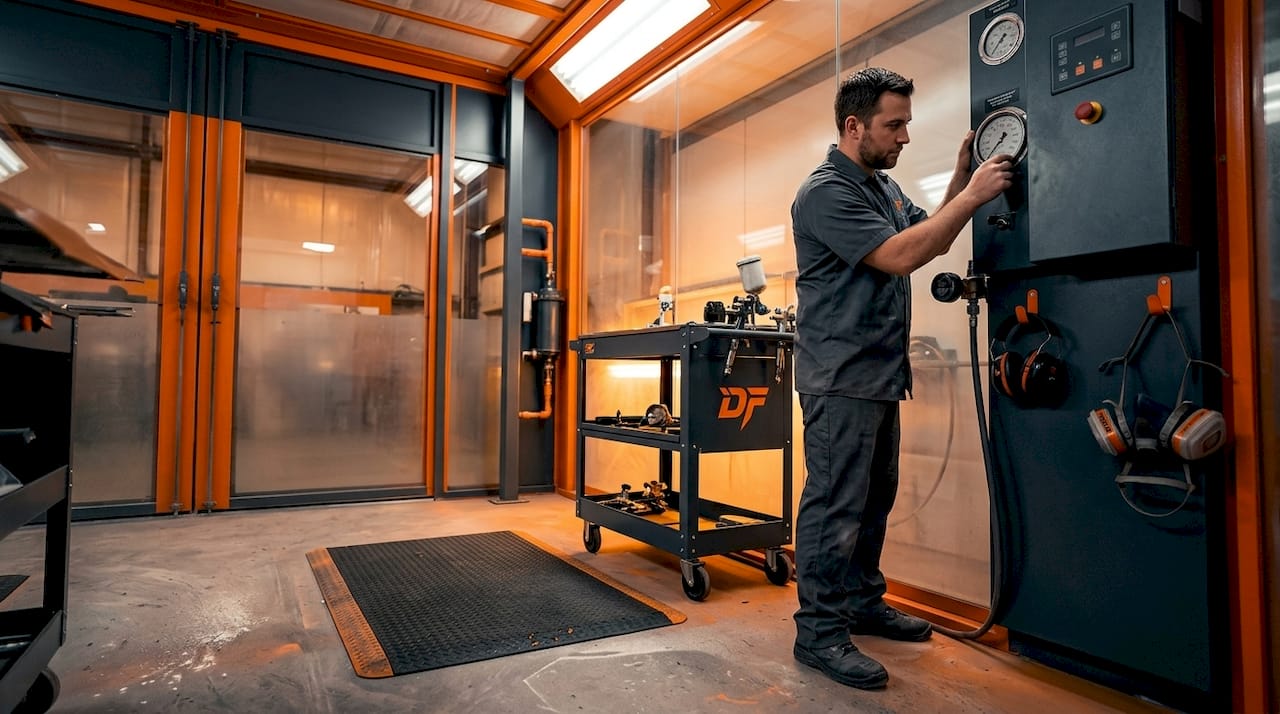
Booth airflow should be verified regularly. Pressure differentials, filter loading, and exhaust fan performance all degrade over time. A booth that passed inspection two years ago may not be performing to spec today. Review your spray booth maintenance program and match it against your actual spray schedule.
Respiratory protection
This is where the biggest misconceptions in automotive paint safety live. Standard cartridge respirators are insufficient for isocyanate spray protection. A half-face organic vapor respirator with cartridges does not provide adequate protection when spraying 2K polyurethane products. Supplied-air respirators (Type CE, or airline-fed units) are the required standard. If your shop is still using cartridge-only respirators for 2K topcoats, that needs to change today.
Fit testing is also non-negotiable. A respirator that doesn’t seal properly provides almost no protection. Annual fit testing for all workers who wear tight-fitting respirators is an OSHA requirement and should be documented.
Full PPE requirements for spray work
- Supplied-air respirator for all 2K isocyanate-containing coatings
- Chemical-resistant gloves rated for organic solvents (nitrile at minimum, laminate gloves for extended exposure)
- Splash-proof goggles or a full-face shield when mixing or handling concentrated materials
- Disposable or washable coveralls to prevent skin absorption and transfer of contaminants
- Safety footwear with chemical-resistant soles in mixing and booth areas
Pro Tip: Never lift your visor or remove your respirator inside the booth during or immediately after spraying to check a panel. Step out, wait for the clearance time, then re-enter for inspection. This single habit prevents the majority of high-dose isocyanate exposures in shops.
Handling and mixing safety
Ground all metal containers and equipment when transferring flammable solvents to prevent static discharge. Keep all ignition sources out of mixing and spraying areas. Use designated chemical-resistant containers for mixing, and never reuse food or beverage containers. Spill response materials including absorbent compound and chemical-compatible disposal bags should be staged within reach in the mixing area.
Quality control, fillers, and the safety connection
Safety and product quality are more connected than most shops recognize. A panel repair done poorly doesn’t just cost you a redo. It creates conditions for additional chemical exposure, increased dust contamination, and longer worker time in hazardous environments.
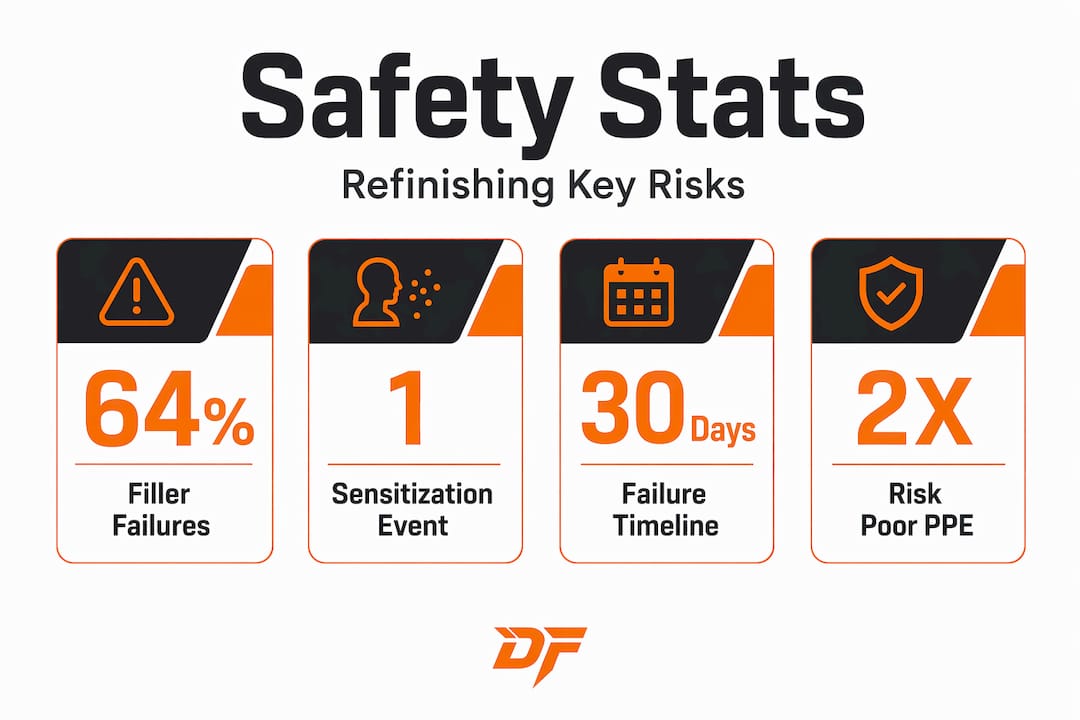
64% of automotive filler failures happen within 30 days of application due to poor mixing ratios or applying filler too thick to speed up the job. Both errors trigger exothermic reactions during cure that cause micro-cracking, which then allows moisture intrusion and corrosion beneath the surface. The rework cycle exposes workers to more sanding dust, more solvent vapors, and more cumulative chemical load.
| Filler mistake | Safety consequence | Quality consequence |
|---|---|---|
| Improper hardener ratio | More dust from rework sanding | Soft spots, early failure |
| Excessive thickness | Heat buildup, fume release | Micro-cracking, corrosion |
| Contaminated mixing board | Degraded catalysis, more rework | Fish-eye, adhesion failure |
| Skipping surface prep | Added solvents to clean, more vapor exposure | Poor adhesion, peeling |
Clean mixing boards, calibrated mixing ratios, and proper thickness limits are not just quality standards. They reduce the number of rework events, which directly reduces worker exposure time. Surface preparation accounts for up to 60% of total job effort, and cutting corners there multiplies downstream hazards.
- Use clean, disposable mixing boards for every batch of filler
- Follow manufacturer thickness guidelines, typically no more than 6mm per lift
- Inspect cured filler under raking light before primer to catch micro-cracks early
- Document and track rework rates to identify recurring application problems
Regulatory compliance and environmental considerations
Regulatory compliance is an area where small shops consistently underestimate their obligations. Many owners assume that being a small operation gives them a pass on environmental and safety regulations. It doesn’t.
The EPA and OSHA both impose requirements on automotive refinishing operations regardless of shop size. Operations exceeding certain paint volumes must operate in enclosed, filtered spray booths with proper air authorization. In Texas and many other states, using more than a defined threshold of paint products per year triggers registration or permit requirements. Shops that assume they qualify for an exemption based on size often do not.
| Regulatory area | Requirement | Consequences of non-compliance |
|---|---|---|
| OSHA respiratory protection | Written program, fit testing, medical evaluation | Citations, fines, worker claims |
| EPA VOC and HAP limits | Use low-VOC products, maintain application records | Fines, permit revocation |
| Hazardous waste disposal | Manifest system, licensed hauler | Serious civil and criminal penalties |
| Health surveillance | Annual lung function testing, urinary isocyanate monitoring | OSHA enforcement, liability exposure |
Health surveillance deserves specific attention. Annual spirometry (lung function testing) for workers exposed to isocyanates, and periodic urinary monitoring for isocyanate metabolites, are required under some jurisdictions and strongly recommended everywhere. Safety managed as a holistic system covering health monitoring, environmental controls, and waste management is the framework that keeps shops legally protected and workers healthy.
Pro Tip: Keep a dedicated compliance binder with your SDS library, written respiratory protection program, fit test records, and any air permits. OSHA inspectors ask for these documents first. Having them organized and current takes 30 minutes to maintain monthly and can make the difference between a warning and a serious citation.
Maintaining a safe and efficient refinishing workspace
Ongoing maintenance of your workspace is where safety protocols in auto painting either hold or fall apart. Written procedures mean nothing if daily habits contradict them.
A few high-impact practices keep safety standards from drifting:
- Airflow verification: Test and log booth differential pressure weekly. Replace filters on a schedule tied to actual usage volume, not just the calendar.
- Booth surface protection: Contaminated booth walls and floors release particulate into the air during spray events, raising the total dust load workers breathe. Using protective films on booth surfaces to control overspray buildup directly reduces this contamination pathway. Review dust-free painting best practices to see how surface management connects to exposure control.
- Training cadence: Safety training should not be annual-only. Short monthly toolbox talks covering one specific topic (isocyanate handling, PPE inspection, spill response) keep awareness current and address any new products being used in the shop.
- Exposure monitoring: If workers report headaches, eye irritation, or respiratory symptoms, treat that as a data point requiring investigation, not just a complaint. Personal air monitoring devices are available and affordable. Use them when changing product lines or when booth performance is suspect.
- Chemical inventory review: Quarterly review of all coatings and chemicals in use against their SDS documents catches reformulations and new hazards before workers encounter them without proper preparation.
The shops with the best safety records are not the ones with the most rules posted on walls. They’re the ones where safety management is treated as an operational responsibility, reviewed regularly, and updated when conditions change.
My take on where shops keep getting this wrong
I’ve seen isocyanate sensitization cases that were entirely preventable. A painter with 15 years of experience, no prior health issues, develops occupational asthma after one high-exposure event during a rushed job. He can no longer work in the shop. Not because no one knew the risk, but because the pressure of a deadline overrode the system.
What I’ve learned is that shops treat safety as a static compliance exercise rather than a live management system. You pass an inspection, file the paperwork, and assume you’re covered until the next audit. But spray booth filter performance degrades. New products with different isocyanate formulations come in without updated SDS review. A new hire uses the respirator from the rack without a fit test.
The uncomfortable truth is that safety in automotive refinishing requires the same ongoing attention as your equipment maintenance schedule. Not more paperwork. More real accountability at the floor level. When a shop owner or manager walks the floor and actually checks that clearance times are being observed, that PPE is being worn correctly, and that mixing ratios are being followed, the injury rate drops. It’s that direct.
Speed and safety are not opposites. They only conflict when safety is bolted on as an afterthought rather than built into the workflow from the start.
— Dust
How Dustfreefilm supports a safer spray booth environment
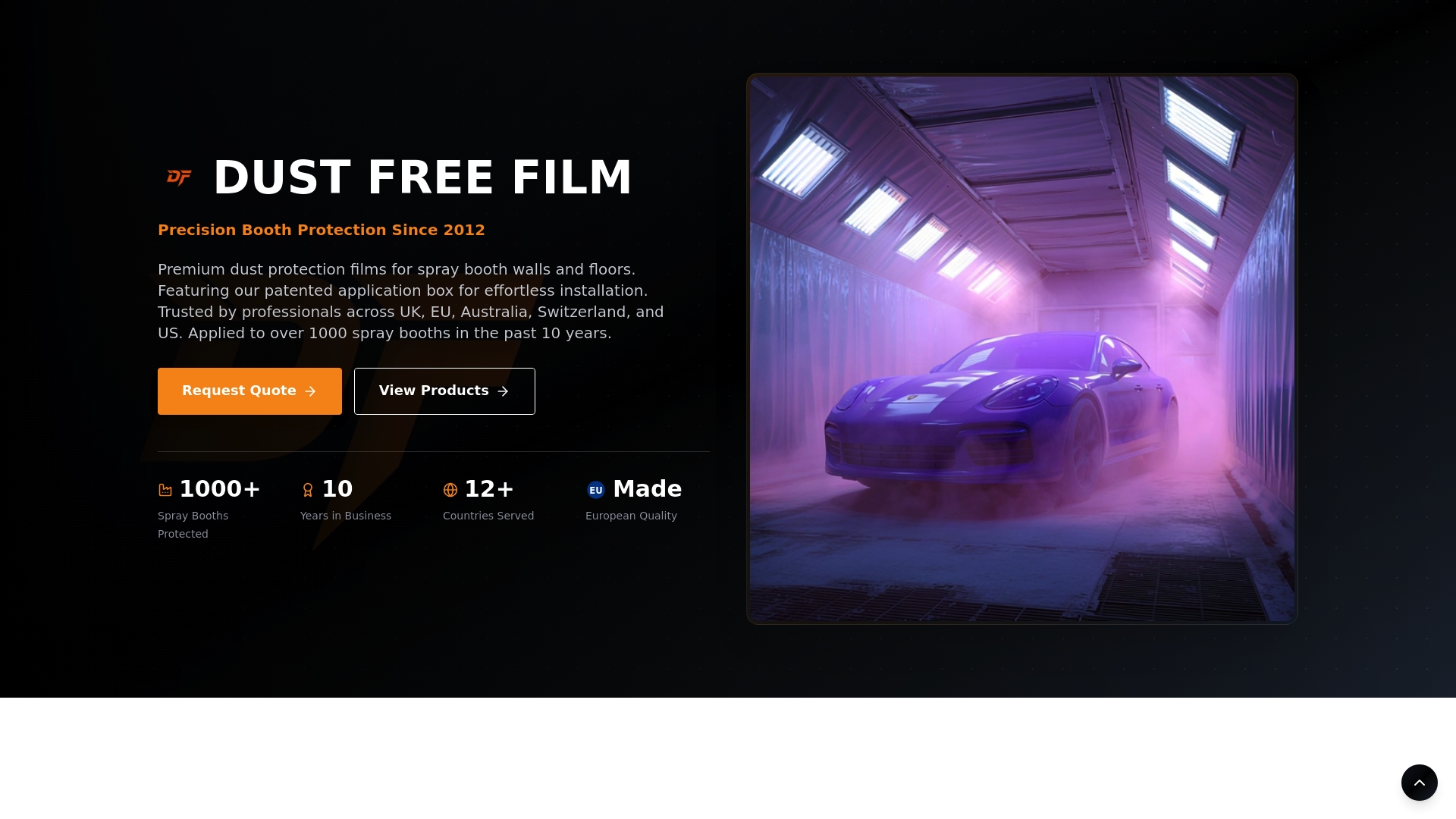
Controlling dust and overspray contamination inside your spray booth is one of the most direct ways to reduce the chemical exposure workers face on every job. Dustfreefilm manufactures multi-layer electrostatic protective films for booth walls and floors that trap overspray, prevent particulate buildup, and peel away cleanly when saturated. No scrubbing, no solvent cleaning, no extended worker contact with contaminated surfaces.
Their booth wall and floor protection products are built to European manufacturing standards, heat-resistant, and static-free, making them appropriate for high-volume production environments and single-bay shops alike. Cleaner booth surfaces mean lower airborne particulate loads, better finish quality, and fewer rework events that drive up total exposure time. If you’re ready to see how Dustfreefilm’s solutions fit your operation, request a quote and get pricing tailored to your booth configuration and production volume.
FAQ
What respiratory protection is required for spraying 2K coatings?
Standard cartridge respirators do not adequately protect against isocyanates in spray polyurethane coatings. Supplied-air respirators are the required standard for all 2K application work.
Can a single exposure to isocyanates cause permanent asthma?
Yes. Isocyanates can cause permanent occupational asthma from a single overexposure event. Once sensitized, a worker reacts to even trace levels and cannot continue working in spray environments.
Why do most automotive filler failures happen so quickly?
64% of filler failures occur within 30 days due to improper mixing ratios or excessive application thickness, both of which trigger exothermic reactions, micro-cracking, and early repair breakdown.
Do small auto body shops need air permits and hazardous waste compliance?
Yes. Shops using significant paint volumes must comply with air authorization requirements and use enclosed, filtered spray booths. Assuming exemption based on shop size is a common and costly mistake.
What is the biggest workplace safety mistake in refinishing shops?
Re-entering the spray booth before the posted clearance time has elapsed. This creates direct high-dose isocyanate exposure and is responsible for many sensitization cases that end careers.