

TL;DR:
- Treating dust as acceptable in auto painting damages quality and increases rework costs over time. Implementing advanced filtration, airflow management, and source capture techniques can drastically reduce defects and improve shop profitability. Prioritizing prevention over correction ensures consistent finishes, higher throughput, and sustained competitive advantage.
If you’re still treating dust in your paint jobs as an acceptable trade-off, you’re quietly hemorrhaging money every single week. Paint defects like pinholes, craters, and mottling happen when airborne particles contaminate wet paint, and the shops that tolerate this are funding their competitors’ growth. Modern dust control isn’t about chasing perfection for its own sake. It’s about running a tighter, more profitable operation where rework is rare, throughput is high, and your reputation for quality actually holds up.
Table of Contents
- Why dust control matters in auto shops
- Key dust control technologies for paint booths
- Beyond booths: Dust control in prep and sanding areas
- Complete dust control integration: Airflow, extraction, and humidity
- Maintenance and monitoring: Sustaining dust-free operations
- The real secret: Prevention, not correction, is profit
- Enhance your shop’s performance with advanced dust control solutions
- Frequently asked questions
Key Takeaways
| Point | Details |
|---|---|
| Dust impacts profits | Uncontrolled dust causes paint defects and rework, eroding shop margins. |
| Integrated approach wins | Combining booth filtration, targeted prep area controls, and humidity keeps shops dust-free. |
| Maintenance is essential | Regular filter checks and cleaning routines are key to long-term dust control. |
| Prevention outperforms correction | Preventing dust is far more effective and efficient than fixing flaws after painting. |
| Modern solutions boost efficiency | Adopting advanced booth designs and shop processes can substantially increase throughput and finish quality. |
Why dust control matters in auto shops
Let’s start by killing a dangerous myth. Some shop managers genuinely believe that finding a few dust nibs in a finished panel is normal, and that wet-sanding them out later is just part of the job. It isn’t. That attitude is what separates low-margin body shops from high-performing ones.
Dust is the number one cause of paint defects in automotive finishing environments. When particles land in wet basecoat or clearcoat, they don’t just create visual flaws. They force your technicians into a rework loop: sand, re-buff, re-inspect, possibly repaint. Each loop burns labor hours, consumes materials, and delays vehicle delivery. When delivery is delayed, customer satisfaction takes a hit, and repeat business quietly walks out the door.
Here’s what the actual costs look like in a busy shop:
- Rework labor adds 30 to 90 minutes per panel, depending on the severity of contamination
- Material waste from additional clearcoat applications and abrasive compounds compounds over a month of jobs
- Throughput losses mean fewer vehicles completed per week, directly cutting revenue
- Customer complaints from repeat dust nibs damage your reviews and referral base
- Staff morale drops when skilled painters spend their time correcting preventable mistakes
The financial case is simple. Prevention is far more efficient than correction. As one thread on a professional auto paint forum shows, some shops claim dust is normal and wet-sand later, but experienced refinishers consistently push back against this approach, pointing out that prevention is the only path to sustainable efficiency. The real question isn’t whether dust control is worth investing in. It’s how much rework cost you’re willing to absorb before you take action.
Key dust control technologies for paint booths
Understanding why dust threatens quality makes the next step clear: choose the right booth technology and keep it performing at its peak. Modern paint booths rely on multi-stage filtration to create a genuinely clean spray environment.
The ceiling intake filters typically run F5-F7 grade (ISO ePM10 to ePM2.5), capturing particles in incoming air before they ever enter the spray zone. Recirculation filters handle residual contaminants that get stirred up during painting, while exhaust paint arrestor filters, usually fiberglass pads, trap overspray before it exits the booth. Each stage has a specific job, and skipping one weakens the whole system.
Beyond filtration, airflow design defines how well your booth performs. Here’s a practical comparison:
| Booth type | Airflow direction | Dust control performance | Best for |
|---|---|---|---|
| Downdraft | Top to floor | Excellent | Full vehicle refinishing |
| Side-downdraft | Side to floor | Very good | Mixed workloads |
| Crossdraft | Front to rear | Moderate | Lower volume shops |
| Open-face | Uncontrolled | Poor | Pre-paint prep only |
Downdraft and side-downdraft booths direct filtered air downward across the vehicle’s surfaces, physically pushing overspray and airborne particles away from wet paint and toward floor-level exhaust points. This directional airflow is what separates professional results from amateur ones. Crossdraft booths push air laterally, which means contaminated air passes directly across the paint surface before it reaches the exhaust. That’s a design flaw for any shop serious about quality.
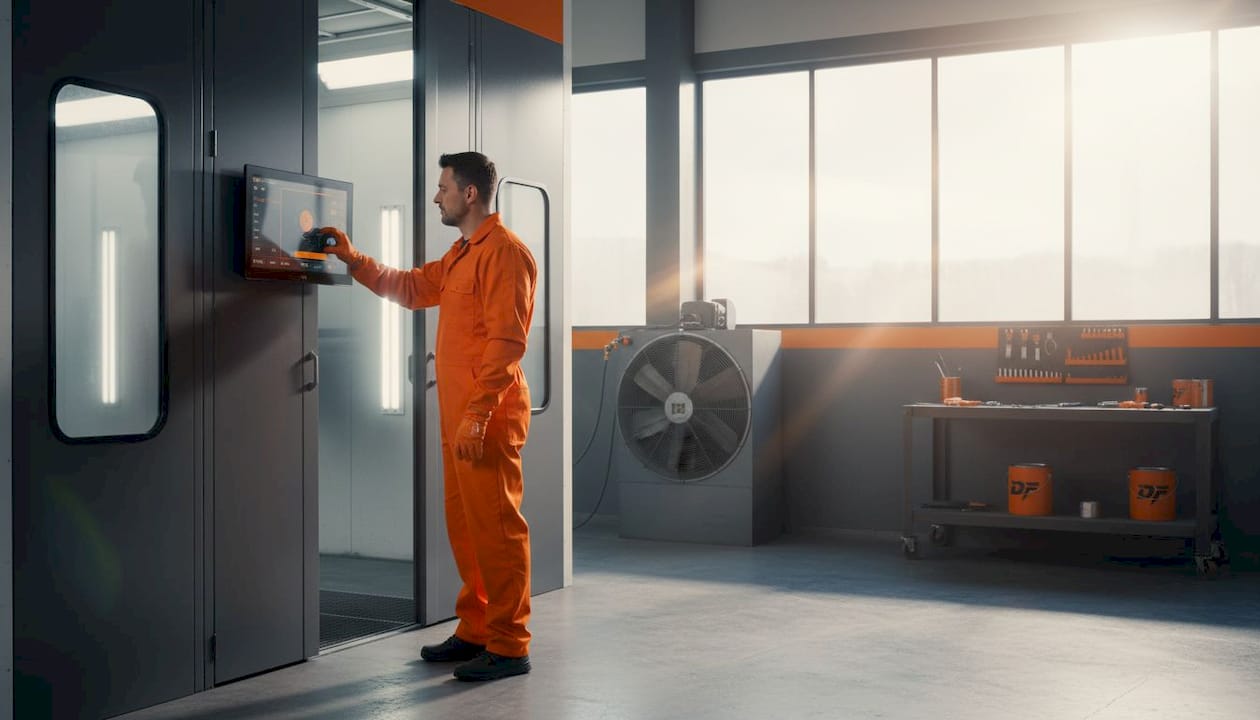
The right dust control methods go beyond just buying a better booth. Every element of contamination prevention needs to work together, from filter grades to airflow velocity to sealing gaps where unfiltered air can sneak in.
Pro Tip: When selecting replacement intake filters, go one grade higher than the manufacturer’s minimum recommendation. The small cost increase pays for itself in reduced defects per month, especially in shops running multiple paint cycles per day.
Beyond booths: Dust control in prep and sanding areas
Here’s where a lot of shops get blindsided. They invest in a quality paint booth and still end up with dust in their finishes. Why? Because the sanding and prep areas outside the booth are generating enormous quantities of airborne particles that migrate freely through the shop.
Sanding is the highest-risk activity for dust generation in any auto body shop. A single hour of aggressive block sanding can produce enough fine particles to contaminate surfaces 30 to 40 feet away if the dust isn’t captured at the source. The solution isn’t more sweeping. It’s source capture.
Here are the steps that actually work for containing dust in prep and sanding zones:
- Switch to vacuum-ready sanders connected to HEPA-filtered extraction units. These capture 99.97% of particles at the tool, before they ever become airborne.
- Install downdraft tables in your prep area. These pull sanding dust downward through a perforated work surface, preventing it from floating toward your booth.
- Run dedicated air scrubbers in the prep zone during and after sanding. These units filter room air continuously, reducing the particle count between work cycles.
- Establish negative pressure in prep areas relative to the paint booth, so airflow always moves away from clean zones, not toward them.
- Ban all sweeping from your shop floor. Every broom stroke sends settled dust back into suspension. Replace sweeping with vacuum-only housekeeping everywhere in the facility.
“Managing dust properly in sanding and prep areas means using vacuum-ready tools with HEPA extraction, downdraft tables, air scrubbers, and vacuum-only housekeeping to capture dust at the source before it reaches paint zones.” Managing dust in vehicle body shops
For cleaning protocols that genuinely support dust control, frequency matters as much as technique. Wipe down booth walls and floors between each paint cycle. Don’t wait until end of shift.
HEPA air scrubbers combined with negative pressure are particularly valuable in high-traffic shops where multiple vehicles move through prep and painting simultaneously. They act as a safety net when source capture alone isn’t enough to keep the ambient particle count low.
Pro Tip: Place your air scrubber inlet near the floor, where settled particles get disturbed by foot traffic and rolling equipment. Most shops position scrubbers at head height, which misses the majority of ground-level contamination.
Complete dust control integration: Airflow, extraction, and humidity
Once your booth and prep areas are individually dialed in, real performance gains come from integrating all your systems. This is where shops go from good to genuinely excellent.
Airflow velocity is the most critical variable to get right. OSHA and NFPA standards recommend airflow velocities of 0.3 to 0.5 meters per second (60 to 100 feet per minute) across the work zone. Downdraft booths operating within this range achieve 90 to 98% overspray capture efficiency. Too slow, and particles linger near the vehicle surface. Too fast, and you create turbulence that kicks up dust rather than sweeping it away.
Raised floor extraction systems take downdraft performance further by creating a uniform floor-level exhaust plane. Instead of air escaping through limited exhaust ports, it exits evenly across the entire floor grate, eliminating dead spots where particles can settle and later get disturbed. A real-world case study from Truckman’s booth installation demonstrates exactly this: after upgrading to raised floor extraction, the operation increased throughput to 12 completed jobs per day, a direct result of better dust control reducing rework time.
Humidity control is the most underutilized tool in most auto shops. Maintaining 55% relative humidity in sanding bays causes fine mist to physically weigh down airborne particles, pulling them out of suspension before they can reach paint zones. This isn’t a marginal improvement. In a busy shop running multiple sanding operations simultaneously, humidity control can cut the ambient particle count dramatically within minutes.
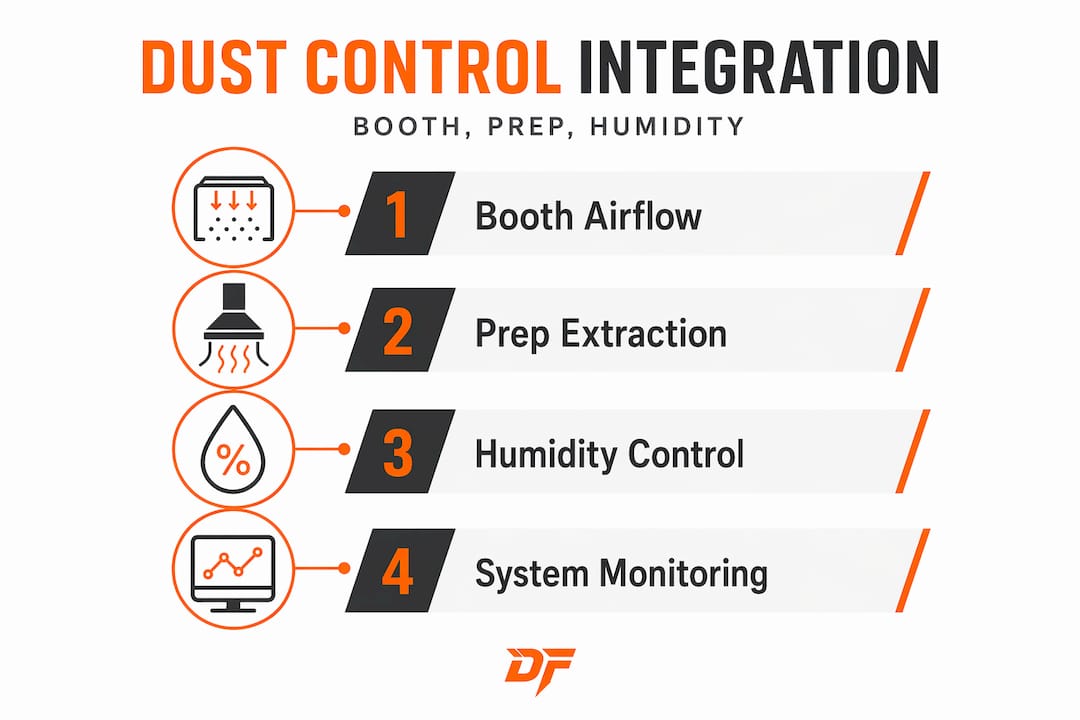
Here’s a quick reference for integrated dust control targets:
| Parameter | Target range | Impact |
|---|---|---|
| Booth airflow velocity | 0.3 to 0.5 m/s (60 to 100 fpm) | Optimal dust capture without turbulence |
| Intake filter grade | F5 to F7 (ISO ePM10 to ePM2.5) | Filters incoming particles from outside air |
| Prep area humidity | 50% to 55% RH | Settles airborne sanding dust |
| Air scrubber runtime | Continuous during prep shifts | Maintains low ambient particle count |
Getting this right also means thinking about your booth setup from a layout perspective. Prep areas should be physically separated from paint zones, with sealed doorways and defined traffic patterns that minimize particle migration. Shops that nail this integration consistently cut paint defects by significant margins compared to those running isolated controls without a unified system.
Maintenance and monitoring: Sustaining dust-free operations
Building a great system is only half the battle. Keeping it performing at that level requires consistent maintenance and smart monitoring habits.
Regular filter monitoring prevents the airflow drops that quietly degrade booth performance long before anyone notices increased defect rates. Many shops don’t realize their filters are saturated until a customer complaint forces an inspection. By then, dozens of paint jobs have already been compromised.
Best practices for sustained dust-free operations include:
- Check booth inlet and exhaust filters weekly in high-volume shops, monthly in lower-traffic facilities
- Monitor airflow velocity with a handheld anemometer at the start of each shift to catch drops early
- Install manometers (pressure gauges) across intake and exhaust filter banks to detect pressure buildup from clogging
- Inspect booth wall and floor protection films between jobs, replacing any sections that are torn or heavily contaminated
- Require all staff entering the booth to wear dedicated lint-free coveralls changed at the booth door
- Enforce a strict door protocol: booth doors stay closed except during vehicle entry and exit
- Schedule a full booth deep-clean at least monthly, including wall wipe-downs, floor scrubbing, and light fixture cleaning
See a complete breakdown of maintenance scheduling in this automotive spray booth maintenance guide that covers everything from filter change intervals to staff protocols.
Pro Tip: Set up a simple digital pressure alert system on your filter banks. When pressure differential crosses a defined threshold, it sends an automatic notification to your shop manager’s phone. This removes the risk of human oversight during busy production weeks, keeping maintenance on schedule without anyone having to remember to check.
The real secret: Prevention, not correction, is profit
Here’s the perspective that most industry guides dance around but never say directly: the widespread acceptance of wet-sanding as a “finishing step” is a profit-killing habit disguised as professional practice.
We’ve seen it across countless shops. A painter spots dust nibs in the clearcoat. Instead of flagging the contamination source, the standard response is to block-sand and re-buff. The job gets delivered, the manager feels the problem is handled, and the underlying cause never gets addressed. Multiply that across 20 or 30 jobs a month and you’re looking at a serious invisible drain on labor costs, materials, and vehicle cycle time.
The shops that genuinely outperform their competition aren’t the ones with the most expensive equipment. They’re the ones with zero-tolerance policies toward dust intrusion. They train every technician to treat a dust nib not as something to sand away, but as a signal to investigate the contamination source. Every defect is a clue. Every clue gets acted on. That’s how you build a system that gets tighter over time rather than slipping toward mediocrity.
As experienced refinishers consistently point out, accepting minor dust as normal creates a culture of lowered standards that gradually erodes both quality and margin. The best shops we’ve observed treat the spray booth as a controlled environment, not just a room with a fan. They invest in industrial quality solutions that address contamination systematically, and they measure the results in defect rates, rework hours, and throughput numbers, not just visual impressions.
Prevention doesn’t cost more in the long run. It costs less. It just requires the discipline to stop normalizing the problem.
Enhance your shop’s performance with advanced dust control solutions
The strategies covered in this article work best when your booth walls and floors are actively protected against accumulated overspray, fallout, and the contamination that builds up between cleaning cycles.
At Dust Free Film, we’ve built our product line specifically around this challenge. Our multi-layer electrostatic booth wall and floor protection films install quickly with our patented dispenser system, create a static-free, heat-resistant barrier, and peel away cleanly when they’re due for replacement. This means your booth surfaces stay consistently clean without lengthy downtime between jobs. Whether you’re running a high-volume body shop or an industrial painting facility, our products are engineered to support the kind of dust-free environment that makes superior finishes repeatable. Explore our full range at dustfreefilm.com and see how the right surface protection integrates with your existing booth technology.
Frequently asked questions
What are the most effective dust control methods in busy auto shops?
Multi-stage filtration in paint booths combined with HEPA extraction in prep zones and vacuum-only housekeeping gives you the most reliable protection against dust contamination in high-volume environments.
How does shop humidity impact dust control?
Keeping humidity near 55% RH in sanding bays causes fine particles to drop out of suspension, preventing them from becoming airborne and migrating into your paint zone.
What is the difference between downdraft and crossdraft paint booths for dust control?
Downdraft booths push filtered air directly downward across the vehicle surface and away from wet paint, while crossdraft designs move air laterally, increasing the risk that contaminated air passes directly over your finish.
How often should paint booth filters be changed in high-traffic auto shops?
Filters should be checked weekly and replaced whenever airflow or pressure readings drop, rather than waiting for a fixed monthly schedule that may not match your actual production volume.