
TL;DR:
- Spray booth acceptance testing verifies compliance with safety, airflow, electrical, and fire protection standards before operation. It includes airflow measurements, electrical classifications, and smoke clearance testing to ensure worker safety and legal compliance. Ongoing inspections, documentation, and adherence to NFPA 33 and OSHA regulations are essential for maintaining certification.
Spray booth acceptance testing is the formal verification process that confirms a spray booth meets required safety, performance, and regulatory standards before it enters operation. Every new installation or major modification requires this certification to prove the booth controls airborne contaminants, meets electrical safety classifications, and delivers adequate ventilation. Standards like NFPA 33 and HSE guidance define the specific criteria technicians must satisfy. Skipping or rushing this process puts workers at risk and exposes facilities to serious legal liability.
What is spray booth acceptance testing and what does it verify?
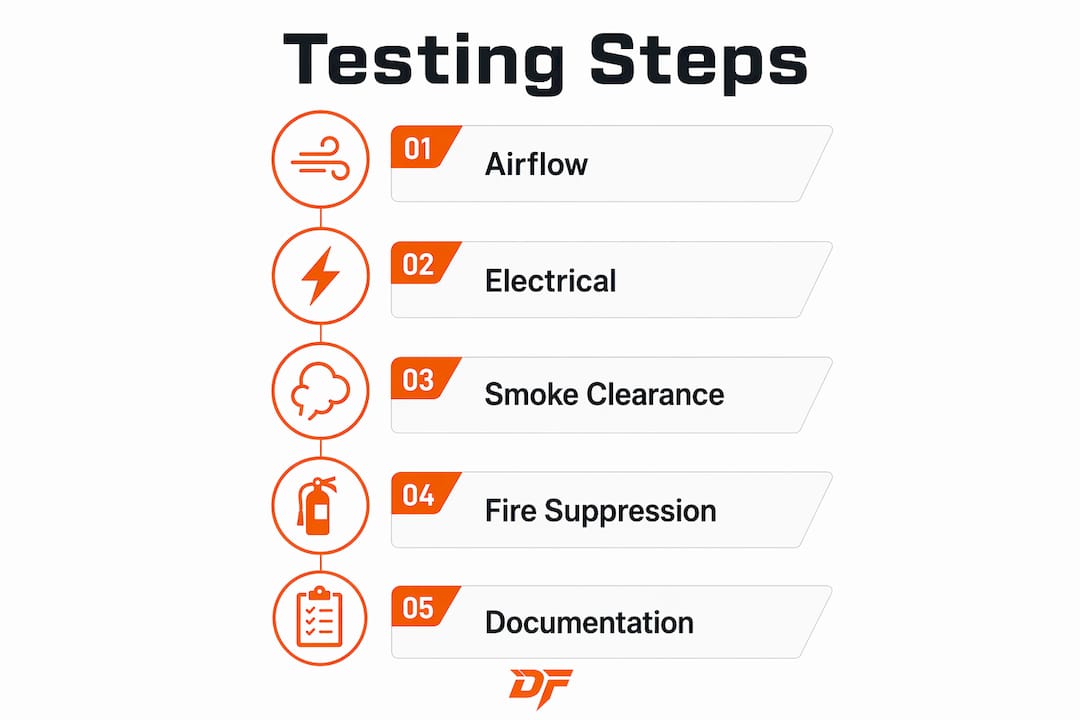
Spray booth acceptance testing is the structured procedure used to certify that a booth complies with safety and performance standards at the point of commissioning. It covers four core areas: airflow performance, electrical safety classification, fire suppression readiness, and ventilation effectiveness. A booth that passes all four areas receives formal certification allowing legal operation. One that fails must be corrected and retested before any spraying begins.
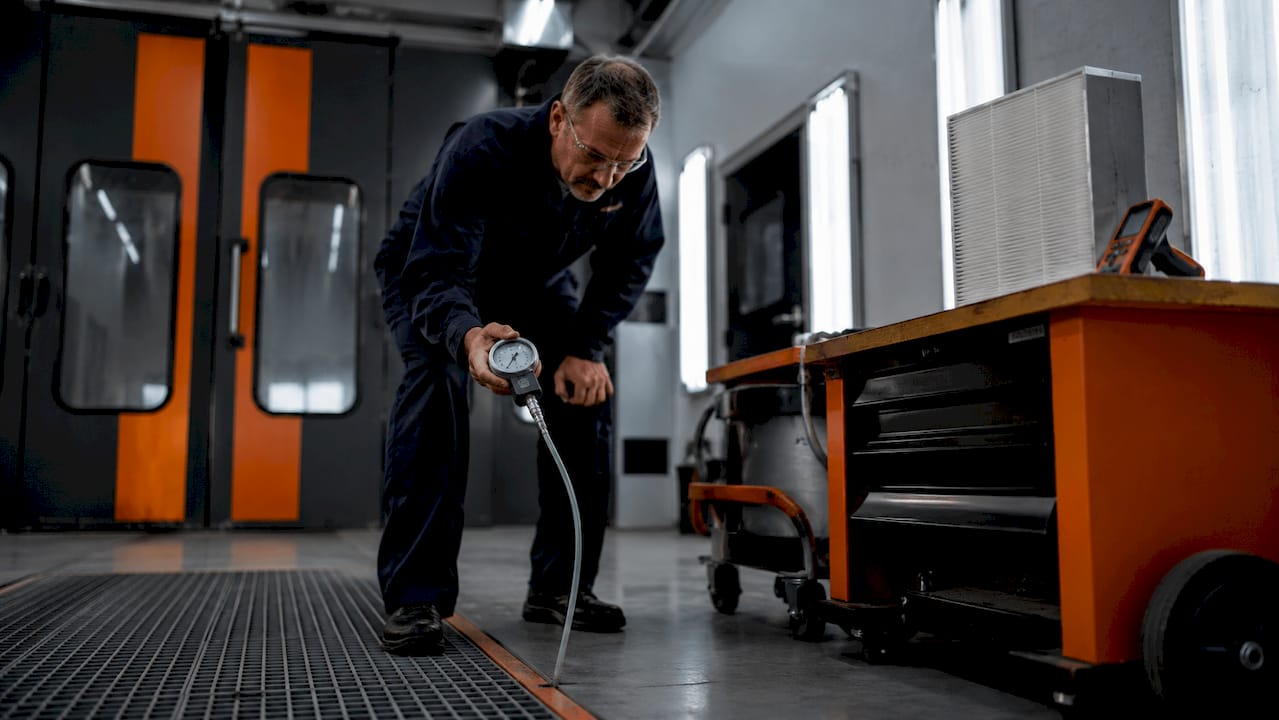
Airflow is the most measured variable during acceptance testing. Downdraft booths must achieve a minimum capture velocity of 0.3 m/s across the working zone to meet NFPA 33 requirements. That threshold exists because lower velocities allow solvent vapors to accumulate, creating both fire and inhalation hazards. Technicians use calibrated anemometers to map velocity across multiple grid points inside the booth.
Electrical safety classification is equally non-negotiable. Spray booths fall under Class I, Division 1 hazardous location classifications, which dictates every electrical component inside the booth. Lighting fixtures, motors, and control panels must all carry appropriate ratings. Any non-compliant component found during acceptance testing triggers an immediate failure.
What are the standard criteria and tests involved?
Acceptance criteria for spray booths cover several distinct technical areas, each with its own measurement method and pass/fail threshold.
Airflow and ventilation checks:
- Minimum downdraft velocity of 0.3 m/s measured at multiple points across the booth floor
- Cross-draft velocity uniformity within acceptable tolerance bands
- Negative pressure confirmation to prevent contaminant migration outside the booth
- Filter condition assessment and baseline pressure drop recording
Electrical and fire safety checks:
- Verification of Class I, Division 1 electrical classification for all internal components
- Fire suppression system inspection confirming service within the last 12 months
- Interlock function testing to confirm extraction activates before spraying begins
- Grounding and bonding continuity checks on all conductive surfaces
Instrumentation and documentation:
- Magnehelic gauge installation and calibration confirmation; missing or broken gauges result in citations during official inspections
- Baseline airflow log established at commissioning for future comparison
- Formal Certificate of Compliance issued by a qualified third-party inspector
Pro Tip: Record your baseline Magnehelic gauge readings on the day of acceptance testing. That number becomes your reference point for every future filter change and inspection.
The table below summarizes the primary test categories and the instruments used.
| Test Category | Method | Instrument Used |
|---|---|---|
| Airflow velocity | Grid measurement across booth floor | Anemometer |
| Filter pressure drop | Differential pressure reading | Magnehelic gauge |
| Electrical classification | Visual and continuity inspection | Multimeter, visual check |
| Fire suppression readiness | Service tag and function test | Inspector review |
| Smoke clearance time | Timed smoke dissipation test | Smoke generator, stopwatch |
How is smoke clearance testing performed and why is it critical?
Smoke clearance testing measures how long a booth takes to remove airborne contaminants after spraying stops. That number directly determines when workers can safely remove respiratory protective equipment. Getting it wrong puts technicians at risk of inhaling isocyanates and solvent vapors at dangerous concentrations.
The procedure follows a specific sequence:
- Turn off extraction and close the booth to prevent any air movement.
- Introduce smoke or fog from a generator until the booth interior is fully saturated.
- Activate the extraction system and start timing immediately.
- Record the time until the smoke has fully cleared from the booth interior.
- Round the result up to the nearest quarter minute.
- Display the clearance time prominently at the booth entrance.
Clearance time testing before filter replacement shows worst-case airflow conditions and is vital for worker safety, especially when isocyanates are used. Testing at this point ensures the displayed clearance time reflects the most demanding operating scenario, not ideal conditions.
The HSE guidance is explicit: clearance time results must be posted at the booth entrance so every operator knows the minimum wait time before removing their respirator. That posted number is a legal safety requirement, not a suggestion.
Pro Tip: Always perform smoke clearance testing just before a scheduled filter change, not after. Dirty filters represent worst-case airflow. Testing with clean filters produces an optimistic result that may not protect workers during normal operation.
Clearance tests must be repeated whenever filters are replaced, fans are serviced, or any modification changes the booth’s airflow characteristics. A single clearance time result does not remain valid indefinitely. Clearance time is a critical safety measure that must reflect current booth conditions, not conditions from months prior.
What are the ongoing inspection and maintenance requirements?
Acceptance testing establishes a baseline. It does not guarantee compliance six months later. Spray booth quality assurance requires a structured lifecycle of periodic inspections and documented maintenance to remain legally valid.
The most important recurring obligation is the Local Exhaust Ventilation Thorough Examination and Test, known as TExT. LEV systems require TExT at least every 14 months, with higher-use environments requiring more frequent intervals. This examination covers fan performance, ductwork integrity, filter condition, and airflow velocity. A lapsed TExT interval invalidates the booth’s compliance status regardless of how well the system performs physically.
Key ongoing inspection requirements include:
- Airflow velocity re-measurement after any filter replacement or fan service
- Fire suppression system service and re-certification on the required schedule
- Daily Magnehelic gauge readings logged and retained for inspector review
- Ductwork inspection for blockages, corrosion, or unauthorized modifications
- Booth interior housekeeping records confirming regular cleaning of overspray buildup
Compliance failures most often arise from poor documentation and housekeeping rather than system breakdown. A booth can perform perfectly and still fail an inspection if the maintenance logs are incomplete, the fire suppression tag is expired, or the airflow records are missing. Organized documentation is as important as physical booth performance.
Pro Tip: Create a single compliance folder for each booth containing the original Certificate of Compliance, all TExT reports, monthly airflow logs, and fire suppression service records. Inspectors work faster and findings are fewer when everything is in one place.
The difference between acceptance testing and a periodic compliance audit is scope and timing. Acceptance testing happens once at commissioning and after major modifications. Periodic audits verify that the booth has not degraded from that certified baseline. Both are necessary. Neither replaces the other. For a detailed spray booth maintenance checklist, the full lifecycle requirements are worth reviewing before your next scheduled inspection.
How do NFPA 33 and OSHA regulations shape acceptance testing?
NFPA 33 is the primary standard governing spray booth design, installation, and operation in the United States. OSHA adopts NFPA 33 as the recognized industry standard of care, meaning OSHA citations for spray booth violations are typically grounded in NFPA 33 requirements. Understanding both frameworks is non-negotiable for any quality assurance manager responsible for booth certification.
NFPA 33 defines requirements across several critical areas:
- Booth construction materials and fire resistance ratings
- Minimum airflow velocities and ventilation design
- Electrical classification for all internal components
- Automatic fire suppression system specifications
- Signage, interlock, and emergency shutdown requirements
OSHA enforcement adds a second layer. Inspectors check physical conditions against NFPA 33 benchmarks and review documentation to confirm ongoing compliance. Third-party certification by a qualified inspector or engineer is required in most jurisdictions. Self-certification and internal logs alone do not satisfy legal requirements for formal compliance.
Local fire marshals also play a direct role. Many jurisdictions require fire marshal sign-off before a newly installed booth can operate. That approval is separate from the technical acceptance test and typically involves a site visit to confirm the booth meets local fire code provisions that may exceed NFPA 33 minimums.
The table below compares the scope of NFPA 33 and OSHA requirements as they apply to spray booth compliance testing.
| Requirement Area | NFPA 33 | OSHA |
|---|---|---|
| Airflow minimums | Defined in standard | Enforced via NFPA 33 reference |
| Electrical classification | Class I, Division 1 specified | Cited under 29 CFR 1910.94 |
| Fire suppression | System design and inspection intervals | Verified during inspections |
| Documentation | Logs and records required | Reviewed during audits |
| Third-party certification | Recommended | Required in most jurisdictions |
For technicians managing paint booth safety across multiple facilities, aligning internal inspection schedules with NFPA 33 intervals prevents gaps that OSHA inspectors consistently flag. Compliance with both frameworks also supports insurance requirements, which increasingly reference NFPA 33 as a condition of coverage. Understanding how industrial drive solutions interact with LEV system performance is also relevant for facilities where surface finishing equipment connects directly to ventilation infrastructure.
Key Takeaways
Spray booth acceptance testing requires verified airflow, electrical classification, fire suppression readiness, and documented smoke clearance time before a booth can legally operate.
| Point | Details |
|---|---|
| Acceptance testing scope | Covers airflow, electrical safety, fire suppression, and smoke clearance at commissioning. |
| Smoke clearance timing | Always test before filter replacement to capture worst-case airflow conditions. |
| Documentation matters | Incomplete logs cause more compliance failures than physical system deficiencies. |
| TExT interval | LEV systems require Thorough Examination and Test at least every 14 months. |
| Third-party certification | Self-certification alone does not satisfy legal compliance in most jurisdictions. |
What I’ve learned from watching booths fail inspections they should have passed
After years of working in and around spray booth environments, the pattern I see most often is not a broken fan or a failed fire suppression system. It is a perfectly functional booth that fails because nobody maintained the paperwork. The Magnehelic gauge works fine, but nobody logged the daily readings. The fire suppression system was serviced, but the tag expired two weeks before the inspector arrived. The clearance time was tested, but the result was never posted at the entrance.
The technical side of acceptance testing is genuinely straightforward once you understand the criteria. Airflow measurements, electrical checks, smoke clearance procedures: these are repeatable, learnable tasks. The harder discipline is building the administrative habits that keep a certified booth certified. That means assigning clear ownership of documentation, scheduling TExT intervals before they lapse, and treating the compliance folder as a living record rather than a one-time filing task.
My honest recommendation to quality assurance managers is this: treat the day of acceptance testing as the start of a compliance program, not the end of an installation project. The baseline you establish at commissioning is only valuable if you track against it consistently. A booth that drifts from its certified airflow performance without anyone noticing is a liability, not an asset.
— Dust
How Dustfreefilm supports cleaner, safer spray booth environments
Maintaining a certified spray booth goes beyond airflow and electrical checks. Dust contamination inside the booth directly affects finish quality and can compromise the controlled environment that acceptance testing verifies.
Dustfreefilm has manufactured premium dust protection films for spray booths since 2012, supplying automotive refinishing shops and industrial painting facilities across multiple countries. Their multi-layer electrostatic booth wall and floor protectors reduce airborne particle contamination at the source, helping facilities maintain the clean environment that compliance testing demands. The patented dispenser system allows quick installation without bubbles or trapped debris. For technicians and quality managers who want to protect their certified booth environment between inspections, Dustfreefilm’s booth protection solutions are worth reviewing as part of a complete compliance strategy.
FAQ
What is the purpose of spray booth acceptance testing?
Spray booth acceptance testing verifies that a newly installed or modified booth meets required safety, airflow, and electrical standards before it enters operation. It establishes the certified baseline against which all future inspections are measured.
How often does a spray booth need to be retested after acceptance?
LEV systems in spray booths require Thorough Examination and Test at least every 14 months, with smoke clearance testing repeated after any filter replacement or significant modification.
What causes most spray booth compliance failures?
Most compliance failures result from incomplete documentation and poor housekeeping rather than equipment malfunction. Missing airflow logs, expired fire suppression tags, and unposted clearance times are the most common inspection findings.
Does NFPA 33 apply to all spray booths in the United States?
NFPA 33 is the primary standard for spray booth design and operation in the United States, and OSHA enforces its requirements under 29 CFR 1910.94. Most jurisdictions also require third-party certification to confirm compliance.
What instruments are used during spray booth performance evaluation?
Technicians use anemometers to measure airflow velocity, Magnehelic gauges to monitor filter pressure drop, and smoke generators to conduct clearance time tests. All three instruments produce data that must be documented and retained for inspector review.