

TL;DR:
- Spray booth NFPA compliance requires strict adherence to safety standards for construction, ventilation, fire suppression, and electrical systems. Regular inspection, proper maintenance, and thorough documentation are essential to ensure ongoing compliance and prevent costly violations. Dustfreefilm provides protective solutions that help maintain clean, code-compliant spray environments.
Spray booth NFPA compliance is defined as mandatory adherence to NFPA 33, the National Fire Protection Association’s standard governing the design, operation, and maintenance of spray booths that use flammable or combustible materials. OSHA 29 CFR 1910.107 reinforces these requirements at the federal level, covering ventilation, electrical classification, and fire protection. Violations carry serious consequences: OSHA fines reach $16,131 per serious violation and up to $161,323 for willful or repeated offenses. That penalty scale reflects how regulators view spray booth hazards. Understanding what these standards require is the first step toward keeping your facility operational, safe, and inspection-ready.
What is spray booth NFPA compliance, and why does it matter?
NFPA 33 is the primary fire safety standard for spray finishing operations in the United States. It covers booth construction, ventilation airflow, fire suppression systems, electrical equipment, and day-to-day operational practices. Most state and local building codes adopt NFPA 33 by reference, which means it carries the force of law in nearly every jurisdiction.
OSHA 29 CFR 1910.107 is the parallel federal regulation. It is frequently cited for violations in ventilation, electrical classification, and fire protection. When OSHA and the local fire marshal both have jurisdiction, a facility must satisfy both sets of requirements simultaneously.
The practical stakes are high. A single serious citation can cost over $16,000. A shutdown order stops production entirely. Beyond fines, an uncontrolled fire in a spray booth can destroy equipment, injure workers, and expose a business to civil liability. Compliance is not a paperwork exercise. It is the operational framework that prevents those outcomes.
What are the design and construction requirements for NFPA 33?
NFPA 33 sets strict rules for how a spray booth is built before a single coat of paint is applied. The goal is to contain vapors, resist ignition, and limit fire spread if something goes wrong.
Key construction requirements include:
- Noncombustible or limited-combustible materials for all booth walls, ceilings, and floors. Steel panels and concrete are standard choices.
- Booth location must minimize vapor exposure to ignition sources. Booths should not share walls with furnaces, water heaters, or open electrical panels.
- Explosion relief vents are required to direct pressure away from occupied areas in the event of an ignition event inside the booth.
- Sealed construction prevents vapor migration into adjacent spaces, which is a common source of secondary fire risk.
- Hazardous location classification designates the booth interior as a Class I, Division 1 area, which drives all downstream electrical and equipment decisions.
Pro Tip: When planning a new booth installation, have your local Authority Having Jurisdiction (AHJ) review the construction drawings before breaking ground. Catching a noncompliant design at the blueprint stage costs far less than retrofitting a completed structure.
The classification of spray areas as hazardous locations is not a formality. It determines every piece of equipment that can legally operate inside the booth, from light fixtures to exhaust fans.
How must spray booth ventilation be designed for NFPA compliance?
Ventilation is a life-safety system, not a comfort feature. Predictable airflow patterns are legally required because they control where flammable vapors travel and how quickly they are diluted below dangerous concentrations.
NFPA 33 requires ventilation systems to maintain vapor concentrations below 25% LEL, the Lower Explosive Limit. That threshold is the point at which a vapor-air mixture can ignite. Staying below 25% LEL provides a meaningful safety margin before conditions become explosive.
Typical design airflow runs between 75 and 125 feet per minute (fpm). OSHA sets a minimum of 100 fpm. The correct velocity depends on the booth size, the materials being sprayed, and the spray method used.
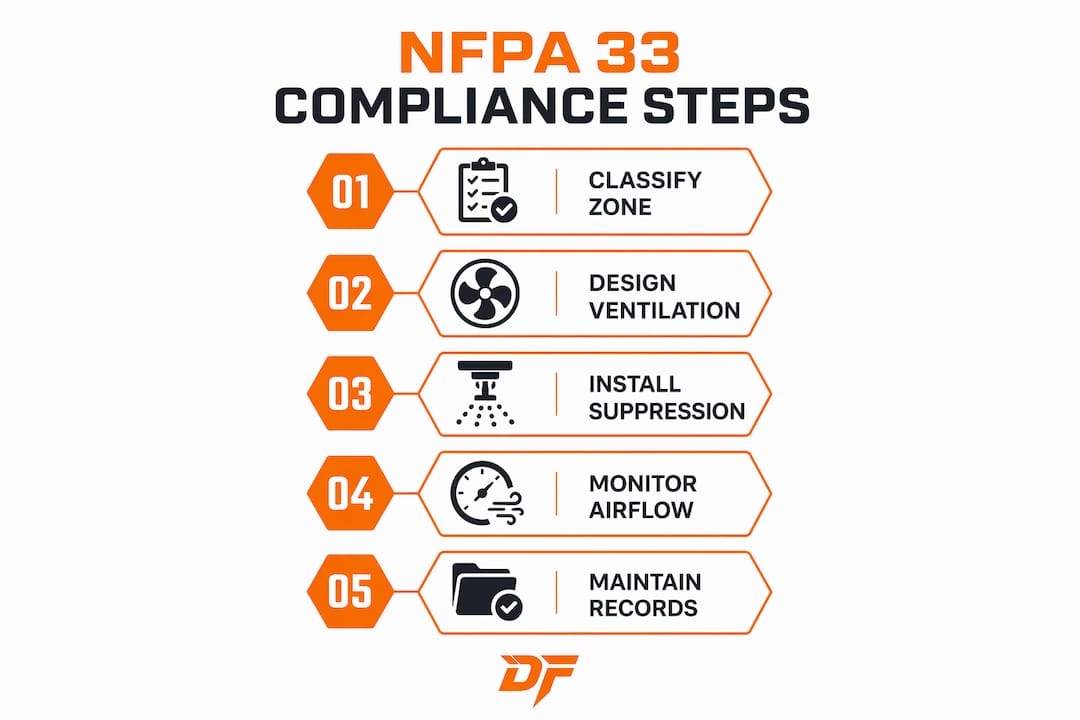
A well-designed ventilation system requires these elements:
- Balanced makeup air supply to replace exhausted air volume. Without it, the booth creates negative pressure inside the facility.
- Negative facility pressure prevention. Unbalanced makeup air pulls unfiltered air through gaps in the building envelope, introducing contaminants that ruin finishes and compromise air quality.
- Airflow monitoring devices, such as Magnehelic gauges, installed and calibrated to provide real-time verification of ventilation performance.
- Documentation of airflow readings taken at regular intervals. Inspectors treat these records as primary evidence of compliance.
- Scheduled filter replacement to maintain consistent airflow resistance and prevent pressure drops that reduce effective fpm.
Pro Tip: Mount your Magnehelic gauge where the spray technician can see it from the work position. A reading that falls outside the normal range during a job is an immediate signal to stop work and investigate before vapors accumulate.
Magnehelic gauges are mandatory under NFPA 33, and their absence is one of the most common causes of compliance citations. Having the right airflow is not enough. You must prove it with instrumentation.
| Ventilation parameter | NFPA 33 / OSHA requirement |
|---|---|
| Maximum vapor concentration | Below 25% LEL |
| Typical design airflow velocity | 75–125 fpm |
| OSHA minimum airflow velocity | 100 fpm |
| Monitoring device | Magnehelic gauge or equivalent |
| Makeup air | Balanced to prevent negative pressure |
What fire suppression and alarm systems does NFPA 33 require?
Automatic fire suppression is not optional in a compliant spray booth. NFPA 33 mandates systems that activate without human intervention and immediately interrupt the conditions that feed a fire.
Required fire suppression elements include:
- Automatic suppression systems complying with NFPA 17 for dry chemical agents or NFPA 17A for wet chemical agents. The correct system type depends on the coatings and solvents in use.
- Fan shutdown interlock. Suppression systems must shut down both intake and exhaust fans on activation. Running fans during a fire event spreads flames and vapors rather than containing them.
- Annual professional inspections by a qualified fire suppression contractor. Self-inspection does not satisfy this requirement.
- Compatible extinguishing agents matched to the specific materials sprayed. Using the wrong agent can fail to suppress the fire or create secondary hazards.
- Alarm system integration so that suppression activation triggers audible and visual alerts throughout the facility, not just inside the booth.
- Documented test records kept on file and available for inspector review.
Detailed guidance on fire suppression system standards covers the operational requirements in depth, including how to verify that fan interlock systems function correctly before each production cycle.
The annual inspection requirement catches problems that daily checks miss. Suppression nozzles clog, agent containers lose pressure, and interlock wiring corrodes. A system that looks intact can fail to activate when needed.
What electrical safety standards must spray booths meet under NFPA 33 and OSHA?
The interior of a spray booth is classified as a Class I, Division 1 hazardous location. That classification means flammable vapors are present or likely to be present under normal operating conditions. Every electrical component inside that zone must be rated for that environment.
Electrical compliance requirements include:
- Explosion-proof electrical components for all motors, switches, and fixtures inside the spray area. Standard commercial-grade equipment is prohibited.
- No standard switches or outlets within the spray zone. Control panels must be located outside the booth or in a rated enclosure.
- Approved light fixtures sealed against vapor intrusion and rated for Class I, Division 1 locations. Surface-mounted shop lights are a common violation.
- No extension cords inside the spray area. Even temporary extension cords create spark risk and constitute a violation under OSHA 29 CFR 1910.107.
- Grounding and bonding of spray equipment to prevent static discharge, which is a documented ignition source for solvent vapors.
Electrical violations are among the most frequently cited in OSHA spray booth inspections. The reason is straightforward: non-rated equipment is cheaper and easier to source, so shortcuts happen. Inspectors know where to look, and the fines reflect the severity of the risk.
What operational and maintenance practices ensure continued NFPA 33 compliance?
A compliant booth on day one is not a compliant booth on day 365 without active maintenance. Compliance is a continuous process, and fire marshals treat maintenance records as critical evidence during inspections.
Core operational and maintenance requirements include:
- Daily airflow verification using the Magnehelic gauge, with readings logged and dated.
- Detailed inspection logs for all systems, including ventilation, fire suppression, and electrical components.
- Annual fire suppression system inspection by a licensed contractor, with the inspection certificate kept on file.
- Regular cleaning to remove combustible residue from booth walls, floors, and exhaust plenums. Accumulated overspray is a fuel source.
- Interlock testing to confirm that suppression activation shuts down fans as required, documented with test dates and technician signatures.
- Filter replacement schedules tracked and recorded to demonstrate consistent airflow maintenance.
Pro Tip: Build your maintenance log into a shared digital system rather than a paper binder. Digital records are harder to lose, easier to search during an inspection, and can be backed up automatically.
Documented maintenance records often determine whether a facility passes or fails an inspection. Having the equipment is necessary. Proving it works, and has been working, is what satisfies the inspector. A spray booth maintenance checklist built around NFPA 33 requirements gives your team a repeatable framework for every inspection cycle.
Key Takeaways
Spray booth NFPA compliance requires meeting NFPA 33 and OSHA 29 CFR 1910.107 standards across construction, ventilation, fire suppression, electrical systems, and documented maintenance practices.
| Point | Details |
|---|---|
| NFPA 33 is the governing standard | It covers booth design, ventilation, fire suppression, and electrical safety for all spray finishing operations. |
| Ventilation must stay below 25% LEL | Airflow between 75–125 fpm and Magnehelic gauge monitoring are both required, not optional. |
| Fire suppression requires annual inspection | Systems must comply with NFPA 17 or NFPA 17A and include a fan shutdown interlock on activation. |
| Electrical equipment must be explosion-proof | Class I, Division 1 classification prohibits standard switches, outlets, and extension cords inside the spray zone. |
| Documentation is compliance evidence | Dated inspection logs and maintenance records are what inspectors use to evaluate a facility’s compliance status. |
The part of NFPA compliance most shops get wrong
After years of working with spray booth operations across automotive and industrial settings, the pattern I see most often is not a facility that ignored the rules. It is a facility that met the rules once and assumed the work was done.
NFPA 33 compliance is not a certificate you earn and frame on the wall. Ventilation filters degrade. Suppression system pressure drops. Interlock wiring corrodes. The standard requires these systems to work, not just to exist. The gap between “we have a suppression system” and “we have a suppression system that has been inspected, tested, and documented this year” is exactly where citations happen.
The other misconception I encounter regularly is about ventilation. Operators assume that if the booth smells fine and the paint looks good, the airflow is adequate. Magnehelic gauges exist precisely because human senses are unreliable indicators of vapor concentration. A reading below the normal range is invisible to a technician but immediately visible to an inspector.
My strongest advice: treat your fire marshal as a resource before an inspection, not an adversary during one. Proactively requesting a pre-inspection walkthrough gives you the chance to identify gaps on your own terms. Inspectors generally respond well to facilities that demonstrate they take compliance seriously. That posture, backed by clean documentation, is the most reliable path to passing.
— Dust
How Dustfreefilm supports your spray booth compliance
Maintaining a clean, compliant spray booth environment requires more than meeting code on paper. Dust contamination during painting cycles creates rework, increases cleaning frequency, and can compromise the airflow patterns that NFPA 33 requires.

Dustfreefilm manufactures multi-layer electrostatic booth wall and floor protection films designed specifically for automotive refinishing and industrial spray environments. The films are heat-resistant, static-free, and built for high-traffic production settings. They reduce combustible residue buildup on booth surfaces, which directly supports the cleaning requirements in NFPA 33. Explore Dustfreefilm’s spray booth solutions and the 2026 maintenance guide to build a compliance-ready operation from the surface up.
FAQ
What is NFPA 33 in spray booth operations?
NFPA 33 is the National Fire Protection Association standard that governs spray booth design, ventilation, fire suppression, and electrical safety for operations using flammable or combustible finishing materials. Most U.S. jurisdictions adopt it by reference into local fire and building codes.
What airflow velocity does NFPA 33 require for spray booths?
NFPA 33 requires ventilation to maintain vapor concentrations below 25% LEL, with typical design airflow between 75 and 125 fpm. OSHA sets a minimum of 100 fpm under 29 CFR 1910.107.
What happens if a spray booth fails NFPA compliance inspection?
OSHA can issue fines of $16,131 per serious violation and up to $161,323 for willful or repeated violations. Local fire marshals can also order an immediate operational shutdown until deficiencies are corrected.
Are Magnehelic gauges required in spray booths?
Yes. NFPA 33 requires airflow monitoring devices such as Magnehelic gauges to verify ventilation performance. Their absence is a common cause of compliance citations during inspections.
What electrical equipment is required inside a spray booth?
All electrical components inside a spray booth must be rated for Class I, Division 1 hazardous locations. Standard switches, outlets, and extension cords are prohibited due to spark ignition risk under both NFPA 33 and OSHA 29 CFR 1910.107.