

TL;DR:
- Static electricity naturally attracts airborne dust in spray booths, leading to finish defects and rework costs. Static-free film reduces static buildup and dust attraction, especially in low-humidity environments, improving paint quality. Proper application, environmental control, and ongoing monitoring are essential for maximizing its effectiveness and ensuring consistent results.
Covering your spray booth walls with ordinary protective film feels like a smart move. You’re blocking contaminants, protecting surfaces, and keeping the booth looking clean. But if your finish quality still disappoints, there’s a good chance the real problem is invisible: static electricity. Static charge builds up on unprotected surfaces, on film layers, on the vehicle itself, and it quietly pulls airborne dust particles directly onto wet paint before you can do anything about it. Static-free film exists to interrupt that process, but it’s widely misunderstood. This guide breaks down exactly how it works, where it fits, and how to use it strategically.
Table of Contents
- The problem with dust and static in spray booths
- What is static-free film? Definitions and key features
- How static-free film works in spray booth environments
- Static-free film vs traditional protection: A practical comparison
- Selecting and maximizing the benefits of static-free film
- A facility leader’s perspective: Why “static-free” is a mindset, not a miracle
- Explore static-free film solutions for your facility
- Frequently asked questions
Key Takeaways
| Point | Details |
|---|---|
| Static drives dust problems | Unseen static attracts more booth dust than airborne particles alone. |
| Film type matters | Understanding the difference between anti-static, dissipative, and conductive films ensures better booth protection. |
| Environment impacts results | Temperature and humidity affect static-free film’s performance, so process adaptation is crucial. |
| No one-size-fits-all | Facility needs and booth setups should guide both film selection and replacement routines. |
The problem with dust and static in spray booths
Walk into any busy auto body shop or industrial painting facility and you’ll notice the effort put into cleanliness. Filters, air pressure systems, meticulous cleaning routines before every job. Yet dust-related defects still account for a substantial portion of costly rework. The reason most cleaning routines miss the mark isn’t technique; it’s physics.
Static electricity builds up naturally in spray booth environments. Compressed air moving through lines and spray guns generates friction. Workers moving across floors, vehicles being wheeled in and out, and the film material itself all contribute to static charge accumulation. Once a surface carries an electrostatic charge, it actively attracts dust and fine particles the way a magnet attracts metal shavings. You can wipe a surface completely clean, but if it’s charged, it will begin pulling particles from the air within seconds.
“Static behavior in booths and film effectiveness can be heavily influenced by environmental factors like relative humidity.” Methods for reducing static in paint booth operations
Ordinary protective films solve one problem: they stop surface contamination from the booth structure itself. They do nothing to reduce or dissipate electrical charge. In fact, many standard polyethylene films are electrically insulating, which means they can hold a static charge rather than releasing it. You’ve covered the surface, but you may have actually increased the charge that pulls dust onto the paint.
Main ways static leads to paint defects and rework costs:
- Charged wall and floor films attract airborne dust, which then migrates toward wet painted surfaces
- Paint overspray generates its own electrostatic charge, increasing the particle load in the air
- Low humidity days dramatically amplify static buildup, making dust issues inconsistent and hard to predict
- Rework on a dust-contaminated surface typically costs two to four times more in labor and materials than the original application
- Repeat contamination shortens the usable life of both the film and the paint job
Understanding static electricity in spray booths is the starting point for any serious dust control strategy. Once you see static as an active force rather than a background nuisance, the purpose of static-free film becomes a lot clearer.
With the challenge of static-driven dust made clear, it’s important to understand what “static-free film” actually means and what it doesn’t.
What is static-free film? Definitions and key features
The term “static-free film” gets used loosely in the industry, and that creates real confusion when you’re trying to make purchasing decisions. Not every film labeled static-free performs the same way, and the differences matter depending on your booth environment, paint process, and local climate.
At its core, static-free film is any protective film designed to reduce or neutralize electrostatic charge on its surface. But within that category, there are three distinct types of films, each with a different mechanism and performance profile.
| Film type | Mechanism | Surface resistivity | Best for |
|---|---|---|---|
| Antistatic film | Prevents static buildup through chemical additives or surface coatings | 10⁹ to 10¹¹ ohms | General dust control in moderate-humidity environments |
| Static-dissipative film | Channels existing static charge safely away over time | 10⁶ to 10⁹ ohms | High-activity booths with frequent spray gun use |
| Conductive film | Rapidly transfers charge to ground when connected | Below 10⁶ ohms | Sensitive electronic or explosive environment applications |
Antistatic film works by treating the film surface so it resists building up a charge in the first place. Dissipative film goes a step further: it actually allows charge to flow through the material slowly, safely reducing charge levels without risk of sudden sparks. Conductive film moves charge very quickly, which is overkill for most spray booth applications and can introduce other risks if not grounded properly.
One of the most common misconceptions is that “static-free” means you will have zero static in your booth at all times. That’s not how it works. As noted in industry research, “static-free” should be treated as a performance target, not a promise under all conditions. Temperature swings, humidity drops, and changes in airflow can all temporarily push static levels beyond what even good film can handle on its own.
Knowing the anti-static film features that matter for your specific application helps you match the right product to your real-world conditions. Similarly, understanding the meaning of electrostatic film in a booth context prevents you from overpaying for properties you don’t need or underbuying and ending up with inadequate protection.
Pro Tip: If your facility operates in a region with seasonal humidity swings, consider specifying a dissipative film rather than a basic antistatic product. Dissipative films maintain effectiveness across a wider humidity range, which matters on the dry winter days when static problems typically spike.
Now that you’re clear on what static-free film is and what it isn’t, let’s explore how it actually works inside a spray booth and how it compares to traditional methods.
How static-free film works in spray booth environments
When a static-free film is installed correctly on booth walls and floors, it creates a low-charge boundary layer between the booth structure and the paint environment. Instead of accumulating charge from vehicle movement, compressed air, and spray activity, the film surface remains electrically neutral or slowly dissipates any charge that does form.
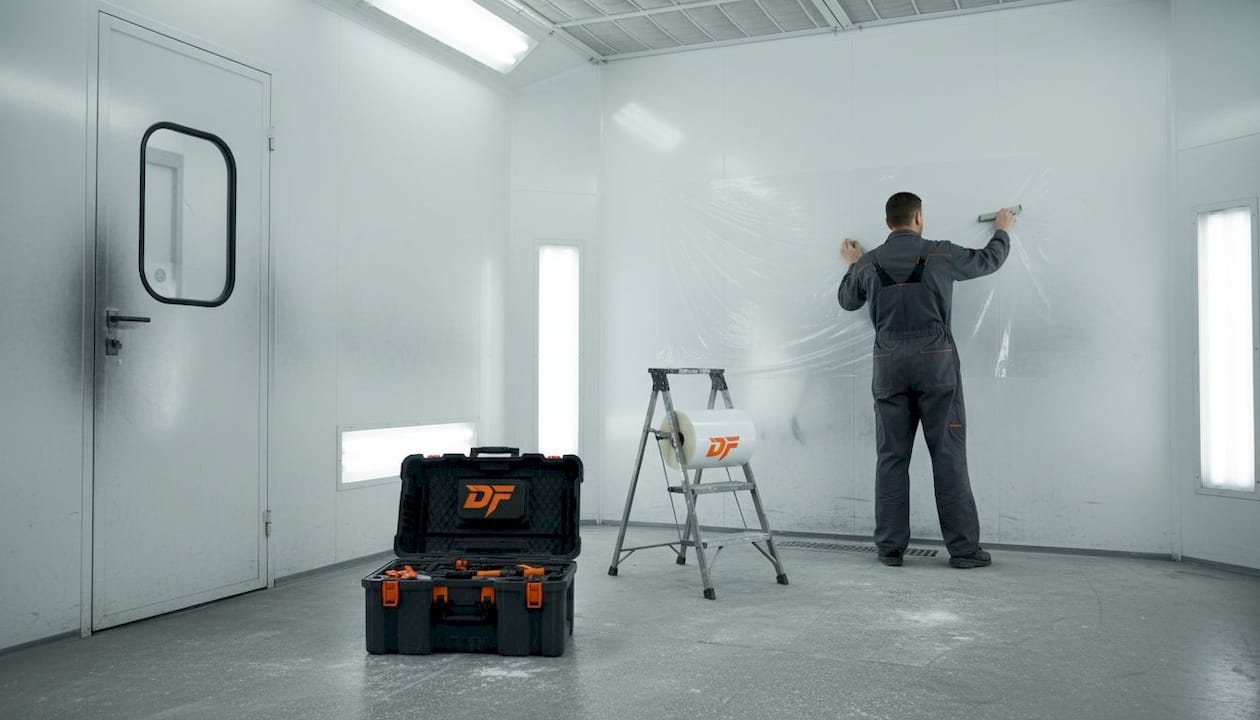
The result is that dust particles floating in the booth air have less of a magnetic pull toward booth surfaces. With fewer charged surfaces actively attracting particles, the overall airborne dust load near wet paint drops significantly. This doesn’t mean zero dust, but it does mean fewer particles settling on paint before it cures, which directly reduces fish-eye defects, nibs, and dirt in the finish.
The real-world impact of static-free film in action shows up clearly in defect rate tracking. Facilities that switch from standard film to proper static-free film typically report measurable reductions in dust-related rejects within the first few weeks of consistent use.
Typical steps for applying static-free film in a spray booth:
- Clean all booth surfaces thoroughly before installation, removing any existing dust, grease, or old film residue
- Check the film’s antistatic rating against your booth’s specific conditions and paint system requirements
- Use a patented dispenser system (or equivalent) to apply film smoothly, avoiding air bubbles that can trap contaminated air underneath
- Start from the ceiling and work down, overlapping seams by at least 2 inches to prevent charge buildup at exposed edges
- Apply floor protection film last, using a heavy-duty variant rated for vehicle traffic
- After installation, allow the film to acclimate to booth temperature for at least 30 minutes before starting paint operations
- Monitor humidity and temperature at the start of each shift and note whether dust issues correlate with specific environmental readings
Environmental conditions have a direct impact on performance. As research into booth operating conditions confirms, performance of static-free film is affected by both film design and booth operating conditions, including humidity. On dry days, even good antistatic film may need support from a humidification system or grounding strap on the vehicle being painted.
Looking at real-world spray booth examples shows how different facility setups call for different application strategies, from small single-booth body shops to high-volume industrial painting lines.
Pro Tip: Keep a simple log of humidity, temperature, and dust incident frequency for each shift. After four to six weeks, patterns will emerge that tell you exactly when and why dust problems spike, giving you actionable data to adjust your film choice or booth conditions.
Understanding the science and process is useful, but choosing the right solution means knowing how static-free film stacks up against other methods.
Static-free film vs traditional protection: A practical comparison
Facility managers often ask whether static-free film is worth the additional cost over standard protective film or enhanced cleaning routines. The answer depends on your defect rate, your rework costs, and the specific conditions in your facility.
| Feature | Static-free film | Ordinary protective film | Enhanced cleaning routine |
|---|---|---|---|
| Dust attraction control | High (reduces charge-driven attraction) | Low (may increase static) | Moderate (temporary) |
| Installation speed | Fast with dispenser system | Fast | Slow (per job) |
| Ongoing cost | Moderate (planned replacement) | Low upfront, higher rework cost | High (labor intensive) |
| Effectiveness in dry conditions | Moderate to high | Poor | Moderate |
| Surface protection | Yes | Yes | No |
| Durability | High (multi-layer options) | Moderate | N/A |
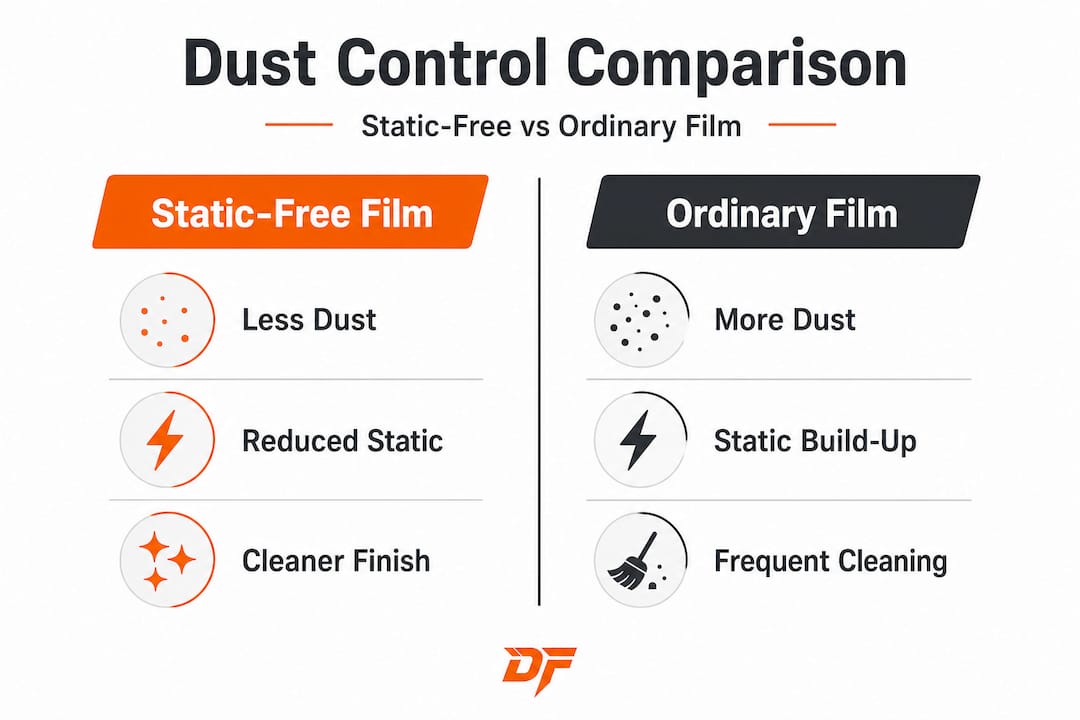
As industry nuances point out, one method may outperform others depending on the booth environment, which is exactly why a blanket answer doesn’t work for everyone.
When to choose static-free film over standard approaches:
- When your facility runs high-volume finishing work and dust defects are a recurring cost
- When your region experiences seasonal dry spells that spike static-related paint issues
- When you paint complex, multi-stage finishes where any defect requires a full strip and redo
- When your booth handles both base coat and clear coat in the same space, multiplying contamination risk
- When existing cleaning routines aren’t bringing defect rates below acceptable thresholds
Standard film may be adequate for low-frequency painting environments where rework costs are minimal and humidity is consistently above 50%. But for most professional auto body and industrial painting operations, the economics favor static-free film once you factor in rework labor, material waste, and customer callbacks.
Strategies for optimizing spray booth quality go beyond just swapping film types. The total booth cleanliness system matters as much as any single product.
With all this context, let’s put it together and determine how to choose and get the most from static-free film in your facility.
Selecting and maximizing the benefits of static-free film
Choosing the right static-free film is only half the job. How you implement, monitor, and maintain it determines whether you see a genuine reduction in defects or just a modest improvement. As operational research confirms, optimal results require facility managers to consider both material selection and operating conditions as a paired decision, not two separate ones.
Top tips for evaluating and maximizing static-free film performance:
- Match film type to booth humidity profile. Review your facility’s humidity data before specifying antistatic vs dissipative film. A basic antistatic film in a dry climate will underperform significantly.
- Set a replacement schedule based on data, not just appearance. Film that looks intact can lose its antistatic properties after extended exposure to chemicals, UV, or repeated cleaning. Track defect rates and correlate them with film age.
- Train staff on proper installation technique. Air bubbles, incorrect overlap, and pulling film tight on edges can all compromise antistatic performance by creating charge concentration points.
- Combine film protection with grounding straps on vehicles. A vehicle that carries static into the booth will still be a contamination source regardless of wall and floor film quality.
- Run a short environmental audit before high-value jobs. Check humidity, verify air filtration, and inspect film condition before tackling complex or customer-priority finishes.
- Consider multi-layer systems for high-traffic floors. Floor film takes the heaviest mechanical stress. Multi-layer options allow you to peel back worn layers without full reinstallation, saving time and labor.
Reviewing top floor protection films helps you match the right floor protection to your vehicle throughput and floor surface type, which is a decision that’s often overlooked in favor of wall film specification.
A facility leader’s perspective: Why “static-free” is a mindset, not a miracle
Here’s what most film suppliers won’t tell you directly: static-free film is a tool, not a solution. We’ve worked with facilities that installed premium antistatic film, saw an initial improvement, and then slowly drifted back toward high defect rates over the following months. In every case, the culprit wasn’t the film. It was the expectation that the film alone would do all the work.
The facilities that consistently achieve the lowest dust-related defect rates aren’t necessarily using the most expensive film. They’re the ones that treat dust control as an ongoing operational discipline rather than a product purchase. They audit their booth conditions weekly. They replace film on schedule rather than when it looks visually bad. They train every new technician on installation standards, not just how to spray.
“Static-free” is always a moving target, not an absolute guarantee. Treat it as part of a culture of continual improvement, and it delivers real, compounding results. Treat it as a plug-and-play fix, and you’ll find yourself frustrated by inconsistent outcomes.
As experienced booth operators confirm, even the best film choice must be paired with process awareness and flexible monitoring to stay effective. The product matters. The process matters more.
The facilities worth learning from see every dust incident as data, not just a headache. Where did it come from? Was humidity low that day? Was the film overdue for replacement? Did a new technician skip a step? That kind of systematic thinking is what separates operations with sub-1% dust defect rates from those stuck at 5% or higher. Explore more on building that foundation with anti-static finishes insight.
Explore static-free film solutions for your facility
Knowing the theory is valuable, but finding the right film for your specific spray booth operation is where real improvement begins. At Dust Free Film, we’ve been supplying high-performance static-free films to auto body shops, industrial coaters, and manufacturing facilities since 2012, and we understand that every booth is different.
Whether you’re running a single booth in a regional body shop or managing a fleet of industrial painting lines, our range of dust-free film options includes multi-layer wall and floor protectors, patented dispenser systems for fast bubble-free installation, and configurations built for high-throughput environments. Ready to find the best fit for your facility? Request a quote and our team will help you match the right product to your booth conditions, budget, and performance targets.
Frequently asked questions
Does static-free film eliminate all dust issues in spray booths?
No, it greatly reduces static-driven dust attraction, but optimal results also require ongoing environmental and process control. As industry guidance notes, static-free film performance is a target, not a guarantee under all conditions.
How often should static-free film be replaced?
Replacement depends on film type, usage intensity, and exposure to chemicals, but most professional facilities schedule changes based on visual inspection combined with tracking dust incident frequency rather than calendar dates alone.
What is the difference between anti-static and dissipative film?
Anti-static film prevents charge from building up on the surface in the first place, while dissipative film allows any existing charge to safely drain away over time. Both reduce dust attraction but work through different mechanisms and suit different booth conditions.
Can static-free film work in very dry or humid climates?
It works across most climates, but performance varies with humidity levels. Extremely dry conditions may require supplementary controls such as humidification systems or vehicle grounding straps to maintain effectiveness.
Are there safety considerations when using static-free film?
Most static-free films are engineered for safe industrial use and are compatible with standard spray booth environments. Always review manufacturer specifications for compatibility with specific paint chemistries, solvents, and heat curing conditions before installation.