
Setting up a paint booth properly is the difference between flawless finishes and costly rework. Many facility managers struggle with contamination, uneven airflow, and safety compliance issues that stem from poor initial setup. This guide walks you through every critical step to build a dust-free, efficient spray booth that meets NFPA 33 standards and maximizes your finishing productivity. Whether you’re installing a new booth or upgrading an existing system, you’ll learn how to optimize layout, ventilation, and maintenance for superior results every time.
Table of Contents
- Prepare Your Workspace And Plan Your Paint Booth Layout
- Step-By-Step Installation Of Paint Booth Components
- Maintain And Manage Your Paint Booth For Optimal, Dust-Free Operation
- Protect Your Paint Booth Surfaces With Dust Free Film
- FAQ
Key takeaways
| Point | Details |
|---|---|
| Booth type selection | Downdraft booths provide superior dust control through vertical airflow compared to crossdraft or semi-downdraft designs. |
| NFPA 33 compliance | Professional installations must meet 100 FPM face velocity, use explosion-proof electrical systems, and include fire suppression. |
| Filter maintenance schedule | Replace exhaust filters every 80-100 operating hours and pre-filters monthly to maintain airflow and prevent contamination. |
| Workflow separation | Keep different color jobs separated by at least 3 feet and schedule finishing cycles strategically to avoid cross-contamination. |
| Productivity optimization | Properly maintained booths achieve 4-6 paint cycles daily with consistent transfer efficiency and minimal defects. |
Prepare your workspace and plan your paint booth layout
Before you bolt a single frame member or connect any ductwork, you need a comprehensive plan that addresses booth type, workspace organization, and utility requirements. Your booth selection directly impacts finishing quality and operational efficiency. Downdraft booths deliver vertical airflow that pulls overspray down through floor filters, making them ideal for high-quality automotive refinishing where dust-free surfaces are non-negotiable. Crossdraft systems push air horizontally from one wall to the opposite, which works for industrial applications where speed matters more than perfection. Semi-downdraft booths split the difference, combining overhead air input with rear wall exhaust.
Your workspace needs clearly defined zones for painting, drying, and staging. Paint application happens in the booth itself, but you need adjacent areas for masking, preparation, and cool-down. Position your booth to allow smooth vehicle flow without bottlenecks. A typical shop layout places the booth centrally with prep stations upstream and detail bays downstream. This linear workflow prevents backtracking and reduces contamination risk from foot traffic.
Utility planning separates amateur setups from professional installations. Electrical service must support high-draw exhaust fans, typically requiring 220-240V circuits with proper grounding. Gas connections for heated booths need sizing calculations based on your target temperature and local climate. Every electrical component inside the booth envelope must be explosion-proof to prevent ignition of flammable vapors. Don’t forget compressed air lines for spray guns, positioned to avoid condensation issues that ruin finishes.
Ventilation design determines whether you achieve dust-free results or constant rework. Your system must deliver consistent airflow across the entire paint zone while filtering incoming air and exhausting overspray safely. Temperature control keeps paint flowing properly and speeds drying without causing runs or sags. Lighting requires special attention because standard fixtures create explosion hazards. You need fixtures rated for Class I, Division 1 environments that provide even, shadow-free illumination.
NFPA 33 compliance isn’t optional for commercial operations. This standard mandates specific construction materials, airflow rates, electrical specifications, and fire protection measures. Walls and ceilings must be noncombustible or treated with fire-resistant coatings. Floor construction needs to prevent solvent penetration while supporting vehicle weight. Verify local code requirements early because some jurisdictions impose additional restrictions beyond NFPA minimums.
Pro Tip: Map your utility runs on paper before starting physical work. Measure twice, cut once applies doubly when you’re routing high-voltage electrical and gas lines that cost thousands to relocate if positioned incorrectly.
Booth type comparison for different applications:
| Booth Type | Airflow Pattern | Best For | Typical Cost Range |
|---|---|---|---|
| Downdraft | Vertical top to floor | High-end auto refinishing | $15,000-$50,000+ |
| Crossdraft | Horizontal wall to wall | Industrial production painting | $8,000-$25,000 |
| Semi-downdraft | Angled from ceiling to rear wall | Mid-range auto body shops | $10,000-$35,000 |
| Open face | Front to rear with no enclosure | Large equipment coating | $5,000-$15,000 |
Step-by-step installation of paint booth components
Start with frame assembly using the manufacturer’s instructions as your baseline, but verify every measurement against your actual space. Booths rarely fit perfectly as-designed because building floors aren’t level and walls aren’t plumb. Shim the base frame level before you erect walls, or you’ll fight alignment issues throughout the entire build. Most modern booths use modular panels that interlock, but you still need to seal every joint to prevent air leaks that destroy your carefully calculated airflow patterns.
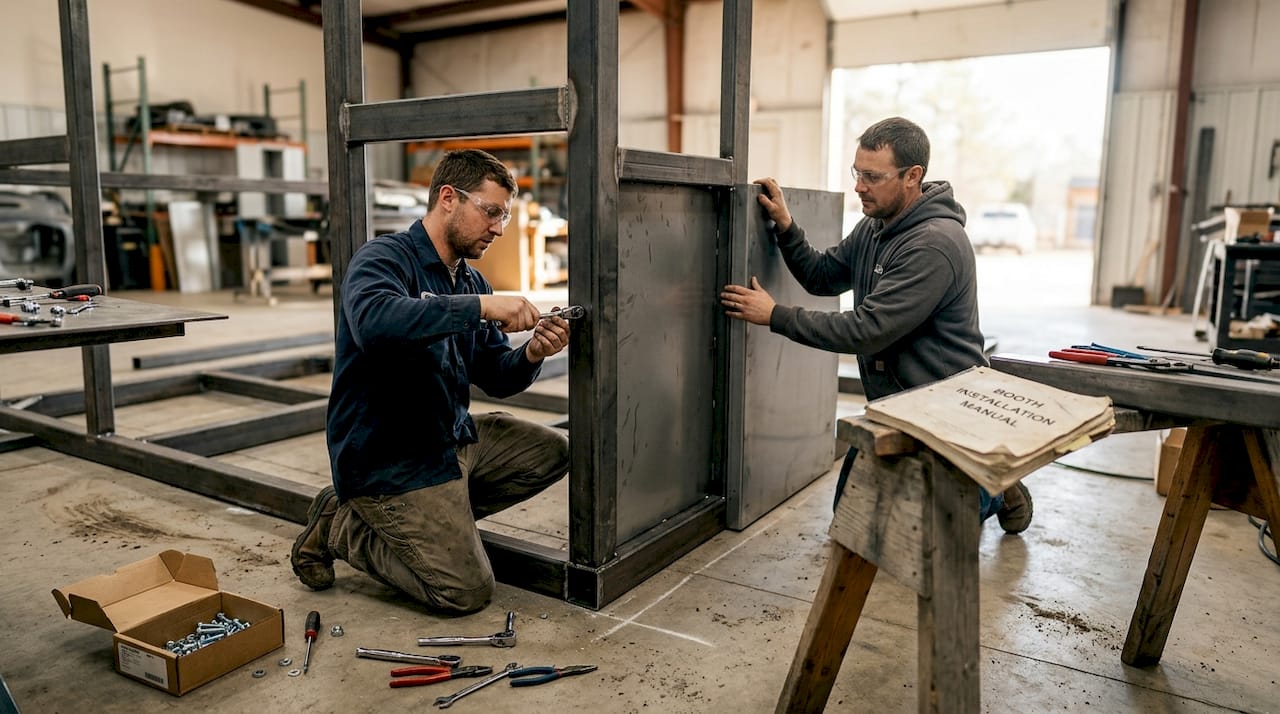
Electrical and gas connections require licensed professionals in most jurisdictions, and for good reason. A single wiring error can create an ignition source that turns your booth into a fireball. Ground every metal component to eliminate static buildup that attracts dust and creates spark potential. Your electrical panel should be located outside the booth envelope with clearly labeled circuits for fans, lights, and heating elements. Gas lines need shutoff valves accessible from outside the booth for emergency situations.
Ventilation installation determines whether your booth performs as designed or becomes an expensive disappointment. NFPA 33 requires 100 FPM face velocity at the booth opening to capture overspray effectively. Calculate your required CFM based on booth dimensions, then select fans with enough capacity to overcome filter resistance while maintaining target velocity. Exhaust fans typically mount on the roof or exterior wall, connected to the booth through insulated ductwork that prevents condensation.
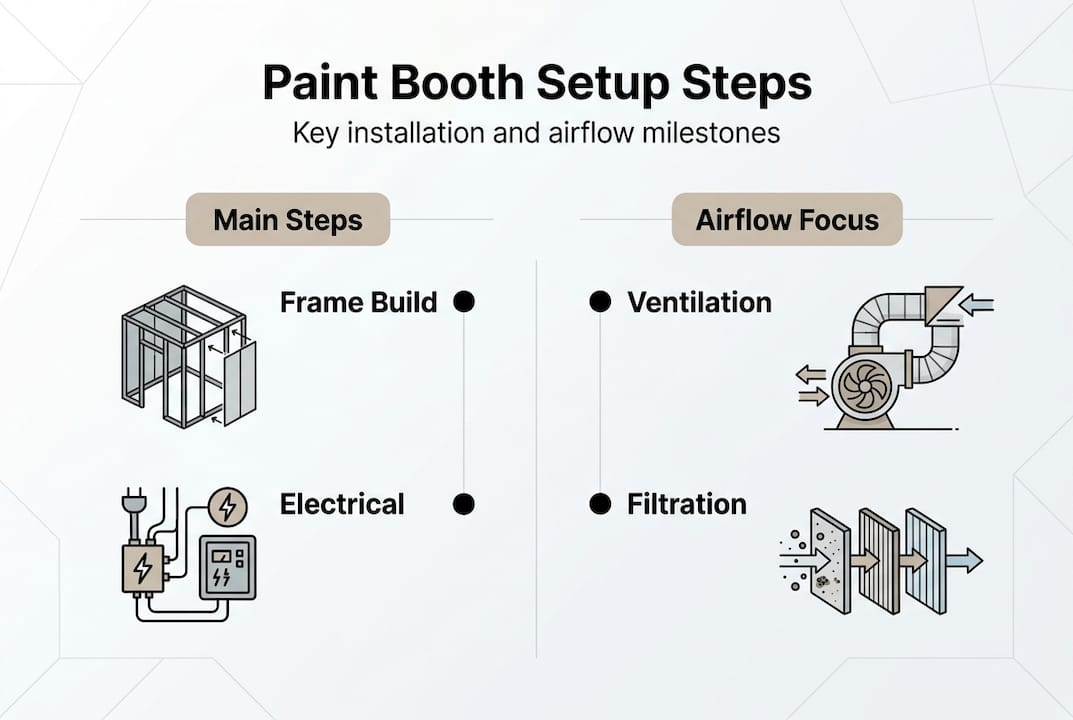
Filtration systems need careful attention because they directly impact finish quality and operating costs. Intake filters remove dust from incoming air before it reaches your paint surface. These typically use progressively finer media, starting with a coarse prefilter that catches large particles, followed by finer filters that remove microscopic contaminants. Exhaust filters capture overspray before it exits the building, protecting the environment and preventing neighbors from calling code enforcement.
Lighting installation follows strict safety protocols because any spark can ignite solvent vapors. Explosion-proof fixtures cost more than standard shop lights, but they’re engineered to contain any internal arc or spark. Position lights to eliminate shadows that hide surface defects. Most professional booths use a combination of overhead and side lighting that provides even illumination across vertical and horizontal surfaces. LED fixtures generate less heat than older technologies, reducing cooling loads and improving painter comfort.
Fire suppression systems are your last line of defense against catastrophic loss. Automatic dry chemical systems detect rapid temperature rise and deploy suppressant before flames spread. Manual pull stations give painters an emergency shutdown option if they spot a problem. Your system needs regular inspection and maintenance to ensure it functions when needed. Don’t skimp on this component because insurance companies scrutinize booth fire protection when underwriting policies.
- Level and anchor the base frame using shims and concrete anchors rated for your booth’s weight.
- Erect wall panels in sequence, sealing all joints with approved sealant to prevent air infiltration.
- Install and ground all electrical components using explosion-proof fixtures and conduit.
- Mount exhaust fans with vibration isolators to reduce noise transmission through the building structure.
- Install intake and exhaust filters according to airflow direction, ensuring proper sealing in their frames.
- Connect heating elements and thermostats, testing temperature control before final commissioning.
- Mount lighting fixtures with proper spacing to eliminate shadows across the entire work area.
- Install fire suppression system components and verify activation mechanisms function correctly.
- Test all systems individually before running the complete booth under load conditions.
Pro Tip: Document every component’s location and specification during installation. You’ll need this information for maintenance scheduling, parts ordering, and troubleshooting down the road.
“A properly installed booth pays for itself within the first year through reduced rework, faster cycle times, and lower material waste. Cutting corners during setup costs you multiples of the initial savings through ongoing operational inefficiencies.”
For comprehensive guidance on maintaining safety throughout your booth’s operational life, explore proven spray booth safety solutions that protect your team and facility.
Maintain and manage your paint booth for optimal, dust-free operation
Daily cleaning routines separate professional shops from those constantly fighting contamination issues. Start each day by vacuuming the floor and wiping down walls with tack cloths to remove settled dust. Pay special attention to corners and ledges where particles accumulate. Inspect your spray guns and fluid lines for dried paint that flakes off during use. Clean your air compressor’s moisture trap because water in your air lines causes finish defects that look like dust contamination.
Weekly airflow verification catches problems before they ruin expensive paint jobs. Check your magnehelic gauge readings against baseline values established during commissioning. Pressure drop across filters increases as they load with particles, reducing airflow velocity. When readings exceed manufacturer specifications, it’s time for filter service even if your calendar schedule says otherwise. Walk the booth perimeter with a smoke stick to verify air patterns match your design, watching for dead zones or reverse flows.
Filter replacement schedules depend on usage intensity, but general guidelines keep you on track. Exhaust filters handling heavy overspray loads need replacement every 80-100 operating hours. Pre-filters protecting your intake system typically last 1-2 months in moderate-use shops. High-volume operations may need weekly prefilter changes to maintain proper airflow. Track your actual filter life to optimize replacement timing and reduce costs without sacrificing performance.
Workflow management prevents cross-contamination between different jobs. Maintain at least 3 feet of separation between parts receiving different colors to prevent overspray transfer. Group tri-coat jobs together because they require multiple passes and extended booth time. Stage completed parts on dedicated racks outside the booth rather than leaving them inside where they collect fresh overspray. This simple separation discipline eliminates most contamination complaints.
Scheduling finishing cycles strategically maximizes booth utilization while maintaining quality. A well-managed booth handles 4-6 complete paint cycles daily, including prep, application, and flash time. Start your day with lighter colors and progress to darker shades to minimize color contamination. Schedule your most critical jobs during mid-morning when temperature and humidity are most stable. Reserve end-of-day slots for less demanding work that tolerates minor variations.
Essential maintenance tasks and frequencies:
| Task | Frequency | Impact if Skipped |
|---|---|---|
| Vacuum floors and wipe walls | Daily | Dust settles on wet paint causing defects |
| Check magnehelic pressure readings | Weekly | Airflow drops below spec undetected |
| Replace exhaust filters | Every 80-100 hours | Contamination and reduced extraction |
| Replace intake pre-filters | Monthly to bi-monthly | Dirty air enters booth causing finish issues |
| Inspect and clean spray equipment | After each use | Dried paint particles contaminate next job |
| Calibrate temperature controls | Quarterly | Inconsistent curing and finish quality |
| Professional HVAC inspection | Annually | Major system failures without warning |
Temperature and humidity control requires active management, not just setting a thermostat and walking away. Paint viscosity changes with temperature, affecting atomization and flow. High humidity slows solvent evaporation, extending flash times and increasing sag risk. Low humidity creates static that attracts dust to freshly painted surfaces. Monitor conditions continuously and adjust your technique to compensate for variations outside your ideal range.
Documentation might seem like busywork, but it saves you when problems arise. Log filter changes, maintenance activities, and any unusual observations in a dedicated booth journal. Track paint usage, cycle times, and defect rates to identify trends before they become crises. This data helps you optimize operations and provides evidence of proper maintenance if insurance or regulatory questions arise.
Discover advanced strategies in our detailed spray booth maintenance guide and learn proven techniques for paint booth contamination prevention that keep your finishes flawless.
Protect your paint booth surfaces with Dust Free Film
Even with perfect maintenance, booth walls and floors take a beating from overspray accumulation. Traditional cleaning methods require harsh solvents and hours of labor that take your booth offline. Spray booth protection products from Dust Free Film offer a smarter approach that saves time and extends your booth’s service life. Our multi-layer electrostatic films adhere to walls and floors without adhesives, creating a protective barrier that captures overspray before it bonds to your booth surfaces.
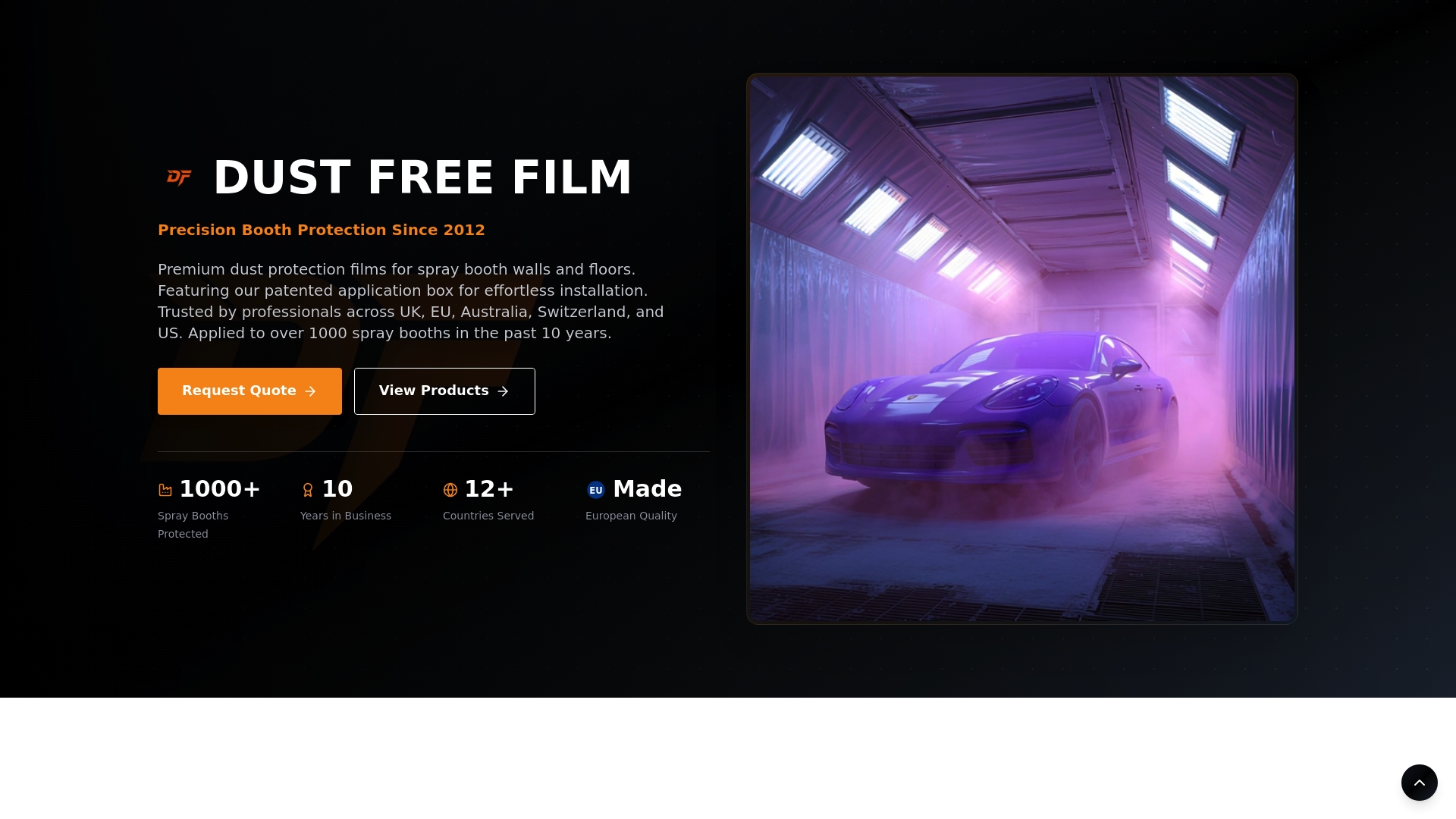
When it’s time to refresh your booth, simply peel away the used film and apply a fresh layer in minutes. Our patented dispenser system ensures bubble-free application every time, and the heat-resistant, static-free construction withstands the demanding conditions inside active spray booths. Facility managers appreciate how our spray booth floor protection and spray booth wall protection solutions reduce downtime and cleaning costs while maintaining the dust-free environment your finishes demand. Explore how European manufacturing standards and custom configurations support your high-volume operations.
FAQ
What is the best paint booth type for optimal dust control?
Downdraft booths provide vertical airflow that delivers superior overspray control compared to crossdraft systems. Air enters through ceiling filters and exits through floor grates, pulling contaminants down and away from the paint surface. This airflow pattern prevents dust from settling on wet paint, making downdraft designs the gold standard for high-quality automotive refinishing. Crossdraft booths work for industrial applications where speed matters more than perfection, but they can’t match downdraft performance for dust-free finishes.
How often should filters be changed in a paint booth?
Exhaust filters need replacement every 80-100 hours of actual painting time to maintain proper airflow and prevent contamination. Pre-filters protecting your intake system typically require monthly or bi-monthly replacement depending on your paint volume and local air quality. Monitor your magnehelic gauge readings to catch filter loading before it impacts performance. High-volume shops may need more frequent changes, while light-use facilities can sometimes extend intervals slightly without compromising results.
Are DIY paint booth setups recommended for auto body shops?
DIY booths work for hobbyists and small jobs but lack the safety compliance and efficiency required for professional industrial settings. Commercial operations need NFPA 33 certification, proper ventilation calculations, explosion-proof electrical systems, and fire suppression that DIY approaches can’t deliver. Professional installation ensures your booth meets code requirements, performs consistently, and protects your insurance coverage. The upfront cost difference disappears quickly when you factor in liability exposure and operational efficiency over the booth’s lifetime.
How does paint booth scheduling affect finishing results?
Efficient scheduling maintains consistent airflow and transfer efficiency throughout the day, enabling well-managed shops to complete 4-6 finish cycles daily. Starting with lighter colors and progressing to darker shades minimizes cross-contamination between jobs. Avoid overlapping different color applications because overspray from one job contaminates adjacent work even with proper separation. Strategic scheduling also considers temperature stability, reserving critical jobs for times when environmental conditions are most predictable and controllable.