

TL;DR:
- Dust control prevents airborne particulate exposure, ensuring air quality, regulatory compliance, and equipment longevity. Implementing a layered system of prevention, capture, and housekeeping, supported by a documented plan and real-time monitoring, is essential. Effective dust management safeguards worker health, environmental impact, operational costs, and community relations.
Dust control is the deliberate application of techniques to prevent, contain, and remove airborne dust particles in operational environments, and it sits at the center of every serious worker health and facility compliance program. The role of dust control extends far beyond housekeeping. It directly determines air quality, regulatory standing, equipment longevity, and the health of every person on your floor. Facilities that treat dust management as an afterthought face increased respiratory illness rates, equipment failures, and regulatory fines. This guide gives facility managers, safety officers, and industrial workers a practical framework for implementing dust control that actually holds up under real operating conditions.
What is the role of dust control in industrial operations?
Dust control is defined as the suppression, capture, and removal of particulate matter generated during industrial processes, construction, material handling, and surface finishing. Its primary function is protecting workers from airborne particulate exposure that causes respiratory disease, reduced visibility, and contamination of finished products. Secondary functions include protecting communities near facilities, preserving equipment, and maintaining compliance with OSHA, EPA, and local environmental regulations.
The health stakes are not abstract. Prolonged exposure to fine particulate matter, particularly PM2.5 and PM10 particles, is linked to chronic obstructive pulmonary disease, silicosis, and cardiovascular damage. Facilities that generate silica dust, wood dust, or metal fumes face the strictest regulatory scrutiny, and the consequences of non-compliance include work stoppages, civil penalties, and litigation. Dust control is not optional in these environments. It is a legal and operational requirement.
Effective dust suppression also protects product quality. In automotive refinishing, spray booth painting, and precision manufacturing, airborne particles contaminate coatings and surfaces, causing defects that require rework. Dustfreefilm’s workshop safety and quality resources document exactly how particulate contamination translates into measurable production losses. The connection between air quality and output quality is direct and quantifiable.
What practical dust management techniques are most effective today?
The most reliable framework for dust suppression is the three-layer model: prevention at the source, capture during work, and housekeeping for cleanup. Each layer addresses a different point in the dust lifecycle, and all three layers must operate together for a facility to achieve consistent compliance and air quality targets.

Prevention means eliminating or reducing dust generation before it becomes airborne. Enclosed work zones, wet drilling, material substitution, and process redesign all fall into this category. Engineering controls like local exhaust ventilation (LEV) systems and enclosed conveyor belts are the most effective prevention tools because they address the source directly. The GRT dust management framework places engineering controls as primary, with administrative controls and PPE serving only as supplements. Relying on respirators as your first line of defense is a compliance failure waiting to happen.
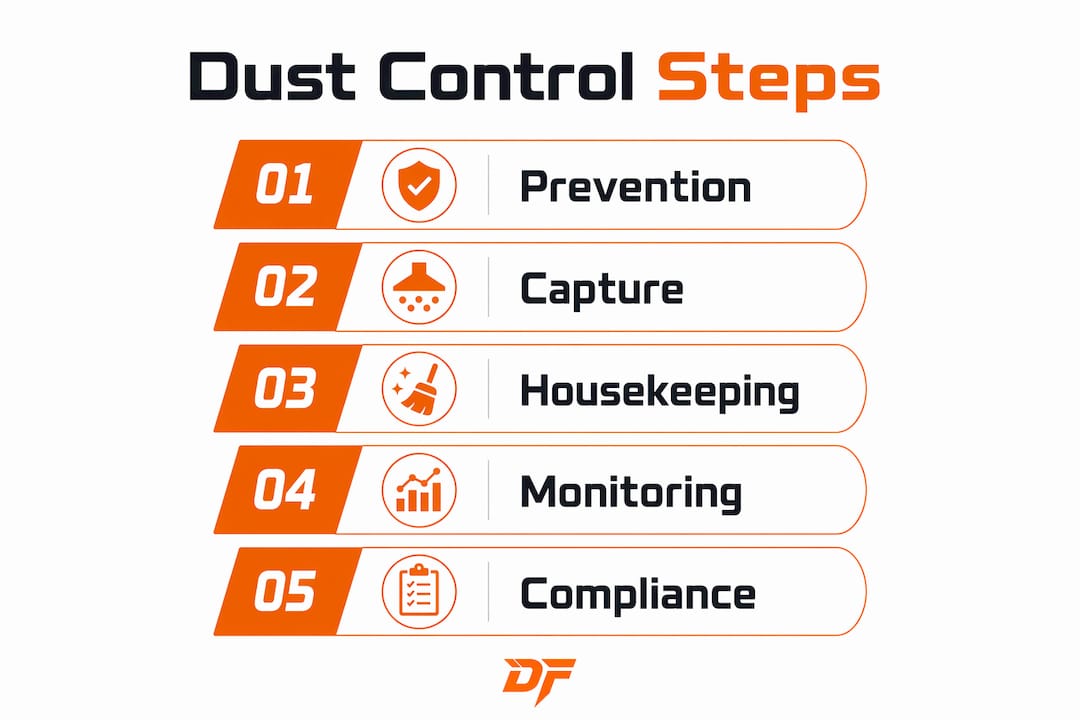
Capture involves containing dust that is generated despite prevention measures. Water-based dust suppression is the most common capture method. NVES guidance recommends water spraying every 2 to 4 hours during active operations, with polymer or calcium chloride additives reducing that frequency by 50 to 80 percent. That reduction matters significantly in high-volume operations where frequent water application disrupts workflow. ISUZU dust control trucks with adjustable spray nozzles demonstrate how precision water suppression scales this approach to large industrial yards and road surfaces.
Housekeeping closes the loop. The most common mistake facilities make at this stage is dry sweeping or blowing, which resuspends fine particles back into the breathing zone. Vacuuming with proper filtration is the correct approach for industrial housekeeping. HEPA-filtered industrial vacuums remove particles without reintroducing them to the air.
Pro Tip: Schedule housekeeping at the end of shifts when workers have cleared the area, and always use wet mopping or HEPA vacuuming. Dry sweeping in a facility with silica or metal dust is a regulatory violation in many jurisdictions, not just a bad practice.
| Method | Best application | Effectiveness |
|---|---|---|
| Local exhaust ventilation | Grinding, cutting, welding stations | High: captures at source |
| Water spray suppression | Roads, yards, demolition, earthworks | Moderate to high: requires scheduling |
| Polymer/calcium chloride additives | Unpaved roads, stockpiles | High: extends suppression duration |
| Physical barriers and windbreaks | Open-air sites, perimeter control | Moderate: reduces boundary migration |
| HEPA vacuum housekeeping | Indoor facilities, spray booths | High: prevents resuspension |
Why does a Dust Management Plan matter for compliance?
A Dust Management Plan (DMP) is a documented operational framework that links risk assessment, engineering controls, monitoring programs, and escalation protocols into a single accountable system. Without a DMP, dust control becomes reactive and inconsistent. With one, every dust source in your facility has a defined control, a measurable success criterion, and a named response when that criterion is breached.
The core components of an effective DMP include a source inventory, control specifications for each source, a monitoring program with defined trigger levels, and a Trigger Action Response Plan (TARP). The TARP is what separates a real DMP from a document that sits in a filing cabinet. It defines exactly what happens when PM10 readings exceed a threshold: who gets notified, what controls are activated, and when operations must pause. Predefined measurable success criteria for each dust source are what make a DMP defensible to regulators and useful to operations teams.
Technology is changing how DMPs function in practice. Real-time dust sensors from platforms like LifeSafety.ai’s environmental monitoring module feed continuous PM data into dashboards that trigger automatic alerts when levels approach thresholds. This removes the lag between a dust event and a human response. Facilities using automated monitoring report faster escalation, better documentation, and fewer regulatory incidents than those relying on scheduled manual readings alone.
Pro Tip: The most common DMP failure is a plan that covers stationary sources but ignores mobile and transient sources like vehicle traffic, material transfers, and maintenance activities. Map every dust-generating activity, not just the obvious ones.
| DMP component | Function |
|---|---|
| Source inventory | Identifies all dust-generating activities and locations |
| Control specification | Assigns engineering, administrative, or PPE controls to each source |
| Monitoring program | Defines measurement methods, frequency, and responsible personnel |
| Trigger Action Response Plan (TARP) | Sets thresholds and prescribes escalation steps when limits are exceeded |
| Review and audit schedule | Ensures the plan stays current as operations change |
How do monitoring and verification processes confirm dust control effectiveness?
Monitoring is the mechanism that proves your dust control program works. Without measurement, you have no evidence of compliance and no basis for improving controls. Effective monitoring programs combine personal exposure sampling, boundary monitoring, opacity readings, and weather tracking into a system that gives you a complete picture of dust behavior across your site.
The following steps outline a standard monitoring and escalation framework for industrial facilities:
- Establish baseline measurements. Sample PM10 and PM2.5 levels at key locations before implementing controls to understand your starting point.
- Set measurable thresholds. Define action levels (e.g., PM10 exceeding 150 µg/m³ at the boundary) that trigger a specific response before regulatory limits are reached.
- Deploy continuous monitoring. Position real-time sensors at dust sources, worker breathing zones, and facility boundaries. Real-time dust sensors with weather integration allow you to correlate wind speed and direction with dust migration patterns.
- Log and review data daily. Assign a responsible person to review monitoring data each shift and flag anomalies. Maintenance software like MPulse’s manufacturing maintenance platform can integrate dust monitoring alerts into broader facility maintenance workflows.
- Execute the TARP when thresholds are breached. Activate additional suppression, restrict operations, or halt work depending on the severity level defined in your DMP.
- Document every event and response. Regulatory inspectors and auditors look for evidence that your monitoring program is active, not just documented. Timestamped records of threshold breaches and responses are your primary defense.
Weather conditions are a critical variable that fixed monitoring schedules ignore. Water spray schedules must adapt to temperature, wind speed, and humidity rather than running on fixed intervals. A hot, dry, windy afternoon requires significantly more suppression than a cool, calm morning. Facilities that fail to adjust for conditions consistently exceed dust limits during adverse weather events.
What are the key benefits of dust control for facility managers?
The benefits of dust control for facility managers and safety officers fall into five categories: worker health protection, regulatory compliance, environmental responsibility, equipment preservation, and community relations. Each category carries direct financial implications that make dust control a business investment, not just a compliance cost.
Worker health protection is the most immediate benefit. Reduced airborne particulate exposure lowers the incidence of occupational respiratory disease, which translates to fewer workers’ compensation claims, lower absenteeism, and reduced liability exposure. Regulatory compliance protects the facility from OSHA citations, EPA penalties, and permit revocations that can halt operations entirely. Environmental protection reduces the facility’s impact on surrounding communities and ecosystems, which matters increasingly to customers, insurers, and local governments.
Equipment preservation is an underappreciated benefit. Dust infiltrates bearings, filters, electrical panels, and precision instruments, accelerating wear and increasing maintenance costs. Facilities with strong dust suppression programs report longer equipment service intervals and lower unplanned downtime. Community relations improve when dust migration beyond the facility boundary is controlled, reducing neighbor complaints and the regulatory scrutiny those complaints trigger.
Practical best practices for facility managers include:
- Conduct a full dust source inventory before selecting controls. Generic solutions applied without a source map waste money and miss critical exposure points.
- Prioritize engineering controls over PPE. Respirators protect individuals but do nothing for air quality, equipment, or regulatory boundary limits.
- Train workers on dust control procedures and the reasoning behind them. Workers who understand why controls matter comply more consistently.
- Review and update your DMP annually or after any significant operational change.
- Use Dustfreefilm’s booth dust control guide as a reference for spray booth-specific dust management in painting and coating operations.
- Schedule high-dust activities during low-wind periods and away from facility boundaries when possible.
Key takeaways
Effective dust control requires a layered system of prevention, capture, and housekeeping, supported by a documented Dust Management Plan and continuous monitoring with defined escalation triggers.
| Point | Details |
|---|---|
| Engineering controls come first | Local exhaust ventilation and enclosed work zones outperform PPE as primary dust controls. |
| Three-layer model is the standard | Prevention, capture, and housekeeping must all operate together for consistent compliance. |
| DMPs require measurable criteria | Every dust source needs a defined threshold and a documented response plan to be effective. |
| Monitoring must adapt to conditions | Water suppression schedules and sensor alerts should respond to weather, not fixed intervals. |
| Benefits extend beyond health | Dust control protects equipment, reduces fines, and improves community and regulatory relations. |
What I’ve learned from watching dust control programs succeed and fail
After working closely with industrial facilities across automotive refinishing, manufacturing, and coatings operations, the pattern I see most often is this: facilities invest in the right equipment and then underinvest in the system around it. A high-quality LEV unit sitting next to a workstation does nothing if workers bypass it because it slows them down. A DMP filed in a binder does nothing if no one reviews the monitoring data.
The facilities that get dust control right treat it as an operational discipline, not a compliance checkbox. They assign ownership. They review data. They retrain after incidents rather than just documenting them. The growing availability of real-time monitoring technology makes this easier than it has ever been, but technology does not replace the human decision to act on what the data shows.
The other thing I have seen consistently is that spray booth environments are where dust control failures are most visible and most costly. A single contaminated paint job can cost more in rework than a month of proper protective film installation. The math on prevention versus remediation is not close. If you manage a spray booth or coating operation, the spray booth safety tips available from Dustfreefilm are worth reviewing before your next operational audit.
Continuous improvement and staff engagement are not soft concepts here. They are the difference between a dust control program that holds up under inspection and one that looks good on paper.
— Dust
Protect your spray booth with Dustfreefilm

Dustfreefilm has specialized in spray booth dust protection since 2012, manufacturing multi-layer electrostatic wall and floor protection films that stop particulate contamination before it reaches your paint surface. The films are heat-resistant, static-free, and designed for high-traffic industrial environments. The patented dispenser system allows quick, bubble-free installation that does not interrupt your workflow. For auto body shops, industrial painting facilities, and manufacturing plants where finish quality is non-negotiable, Dustfreefilm’s booth protection solutions deliver measurable contamination reduction. Ready to spec the right solution for your operation? Request a quote and get product recommendations matched to your booth size and throughput.
FAQ
What is the role of dust control in workplace safety?
Dust control suppresses, captures, and removes airborne particulate matter to protect workers from respiratory disease, reduce equipment damage, and maintain regulatory compliance. Engineering controls like local exhaust ventilation are the primary tools, with PPE serving only as a supplement.
What dust management techniques work best in industrial settings?
The most effective approach combines source prevention through engineering controls, active capture using water suppression or LEV systems, and housekeeping with HEPA-filtered vacuums. Water-based suppression applied every 2 to 4 hours is the most common method, with polymer additives reducing that frequency by up to 80 percent.
Why is a Dust Management Plan required for compliance?
A Dust Management Plan documents every dust source, assigns controls, sets measurable thresholds, and defines escalation steps when limits are exceeded. Regulators including OSHA and the EPA treat a documented, active DMP as evidence of good-faith compliance efforts.
How do you monitor dust control effectiveness?
Effective monitoring combines personal exposure sampling, boundary PM10 and PM2.5 readings, opacity checks, and weather tracking. Real-time sensors with defined trigger levels allow facilities to escalate controls before regulatory thresholds are breached rather than after.
What are the main benefits of dust control for facility managers?
Dust control reduces workers’ compensation claims, prevents regulatory fines, extends equipment service life, and limits community complaints from dust migration beyond facility boundaries. Facilities with active dust suppression programs report lower unplanned downtime and stronger audit outcomes.