

TL;DR:
- Dust control in auto body shops extends beyond surface cleaning to impact paint quality, worker safety, and operational costs. Proper systems include high-performance filters, ventilation management, physical barriers, and disciplined SOPs to prevent contamination at all sources, especially sanding dust and clothing transfer. Implementing proactive, integrated dust protection measures reduces rework, enhances finish quality, and minimizes health and safety risks, giving shops a competitive advantage.
Most auto body shop owners think of dust control as a housekeeping issue. Clean booth, clean car, done. But the role of dust protection in auto body shops goes much deeper than surface cleanliness. Dust directly determines whether a paint job clears inspection or heads back to the booth for rework. It affects worker health, OSHA compliance, energy costs, and shop throughput. This guide cuts through the noise to show you exactly what dust management does, where most shops fall short, and what a disciplined dust protection system actually looks like in practice.
Table of Contents
- Key takeaways
- The role of dust protection in auto body shops
- Dust protection systems and standards
- Practical dust management tips for daily operations
- Common pitfalls that undermine dust control
- My take on dust protection as a shop standard
- How Dustfreefilm supports your dust protection strategy
- FAQ
Key takeaways
| Point | Details |
|---|---|
| Dust affects far more than cleanliness | Airborne particles cause paint defects, create health hazards, and drive up rework costs in ways that are rarely visible until it’s too late. |
| Filtration alone is not enough | HEPA filters are critical, but clothing contamination, airflow imbalance, and filter breakthrough are equally damaging sources of dust problems. |
| SOPs make the difference | Shops that build dust prevention into daily procedures produce measurably better finishes than those that react to problems after they appear. |
| Maintenance is non-negotiable | Clogged filters increase energy costs, cause surface defects, and create safety risks that compound over time if left unchecked. |
| Physical barriers add a critical layer | Protective films on booth walls and floors reduce particle accumulation at the source, cutting cleaning time and contamination risk simultaneously. |
The role of dust protection in auto body shops
Dust in an auto body shop is not a single problem. It is a chain of problems, and each link in that chain connects back to the same question: where is the dust coming from, and where is it going?
How dust sources stack up in a working shop
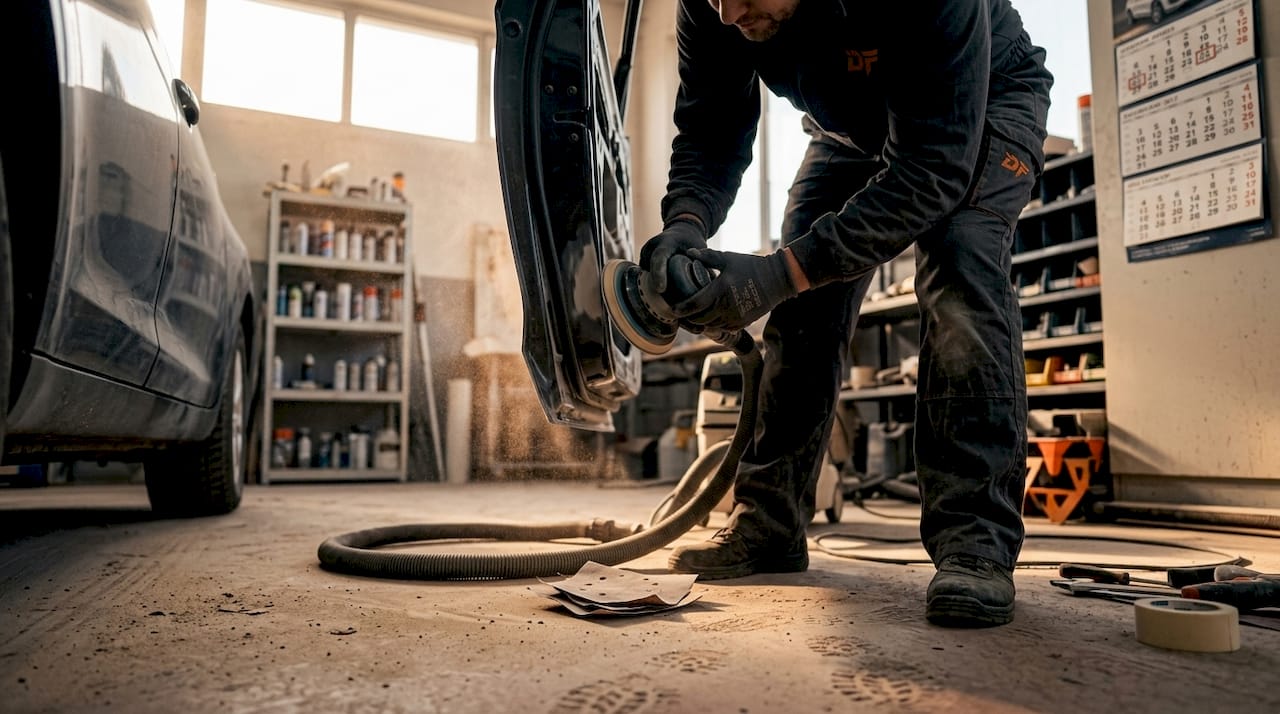
Sanding and grinding operations generate the highest volume of airborne particles. A single prep technician sanding a door panel can release millions of respirable particles into the air within minutes. Those particles do not stay where they are created. Sanding dust migrates into other areas, carrying contamination into paint zones, ventilation systems, and adjacent workspaces unless zoning and pressure differentials are actively managed.
The second major source is less obvious: the people doing the work. Technicians move between prep areas and spray booths, and their clothing carries dust with them. Self-contamination from prep areas and clothing is often the biggest dust source in the entire shop, not the intake air.
What dust actually does to paint
The effects of dust on paint are specific and well-documented:
- Dust nibs: Tiny particles settle on wet paint and get locked into the film, creating raised bumps that require sanding and recoating.
- Fisheyes: Contaminated surfaces cause paint to pull away in circular patterns, often traced back to silicone or sanding dust that was not fully removed.
- Rough texture: Imbalanced airflow and clogged filters create turbulence that deposits particles on the surface during application.
Beyond finish quality, the health dimension cannot be ignored. Fine dust from sanding contains hazardous particles requiring local exhaust ventilation and PPE to prevent serious respiratory risks. Silica, isocyanates, and heavy metal residues from old paint are all present in typical shop dust, making proper dust management a compliance issue, not just a quality one.
Dust protection systems and standards
Understanding what a proper dust protection system looks like is the starting point for any effective dust control guide for auto shops.
Filtration: the backbone of booth air quality
HEPA filters remove at least 99.97% of airborne particles at 0.3 microns, the size range most likely to contaminate wet paint and penetrate deep into the respiratory tract. Nothing else comes close for booth air filtration. But HEPA performance depends entirely on filter condition and installation. A filter that is saturated, improperly seated, or bypassed at the frame edges becomes a contamination source rather than a barrier.
| Filtration method | Particle capture size | Best application |
|---|---|---|
| HEPA filter | 0.3 microns and above (99.97%) | Booth air recirculation and final filtration |
| Downdraft bench exhaust | Variable, tool-dependent | Prep area local extraction |
| On-tool HEPA vacuum | 0.3 microns and above | Sanding and grinding at the source |
| Pre-filters (panel/bag) | 5 microns and above | Protecting HEPA from coarse loading |
Ventilation design and compliance requirements
Local exhaust ventilation at the point of generation is the most cost-effective approach to preventing dust in workshops. On-tool extraction removes particles before they become airborne, reducing the load on your booth filtration system and cutting exposure for everyone in the shop.
OSHA prohibits dry sweeping and compressed air for cleaning in dust environments due to respirable silica exposure risks. This is not optional guidance. If your technicians are blowing down surfaces with compressed air or sweeping dry, you are both creating a health hazard and redistributing particles you worked to contain.
Pro Tip: Install a magnehelic gauge on your booth to monitor static pressure across filters in real time. When pressure differential exceeds the manufacturer’s specification, replace filters immediately rather than waiting for a scheduled date.
Balanced airflow is the other pillar of booth design. Too much positive pressure and dust from the surrounding shop gets pushed in. Too much negative pressure and airflow becomes turbulent enough to carry particles onto wet paint. The goal is a controlled, laminar flow from intake ceiling to exhaust floor, with regular checks to confirm the pattern has not shifted due to filter loading.
Practical dust management tips for daily operations
Knowing the standards is one thing. Building them into daily shop operations is where most facilities either succeed or fall behind. Here is a practical framework drawn from real-world dust management tips for auto body shops.
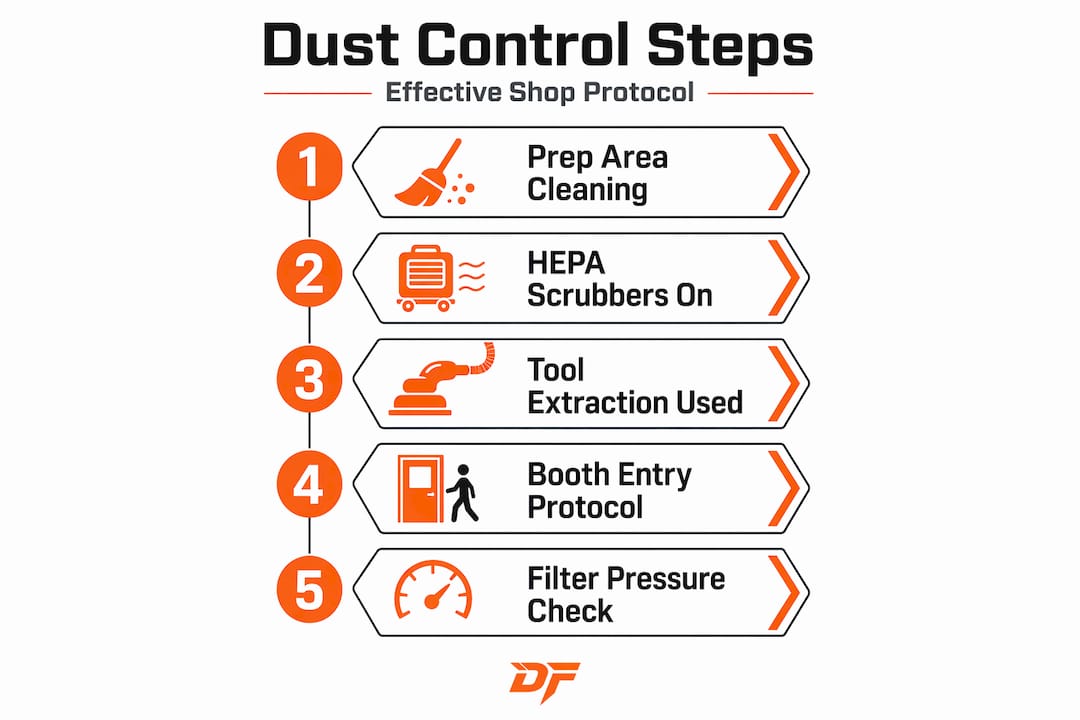
- Switch to vacuum-ready sanders across all prep stations. Vacuum-ready sanders improve finish quality by maintaining clear surface visibility and consistent scratch patterns while eliminating up to 90% of dust at the source. The investment pays back in rework reduction alone.
- Establish a booth entry protocol. Anyone entering the spray booth should use a tack cloth on clothing and hands, and booths should have a sticky-mat entry to capture shoe-borne particles. This single habit cuts a significant portion of cross-contamination.
- Use dust barriers between zones to isolate prep from paint areas. Physical separation prevents airborne particles from migrating during concurrent operations.
- Replace compressed air cleaning with HEPA vacuuming. This applies to vehicles, workbenches, and booth surfaces. Compressed air does not remove dust; it relocates it.
- Schedule filter inspections on vehicle count, not calendar dates. High-volume periods load filters faster than a monthly schedule accounts for. Track jobs per filter cycle and adjust replacement frequency accordingly.
- Write dust protection into your SOPs explicitly. Shops that integrate dust control into standard operating procedures treat it as a quality control process rather than a reactive fix, and their defect rates show it.
Pro Tip: Use a negative pressure cleaning station at prep area exits. A properly designed station with an air spray manifold removes 50% more dust from clothing than manual brushing, reducing the single biggest vector for cross-contamination between prep and paint zones.
Effective dust management also includes continuous HEPA air scrubbers running in prep areas during and after sanding, downdraft benches for smaller panels, and scheduled floor cleaning using wet methods or HEPA-equipped vacuums only.
Common pitfalls that undermine dust control
Even well-intentioned shops make mistakes that quietly erode their dust protection efforts. Recognizing these patterns is the difference between a system that works and one that only looks like it does.
The filter breakthrough problem
When filters are saturated, they do not simply stop working. Overloaded filters let fine particles pass through or bypass the filter frame entirely, causing what engineers call “breakthrough.” The result is a filter that registers as installed but functions as a contamination source. Filter frame integrity and routine pressure monitoring are as important as filter media quality. Check your booth for gaps around filter edges every time you perform a replacement.
Misdiagnosed paint defects
This is a costly blind spot. Paint defects are frequently misdiagnosed as operator error or poor paint quality when the actual cause is airflow imbalance or filter failure. If your shop is seeing recurring nibs, texture issues, or cratering on otherwise well-prepped jobs, audit your booth airflow before blaming the paint or the painter.
Other pitfalls worth noting:
- HVAC cross-contamination: Shop HVAC systems that are not separated from booth intake air carry prep zone particles directly into painting environments.
- Abrasive loading reducing visibility: Dust loading abrasive tools obscures surface contours during sanding, causing technicians to apply inconsistent scratch patterns and miss surface defects before paint is applied.
- Inconsistent PPE use: Dust that lands on unprotected skin or hair re-enters the environment the moment a technician moves. PPE is not just a health protection; it is a contamination control.
The shops that consistently deliver flawless finishes are not necessarily the ones with the most expensive booths. They are the ones that understand every path dust can travel and close those paths systematically.
My take on dust protection as a shop standard
I’ve worked closely with auto body shops long enough to recognize a consistent pattern. The facilities struggling with rework, customer complaints, and inconsistent finish quality almost always share one trait: they treat dust control as something they do when problems appear, not as something built into how every job gets done.
What I’ve learned is that dust protection’s real value shows up in the absence of problems. When your filter logs are up to date, your technicians follow booth entry protocols without being reminded, and your booth walls and floors are protected from particle accumulation, you don’t generate the rework that quietly kills shop margins.
The business cost of ignoring dust goes well beyond the obvious. Dirty filters increase energy costs, extend flash-off times, and create safety liabilities that are expensive to defend. A single rework job burns labor, materials, and booth time that could have produced revenue.
My honest recommendation: stop treating dust management as a maintenance task and start treating it as a quality system. Measure it, schedule it, train your team on it, and build it into every SOP that touches a vehicle. Small, disciplined changes in how dust is controlled compound into a finish quality advantage that your competitors who are still reaching for the compressed air gun simply cannot match.
— Dust
How Dustfreefilm supports your dust protection strategy
Dustfreefilm designs and manufactures premium multi-layer electrostatic films for spray booth walls and floors, purpose-built for the demands of automotive refinishing. Since 2012, their products have helped shops reduce airborne particle accumulation at the surfaces where it matters most, cutting cleaning time between jobs and eliminating the particle release that worn or unprotected booth surfaces generate during spray operations.
Their patented dispenser system allows for quick, bubble-free film installation that does not interrupt your production schedule. The films are heat-resistant, static-free, and built for the high-traffic conditions of professional auto body environments. You can explore the full range of booth wall and floor protection options on their site, or if you’re ready to spec a solution for your facility, request a quote directly to get pricing and configuration guidance from their team.
For shops looking to sharpen their overall approach, Dustfreefilm also publishes detailed resources on paint booth contamination prevention and booth maintenance routines that pair well with the protective film system.
FAQ
What is auto body shop dust management?
Auto body shop dust management is the set of systems, procedures, and equipment used to prevent airborne particles from contaminating paint surfaces, harming workers, and disrupting operations. It covers filtration, ventilation, extraction tools, cleaning protocols, and physical barriers working together.
What are the main effects of dust on paint finishes?
Dust particles settling on wet paint cause defects including nibs, fisheyes, and rough texture. Imbalanced airflow and clogged filters are the most common mechanical causes, often misattributed to painter error or product quality.
How do you reduce dust exposure in a spray booth?
Use HEPA filtration, on-tool extraction for sanding operations, a vacuum-only cleaning protocol, and strict booth entry procedures including tack cloth and sticky mats. Monitor filter pressure differentials regularly and replace filters based on usage load, not calendar intervals alone.
Why is HEPA filtration important for preventing dust in workshops?
HEPA filters capture at least 99.97% of particles at 0.3 microns, which is the size range most responsible for paint defects and respiratory hazards. No standard filter type matches that performance level for booth and prep area applications.
How does filter breakthrough affect paint quality?
When filters are overloaded, fine particles bypass the filter media or escape through frame gaps, turning the filter into a dust source rather than a barrier. Regular pressure monitoring and checking frame integrity at every replacement cycle prevent this from happening.