
TL;DR:
- Using multi-layer peelable films in spray booths drastically reduces maintenance time, from hours to under 15 minutes per cycle.
- These films preserve lighting, prevent surface degradation, and lower overall cleaning costs, improving paint quality and operational efficiency.
Spray booths take a beating. Overspray coats every surface with each job cycle, lighting degrades, and walls accumulate layers of paint residue that no chemical wipe-down fully removes. For facility managers running automotive refinishing or industrial painting operations, the benefits of booth wall protectors go well beyond basic cleanliness. They directly affect throughput, paint quality, labor costs, and the long-term condition of your booth infrastructure. This article breaks down the specific advantages you need to consider when evaluating protection strategies for your facility.
Table of Contents
- Key takeaways
- 1. Core benefits of booth wall protectors for daily operations
- 2. Reduced maintenance time through multi-layer film systems
- 3. Preservation of booth lighting and color accuracy
- 4. Durability and heat resistance in demanding environments
- 5. Cost effectiveness compared to traditional cleaning methods
- 6. Improved quality assurance and reduced defect rates
- 7. Operational efficiency and lean workflow alignment
- 8. Long-term booth surface preservation
- My take on booth wall protection as a strategic investment
- How Dustfreefilm helps you put these benefits to work
- FAQ
Key takeaways
| Point | Details |
|---|---|
| Drastic time savings | Multi-layer peelable films cut full-booth maintenance to under 15 minutes per cycle. |
| Lighting quality preserved | Protective films prevent overspray darkening that reduces light reflectivity and color accuracy. |
| Heat-rated materials matter | Only films rated to at least 200°F are safe for use during curing cycles. |
| Cost advantage is clear | Film replacement costs a fraction of deep cleaning or professional surface restoration. |
| Lean workflow integration | Numbered layer systems enable proactive tracking that fits directly into production schedules. |
1. Core benefits of booth wall protectors for daily operations
The most immediate benefit you notice when switching to wall protection is how maintenance stops being an event and starts being a routine. Without protection, cleaning a spray booth requires chemical solvents, scrubbing equipment, extended downtime, and often a crew. That is not a minor inconvenience. It is a production bottleneck that repeats itself on a schedule.
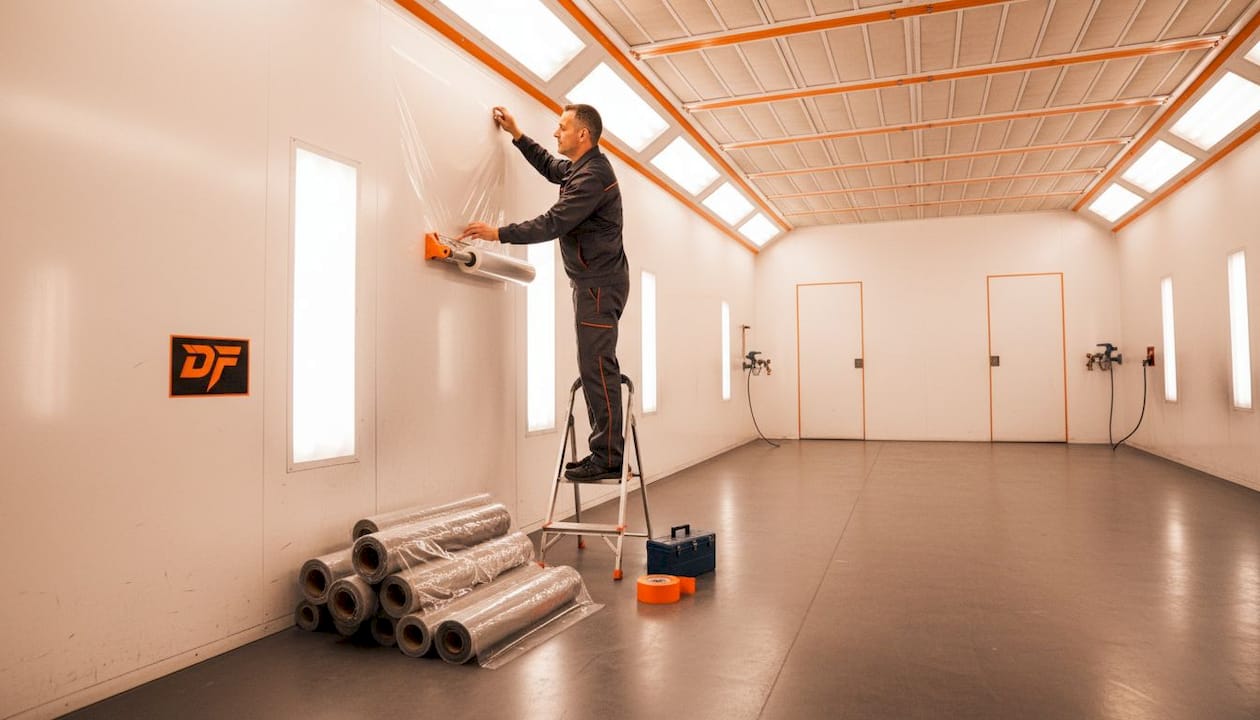
Multi-layer peelable films change that equation. When a layer becomes saturated with overspray, you simply peel it off to reveal a fresh surface underneath. The booth is ready for the next job in minutes, not hours. This approach also removes the risk of chemical residue contaminating subsequent paint jobs, which is a real concern in precision automotive refinishing work.
The advantages of booth protectors extend to labor allocation as well. When cleaning no longer requires a team and special equipment, you free up skilled workers for higher-value tasks. That is an operational gain that compounds over weeks and months.
2. Reduced maintenance time through multi-layer film systems
Speed matters in high-throughput facilities. A single operator can mask the full booth perimeter in approximately 10 minutes using modern multi-layer film systems. That figure is not an estimate. It reflects actual application performance in production environments.
Peelable four-layer films allow operators to remove one contaminated layer at a time, each peel revealing a clean surface without any additional preparation work. Compare that to the standard alternative: solvent cleaning that takes 45 minutes to two hours, plus dry time, plus a safety window before painting resumes. The time difference across a 250-day work year is substantial.
Pro Tip: Set a fixed peel schedule tied to job count rather than visual inspection. Waiting until a layer looks obviously contaminated means you have already allowed light-dimming overspray buildup to affect your output quality.
The lean manufacturing principle here is straightforward. When you convert booth maintenance from a disruptive cleaning event to a two-minute peel-and-reveal task, your booth availability percentage increases directly. For facilities running multiple shifts, that translates to additional job capacity every single week.
3. Preservation of booth lighting and color accuracy
This benefit is underestimated far more than it should be. Paint booths depend on controlled, consistent lighting to achieve accurate color matching. When overspray accumulates on wall surfaces, it does not just look dirty. It absorbs light instead of reflecting it, measurably reducing the brightness of the working environment.
For automotive refinishing, this matters at a technical level. Color matching requires a specific light intensity measured in lux, and as wall reflectivity drops, so does your ability to detect tonal differences between the original and repaired panels. Rework rates increase. Customer complaints follow.
Preventing overspray accumulation is not only about cleanliness. It is critical for maintaining the lighting environment needed for precision work. Facilities that protect their booth walls consistently report more stable lighting conditions throughout the film lifecycle, which directly supports color-matching accuracy.
Protective films maintain wall reflectivity by preventing that overspray layer from bonding permanently to the wall surface. When you peel the film, you restore the original reflective condition of the wall without any restoration work. For quality-focused operations, this is one of the most compelling booth wall protection benefits available.
4. Durability and heat resistance in demanding environments
Not every protective film performs equally under booth conditions. Spray booths run curing cycles that reach high temperatures, and films that are not rated for those conditions will bubble, peel prematurely, or off-gas during the bake phase. That creates contamination exactly when you need the cleanest possible environment.
High-quality protective films withstand temperatures up to 200°F without degrading. That threshold covers the curing requirements of most automotive and industrial coatings. Films rated below that threshold are a liability, not an asset.
| Film Property | Standard Film | High-Performance Film |
|---|---|---|
| Temperature resistance | Up to 140°F | Up to 200°F |
| Layer count | 1 layer | 4+ layers |
| Application method | Manual smoothing | Bubble-free dispenser |
| Maintenance cycle | Full replacement | Peel one layer at a time |
| Chemical resistance | Low | High |
Puncture-resistant, self-adhesive films also reduce physical damage risks during maintenance. When workers are moving equipment or spray guns near booth walls, unprotected surfaces are vulnerable to scratches, gouges, and impact marks. A durable film absorbs that contact without transferring damage to the underlying wall structure.
Pro Tip: Always verify the temperature rating of your protective film against the maximum curing temperature your booth reaches, not the average. Peak temperatures during bake cycles are what determine whether a film holds or fails.
5. Cost effectiveness compared to traditional cleaning methods
The financial case for booth wall protectors is direct. Film replacement costs a fraction of what periodic deep cleaning or surface restoration requires in both materials and labor. When you factor in the downtime cost of taking a booth offline for extended cleaning, the gap widens further.
Consider a realistic comparison for a mid-size auto body shop running one spray booth:
| Cost Category | Without Protectors | With Protectors |
|---|---|---|
| Cleaning labor per month | 8 to 12 hours | 1 to 2 hours |
| Chemical cleaning supplies | $80 to $150/month | Minimal |
| Booth downtime per cleaning | 2 to 4 hours | Under 15 minutes |
| Wall resurfacing frequency | Every 2 to 3 years | Significantly extended |
| Risk of paint job contamination | Higher | Lower |
The purpose of wall protectors, from a financial perspective, is to convert an unpredictable, high-cost maintenance event into a predictable, low-cost routine. Chemical cleaning is also a regulatory and environmental cost. Facilities using solvent-based cleaning products face disposal requirements, VOC exposure records, and potential safety compliance costs. Reducing chemical use has downstream value that does not always show up in a simple line-item budget comparison but absolutely shows up in total operational cost.
6. Improved quality assurance and reduced defect rates
Clean booth walls are a direct input to paint quality. Every particle of debris or overspray residue that becomes airborne during a paint job is a potential defect on your finished surface. Unprotected walls shed contamination constantly, particularly as dried overspray flakes under airflow conditions.
When your booth surfaces are protected by a fresh film layer, that shedding risk drops significantly. The result is fewer inclusions in clear coats, fewer fisheye defects, and a lower rework rate overall. For operations working on high-value vehicles or tight production tolerances, that quality consistency has real monetary value per job.
Facilities that incorporate wall protection into their quality management programs report more stable defect metrics over time. The booth environment becomes a controlled variable rather than an uncontrolled source of variation. That shift matters if you are tracking first-pass yield rates or working toward lean manufacturing certifications.
7. Operational efficiency and lean workflow alignment
The how of wall protectors helping lean production comes down to predictability. Lean manufacturing depends on knowing exactly how long each task takes and removing variability from maintenance sequences. Traditional booth cleaning violates both of those principles.
Numbered multi-layer film systems solve this by making maintenance status visible at a glance. Operators can see how many layers remain without touching the film or pulling records. That visual cue supports proactive planning: when you reach layer two, you schedule the next film application during a planned downtime window rather than reacting to a saturated surface mid-production.
Here is what lean-aligned booth maintenance looks like in practice:
- Peel cycles are tied to job counts, not subjective condition assessments
- Film layer numbers are logged as part of booth readiness checks
- New film rolls are restocked based on predictable consumption rates
- Booth downtime for maintenance is scheduled, never reactive
This kind of structured approach fits directly into maintenance scheduling practices used in high-throughput facilities. When your booth wall maintenance behaves like every other planned maintenance task, it stops being a source of production disruption.
8. Long-term booth surface preservation
Every time you clean an unprotected booth wall with abrasive or solvent methods, you degrade the surface. Primers and sealants that give booth walls their smooth, reflective finish have a finite lifespan under aggressive cleaning. Over time, surfaces become porous and harder to clean, which makes contamination worse, not better. It is a compounding problem.
Protective films prevent surface degradation by keeping overspray off the wall substrate entirely. When you remove the film, the underlying surface is the same condition it was on installation day. This extends the functional life of your booth surfaces by years and preserves the resale or upgrade value of the booth itself.
For facilities planning long-term capital expenditure, that surface preservation translates into deferred replacement costs and better asset value on equipment that often represents a significant investment.
My take on booth wall protection as a strategic investment
I have seen facility managers treat booth wall protection as a consumable purchase decision, the kind of thing you optimize purely on price per roll. That framing misses almost everything that matters.
In my experience, the facilities that get the most from protective films are the ones that treat wall protection as part of their production system, not their cleaning supply budget. They schedule peel cycles the same way they schedule filter changes. They track film consumption alongside job output. They recognize that a contaminated booth wall is not a housekeeping problem. It is a quality control problem with a cost attached to every affected paint job.
What I have learned is that the early adopters of multi-layer film systems consistently report improvements in two areas most managers care about: throughput and rework. Those are not small wins. Reducing rework by even a few jobs per month recovers the entire cost of your film supply many times over.
The misconception worth addressing is that wall protectors are only useful for extremely high-volume shops. Small and mid-size operations benefit just as much, often more, because they have less buffer capacity to absorb downtime or quality failures. Protecting booth walls is a decision that pays at every scale.
— Dust
How Dustfreefilm helps you put these benefits to work
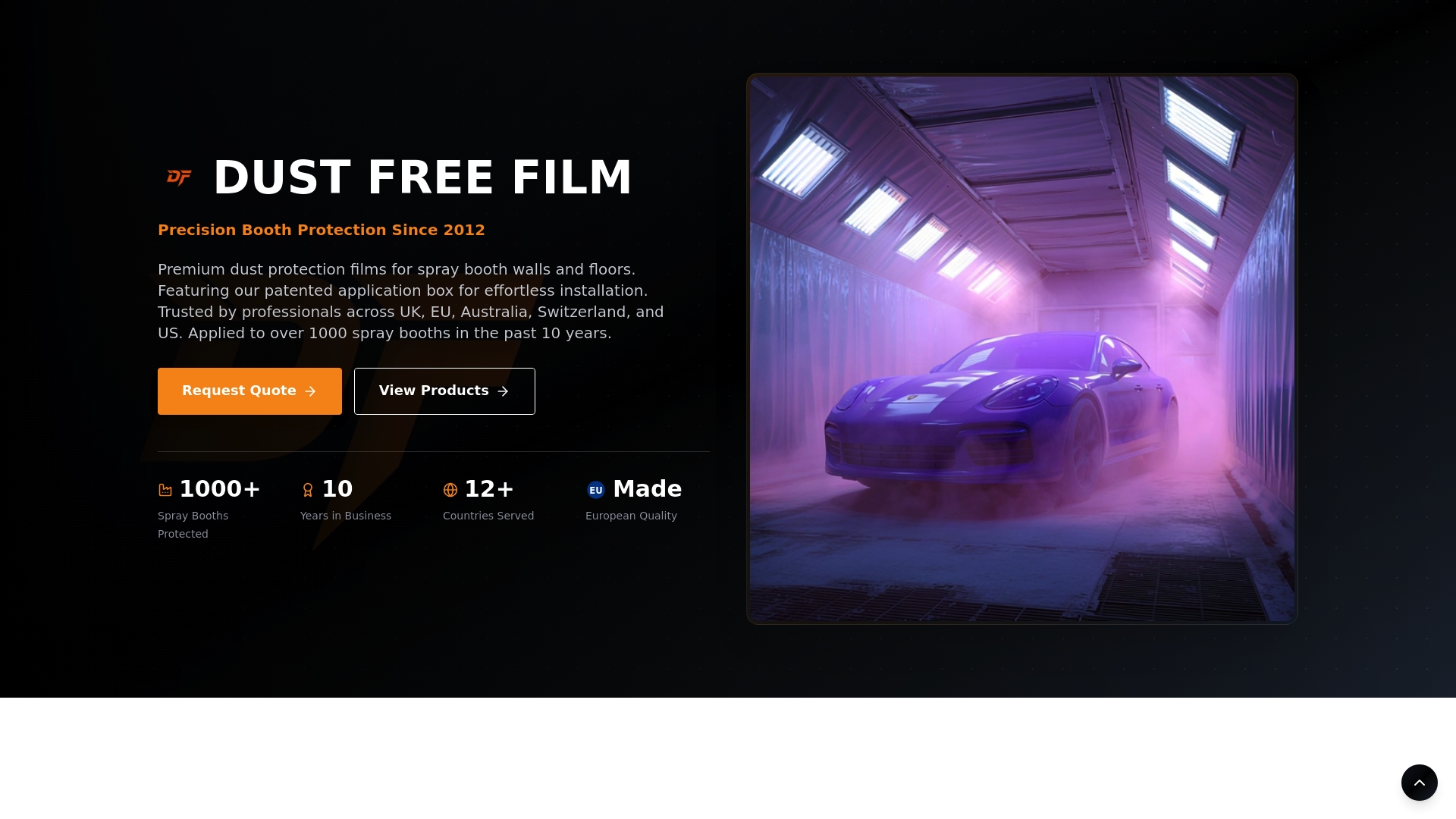
Dustfreefilm has been designing and manufacturing premium multi-layer booth wall protectors since 2012, built specifically for the demands of automotive refinishing and industrial painting environments. Their films are heat-resistant to 200°F, static-free, and engineered for bubble-free application through a patented dispenser system that gets one operator through a full booth perimeter in under 10 minutes.
Every product in the Dustfreefilm line is built to European manufacturing standards, with options for custom configurations and bulk purchasing that support large-scale facility operations. If you are looking to reduce cleaning labor, protect booth surfaces, and improve paint quality consistency, explore the booth wall protector options on the Dustfreefilm website. Their team supports customers through product selection, application guidance, and ongoing operational questions.
Visit dustfreefilm.com to review specifications and find the right solution for your booth setup.
FAQ
What are the main benefits of booth wall protectors?
Booth wall protectors reduce maintenance time, preserve lighting quality, prevent surface degradation, and lower cleaning costs. Multi-layer films also support lean production by converting maintenance into a quick, scheduled peel rather than an extended cleaning event.
How do wall protectors help with paint quality?
Protective films prevent overspray from bonding to booth surfaces, which keeps walls reflective and reduces airborne contamination during painting. Cleaner wall surfaces directly lower defect rates and rework frequency.
How long does it take to apply booth wall protection film?
A single operator can apply full-perimeter protection in approximately 10 minutes using a quality dispenser system, which is significantly faster than traditional masking or post-job chemical cleaning.
Do booth wall protectors work at high curing temperatures?
Yes, provided you use films rated for the job. High-performance protective films resist temperatures up to 200°F without bubbling or releasing contaminants, making them safe for use through full bake cycles.
How often should you replace booth wall protection film?
Replacement frequency depends on job volume and overspray load, but facilities using numbered layer tracking systems can schedule peel cycles proactively based on layer count rather than waiting for visual degradation.