

TL;DR:
- Proper ventilation, electrical safety, and fire suppression are essential for spray booth safety.
- Safe chemical storage and PPE compliance prevent accidents and ensure product quality.
- Building operational discipline and using protective surface barriers enhance overall spray booth safety.
Running a high-output spray booth means managing two competing pressures at once: keeping your finishes flawless and keeping your team safe. Dust contamination, flammable vapors, and ignition risks don’t take turns. They show up together, and when any one of them goes unchecked, you pay for it in rework, downtime, or worse. This guide covers the six most critical areas of spray booth safety for facility managers in automotive and industrial settings: ventilation, electrical controls, fire suppression, chemical storage, physical barriers, and PPE. Follow these evidence-based strategies and you’ll protect both your people and your product quality.
Table of Contents
- Maintain proper ventilation and airflow rates
- Use explosion-proof equipment and electrical safety controls
- Implement fire suppression and emergency response systems
- Manage chemical and flammable material storage safely
- Physical barriers and personal protective equipment (PPE) essentials
- A smarter approach: Beyond compliance for true paint booth safety
- Upgrade your paint booth’s safety and dust control
- Frequently asked questions
Key Takeaways
| Point | Details |
|---|---|
| Ventilation is vital | Proper airflow removes hazardous vapors and dust, dramatically lowering fire and health risks. |
| Eliminate ignition sources | Explosion-proof equipment and static control prevent dangerous incidents overlooked in routine work. |
| Store chemicals safely | Keeping flammables outside the booth and limiting supply reduces the chance of costly fires. |
| Use PPE and barriers | Personal protective equipment and physical partitioning safeguard workers and keep product finishes pristine. |
| Culture beats compliance | A proactive safety culture addresses what rules cannot, making booths truly safe and efficient every day. |
Maintain proper ventilation and airflow rates
Ventilation is the foundation of every safe, high-quality spray booth operation. Without adequate airflow, solvent vapors accumulate, overspray settles on surfaces, and the risk of explosion climbs fast. Getting airflow right is not optional. It’s the single most effective control you have.
Different booth configurations require different minimum velocities. According to ventilation airflow requirements, you must maintain these minimums:
| Booth type | Minimum airflow velocity |
|---|---|
| Open-face booth | 100 fpm (feet per minute) |
| Crossdraft booth | 150 fpm face velocity |
| Downdraft booth | 100 fpm face velocity |
These rates exist to capture overspray and keep vapor concentrations below the lower explosive limit (LEL), which is the minimum concentration at which a vapor can ignite. Falling below these numbers even briefly creates a hazardous window.
Beyond hitting the minimums, you need a consistent maintenance schedule to keep airflow performing reliably:
- Inspect and replace intake and exhaust filters on a schedule tied to actual booth usage, not just the calendar
- Check fan belts, bearings, and motor mounts monthly for wear
- Use a calibrated anemometer (an airflow measuring device) to verify face velocity at least quarterly
- Clean exhaust plenum walls to prevent filter-bypassing buildup
- Log every measurement and maintenance action for regulatory audits
Good paint booth cleanliness directly supports airflow performance. Clogged filters and dirty walls force your ventilation system to work harder and deliver less. Keeping surfaces clean isn’t just about finish quality. It’s a safety issue.
Monitoring spray booth air quality with continuous sensors gives you real-time data instead of relying on scheduled checks alone. When vapor levels spike unexpectedly, you want an alert, not a surprise.
Pro Tip: Run weekly interlock tests to confirm your booth won’t allow spraying when airflow drops below the safe threshold. A failed interlock that goes undetected is one of the most common root causes of vapor-related incidents.
Use explosion-proof equipment and electrical safety controls
Good airflow addresses many hazards, but ignition prevention through electrical safety is just as critical. Every electrical component inside a spray booth is a potential ignition source unless it is specifically rated for that environment.
NFPA 33, the national standard for spray application of flammable materials, requires all electrical equipment inside booths to meet Class I, Division 1 ratings. This means the components are designed to contain any internal ignition and prevent sparks from reaching the surrounding atmosphere. The required controls include:
- Explosion-proof lighting fixtures with sealed housings
- Intrinsically safe switches and controls that cannot generate sparks
- Properly grounded spray guns, hangers, and conveyor systems
- Bonding cables connecting all conductive components to a common ground
- Static control devices on all fluid lines carrying flammable coatings
Static electricity is a risk that many facilities underestimate. Explosion-proof equipment details confirm that overspray particles in motion can generate static charges even when no obvious ignition source is present. A single ungrounded metal part can accumulate enough charge to ignite a vapor cloud.
“The most dangerous ignition sources in spray booths are the ones nobody is watching. Static buildup from overspray particles is invisible, silent, and entirely preventable with proper grounding and bonding.” — Industrial safety consultant
Integrating contamination prevention steps into your electrical safety routine also pays dividends. Contaminated surfaces can interfere with grounding connections and increase static risk over time.
Pro Tip: Install continuous VOC (volatile organic compound) sensors that trigger real-time alerts before vapor concentrations approach hazardous levels. Don’t wait for a scheduled air quality check to find out you have a problem.
Implement fire suppression and emergency response systems
Electrical safeguards are vital, but comprehensive protection also depends on ready-to-activate fire suppression systems. Even with perfect ventilation and grounding, fires can start. Your suppression system is what keeps a small incident from becoming a catastrophic loss.
NFPA 33 mandates that fire suppression requirements be met with automatic systems that activate without human intervention. Here’s how the main system types compare:
| System type | Best use case | Key consideration |
|---|---|---|
| CO2 suppression | Enclosed booths, clean agent | Displaces oxygen, not safe for occupied spaces |
| Dry chemical | High-risk areas, fast suppression | Leaves residue, requires cleanup after activation |
| Wet sprinkler | Larger facilities, general coverage | Water damage risk to finishes and equipment |
Choosing the right system depends on your booth size, occupancy, and the coatings you use. What matters most is that the system is installed, tested, and documented.
Here is a step-by-step approach to keeping your fire suppression system ready:
- Inspect all nozzles, agent containers, and detection heads monthly for physical damage or blockage
- Test alarm and activation signals quarterly with your fire protection contractor
- Verify automatic shutoff connections to ventilation and electrical systems during each test
- Document every inspection and test in a dedicated logbook kept on-site
- Schedule annual third-party certification to meet insurance and regulatory requirements
Facilities with tested, compliant suppression systems see dramatically lower losses when incidents occur. The investment in spray booth cleaning and system maintenance is small compared to the cost of a single uncontrolled fire event.
Manage chemical and flammable material storage safely
Fire suppression limits the damage, but safe chemical storage is your next line of defense against preventable incidents. The way your team handles and stores coatings, thinners, and solvents determines how much fuel is available if something goes wrong.
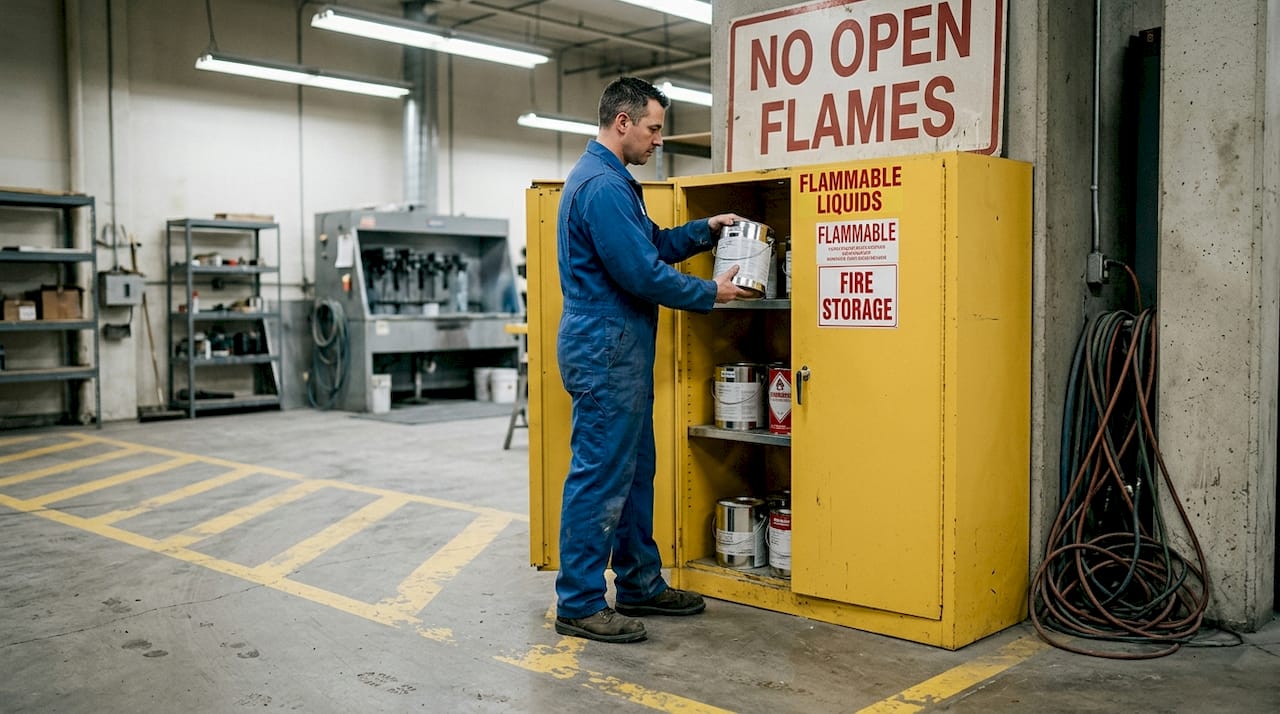
The rule is simple and non-negotiable: no flammable storage inside the booth. Only bring in what you need for a single shift, and never mix coatings inside the spray area. Here are the core storage practices every facility should follow:
- Store all flammable liquids in approved safety cans with self-closing lids and flame arrestors
- Keep bulk storage in a dedicated, ventilated flammable storage cabinet outside the booth
- Segregate incompatible chemicals (oxidizers away from solvents) to prevent reactive hazards
- Limit the quantity of coating material near the booth to one shift’s worth of supply
- Never leave open containers unattended inside or near the spray area
- Dispose of solvent-soaked rags in sealed, metal waste containers emptied daily
Maintaining a spray booth efficiency mindset also means keeping the area around your booth clear. Most spray booth fires trace back to improper chemical handling or storage, not equipment failure. A three-foot clearance zone around the booth perimeter, enforced consistently, reduces the chance that a spill or vapor release finds an ignition source.
When your workflow requires mixing stations near the spray area, use physical partitions rated for flammable environments and ensure that mixing areas have their own ventilation.
Physical barriers and personal protective equipment (PPE) essentials
Once chemical and fire risks are controlled, spatial barriers and the right PPE help protect both workers and product finishes. These two elements work together: barriers keep hazards contained, and PPE protects the operator when barriers aren’t enough.
Here are the key practices every spray booth operator and facility manager should enforce:
- Maintain a 3-foot clearance around the booth from other operations, or install rated partitions where space is limited
- Require fit-tested respirators for all operators. Half-face respirators with organic vapor cartridges are the minimum. Full-face units are better for high-output environments
- Specify anti-static footwear for all personnel entering the booth. Standard rubber-soled shoes can accumulate static charge that transfers to grounded surfaces
- Require chemical-resistant gloves and coveralls to prevent skin absorption of solvents
- Use splash-rated safety goggles, not just safety glasses, when spraying at any angle above waist height
- Post clear signage at booth entry points listing all required PPE requirements before entry
“In every near-miss we’ve reviewed, PPE compliance was the variable that separated a minor incident from a serious injury. The equipment works when it’s worn correctly and consistently.” — Occupational safety officer
Anti-static PPE is particularly important in booths where dust control methods rely on electrostatic film and grounded surfaces. A worker with charged footwear can disrupt the static balance of a carefully controlled environment.
Pro Tip: Fit test respirators at least annually and after any significant change in facial structure (weight change, dental work). A poorly fitting respirator provides almost no protection regardless of its rating.
A smarter approach: Beyond compliance for true paint booth safety
Regulatory compliance gives you a baseline. It tells you the minimum you must do to avoid a citation. But in our experience working with automotive and industrial facilities since 2012, the shops with the best safety records don’t just meet the standards. They build safety into the daily rhythm of the operation.
The most common pattern we see before a serious incident is not a single catastrophic failure. It’s a series of small, tolerated shortcuts. A filter change skipped because production was behind. A grounding cable left disconnected after a booth reconfiguration. PPE worn incorrectly because nobody said anything.
The fix is operational discipline, not more paperwork. Engage your operators in regular walkarounds and make them co-owners of the standard operating procedures (SOPs). When the people doing the work help write the rules, they follow them. Review your booth maintenance workflow with your team quarterly and update it based on what they actually encounter.
Pro Tip: Schedule unannounced airflow and PPE checks at least once a month. Accountability improves dramatically when the team knows inspections aren’t always predictable.
Upgrade your paint booth’s safety and dust control
Building a safer, cleaner spray booth doesn’t stop at ventilation and PPE. Physical surface protection is the layer that ties everything together, keeping walls and floors free of overspray buildup that degrades air quality, creates fire fuel, and contaminates fresh finishes.

Dust Free Film solutions are engineered specifically for automotive and industrial spray environments. Our multi-layer, heat-resistant, static-free booth films install quickly with our patented dispenser system and peel away cleanly, taking contamination with them. Integrating our wall and floor protectors into your existing safety program means less time cleaning, fewer contamination defects, and a booth that stays compliant between deep cleans. Ready to see what the right protection can do for your operation? Request a quote and we’ll configure a solution for your booth size and throughput.
Frequently asked questions
What are the minimum ventilation requirements for an industrial paint booth?
Open-face booths require 100 fpm minimum, crossdraft booths need 150 fpm, and downdraft booths need 100 fpm face velocity to safely capture overspray and keep vapors below the lower explosive limit.
Do I need explosion-proof lighting and wiring in my spray booth?
Yes. NFPA 33 requires all electrical components inside spray booths to be explosion-proof, properly grounded, and bonded to eliminate static ignition risks.
How often should fire suppression systems be tested in spray booths?
Automatic fire suppression systems must be tested regularly per NFPA 33, with monthly physical inspections, quarterly activation tests, and annual third-party certification recommended.
Can flammable liquids be stored inside the spray area?
No. Flammable liquids cannot be stored inside booths. Only a single shift’s supply may be kept nearby, and all mixing must happen outside the spray area.
What PPE is required for spray booth operators?
Operators must wear fit-tested respirators, anti-static footwear, splash-rated goggles, and chemical-resistant gloves and coveralls at all times during spray operations.