

TL;DR:
- Consistent spray technique, proper environmental controls, and surface protection are essential for flawless finishes.
- Managing viscosity, temperature, and paint ratio scientifically improves adhesion, durability, and appearance.
- Integrating digital tools and protective films enhances efficiency, reduces rework, and maintains high-quality results.
Flawless paint finishes define a shop’s reputation. One dust particle trapped under clearcoat can mean an expensive redo, a dissatisfied customer, and lost referrals. For auto body shop owners and facility managers, spray booth performance is not just a quality issue — it is a business issue. The tips in this article move beyond generic advice and cover technique calibration, paint chemistry, environmental controls, and surface protection strategies that professional finishers use to consistently hit a perfect result. Whether you are running one booth or ten, these methods are built for your environment.
Table of Contents
- Optimize your spray technique for flawless results
- Control paint viscosity and environmental temperature
- Adjust your paint and thinner ratio for maximum adhesion
- Utilize digital tools and protective films for efficiency gains
- What most finish improvement guides overlook
- Ready to elevate your paint finish results?
- Frequently asked questions
Key Takeaways
| Point | Details |
|---|---|
| Master spray technique | Precise distance, overlap, and speed lead to smoother, defect-free finishes. |
| Control viscosity and temperature | Adjusting paint consistency and booth heat prevents roughness and uneven surfaces. |
| Optimize paint mixture | The right paint-to-thinner ratio maximizes adhesion and surface hardness for durability. |
| Leverage automation | Digital tools and protective films cut labor costs and rework while enhancing finish consistency. |
| Integrate strategies system-wide | Combining methodical technique, environmental control, and technology delivers real improvements. |
Optimize your spray technique for flawless results
Every defect-free finish starts with disciplined spray technique. The physics of atomization, distance, and overlap are not optional variables — they are the foundation. When paint finish quality factors are ignored at the application stage, no amount of prep or protection will compensate.
The most common mistakes in auto body spray booths come down to three things: wrong distance, inconsistent speed, and poor overlap. These errors show up as orange peel texture, mottling, or dry spray. The good news is that each one is fully preventable with consistent practice and a structured calibration routine.
Here is what optimal spray technique requires for consistent, defect-free results:
- Distance: Maintain 6 to 8 inches between gun tip and panel surface for uniform atomization and coverage
- Overlap: Use a 50% overlap on each pass to eliminate missed spots and reduce dry edges
- Speed and angle: Keep gun movement steady and perpendicular to the surface — rushing creates orange peel, slowing down risks runs
- Coat thickness: Apply thin coats and allow proper flash time between each layer to prevent solvent entrapment
- Gun settings: Adjust fluid, air cap, and fan width to match the specific product and temperature conditions each session
Flash time is often underestimated. Spraying the next coat too early traps solvents beneath the surface, leading to bubbling or adhesion loss later. Most basecoats need at least 5 to 10 minutes of flash between coats depending on booth temperature.
“Thin coats with proper flash time prevent solvent entrapment and are critical for producing smooth, defect-free automotive finishes at any production volume.”
Pro Tip: Before applying product to a vehicle, always spray a quick test panel from the same batch. This lets you verify atomization quality, fan pattern consistency, and fluid delivery before touching the actual job.
For shops looking to tighten their process further, a well-organized spray booth setup guide covers airflow, lighting, and gun positioning standards that support a repeatable technique.
Control paint viscosity and environmental temperature
Once technique is mastered, refining the paint’s physical properties and the environment around it unlocks further gains. Viscosity and temperature are two variables that most painters adjust by feel — but there is hard science behind why precision here matters more than intuition.
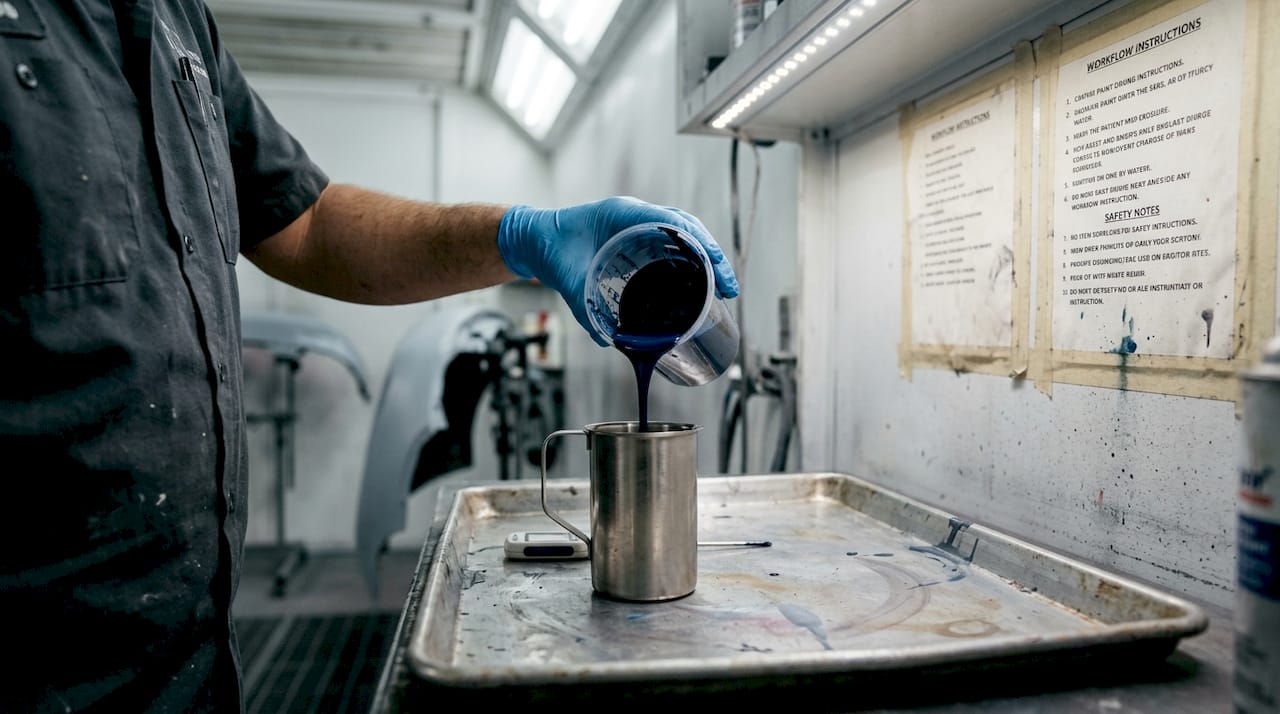
Viscosity describes how thick or thin a paint flows through the gun. Too thick and you get poor atomization, heavy texture, and uneven film build. Too thin and the coating sags, loses adhesion, and dries with an uneven surface. Viscosity and temperature are primary factors for achieving uniform thickness, with research showing a correlation coefficient of R²=0.97 between these variables and film thickness consistency.
Booth temperature has an equally direct effect. Low temperatures slow solvent evaporation, leaving the surface tacky and prone to contamination. High temperatures can flash the surface before solvents fully escape, trapping them inside the film. Environmental factors like humidity, airflow velocity, and ambient heat all feed into the final surface quality.
Here are the key variables to manage with every batch:
- Target booth temperature: Between 65°F and 75°F for most solventborne and waterborne systems
- Relative humidity: Keep below 65% to avoid blushing on waterborne coatings
- Viscosity check: Always measure with a calibrated viscosity cup before application, not by eye
- Product temperature: Let paint reach booth temperature before mixing — cold paint sprays differently than warm paint
| Coating type | Recommended viscosity (cP) | Optimal temperature (°F) |
|---|---|---|
| Waterborne basecoat | 80 to 120 | 68 to 75 |
| Solventborne basecoat | 100 to 150 | 65 to 72 |
| 2K clearcoat | 150 to 200 | 68 to 77 |
| Primer surfacer | 200 to 300 | 65 to 75 |
Pro Tip: Keep a viscosity cup and a digital thermometer mounted in your booth and use both before every job. Spray speed itself also matters here — faster gun movement increases film roughness while slower movement risks runs, so match your speed to the viscosity of each product.
Adjust your paint and thinner ratio for maximum adhesion
With viscosity and temperature handled, the correct paint mix is your next variable for a flawless finish. Thinning ratios affect everything from film build and gloss to adhesion strength and long-term hardness. This is one area where guesswork genuinely costs money.
Research published in the Journal of Mechanical Engineering quantified exactly what happens when you vary the paint:thinner ratio. At a 100:130 ratio, results showed peak adhesion at the 5B level (the highest score on the cross-cut adhesion scale) and a surface hardness of 88.77 HD. As excess thinner is added beyond the optimal point, both adhesion and hardness drop measurably.
Here is why this matters operationally:
- Excess thinner reduces dry film hardness, making the finish more vulnerable to scratching and chipping
- Under-thinned paint creates application problems like poor atomization, heavy orange peel, and uneven film build
- Optimal ratio gives the right flow, proper leveling, and maximum crosslink density once cured
- Consistency across batches is critical — even a 5 to 10 point deviation in ratio can shift finish quality noticeably
| Paint:thinner ratio | Adhesion rating | Surface hardness (HD) | Finish quality |
|---|---|---|---|
| 100:100 | 3B | 72.4 | Acceptable |
| 100:115 | 4B | 80.1 | Good |
| 100:130 | 5B | 88.77 | Optimal |
| 100:145 | 3B | 68.3 | Reduced |
| 100:160 | 2B | 61.5 | Poor |
A well-documented spray booth maintenance workflow includes standardized mixing logs so technicians stay consistent across shifts, across seasons, and across product changes. Building mix verification into your standard process removes the human error factor entirely.
Key takeaway: The 100:130 ratio is not a suggestion — it is a scientifically validated target. Documenting your ratios and training technicians to measure rather than estimate is one of the simplest changes that produces an immediate, measurable improvement in finish durability.
Utilize digital tools and protective films for efficiency gains
Advanced finish improvements now shift from manual control to strategic shop upgrades and technology. The best technique in the world still produces rework if your booth environment allows dust in or your workflow wastes time between stages.
Digital tools and robotics can reduce non-value time by 12.5% and cut operator count by 18.8% in production painting lines, according to published research. That is a significant operational gain for any shop managing multiple jobs simultaneously. Understanding spray booth efficiency at a systems level is what separates high-output shops from average ones.
Top efficiency-boosting digital tools for auto body spray operations:
- Value stream mapping (VSM) software — identifies non-productive time between process steps and shows exactly where your workflow loses minutes per job
- Robotic spray arms — deliver consistent gun speed, distance, and overlap without fatigue-related variation across long production runs
- Automated cure monitoring — tracks booth temperature and humidity in real time, alerting technicians before conditions fall outside specification
- Digital viscosity meters — replace manual cups with instant, repeatable readings logged by batch for quality traceability
- Booth management systems — control airflow, temperature, and lighting zones from a single interface, reducing setup time between jobs
Protective films add a physical layer of defense that digital tools cannot replace. The benefits of spray booth films include dust capture, overspray containment, and dramatically reduced cleaning time between cycles. Their role in protective film quality control is underappreciated until you see the rework reduction numbers.
Benefits of using multi-layer electrostatic protective films in your booth:
- Capture airborne dust before it settles on freshly applied paint
- Prevent cross-contamination between jobs by peeling off contaminated layers
- Reduce booth cleaning time by up to 60% compared to manual wiping methods
- Static-free construction stops films from attracting new dust after installation
- Heat resistance ensures performance throughout baking cycles
A documented surface protection process that integrates protective films into daily workflow can cut rework by 25%. That is not a marginal improvement — it is a direct reduction in material waste, labor hours, and job cycle time.
Pro Tip: Integrate VSM software into your shop’s quarterly review process. Map every minute from job intake to delivery, identify the top three time wasters, and target one improvement per quarter.
What most finish improvement guides overlook
Most published guides treat finish quality as a collection of separate variables: fix your spray distance, check your temperature, choose the right thinner. Each tip is presented as a standalone fix. The problem is that finish quality is not a sum of parts — it is the product of a system.
When technique, chemistry, environmental control, and surface protection work together, each element amplifies the others. Perfect viscosity only helps if your booth temperature is right. Optimal thinning ratios only stick if your surface preparation and environment are clean. Protective films only deliver their full value when airflow and technique are already optimized. The interaction between these factors is what dust prevention best practices in leading shops are built around.
The shops that consistently produce superior finishes are not guessing. They have built connected systems where every variable is documented, measured, and reviewed. They do not wait for a defect to diagnose the cause. They manage every link in the finish chain proactively, from the moment product is mixed to the moment the vehicle rolls out. That mindset, more than any single tip, is what separates the best shops from the rest.
Ready to elevate your paint finish results?
The strategies in this article are proven, but implementing them consistently requires the right physical environment. Protective films are one of the most direct upgrades you can make to your spray booth today.
At Dust Free Film, we manufacture multi-layer electrostatic booth protection films built for demanding auto body environments. Our patented dispenser system makes installation fast and bubble-free, so your crew spends time finishing cars, not cleaning booths. Explore our full range of dust-free film solutions or request a quote to find the configuration that fits your booth size, production volume, and quality targets. Your next flawless finish starts with a cleaner environment.
Frequently asked questions
What spray technique prevents orange peel?
Spray at a 6-8 inch distance with 50% overlap, keeping gun speed and angle consistent, and apply thin coats with full flash time between each layer to avoid orange peel texture.
How does temperature affect paint finish?
Booth temperature directly controls solvent evaporation speed and surface roughness; staying within the recommended temperature range for your coating type produces smoother, more durable finishes with fewer defects.
What is the best paint:thinner ratio for adhesion?
The optimal 100:130 ratio yields the highest adhesion rating (5B) and surface hardness (88.77 HD), giving you maximum durability and a smooth, lasting finish.
Can automation improve paint finish consistency?
Digital tools and robotics eliminate the variability introduced by manual application, automating spray speed, distance, and workflow timing to produce consistent results across every job and every shift.