

Achieving flawless paint finishes demands pristine spray booth air quality, yet many operators struggle with contamination, turbulence, and filter issues that compromise results. Poor air quality introduces defects like orange peel, fisheyes, and dust nibs that waste time and materials. This guide examines proven methods to assess and enhance air flow, filtration, and contamination control in your spray booth. You’ll discover practical strategies to optimize booth performance, reduce finish defects, and maintain consistent quality across every job. Whether you manage an automotive body shop or industrial painting facility, these techniques deliver measurable improvements in air quality and finish outcomes.
Table of Contents
- How To Assess And Maintain Airflow For Optimal Spray Booth Air Quality
- Choosing And Maintaining Filters For Cleaner Spray Booth Air
- Contamination Control: Reducing Dust And Debris Inside Spray Booths
- Comparing Spray Booth Air Quality Improvement Methods For Effective Decision-Making
- Enhance Your Spray Booth’s Air Quality With Dust Free Film
Key takeaways
| Point | Details |
|---|---|
| Filter management drives quality | Regular inspection and proper loading prevent turbulence and maintain clean air flow |
| Airflow testing reveals problems | Empty booth testing identifies eddies and turbulence before they ruin finishes |
| Contamination control protects finishes | Strategic cleaning and entry procedures minimize dust introduction |
| Integrated approach works best | Combining airflow, filtration, and contamination methods delivers optimal results |
How to assess and maintain airflow for optimal spray booth air quality
Airflow forms the foundation of spray booth performance. Clear, laminar air flow carries overspray away from the work surface and prevents contaminants from settling on wet paint. When filters become clogged or improperly loaded, turbulence and eddies form that disrupt this critical air movement and introduce finish defects.
Testing your booth while empty provides the most accurate assessment of airflow patterns. This worst-case scenario reveals turbulence issues before adding vehicles or parts that further complicate air movement. Use smoke sticks or theatrical fog to visualize flow patterns, watching for swirling motions or dead spots where air stagnates. These problem areas trap contaminants and create conditions for finish defects.
Inspecting and clearing airflow paths requires systematic attention to several key areas:
- Check intake filters for dust accumulation and proper seating
- Examine exhaust filters for blockages or damage
- Verify plenum chambers remain free of debris
- Confirm all access panels seal properly
- Test air velocity at multiple booth locations
Balancing intake and exhaust volumes ensures proper booth pressurization. Negative pressure pulls unfiltered air through gaps and seams, introducing contamination. Positive pressure pushes filtered air outward, maintaining cleaner conditions inside the booth. Measure air velocity at intake and exhaust points, adjusting dampers to achieve manufacturer-specified balance.
Pro Tip: Schedule airflow measurements monthly to detect declining performance before it affects finish quality. Keep a log of velocity readings at fixed locations to track trends over time.
Regular spray booth maintenance prevents gradual performance degradation. Small changes in filter resistance or seal integrity compound over weeks, eventually creating significant air quality problems that impact every job. Catching these issues early through systematic testing saves money and preserves your reputation for quality work.
Choosing and maintaining filters for cleaner spray booth air
Filters remove particulates from incoming and recirculating air, directly determining booth air cleanliness. Selecting appropriate filter types and maintaining them properly prevents the turbulence and contamination that compromise paint finishes. Understanding filter options helps you balance efficiency, cost, and maintenance requirements.
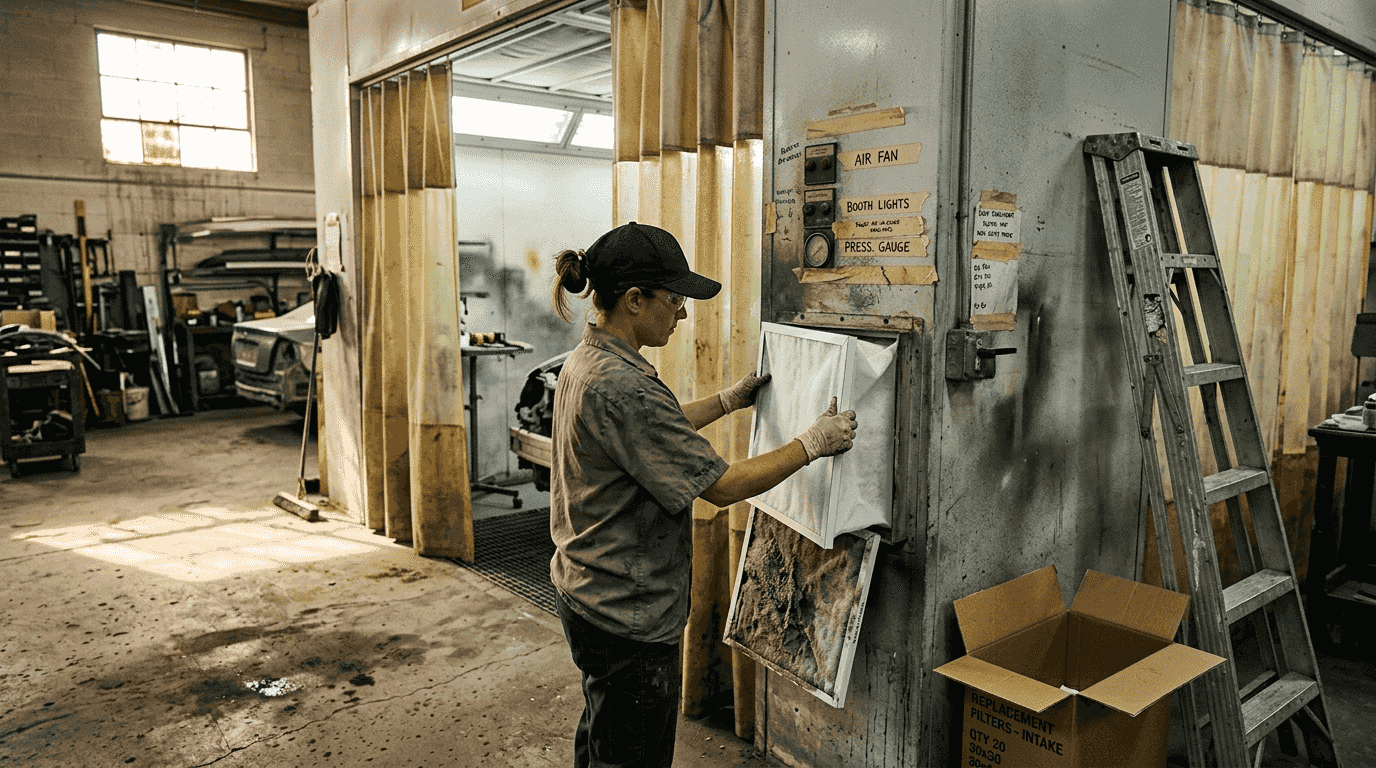
Spray booths typically use three filter types. Intake filters clean outside air entering the booth, removing dust, pollen, and industrial particulates. Exhaust filters capture overspray before air exits to the environment, protecting workers and meeting environmental regulations. Recirculation filters clean air in downdraft or crossdraft systems, removing particles before air contacts the work surface again.
| Filter Type | Efficiency Rating | Typical Lifespan | Cost Range | Best Application |
|---|---|---|---|---|
| Fiberglass intake | 85-90% | 3-4 months | Low | Light duty automotive |
| Pleated synthetic intake | 92-95% | 4-6 months | Medium | High volume operations |
| HEPA intake | 99.97% | 6-12 months | High | Industrial precision work |
| Cardboard exhaust | 98% overspray | 2-3 months | Low | Standard automotive |
| Fiberglass exhaust | 99% overspray | 3-4 months | Medium | Heavy industrial use |
Loading filters correctly prevents airflow disruption and maintains designed performance. Follow these steps for proper installation:
- Remove old filters completely, checking frames for damage
- Clean filter frames and sealing surfaces thoroughly
- Inspect new filters for tears or manufacturing defects
- Position filters with airflow direction arrows correctly oriented
- Secure filters evenly to prevent bypass gaps
- Test booth immediately after installation to verify proper flow
Replacement frequency depends on usage intensity and environmental conditions. High volume shops in dusty locations need more frequent changes than occasional users in clean environments. Monitor pressure drop across filters using a manometer, replacing filters when resistance exceeds manufacturer specifications. Visual inspection catches obvious problems, but pressure measurement provides objective data for scheduling replacements.
Proper filter maintenance extends beyond simple replacement. Inspect filter housings for air leaks around seals and gaskets. Check for filter frame warping that creates bypass gaps. Verify filter media remains intact without tears or separation. These details matter because even small amounts of unfiltered air introduce enough contamination to cause finish defects.
Integrating dust-free maintenance practices with filter management creates comprehensive protection. The 2026 maintenance approach emphasizes preventive inspection and data-driven replacement scheduling rather than reactive repairs after problems appear. This strategy optimizes booth efficiency while reducing downtime and material waste from contaminated finishes.
Contamination control: reducing dust and debris inside spray booths
Even perfectly maintained filters cannot eliminate contamination introduced directly into the booth environment. Personnel, equipment, and poor housekeeping practices bring dust and debris that settle on wet paint or become airborne during spraying. Strategic contamination control measures address these sources at their origin.
Contamination enters spray booths through several pathways. Workers carry dust on clothing, shoes, and skin. Tools and equipment accumulate particles in storage areas. Opened doors allow unfiltered air infiltration. The booth structure itself generates dust as protective coatings degrade or surfaces deteriorate. Identifying and controlling each source requires systematic attention.
Effective cleaning schedules prevent dust accumulation before it becomes airborne. Implement these practices:
- Vacuum booth walls and floors daily using HEPA-filtered equipment
- Wipe down all horizontal surfaces before each paint job
- Clean light fixtures and ventilation grilles weekly
- Pressure wash booth floors monthly to remove embedded particles
- Inspect and clean air plenums quarterly
Protective materials limit contamination from booth surfaces. Wall and floor coverings trap particles that would otherwise become airborne as paint overspray accumulates and dries. These barriers also simplify cleaning by providing smooth, non-porous surfaces that release dust easily. Replacing degraded coverings eliminates a major contamination source.
Booth entry procedures create a critical control point for contamination. Establish clear protocols:
- Require lint-free spray suits changed inside a clean anteroom
- Use dedicated booth shoes that never leave the painting area
- Install tack mats at entry points to capture shoe-borne particles
- Prohibit cardboard boxes and other particle-shedding materials
- Limit booth access to essential personnel only
Pro Tip: Implement an air shower at the booth entrance to remove loose particles from clothing and equipment before entry. This simple addition dramatically reduces contamination introduction.
Personal hygiene affects air quality more than many operators realize. Skin flakes, hair, and clothing fibers become airborne during movement and settle on wet finishes. Requiring complete coverage with spray suits, hoods, and gloves minimizes these biological contaminants. Regular laundering of spray suits in lint-free cycles maintains their protective effectiveness.
Dust reduction strategies work synergistically with filtration and airflow management. The most sophisticated ventilation system cannot compensate for poor contamination control practices. Conversely, meticulous cleaning efforts show limited results when filters fail or airflow patterns create turbulence. Comprehensive cleaning best practices address all contamination sources simultaneously for maximum effectiveness.
Comparing spray booth air quality improvement methods for effective decision-making
Choosing which improvements to prioritize requires understanding the relative impact, cost, and maintenance demands of each approach. This comparison helps you allocate resources effectively based on your operation’s specific needs and constraints.
| Improvement Method | Implementation Cost | Maintenance Frequency | Impact on Finish Quality | Ease of Implementation |
|---|---|---|---|---|
| Airflow testing and adjustment | Low to medium | Monthly | High | Medium |
| Filter upgrades and maintenance | Medium | Every 3-6 months | Very high | Easy |
| Contamination control protocols | Low | Daily to weekly | High | Medium |
| Surface protection installation | Medium | As needed | Medium to high | Easy |
| Booth structural repairs | High | Annually | Medium | Difficult |
Budget-conscious operations should prioritize filter maintenance and contamination control protocols. These methods deliver substantial improvements with modest investment and can be implemented using existing staff. Regular filter changes prevent the cascading problems that result from restricted airflow, while systematic cleaning addresses contamination at its source.
Performance-focused facilities benefit from comprehensive approaches combining all improvement methods. Industrial spray booth setups designed for maximum quality integrate advanced filtration, optimized airflow patterns, and rigorous contamination control from the start. These 2026 setup strategies reflect current best practices for achieving consistent, defect-free finishes.
The most effective approach combines multiple methods rather than relying on a single solution. Excellent filters cannot overcome poor airflow patterns. Pristine airflow loses effectiveness when contamination enters through inadequate entry controls. Integrated strategies address all air quality factors simultaneously, creating conditions where each improvement reinforces the others.
Return on investment varies by baseline conditions. Booths with severely degraded performance see dramatic improvements from basic filter maintenance and cleaning. Well-maintained facilities require more sophisticated interventions like airflow optimization or advanced filtration to achieve incremental gains. Assess your current state honestly to target improvements where they will deliver maximum benefit.
Enhance your spray booth’s air quality with Dust Free Film
Surface protection plays a crucial role in maintaining spray booth air quality by preventing contamination from degraded walls and floors. Dust Free Film offers premium protective films specifically engineered for automotive and industrial spray booth applications. Our multi-layer electrostatic films create smooth, static-free barriers that trap particles and simplify cleaning.

Our patented dispenser system enables quick, bubble-free installation that minimizes downtime. Heat-resistant formulations withstand spray booth operating temperatures while maintaining adhesion and protective properties. Whether you need wall protection, floor coverage, or complete booth enclosure, our European-manufactured films deliver durability and performance for high-volume operations. Visit Dust Free Film to explore our complete product range or request a quote for customized solutions that complement your air quality improvement efforts.
FAQ
What are the most common causes of poor spray booth air quality?
Clogged filters create the most frequent air quality problems by restricting flow and causing turbulence. Incorrect filter loading allows bypass gaps where unfiltered air enters the booth. Dust infiltration from personnel clothing and inadequate cleaning accumulates on surfaces and becomes airborne during spraying. Insufficient airflow velocity fails to capture overspray effectively, allowing it to settle on wet finishes.
How often should spray booth filters be changed to maintain air quality?
Filter replacement frequency depends on usage intensity and environmental dust levels, typically ranging from three to six months for most operations. High-volume shops in dusty locations may need monthly changes, while occasional users in clean environments extend intervals to six months or longer. Monitor pressure drop across filters using a manometer rather than relying solely on calendar schedules. Replace filters when resistance exceeds manufacturer specifications, even if the scheduled interval has not elapsed. Refer to our maintenance guide for detailed replacement procedures.
Can using surface protection films reduce spray booth dust contamination?
Yes, protective films significantly reduce dust contamination by covering degraded booth surfaces that shed particles. As paint overspray accumulates on booth walls and floors, it dries and cracks, releasing dust into the air during subsequent jobs. Films create smooth, non-porous barriers that prevent this particle generation while simplifying cleaning. They complement filtration and airflow improvements by addressing contamination at its source. Explore spray booth protection options to find solutions matching your facility requirements.
What is the best way to test airflow and turbulence in a spray booth?
Perform airflow tests with the booth empty to identify turbulence and eddies in worst-case conditions. Use theatrical smoke or smoke sticks to visualize air movement patterns, watching for swirling motions or stagnant areas. Measure air velocity at multiple locations using a hot-wire anemometer or vane anemometer, comparing readings to manufacturer specifications. Document problem areas and adjust filter loading, damper settings, or booth configuration to achieve smooth, laminar flow. Review our maintenance guide for comprehensive airflow testing procedures and troubleshooting strategies.