

TL;DR:
- Choosing the correct surface protectors is crucial for maintaining finish quality and minimizing rework in automotive and industrial settings.
- Material type, adhesive compatibility, environmental conditions, and protection duration determine the most suitable film or board for each application.
Selecting the right types of surface protectors is one of the most consequential decisions in any automotive refinish, industrial painting, or facility maintenance project. Choose wrong, and you risk adhesive residue on a freshly cured panel, moisture trapped under a floor covering, or dust contamination ruining a spray booth finish. Choose right, and your surfaces arrive clean, your finishes stay pristine, and your rework drops. This article breaks down every major protector type, the materials behind them, and how to match each one to your specific application.
Table of Contents
- Key takeaways
- Types of surface protectors: how to evaluate before you buy
- 1. Polyethylene (PE) surface protectors
- 2. PET (polyethylene terephthalate) surface protectors
- 3. Polyurethane (PU) surface protectors
- 4. Sticky mats for dust control
- 5. Rigid protection boards
- 6. Surface protection tapes and edge guards
- 7. Anti-static specialty films
- 8. UV-resistant surface protectors
- 9. Breathable and moisture-control protectors
- 10. Comparative summary: choosing by application
- My perspective on surface protection in professional environments
- Dust Free Film surface protection for spray booths
- FAQ
Key takeaways
| Point | Details |
|---|---|
| Material determines performance | PE, PET, and PU films each serve distinct applications based on heat resistance, clarity, and cost. |
| Adhesive compatibility is critical | The wrong adhesive type can lift finishes or leave residue, regardless of film quality. |
| Duration ratings matter | Standard films protect up to 45 days; rigid boards extend protection to 180 days in heavy-traffic areas. |
| Specialty films solve specific problems | Anti-static and UV-resistant films prevent failure modes that generic films cannot address. |
| Installation quality seals the deal | Wrinkle-free application and edge sealing determine whether a protector performs or fails. |
Types of surface protectors: how to evaluate before you buy
Before reviewing any specific product, you need a framework. Every surface protection decision starts with four variables: material composition, adhesive type, protection duration, and environmental conditions.
Material composition defines what the film can withstand. PE, PET, and PU films differ significantly in heat resistance, flexibility, and surface clarity. PE is the budget workhorse. PET handles heat and chemicals. PU is reserved for surfaces where clarity and gentleness matter most.
Adhesive type is actually where most selection mistakes happen. Adhesive type determines surface compatibility more than the film itself. A high-tack adhesive on a freshly painted panel will lift the finish when removed. A low-tack adhesive on a high-traffic floor will peel away prematurely.
Environmental factors add a third layer of complexity:
- Temperature range in the work area (especially relevant in heated spray booths)
- UV exposure, which degrades certain films and adhesives rapidly
- Foot traffic volume and load type on floor surfaces
- Dust or particulate levels requiring containment, not just protection
- Surface porosity, which determines how aggressively adhesive bonds
Pro Tip: Before committing to any film on a new surface type, run a small patch test in an inconspicuous area for 24 to 48 hours. This single step catches adhesive incompatibility before it causes real damage, particularly on porous materials like natural stone or surfaces with fresh coatings.
If you are selecting protective films for spray booths, those environmental factors get amplified by heat cycles, chemical exposure, and the zero-tolerance standard for dust contamination.
1. Polyethylene (PE) surface protectors
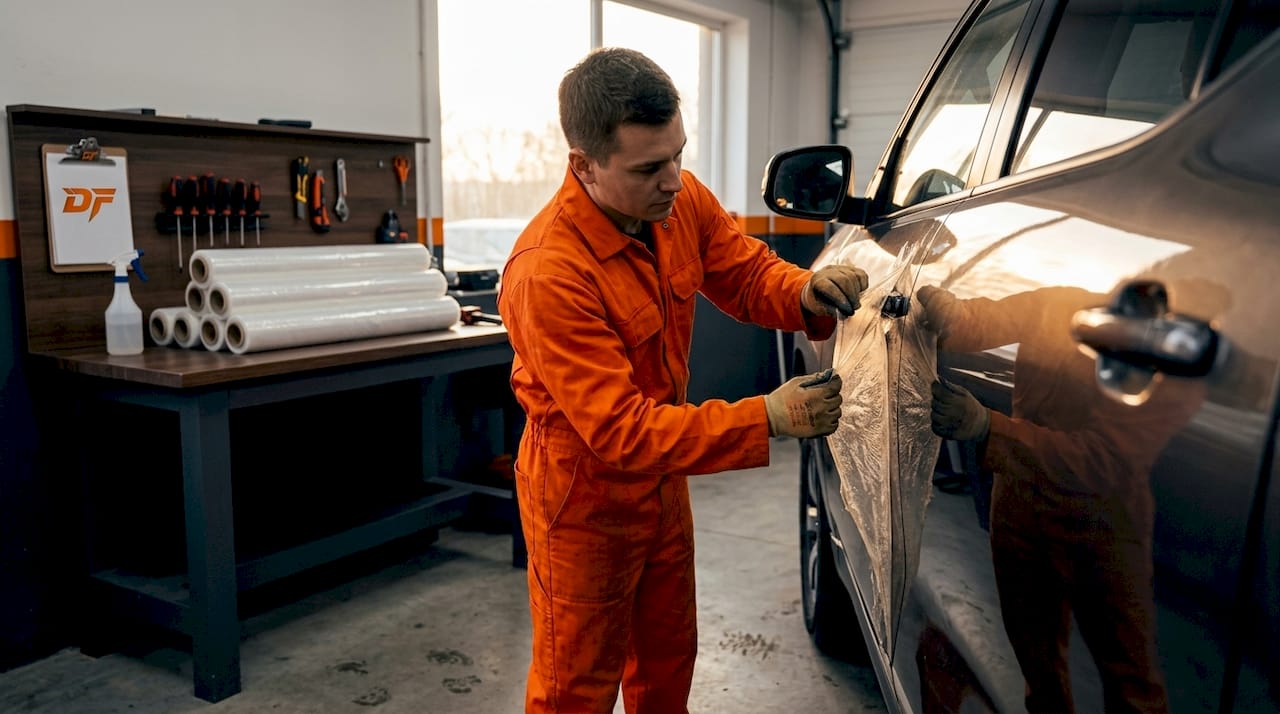
PE films are the most widely used surface protection materials on the market. They are flexible, cost-effective, and available in roll formats that cover large areas quickly. For general scratch and dust protection, they are hard to beat on a per-square-foot cost basis.
Key characteristics of PE surface protectors:
- Flexible enough to conform to slightly irregular surfaces without lifting at edges
- Self-adhesive PE films offer clean removal for up to 45 days without residue
- Available in various thicknesses, typically from 2 mil to 6 mil, for different traffic levels
- Lower heat resistance compared to PET or PU, limiting use in high-temperature spray booths
- Cost advantage makes them practical for large-scale coverage in construction and industrial settings
The limitation that matters most for automotive and industrial professionals is heat resistance. Standard PE films soften at temperatures commonly reached inside a heated spray booth. If your process involves bake cycles, PE alone will not hold up. That said, for pre-paint masking, covering adjacent surfaces during spray, or protecting floors between jobs, PE delivers strong value.
Factory-applied plastic films degrade quickly under UV or heat and should be replaced immediately with job-site-rated PE films for longer projects. Do not assume the thin film shipped on a new panel will protect it through a full renovation or paint job.
2. PET (polyethylene terephthalate) surface protectors
PET films are the step up from PE in nearly every performance category. They are dimensionally stable, resistant to moderate chemical exposure, and hold up in higher temperature environments. For material durability in spray booths, PET is a frequent choice.
| Property | PE Film | PET Film |
|---|---|---|
| Heat resistance | Low (softens under booth temps) | Moderate to high |
| Chemical resistance | Basic | Good |
| Clarity | Moderate | High |
| Rigidity | Flexible | Semi-rigid |
| Cost | Low | Medium |
| Best use | General scratch/dust protection | Automotive refinish, electronics |
PET surface protectors work particularly well for:
- Protecting painted automotive panels during transport and storage
- Masking glass and trim surfaces in a refinish environment
- Long-term UV-resistant applications where PE would yellow or degrade
- Electronic component protection where static dissipation is not required but clarity is
The trade-off is handling complexity. PET films are stiffer and can be harder to apply cleanly in tight areas. They also cost more per roll than comparable PE options, which matters when you are covering an entire spray booth floor every week.
3. Polyurethane (PU) surface protectors
PU films occupy a specific niche where delicate surfaces demand the softest touch. These films are used extensively in automotive paint protection, optical component manufacturing, and any application where surface clarity and minimal adhesive aggression are non-negotiable.
PU films offer anti-static capabilities that PE and standard PET cannot match. In a spray booth environment, static charges attract airborne dust particles directly onto wet paint. A shift toward anti-static and UV-resistant specialty films reflects the industry’s recognition that generic films create failure modes that proper films prevent.
PU protectors also conform exceptionally well to contoured surfaces, which is why they are the default choice for paint protection film on vehicle body panels. They stretch without tearing, recover after minor impacts, and maintain optical clarity over extended periods.
The cost is the limiting factor. PU films run significantly higher than PE per square foot, and the application process requires more care to avoid stretch marks or improper bonding. For high-value surfaces where a mistake costs thousands in rework, that cost is justified.
4. Sticky mats for dust control
Sticky mats are a surface shield option that many professionals overlook in favor of films, but they solve a problem that no film can. At spray booth entry points, facility doors, and clean room thresholds, foot traffic drags in contamination. A sticky mat stops it at the source.
Multilayer adhesive mats typically contain around 30 adhesive layers. When the top layer saturates with debris, you peel it off to expose a fresh surface underneath. The result is continuous dust control without stopping to replace the entire mat. In an automotive refinish setting, a sticky mat at the booth entrance is one of the simplest ways to protect the floor protectors inside from tracking contamination back onto the surface.
Sticky mats work best when:
- Positioned directly at every entry point to the protected area
- Sized to require at least two full steps to cross, capturing debris from both feet
- Replaced (full mat) when the layer count drops below five, since thinner stacks lose grip
- Combined with booth floor films rather than used as a standalone dust control solution
5. Rigid protection boards
When foot traffic becomes heavy equipment traffic, films give way to rigid boards. These are the surface protection materials used on flooring in manufacturing plants, renovation sites handling machinery, and facility maintenance projects where a rolling tool chest or pallet jack would destroy a standard film.
Rigid boards protect surfaces for up to 180 days under heavy-duty industrial conditions. They are reusable, stackable, and can be cut to fit. The cost per day of protection drops significantly over their usable life compared to disposable films.
For spray booth environments specifically, rigid boards at vehicle entry points and under lifts prevent the kind of concentrated load damage that films cannot handle. They also prevent tripping hazards better than curled film edges in high-traffic zones.
6. Surface protection tapes and edge guards
Tapes and edge protectors address what films and boards miss: corners, transitions, and exposed edges. In automotive refinish, edge lifting on a floor film is a contamination path. In industrial painting, an unprotected door frame edge catches overspray and accumulates debris.
Surface protection tapes bond two film sections together, seal film edges to baseboards, and protect trim lines during painting. Edge bumpers protect corners from physical impact during equipment movement. These are not standalone surface protection solutions, but they complete the system. Every floor protection installation performed without edge sealing is leaving a gap in coverage.
7. Anti-static specialty films
In spray booths and electronics manufacturing, static electricity is not just a minor annoyance. Static charges pull airborne dust onto surfaces with enough force to contaminate paint finishes and damage sensitive components. Standard PE or PET films can actually generate static during installation and removal, making the contamination problem worse.
Anti-static films are engineered with conductive or dissipative additives that prevent charge buildup. Wrong protector choices cause contamination and surface damage that show up as defects in the finished product, and static attraction is one of the most common and least obvious culprits in spray booth contamination.
For automotive refinish professionals, anti-static booth wall and floor films are worth the premium specifically because they do not become part of the contamination problem.
8. UV-resistant surface protectors
Any protector used outdoors or near windows must account for UV degradation. Standard PE yellows, embrittles, and loses adhesion under sustained UV exposure. The film that looked fine on day one becomes a removal nightmare on day 30 after sun exposure.
UV-resistant films use stabilized polymer formulations that maintain clarity, adhesion, and flexibility under prolonged UV exposure. They are the correct choice for glass protection on building facades, exterior automotive components during transport, and long-term storage applications where the film will sit in ambient light for weeks or months.
9. Breathable and moisture-control protectors
Some surfaces generate moisture vapor during curing, drying, or temperature changes. Trapping that moisture under a non-permeable film leads to exactly the kind of damage professionals work hardest to prevent: bubbling paint, delamination, and substrate degradation.
Breathable protective films allow vapor transmission while still blocking dust, liquid spills, and physical abrasion. They are particularly relevant for protecting newly poured concrete floors during curing, freshly applied coatings that need to off-gas, and wood surfaces in environments with humidity fluctuations.
10. Comparative summary: choosing by application
The most practical way to select among all these types is to match your scenario directly:
| Application | Recommended type | Duration | Key priority |
|---|---|---|---|
| Spray booth wall protection | Anti-static multi-layer film | Per job cycle | Dust control, static prevention |
| Spray booth floor | PE or anti-static floor film | 30 to 45 days | Clean removal, dust containment |
| Automotive panel protection | PU paint protection film | Months | Clarity, gentle adhesive |
| Industrial high-traffic floors | Rigid boards | Up to 180 days | Load bearing, reusability |
| Booth entry points | Sticky mats | Days (per layer) | Debris capture before entry |
| Exterior glass or transport | UV-resistant film | 30 to 90 days | UV stability, clean removal |
| Fresh coatings or concrete | Breathable film | Days to weeks | Moisture vapor transmission |
Surface damage costs regularly outpace the investment in proper protection, making every line in this table a risk management decision, not just a product choice. Selecting spray booth floor protection options by scenario rather than habit is how professionals reduce rework and warranty claims.
Pro Tip: When installing any floor film in a spray booth, use a clean seam roller and seal every edge with compatible tape before the first vehicle enters. Proper installation technique prevents debris ingress at edges, eliminates tripping hazards, and extends the effective protection period by days or weeks.
My perspective on surface protection in professional environments
I have watched shops treat surface protectors as a commodity purchase, the cheapest roll that fits the cart. That approach costs more than it saves. I have seen paint jobs fail booth inspections because the floor film generated static during removal. I have seen freshly cured panels lifted by adhesive that was never tested on the substrate.
What I have learned is that surface protection planning belongs at the beginning of the project, not as an afterthought at the supply counter. When you map your environment first (temperature, traffic, surface type, protection duration) the right product becomes obvious. When you skip that step, you are gambling with finish quality.
The most overlooked protectors in most shops are anti-static films and breathable options. Shops default to standard PE for everything, which works until it doesn’t. A 25% reduction in spray booth rework is achievable when you match the protector to the job rather than defaulting to habit.
One more thing. Installation matters as much as product selection. A premium film applied with bubbles and unsealed edges will fail before a budget film that is installed correctly. Every time.
— Dust
Dust Free Film surface protection for spray booths
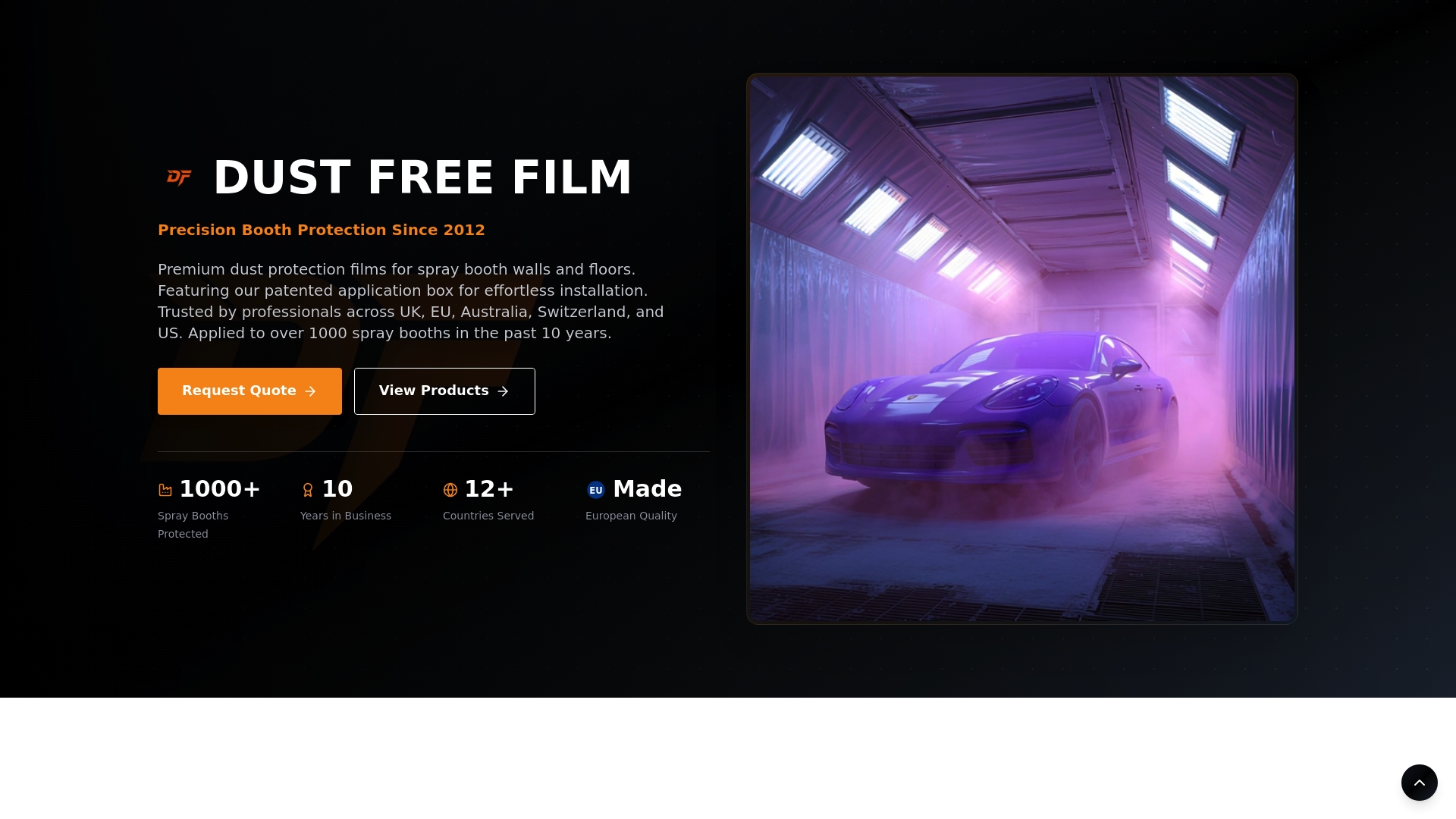
Dustfreefilm has built its product line specifically for the environments described in this article: heated spray booths, high-traffic industrial floors, and automotive refinish operations where dust control and finish quality are non-negotiable. Their spray booth wall and floor protection films are engineered with anti-static properties, heat resistance, and multi-layer formats that deliver clean, bubble-free installation through a patented dispenser system.
For shops that need spray booth floor protection that holds up through multiple job cycles without adhesive residue or static contamination, Dustfreefilm’s European-manufactured films are built to that standard. Their wall protection films complete the system, sealing booth interiors against the dust contamination that causes paint defects.
If you are specifying surface protection for a new booth setup or looking to reduce rework in an existing operation, reach out through the request a quote page for product configurations matched to your volume and application.
FAQ
What are the main types of surface protectors?
The main types are PE films, PET films, PU films, rigid boards, sticky mats, surface protection tapes, anti-static specialty films, UV-resistant films, and breathable films. Each addresses different surface types, durations, and environmental conditions.
How long do surface protectors last before needing replacement?
Standard PE and PET floor films last 30 to 45 days before adhesive residue risk increases. Rigid boards rated for heavy-duty industrial use can last up to 180 days. Sticky mats are replaced layer by layer, with full mat replacement when fewer than five layers remain.
What surface protectors work best in spray booths?
Anti-static multi-layer films for walls and floors are the top choice for spray booths because they prevent static charge buildup that attracts airborne dust onto wet paint. Combined with sticky mats at entry points, they deliver the dust-free environment that quality finishes require.
Can the wrong surface protector damage a surface?
Yes. High-tack adhesives can lift freshly cured coatings, non-breathable films trap moisture under curing surfaces, and non-UV-stabilized films degrade and bond permanently under heat or sun exposure. Always test adhesive compatibility before full application on any new substrate.
What is the difference between PE and PU surface protectors?
PE films are flexible, cost-effective, and suitable for general scratch and dust protection with clean removal up to 45 days. PU films are higher-cost, ultra-clear, anti-static capable, and designed for delicate surfaces like painted automotive panels where gentle adhesion and optical clarity are required.