
TL;DR:
- A downdraft spray booth uses top-to-bottom airflow to remove overspray and contaminants, producing high-quality finishes. The controlled airflow improves safety, reduces contamination, and enhances curing consistency, making it ideal for automotive and industrial coating operations. Proper plenum design and site planning are critical for maximizing performance and finish quality.
A downdraft spray booth is a specialized painting enclosure that uses top-to-bottom airflow to pull overspray and contaminants downward through the floor, producing a clean, high-quality finish. The design is the industry gold standard for automotive refinishing, aerospace coatings, and industrial painting operations. Air enters through a filtered ceiling plenum, travels vertically over the workpiece, and exits through floor grates into an exhaust system. That single airflow principle separates downdraft booths from every other booth configuration and explains why auto body shops and OEM manufacturers rely on them for Class A finishes.
What is a downdraft spray booth and how does it work?
A downdraft spray booth works by creating a controlled column of clean air that moves from ceiling to floor across the entire workspace. Air enters through intake filters mounted in the ceiling plenum, which strip incoming particles before the air reaches the paint surface. That filtered air then flows uniformly downward over the vehicle or workpiece, carrying overspray and solvent vapors with it. The contaminated air exits through floor grates and passes through exhaust filters before leaving the building.
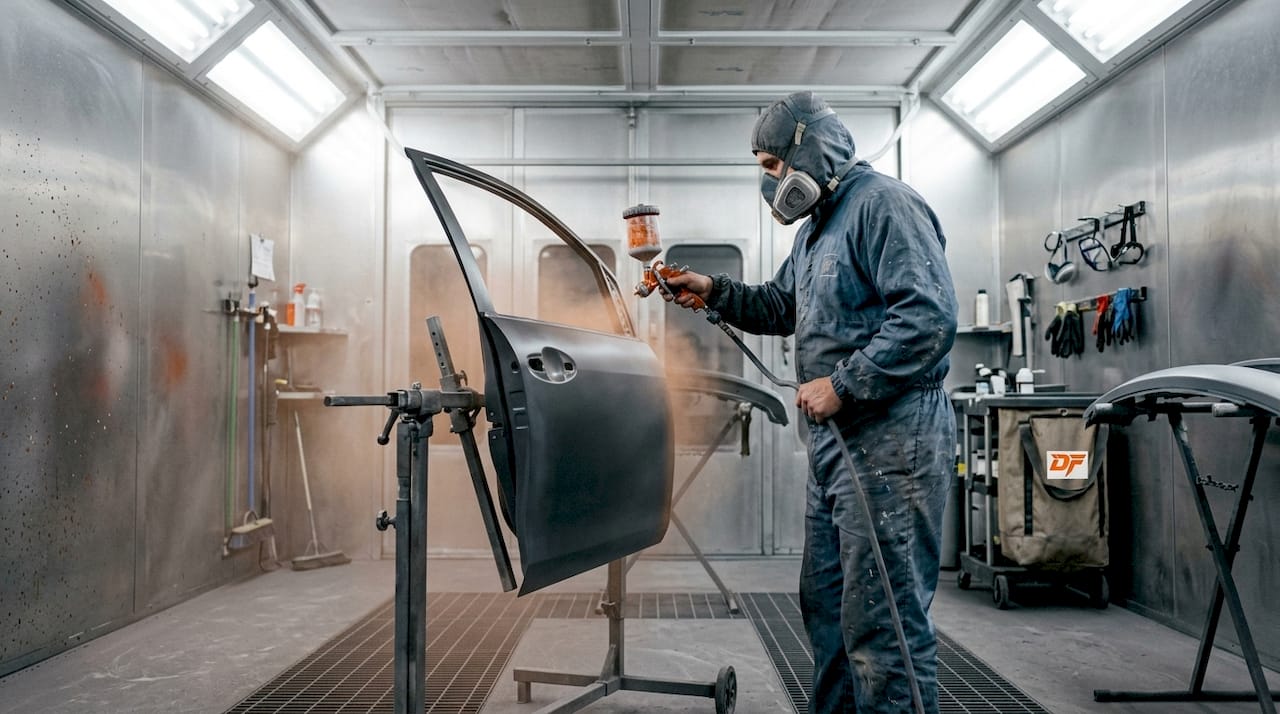
The floor exhaust system is the defining feature of this design. By pulling fumes and overspray downward, the booth keeps hazardous vapors below the operator’s breathing zone at all times. This is a direct safety advantage over horizontal airflow systems, where fumes travel across the operator’s face before exiting.
Filtration happens in two stages. Ceiling intake filters, typically made from fiberglass or polyester media, capture incoming particles before clean air enters the booth. Floor exhaust filters then trap overspray and paint solids before the air reaches the exhaust fan and exits to atmosphere. High-specification booths use HEPA-grade exhaust filtration to prevent harmful substances from escaping into the surrounding environment.
Pro Tip: Replace ceiling intake filters on a set schedule, not just when airflow feels reduced. Partially clogged intake filters create uneven air pressure across the plenum, which causes turbulence at the paint surface and visible defects in the finish.
The ceiling plenum itself plays a critical role that many operators overlook. Balanced air distribution through the plenum prevents turbulence and ensures consistent finish quality. A well-designed plenum delivers the same air velocity at every point across the ceiling, so the airflow column remains uniform from front to back and side to side.
What are the types of downdraft spray booths?
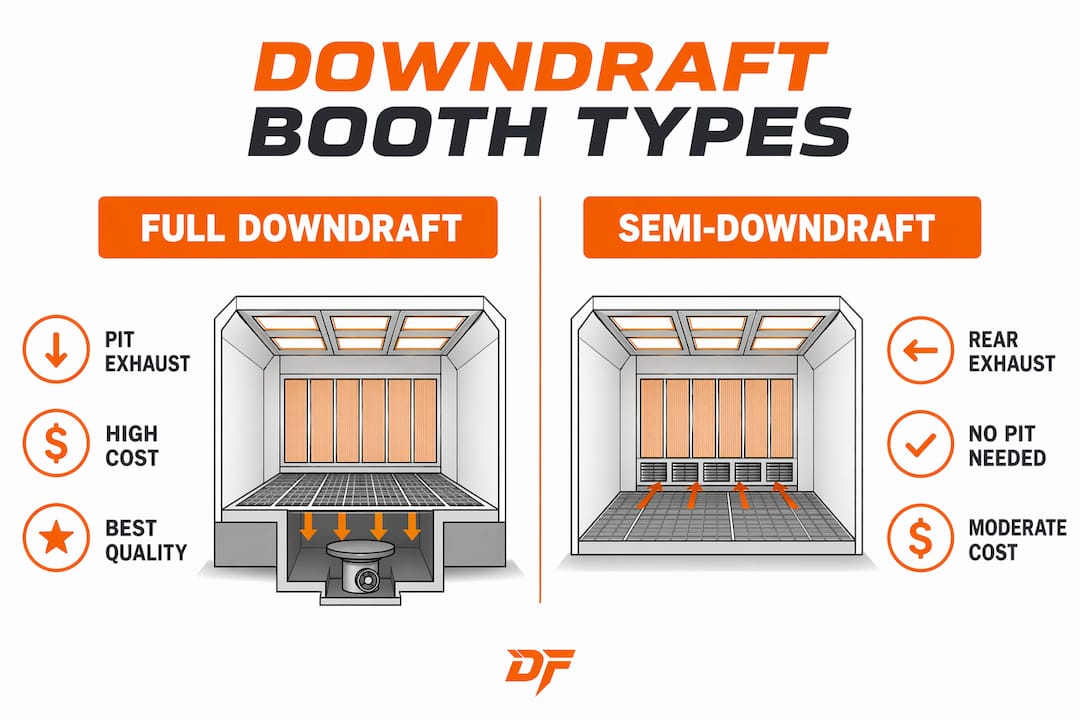
Downdraft booths come in three main configurations, each suited to different facility conditions and budget levels.
Full downdraft booths use a pit or tunnel excavated beneath the floor to house the exhaust ductwork and filters. Air extracts through the entire floor surface, which maximizes airflow consistency across the workspace. Full downdraft extraction through the complete floor area delivers the most uniform airflow of any booth design. This configuration is the preferred choice for automotive OEM production, aerospace finishing, and any application requiring a Class A surface.
Semi-downdraft booths exhaust air through the rear lower walls rather than the floor. This design avoids the need for floor excavation, making it practical for facilities where pit construction is cost-prohibitive or structurally impossible. The tradeoff is airflow consistency. Air exits from one end of the booth rather than uniformly across the floor, which creates a slight horizontal component to the airflow pattern. Finish quality remains high, but it does not fully match a true full downdraft system.
Raised floor designs sit the booth on a platform above the existing floor level, routing exhaust ductwork beneath the raised deck. This approach achieves true downdraft airflow without excavating the building’s concrete slab. Raised floor booths cost more to build than semi-downdraft systems but deliver airflow performance closer to a pit-based full downdraft booth.
The table below summarizes the practical differences between these three configurations.
| Configuration | Exhaust method | Excavation required | Best suited for |
|---|---|---|---|
| Full downdraft | Floor pit or tunnel | Yes | OEM, aerospace, Class A finishes |
| Semi-downdraft | Rear lower wall vents | No | Shops with floor constraints |
| Raised floor | Beneath raised deck | No | High-quality finish without pit work |
Facility planning must account for vertical clearance and building layout before selecting a configuration. Full downdraft booths require additional height above the booth for air handling equipment and below the floor for the exhaust pit. Many operators discover these constraints only after committing to a booth purchase, which leads to costly redesigns.
Pro Tip: Commission a site survey before signing any booth contract. Measure ceiling height from floor to roof structure, not just to the ceiling tiles. Air handling units mounted on top of the booth can add 3 to 5 feet to the total installation height.
What are the key benefits of using a downdraft booth?
The advantages of downdraft spray booths go well beyond cleaner air. They affect finish quality, operator health, regulatory compliance, and production throughput simultaneously.
-
Reduced surface contamination. Overspray travels downward away from the wet paint surface rather than across it. Airborne contamination on wet surfaces drops sharply because particles are pulled into the floor filters before they can settle on the workpiece.
-
Superior overspray capture. Floor-level extraction captures paint solids efficiently, reducing material waste and keeping the booth interior cleaner between jobs. Less overspray buildup on walls and fixtures means faster booth cleaning and lower maintenance labor.
-
Improved operator safety. Fumes and flammable paint particles travel downward, away from the painter’s breathing zone. Pulling flammable particles downward also minimizes fire risk by keeping vapor concentrations low at head height. HEPA exhaust filtration prevents harmful substances from escaping into the shop or atmosphere.
-
Regulatory compliance. Downdraft booths support compliance with OSHA ventilation requirements for spray finishing operations and EPA air quality standards for coating facilities. The controlled airflow and multi-stage filtration system are designed to meet these regulatory thresholds.
-
Faster, more consistent curing. Uniform vertical airflow helps coatings dry evenly across the entire surface during the bake cycle. Uneven airflow in other booth types causes inconsistent curing, which can produce soft spots or color variation in the finished coat.
-
Lower rework rates. Cleaner air during application means fewer dust nibs, fish eyes, and contamination defects. Fewer defects mean less time spent on correction work, which directly improves throughput and labor efficiency.
Professionals researching auto body refinishing consistently identify contamination control as the single biggest driver of rework costs. A downdraft booth addresses that problem at the source.
How to choose the best downdraft spray booth for your facility
Selecting the right booth requires matching operational requirements to site conditions and budget. Work through these five factors before committing to a configuration.
-
Define your finish quality standard. If your work includes automotive OEM production, aerospace coatings, or any Class A surface requirement, a full downdraft pit booth is the correct choice. Semi-downdraft systems are appropriate for general automotive refinishing where Class A is the goal but not a contractual requirement.
-
Assess your floor and building structure. Determine whether excavation is feasible. Check the concrete slab thickness, the presence of underground utilities, and the building’s structural load capacity. If excavation is not possible, evaluate raised floor designs before defaulting to a semi-downdraft system.
-
Measure available vertical clearance. Full downdraft booths need overhead space for air handling units. Early site surveys are the recommended practice to avoid costly installation problems. Confirm the clear height from floor to roof structure, not to suspended ceilings or lighting fixtures.
-
Match booth size to production volume. A booth that is too small creates bottlenecks. A booth that is too large wastes energy moving air through unused space. Calculate your average daily throughput in vehicles or parts and size the booth to handle peak volume without idle time.
-
Evaluate filtration system precision. Not all downdraft booths perform identically. The quality of the ceiling plenum design and the grade of filtration media determine actual finish quality. Request airflow uniformity data from the manufacturer and verify that exhaust filtration meets local EPA requirements.
Full downdraft booths carry the highest capital cost of any spray booth configuration. They are best understood as long-term investments in finishing efficiency. Reduced rework, lower material waste, and faster cycle times generate returns that offset the higher upfront cost over the life of the equipment.
Key Takeaways
A downdraft spray booth is the most effective booth design for contamination control, operator safety, and finish quality in automotive and industrial painting operations.
| Point | Details |
|---|---|
| Vertical airflow is the core mechanism | Air moves from ceiling to floor, carrying overspray away from the paint surface and operator. |
| Full downdraft requires excavation | Pit or tunnel construction is needed for true floor-level extraction; raised floor designs offer an alternative. |
| Filtration happens in two stages | Ceiling intake filters clean incoming air; floor exhaust filters capture overspray before air exits the building. |
| Plenum balance determines finish quality | Uniform air distribution across the ceiling prevents turbulence that causes visible surface defects. |
| Site survey before purchase is critical | Vertical clearance and floor structure must be confirmed before selecting a booth configuration. |
What I’ve learned about downdraft booths that most guides skip
Most articles on downdraft booths focus on airflow direction and stop there. That framing misses the real performance variable, which is air distribution precision inside the ceiling plenum.
I’ve seen facilities invest in full downdraft pit booths and still produce finishes with contamination problems. In every case, the root cause was an undersized or poorly baffled plenum delivering uneven air velocity across the ceiling. The air was moving downward, but it was moving faster in some zones than others. That turbulence was enough to stir settled particles back onto the wet surface.
The lesson is that airflow direction is necessary but not sufficient. The quality of the plenum design matters as much as the booth configuration itself. When evaluating booths, ask the manufacturer for velocity uniformity specifications, not just cubic feet per minute ratings.
The second thing most guides understate is the value of downdraft booths during the curing phase. Operators tend to think of the booth as a spraying tool and treat the bake cycle as passive. Uniform vertical airflow during baking produces faster, more even drying than any other booth type. Shops that track cycle times carefully find that full downdraft booths reduce bake time compared to semi-downdraft systems, which compounds into meaningful throughput gains over a year.
Finally, do not underestimate the planning phase. The operators who get the most out of their downdraft booths are the ones who ran a thorough site survey before installation, not after. Vertical clearance and pit feasibility are not details to confirm at the last minute. They determine which configuration is even possible for your building.
— Dust
Dustfreefilm’s role in keeping your downdraft booth performing at its best
A downdraft booth controls airflow. What it cannot control on its own is the dust and debris that accumulates on booth walls and floors between jobs, and that contamination finds its way onto your next paint surface.

Dustfreefilm manufactures multi-layer electrostatic protective films designed specifically for spray booth walls and floors. The films use a patented dispenser system for quick, bubble-free installation, and they are heat-resistant and static-free for use in active paint and bake environments. When you peel away a used layer, the next clean surface is ready immediately. Explore Dustfreefilm’s full range of booth protection solutions and see how the right film system complements your downdraft booth’s airflow performance to deliver consistently clean finishes.
FAQ
What is the main difference between a downdraft and crossdraft booth?
A downdraft booth moves air from ceiling to floor, keeping overspray away from the paint surface and the operator’s breathing zone. A crossdraft booth moves air horizontally from one end to the other, which carries overspray across the workpiece and the painter before it exits.
Do downdraft spray booths require a floor pit?
Full downdraft booths require a pit or tunnel beneath the floor for exhaust extraction. Semi-downdraft and raised floor designs are alternatives for facilities where excavation is not feasible.
Are downdraft booths compliant with OSHA and EPA standards?
Downdraft booths are designed to support compliance with OSHA ventilation requirements for spray finishing and EPA air quality standards. Multi-stage filtration, including HEPA exhaust media, prevents harmful substances from escaping into the workspace or atmosphere.
How does a downdraft booth improve paint finish quality?
The vertical airflow pattern pulls overspray downward before it can settle on the wet paint surface, which dramatically reduces contamination defects like dust nibs and fish eyes.
Can a downdraft booth be used for both spraying and curing?
Full downdraft booths are effective for both phases. Uniform vertical airflow during the bake cycle produces even, rapid coating drying that reduces cure time compared to booths with less consistent airflow patterns.