

TL;DR:
- Advanced booth safety involves a coordinated system of ventilation, electrical safety, fire suppression, and interlocks to prevent catastrophic incidents in spray and powder coating facilities. Proper maintenance, inspection, and real-time monitoring are essential to ensure all hazard controls function effectively and remain compliant with NFPA 33, OSHA, and NFPA 652 standards. Prioritizing cleanliness, active safety management, and system integration significantly reduces fire, explosion, and static hazards in industrial booths.
Understanding what is advanced booth safety separates facilities that pass inspections from those that prevent catastrophic incidents. Most shops think about booth safety as a collection of devices: a fire extinguisher here, an exhaust fan there. That framing misses the point entirely. Advanced booth safety, or what engineers formally call an integrated hazard control system, is the coordinated design, operation, and maintenance of ventilation, explosion-rated electrical equipment, fire suppression, and dust management working as a single engineered system. This guide breaks down each component so you can build or audit a program that holds up in 2026.
Key takeaways
| Point | Details |
|---|---|
| It’s a system, not a checklist | Advanced booth safety means every hazard control is coordinated, not independently managed. |
| Ventilation carries the most weight | Controlling vapor and dust concentrations through mechanical airflow is the primary risk reduction method. |
| Powder booths face unique risks | Combustible dust hazards require a formal Dust Hazard Analysis under NFPA 652 before any other controls are designed. |
| Fire suppression needs interlocks | Suppression systems must shut down ventilation and equipment simultaneously to avoid amplifying a fire event. |
| Maintenance is the safety program | Without documented inspection schedules and training, even well-designed systems fail under real operating conditions. |
What advanced booth safety actually means
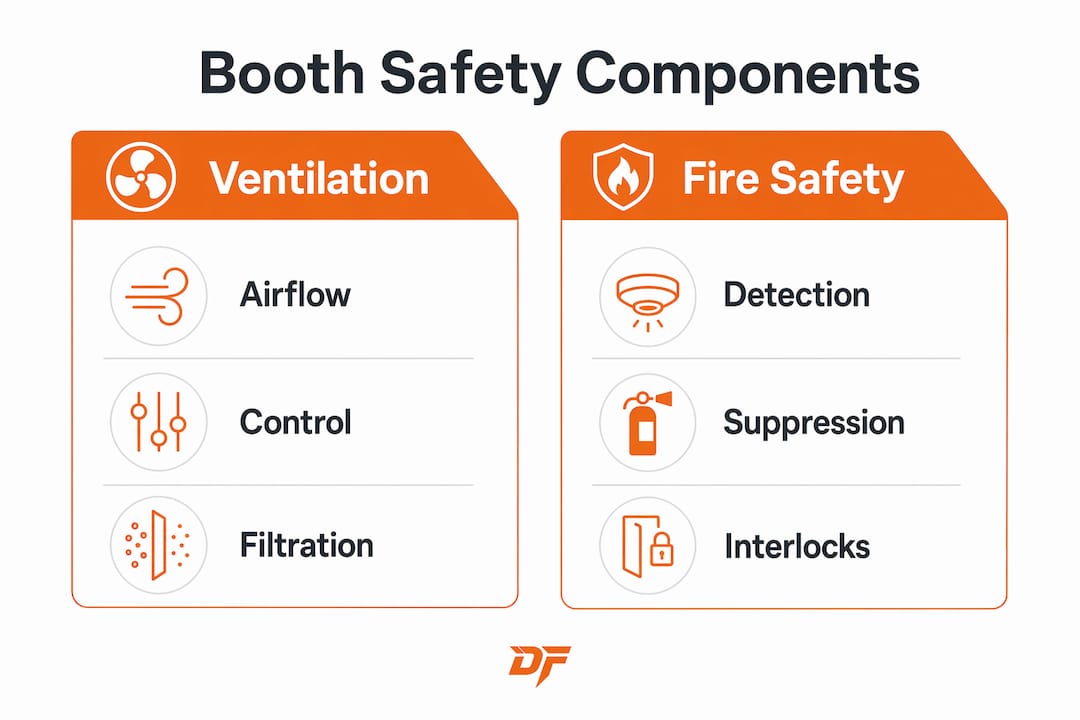
Advanced booth safety is not a product category or a certification level. It is the practice of treating every spray or powder coating booth as a multi-hazard environment and designing coordinated controls that address those hazards simultaneously. The recognized industry framework for spray finishing is NFPA 33, which defines the required integration of ventilation, hazardous location electrical design, fire suppression, and operational interlocks.
The four core components work together in a specific way:
- Ventilation keeps flammable vapors and airborne particulates below their lower explosive limit (LEL) during spray operations.
- Hazardous location electrical design specifies explosion-proof motors, wiring, and lighting for zones where flammable atmospheres can exist.
- Automatic fire suppression detects ignition events and delivers suppression agents before a fire grows.
- System interlocks link these components so that a failure in one triggers a protective response in another.
OSHA spray booth requirements emphasize that these controls are not optional enhancements. They are minimum requirements for any enclosed spray finishing operation. The word “advanced” applies when a facility moves beyond bare minimum compliance toward a fully maintained, documented, and tested system.
Pro Tip: Review your booth’s original equipment documentation against current NFPA 33 and OSHA standards annually. Codes update, and booths installed a decade ago may no longer meet current requirements even if nothing visibly changed.
Ventilation and airflow management
Ventilation is the single most consequential element in the industrial booth safety workflow. Get airflow wrong and every other control becomes a reactive measure against a preventable hazard. The goal is mechanical air movement that continuously dilutes solvent vapors below 25% of the LEL during all spray operations, while also carrying overspray away from workers and booth surfaces.
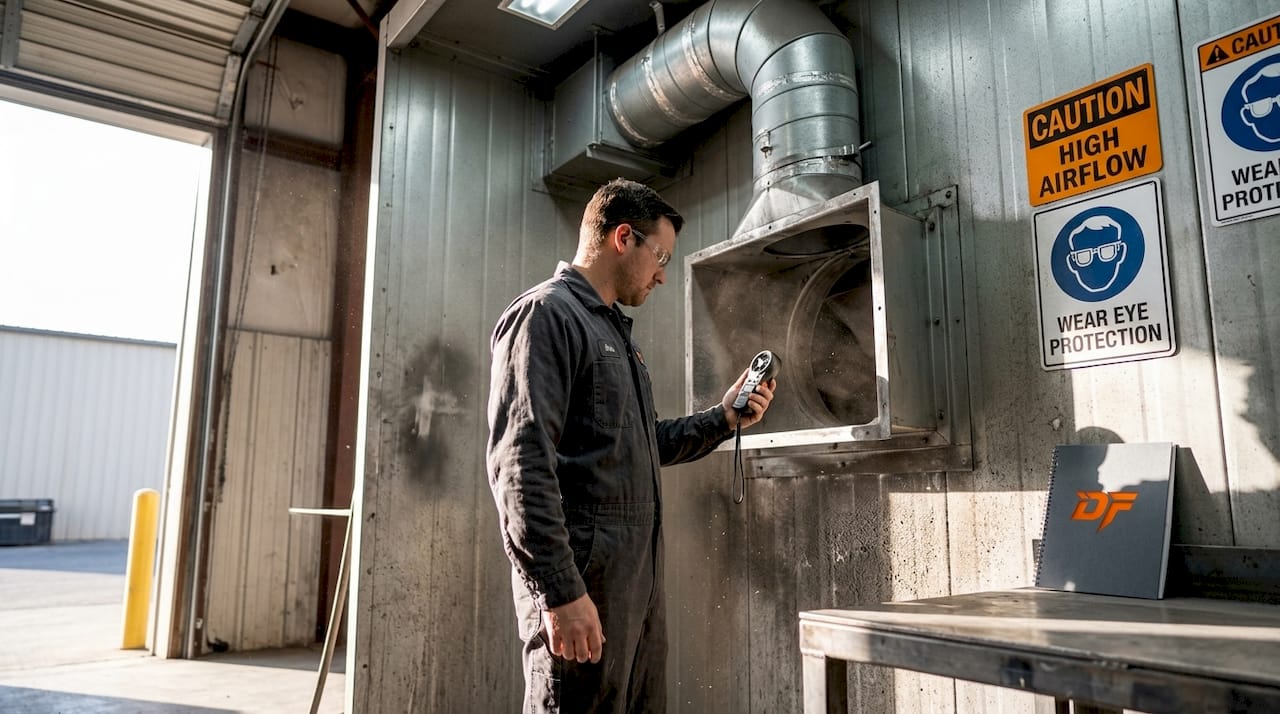
NFPA 33 and OSHA require that ventilation systems deliver sufficient airflow to prevent vapor accumulation in any part of the booth, including corners, ceiling plenums, and floor-level zones near drains. Uneven airflow creates dead zones where vapors concentrate. That is where ignition events begin.
Here is how professionals verify and maintain airflow performance:
- Establish target velocity. Most cross-draft booths require 100 feet per minute across the full cross section of the booth opening. Downdraft designs have different requirements. Know your specification.
- Measure actual airflow. Use a Magnehelic differential pressure gauge across the exhaust filter bank, or a calibrated anemometer at the face of the booth. Readings should match design specifications.
- Document every measurement. Regulators and insurers both expect a written record. A log that shows consistent measurement over time is the clearest evidence of an active safety program.
- Link measurements to maintenance triggers. When pressure drop across exhaust filters rises above a set threshold, that signals filter loading. Change filters before airflow degrades below safe levels.
- Inspect ductwork and fans quarterly. Overspray accumulates on fan blades, reducing efficiency and increasing fire load. Advanced dust control in booths requires treating accumulated residue as a distinct hazard, separate from active spraying.
Pro Tip: Treat ventilation as a control loop, not a one-time setup. Set a target velocity, measure it on a schedule, and connect measurement results directly to your maintenance calendar. That approach satisfies both OSHA inspectors and insurance underwriters.
Powder coating booths and combustible dust
Paint spray booths and powder coating booths share structural similarities but face fundamentally different hazard profiles. Liquid paint solvents create flammable vapor hazards. Powder coating creates combustible dust hazards, and dust explosions can be significantly more violent than vapor-based fires because the total fuel surface area is far greater.
| Hazard factor | Spray paint booth | Powder coating booth |
|---|---|---|
| Primary hazard | Flammable vapor (LEL-based) | Combustible dust (MEC-based) |
| Governing standard | NFPA 33 | NFPA 33 + NFPA 652 |
| Ignition sensitivity | Moderate (spark, static) | High (static, friction, heat) |
| Suppression priority | Fire suppression | Rapid flame detection and shutdown |
| Grounding requirement | Standard bonding | Continuous bonding and grounding |
A Dust Hazard Analysis (DHA), mandated by NFPA 652, is the formal starting point for any powder coating booth safety program. The DHA is a systematic evaluation that identifies your specific powder characteristics, probable ignition sources, and the engineering controls needed to address them. Skipping this step is one of the most common compliance failures in industrial finishing operations.
Beyond the DHA, advanced booth safety techniques for powder environments include:
- Maintaining airborne powder concentration below the minimum explosible concentration (MEC) at all times.
- Using only explosion-rated electrical equipment throughout the hazard zone.
- Installing rapid flame detectors calibrated for the infrared and ultraviolet signatures specific to powder fires, which can reach full intensity within milliseconds.
- Implementing a documented housekeeping schedule that prevents powder accumulation on horizontal surfaces, ledges, and in ductwork.
- Verifying continuous bonding and grounding on all conductive components, including the part being coated, to eliminate static discharge as an ignition source.
The importance of booth safety in powder environments becomes clear when you consider that a thin layer of settled dust covering just a small floor area can fuel a secondary explosion far more damaging than the initial event.
Fire detection, suppression, and interlocks
Fire detection in spray and powder booths cannot rely on standard commercial smoke detectors. Atomized paint particles and solvent vapors interfere with ionization and photoelectric sensors, triggering false alarms or, worse, delayed detection. Booths require detectors tuned to the specific combustion signatures of the materials being sprayed: typically UV/IR flame detectors that respond to the optical characteristics of a hydrocarbon or polymer fire.
Automatic suppression systems aligned with NFPA 33 must do more than just release agent when fire is detected. The system activation must simultaneously:
- Shut down or close dampers on supply and exhaust fans to prevent the fire from being fed with fresh oxygen.
- Cut power to spray equipment and conveyor systems.
- Trigger audible and visual alarms inside and outside the booth.
- Send a signal to a monitoring station or directly to emergency services where required.
That sequence of coordinated shutdowns is what distinguishes an interlock-integrated system from a standalone extinguisher. The interlock is what converts individual safety devices into a true booth safety system.
Suppression agent selection matters. Dry chemical works well for flammable liquid fires but leaves residue that complicates post-incident cleanup and can damage sensitive equipment. Clean agents such as FK-5-1-12 suppress fires without residue but require careful engineering to achieve sufficient concentration in booths with high air exchange rates. Work with a suppression system engineer who understands your specific booth geometry.
Maintenance, inspections, and training
A well-designed booth with a poorly maintained safety program is not a safe booth. Overspray accumulation on walls, ceilings, fan blades, and ductwork is one of the leading contributors to booth fires. OSHA and NFPA 33 both set expectations for cleaning frequency tied to production volume, not just calendar dates.
A practical compliance-focused inspection and training program includes:
- Daily housekeeping. Remove overspray buildup from booth walls and floors after each shift. This is where protective wall and floor films deliver real operational value by allowing fast, clean layer removal instead of scraping.
- Weekly interlock and alarm tests. Manually trigger each interlock to confirm suppression activation, fan shutdown, and alarm response function as designed.
- Monthly filter assessment. Check pressure drop readings and replace exhaust filters before airflow degrades. Log the date, reading, and filter lot number.
- Quarterly full system inspection. Inspect suppression agent levels, detector sensitivity, electrical equipment for signs of corrosion or damage, and bonding and grounding continuity.
- Annual third-party audit. An independent review against current OSHA and NFPA requirements confirms compliance and identifies issues your in-house team may have normalized.
PPE is non-negotiable. Spray operations involving isocyanate-based coatings require positive-pressure supplied-air respirators, not just half-mask air-purifying respirators. Chemical-resistant gloves, splash-rated eye protection, and coveralls complete the standard requirement.
Training must cover emergency procedures, not just safe operating procedures. Workers should know how to initiate emergency stop functions, evacuate the booth, and account for all personnel. That knowledge does not transfer from a poster on the wall.
My take on what actually makes booth safety work
I’ve seen plenty of facilities that check every compliance box and still have near-miss incidents every quarter. The reason is almost always the same. They treat booth safety as a documentation exercise rather than a live operational system. The forms get filled out. The audits pass. But when a filter goes two weeks past its replacement threshold because production pressure pushed it, or a grounding cable gets disconnected during a fixture change and nobody logs it, the integrated system fails. Not all at once, but piece by piece.
What I’ve learned from watching both well-run and poorly run operations is that the facilities with genuinely strong safety records share one characteristic. They have someone with real authority whose job is to say no when shortcuts get proposed. Not a safety officer buried three levels down in the org chart, but someone close enough to production decisions to actually intervene.
The other thing I keep seeing underestimated is the role of wall and floor cleanliness in fire risk. People focus on the high-tech suppression hardware and overlook the fact that accumulated overspray is fuel. Every layer of dried paint on a booth wall is a liability. The easiest spray booth safety measures to implement are often the ones that reduce that fuel load before ignition ever becomes a question.
Emerging sensor technology for real-time LEL monitoring and automated airflow adjustment is worth watching. Several manufacturers now offer continuous vapor monitoring tied directly to ventilation speed controls. That kind of active feedback loop is where booth safety is heading, and it will raise the baseline for what regulators consider adequate in the next several years.
— Dust
Protect your booth from the inside out
Keeping a booth clean is not just a quality concern. It is a direct safety measure. Overspray accumulation on walls and floors increases fire load, clogs filters faster, and shortens the life of expensive equipment. Dustfreefilm manufactures multi-layer electrostatic booth wall and floor protection films specifically designed for automotive refinishing and industrial spray environments. The films are heat-resistant, static-free, and allow you to peel away contaminated layers in minutes instead of scrubbing for hours. If you want to reduce housekeeping time, lower fire risk, and stay on the right side of your maintenance schedule, request a quote and see how Dustfreefilm fits into your booth safety program.
FAQ
What is advanced booth safety in simple terms?
Advanced booth safety is an integrated system of ventilation, explosion-rated electrical equipment, fire suppression, and operational interlocks designed to control flammable vapor, combustible dust, and fire hazards in spray and powder coating booths.
What are the main booth safety regulations to follow?
The primary standards are NFPA 33 for spray application finishing processes and OSHA 29 CFR 1910.94 for ventilation, electrical safety, and PPE requirements. Powder coating facilities must also comply with NFPA 652 for combustible dust hazard analysis.
How often should booth safety systems be inspected?
Daily housekeeping and weekly interlock tests are the minimum. Monthly filter assessments, quarterly full system inspections, and an annual third-party audit against current OSHA and NFPA requirements constitute a complete ongoing program.
Why does a powder coating booth need a Dust Hazard Analysis?
NFPA 652 mandates a DHA because combustible powder characteristics vary significantly between materials. The DHA drives engineering decisions on hazard zone classification, suppression system design, and housekeeping frequency specific to each facility and process.
How does ventilation reduce fire and explosion risk in booths?
Mechanical ventilation dilutes solvent vapors and airborne powder below their explosive concentration limits. Maintaining airflow above the minimum required velocity prevents the buildup that makes ignition possible, making ventilation the primary hazard control in any booth.