

TL;DR:
- Industrial over-spray occurs when airborne paint particles deposit on unintended surfaces, causing waste and safety risks. Preventative measures include proper booth ventilation, masking, spray technique discipline, and surface protection films to control and reduce over-spray effectively. Regular maintenance, operator training, and advanced containment technologies are essential for compliant, safe, and high-quality industrial coating operations.
Industrial over-spray is defined as paint or coating particles that become airborne during spray application and deposit on surfaces outside the intended target area. Every professional in automotive refinishing or large-scale industrial coating has dealt with its consequences: wasted material, contaminated finishes, and safety hazards that compound over time. Understanding what causes over-spray, how it spreads, and how to control it separates shops that consistently produce quality work from those that constantly chase defects.
What is industrial over-spray and what causes it?
Industrial over-spray is a particle transfer-loss mechanism where atomized coating material misses the target substrate and travels through the air before settling on unintended surfaces. This happens in every spray application environment, from automotive body shops to heavy industrial coating lines. The consequences range from cosmetic defects on adjacent panels to material waste that adds up to significant cost over a production run.
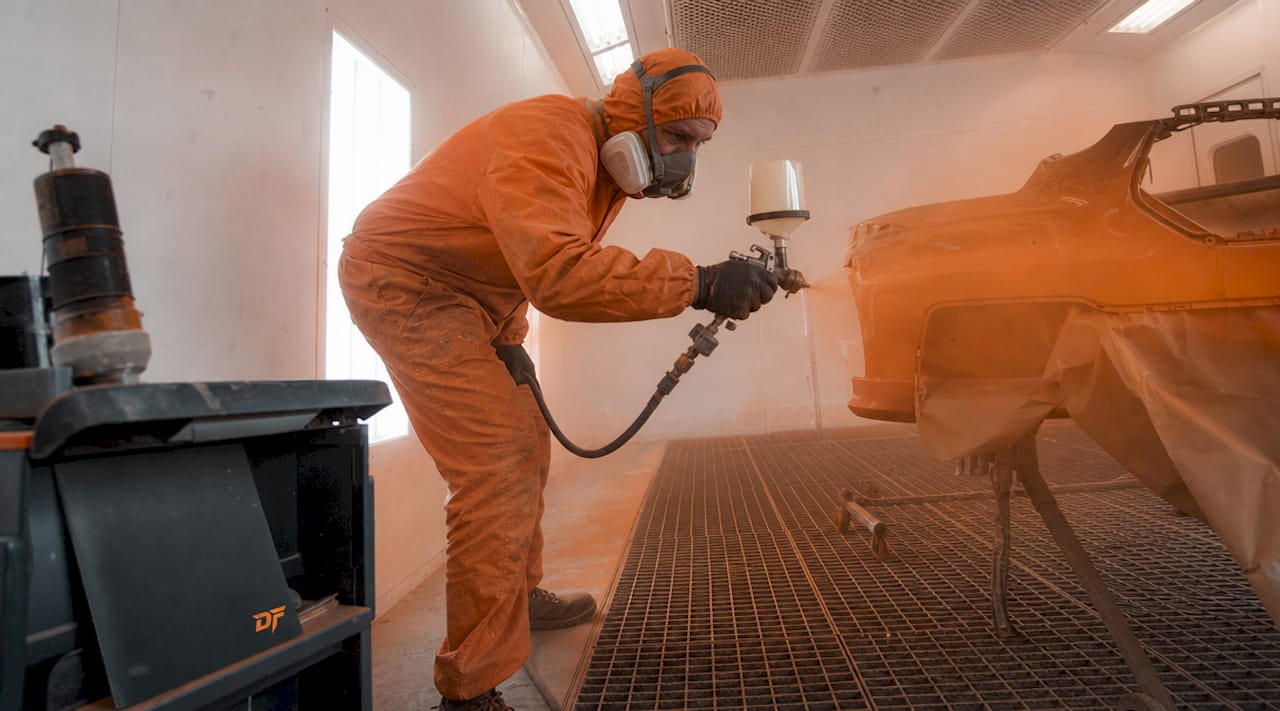
PPG identifies four primary variables that drive overspray in automotive refinishing: poor ventilation, excessive air pressure, inadequate masking, and recoat paint settling on surfaces that were not fully protected. Each variable compounds the others. High air pressure atomizes paint into finer particles that stay airborne longer, while poor ventilation means those particles have nowhere to go except onto your equipment, booth walls, and adjacent vehicles.
The operational implications extend beyond surface defects. Airborne coating particles contaminate spray booth components, clog filtration systems faster than expected, and create inconsistent finish quality that requires rework. In high-volume shops, this rework cost is rarely tracked directly to over-spray, but it is one of the most consistent sources of lost productivity.
Key causes of industrial over-spray in practice include:
- Excessive compressed air pressure pushing atomized particles beyond the spray pattern boundary
- Incorrect spray gun angle relative to the substrate surface, scattering particles laterally
- Inadequate or failed masking allowing paint to reach adjacent panels or components
- Poor booth airflow and extraction leaving airborne particles suspended rather than captured
- Spray distance too great from the substrate, reducing transfer efficiency
Pro Tip: Before blaming operator technique, audit masking tape edge integrity and air pressure settings first. PPG’s refinishing guidance identifies these two variables as the primary audit points in any over-spray investigation.
How does over-spray affect health, safety, and regulatory compliance?
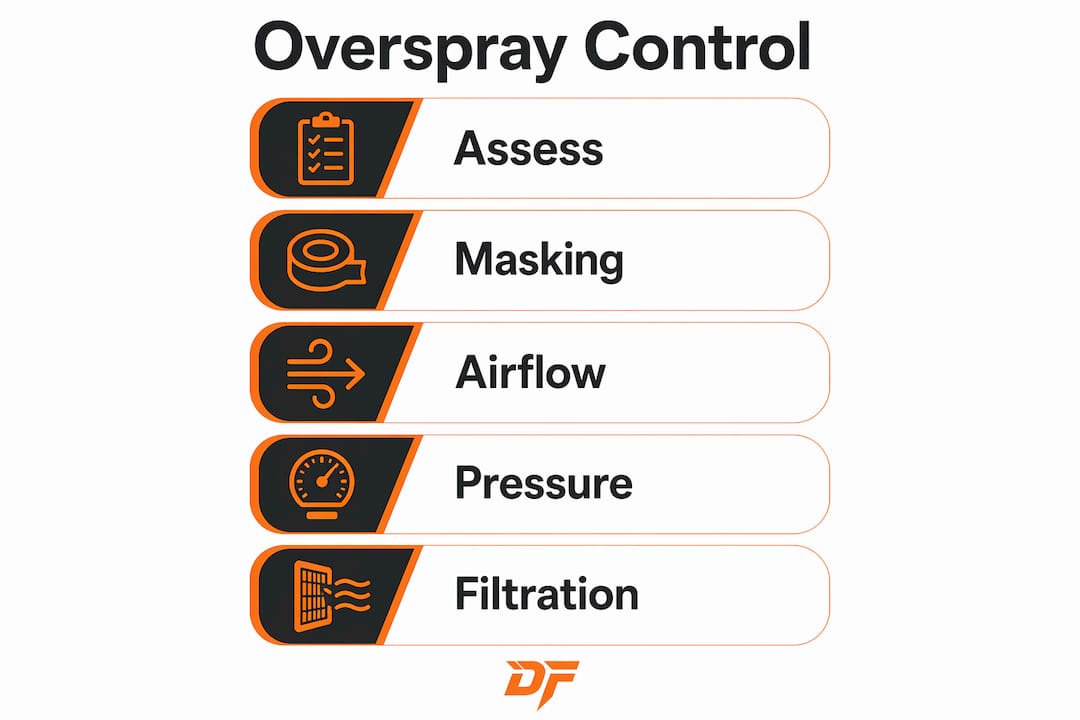
The health risks from industrial over-spray are direct and well-documented. A CFD-based study of automotive workshops found that improper spray angle and poor extraction can cause up to 70% of paint to become airborne, with simulated particle concentrations reaching 0.85 kg/m³ and dispersion extending over 1.5 meters from the spray zone. That level of airborne contamination produces respiratory irritation and Sick Building Syndrome symptoms in workers with regular exposure. The same study confirms that controlling spray angle and local extraction performance directly reduces occupational health risk.
Fire safety is the other critical dimension. Overspray accumulation in ventilation ducts creates a latent fire hazard that is invisible on the shop floor but highly dangerous. Residue builds up in ducts and on booth components over time, and a single ignition source can trigger a fire that spreads through the entire ventilation system. OSHA regulations require spray booths to maintain automatic fire suppression systems and control overspray residue buildup in filters and ducts as a primary prevention measure.
“Invisible overspray residue in ventilation ducts presents a latent fire and maintenance hazard, emphasizing the need for comprehensive spray booth cleaning protocols beyond visible contamination control.” — OSHA spray booth maintenance guidance
Regulatory compliance obligations for industrial painting operations include:
- Automatic fire suppression systems installed and maintained in spray booths
- Regular filter replacement to prevent overspray-saturated media from becoming a fire fuel source
- Duct cleaning schedules that address residue accumulation beyond what is visible at booth level
- Ventilation performance verification to confirm extraction rates meet OSHA and local fire code requirements
The fire and respiratory risks associated with overspray accumulation are not theoretical. They are the reason OSHA standards for spray booth maintenance are as specific as they are, and why shops that treat housekeeping as optional create compounding liability.
What are the key industrial over-spray control methods?
Controlling over-spray requires a layered approach. No single technology eliminates it entirely, but combining proper booth airflow, spray technique discipline, and advanced containment systems reduces it to manageable levels. The foundational control is booth ventilation. Proper booth airflow and filtration capture paint mist before it settles on equipment or surfaces, and the design of that airflow determines how effective the capture actually is.
A 2026 MDPI study on high-pressure airless spray coating used CFD simulation and experimental validation to show that blowing angle and hood spacing significantly affect overspray containment in air-curtain spray hood systems. The study confirms that commissioning must verify airflow interactions beyond simple filter replacement to optimize results. This is directly applicable to robotic spray lines in industrial manufacturing, where hood-to-wall spacing is often set at installation and never revisited.
In powder coating operations, cyclone separators recover unadhered overspray powder for reuse, reducing both powder waste and filter loading. This recovery approach translates directly to energy savings and lower operating costs, making it one of the most economically compelling overspray control technologies available in industrial finishing.
| Control method | Application | Effectiveness |
|---|---|---|
| Spray booth downdraft ventilation | Automotive refinishing, general industrial | High; captures airborne particles before surface settlement |
| Air-curtain spray hoods | Robotic high-pressure airless systems | High; CFD-validated containment at source |
| Cyclone separator recovery | Powder coating lines | High; recovers unadhered powder for reuse |
| Masking and surface protection film | All spray environments | Medium-high; prevents overspray adhesion on adjacent surfaces |
| Spray technique adjustment | All spray environments | Medium; reduces generation but does not eliminate it |
Pro Tip: In robotic spray systems, revisit hood-to-wall spacing and blowing angles during commissioning reviews, not just at initial installation. CFD modeling shows these parameters drift in effect as production volumes and coating materials change.
Spray technique adjustments remain relevant even in automated environments. Reducing air pressure to the minimum needed for proper atomization, maintaining correct gun-to-substrate distance, and keeping spray angles perpendicular to the surface all reduce the volume of particles that escape the target zone. These adjustments cost nothing and produce measurable reductions in over-spray generation.
What practical steps can professionals take to manage over-spray?
Managing over-spray effectively requires consistent practice across equipment setup, booth maintenance, and surface protection. The following steps represent the standard operating procedure for shops that keep over-spray under control.
- Set air pressure to the minimum effective level. Test each coating material at the lowest pressure that achieves proper atomization. Excess pressure is the single fastest way to increase airborne particle volume.
- Inspect and replace masking before every job. Masking tape edges that have lifted or failed are a direct path for over-spray to reach adjacent surfaces. Replace rather than reuse masking on high-value work.
- Verify booth airflow before each spray session. Check that extraction fans are operating at rated capacity and that inlet filters are not restricting airflow. Reduced airflow means longer particle suspension time.
- Replace booth filters on a schedule, not just when visibly clogged. Overspray-saturated filters restrict airflow and become fire hazards before they look dirty. Follow manufacturer replacement intervals.
- Apply protective film to booth walls and floors. Multi-layer electrostatic protection film, such as the products manufactured by Dustfreefilm, prevents over-spray from adhering to booth surfaces. When a layer becomes coated, you peel it off and expose a clean surface rather than scrubbing the booth.
- Conduct post-spray inspections of duct interiors quarterly. Residue accumulation in ducts is invisible from the shop floor but represents both a fire risk and a maintenance cost. Schedule duct cleaning as part of your booth maintenance calendar.
- Train operators on spray angle and distance discipline. Occupational exposure research confirms that spray angle is one of the two most controllable variables affecting airborne particle concentration. Regular technique reviews pay dividends in both finish quality and worker safety.
For shops that want a deeper look at overspray protection strategies, the combination of technique discipline and physical booth protection consistently outperforms either approach alone.
Key takeaways
Industrial over-spray is a controllable operational hazard that requires layered management across spray technique, booth ventilation, surface protection, and maintenance discipline to minimize material waste, finish defects, and safety risk.
| Point | Details |
|---|---|
| Definition and scope | Over-spray is airborne coating particles depositing off-target, affecting quality, cost, and safety in all spray environments. |
| Primary causes | Excessive air pressure, poor masking, incorrect spray angle, and inadequate booth extraction drive most over-spray incidents. |
| Health and fire risk | Airborne particles cause respiratory harm; duct accumulation creates latent fire hazards requiring OSHA-compliant housekeeping. |
| Control technologies | Air-curtain hoods, cyclone recovery, downdraft ventilation, and protective films each address different points in the over-spray chain. |
| Practical management | Combining pressure discipline, masking integrity, filter maintenance, and booth wall protection reduces over-spray to manageable levels. |
Why over-spray control is the discipline most shops underestimate
I have spent years working with spray booth environments across automotive refinishing and industrial coating, and the pattern I see most often is this: shops invest in quality coatings and quality equipment, then lose a significant portion of that investment to over-spray they treat as unavoidable. It is not unavoidable. It is a controllable variable that most operations simply have not prioritized.
The 2026 CFD research on air-curtain spray hoods is a good example of where the industry is heading. The ability to model airflow and hood geometry before commissioning a system means that the guesswork is largely gone for new installations. What surprises me is how few shops apply that same analytical rigor to their existing setups. Revisiting blowing angles and extraction rates in a booth that has been running for five years often reveals that the original configuration is no longer optimal for current production volumes or coating materials.
The practical reality is that spray booth safety measures and over-spray control are the same discipline. You cannot have one without the other. Shops that treat them as separate concerns end up with compliance checklists that do not actually reduce risk. The most effective operations I have seen integrate technique training, engineering controls, and physical protection into a single standard operating procedure that every operator follows on every job.
Over-spray will always exist. The question is whether you are managing it or reacting to it.
— Dust
Protect your spray booth from over-spray with Dustfreefilm

Over-spray does not stop at the target panel. It coats your booth walls, floors, and equipment, creating cleanup costs and fire hazards that compound with every spray cycle. Dustfreefilm manufactures multi-layer electrostatic protection films designed specifically for spray booth walls and floors in automotive refinishing and industrial painting environments. The patented dispenser system allows quick, bubble-free installation, and each layer peels away cleanly when coated, exposing a fresh surface without scrubbing or solvent cleaning.
The result is a cleaner booth, better paint finishes, and a measurable reduction in the fire risk that comes from overspray residue buildup. Explore the full range of booth protection solutions or request a quote to find the right configuration for your operation.
FAQ
What is the industrial overspray definition?
Industrial over-spray is paint or coating particles that become airborne during spray application and deposit on surfaces outside the intended target. It is classified as a particle transfer-loss mechanism that causes material waste, surface defects, and safety hazards in spray environments.
What causes industrial over-spray in automotive refinishing?
The primary causes are excessive compressed air pressure, poor masking integrity, incorrect spray gun angle, and inadequate booth ventilation or extraction. PPG identifies masking tape edge failure and air pressure settings as the first audit points in any over-spray investigation.
What are the main industrial overspray hazards?
Over-spray creates two categories of hazard: occupational health risk from inhaling airborne coating particles, and fire risk from residue accumulating in ventilation ducts and booth components. OSHA requires automatic fire suppression systems and regular filter maintenance to address both.
How do you manage and reduce industrial over-spray?
Effective management combines minimum-pressure spray settings, rigorous masking, verified booth airflow, scheduled filter replacement, and protective film on booth surfaces. Cyclone separator recovery systems in powder coating operations also recover unadhered material for reuse, reducing both waste and operating cost.
Does spray booth protective film reduce over-spray impact?
Protective film applied to booth walls and floors prevents over-spray from adhering to booth surfaces, eliminating scrubbing and solvent cleaning between jobs. Multi-layer systems like those manufactured by Dustfreefilm allow operators to peel away a coated layer and expose a clean surface in seconds.