Overspray wreaks havoc on spray booth operations in ways many automotive shop owners underestimate. Paint mist settling on freshly coated surfaces creates defects that demand costly rework, while contaminated booth walls reduce lighting efficiency and complicate cleanup. Effective overspray protection combines optimized airflow, multi-stage filtration, and protective coatings to preserve paint quality and reduce downtime. This guide explains proven methods to control overspray, from booth design fundamentals to innovative peelable films that transform maintenance routines. You will learn how to integrate these solutions for cleaner operations and superior finishes.
Table of Contents
- What Is Overspray Protection And Why It Matters
- Core Mechanics Of Overspray Control: Airflow, Filtration, And Technique
- Peelable Booth Coatings: A Practical Solution For Overspray Protection
- Advanced Considerations And Best Practices For Optimal Overspray Protection
- Explore Dust-Free Film Solutions For Spray Booth Overspray Protection
- Frequently Asked Questions
Key takeaways
| Point | Details |
|---|---|
| Overspray prevention | Proper protection stops paint mist from contaminating booth surfaces and freshly painted vehicles. |
| Airflow and filtration | Downdraft or crossdraft systems with 95%+ efficiency filters capture overspray particles effectively. |
| Peelable coatings | Spray-on films protect booth walls for 300-500 cycles, then peel away with accumulated overspray. |
| Spray gun technique | HVLP guns at low PSI with 60-70% overlap reduce paint waste and airborne mist. |
| Combined approach | Integrating filtration, coatings, and technique delivers optimal quality and efficiency. |
What is overspray protection and why it matters
Overspray occurs when atomized paint particles fail to adhere to the target surface and instead become airborne mist that settles on booth walls, equipment, and adjacent vehicle panels. In automotive refinishing, this phenomenon creates multiple operational challenges. Paint contamination on freshly coated surfaces produces orange peel texture, dirt nibs, and color inconsistencies that require sanding and respraying. Booth surfaces coated with dried overspray absorb light, reducing visibility and making color matching more difficult. Equipment covered in paint residue demands frequent cleaning that pulls technicians away from productive work.
The consequences extend beyond aesthetics. Accumulated overspray on filters restricts airflow, forcing HVAC systems to work harder and increasing energy costs. Contaminated surfaces become fire hazards when solvent-based paints build up near heat sources. Regulatory compliance suffers when shops fail to capture volatile organic compounds through proper filtration. These issues translate directly to higher operating expenses and lower customer satisfaction.
Overspray protection encompasses methods and products that prevent paint mist from contaminating booth surfaces, equipment, and freshly painted vehicles. Effective protection matters for several critical reasons:
- Maintaining finish quality by eliminating contamination sources
- Reducing downtime spent on booth cleaning and equipment maintenance
- Ensuring safety compliance by controlling flammable paint accumulation
- Preserving booth brightness for accurate color matching
- Lowering operational costs through reduced paint waste and energy consumption
Automotive repair shops that implement comprehensive overspray strategies report fewer comebacks, faster turnaround times, and improved profitability. The investment in protection systems pays dividends through consistent quality and operational efficiency. Understanding how to maintain spray booth workflow becomes essential for shops aiming to compete on quality. Modern spray booth protection methods combine traditional engineering with innovative materials to address overspray challenges comprehensively.
Core mechanics of overspray control: airflow, filtration, and technique
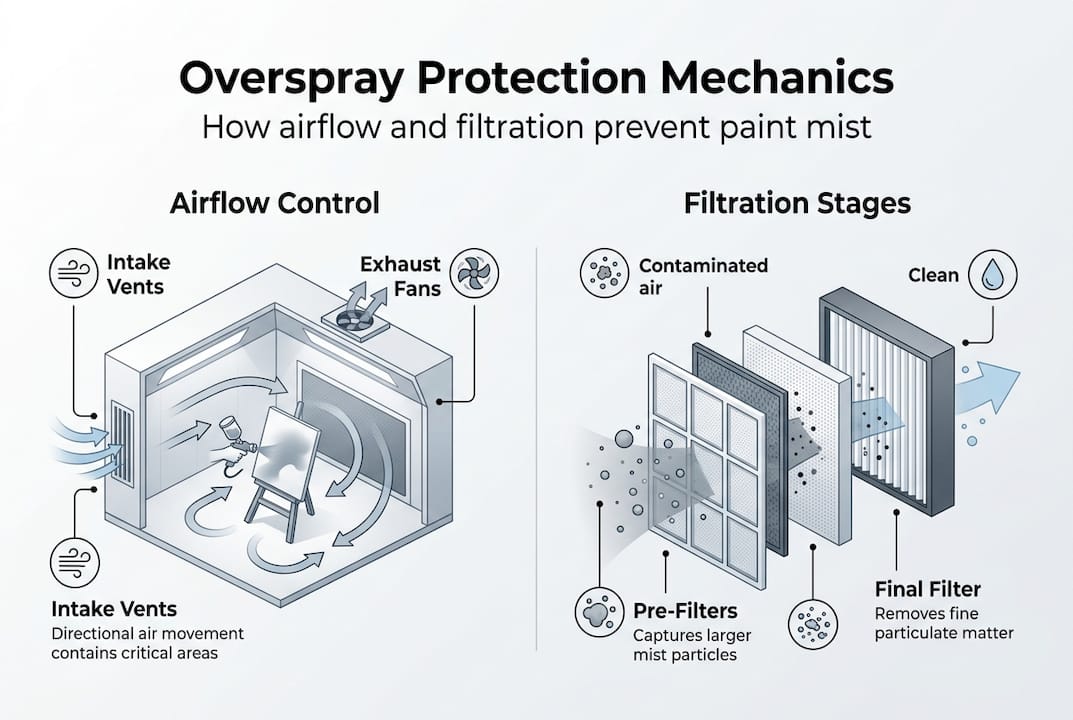
Controlling overspray requires understanding three interconnected systems that work together to capture and redirect paint particles. Booth airflow design forms the foundation by establishing how air moves through the workspace. Downdraft booths pull air vertically downward through floor grates, carrying overspray away from the vehicle and operator. Crossdraft systems move air horizontally from intake to exhaust, creating a side-to-side flow pattern. Each design influences particle trajectory and capture efficiency. Downdraft configurations typically provide superior contamination control because gravity assists particle movement toward filters.

Multi-stage filtration captures overspray at different points in the airflow path. Pre-filters installed at air intake points remove ambient dust before it enters the booth. Ceiling filters positioned above the work area catch larger paint particles during application. Exhaust filters at exit points trap remaining particles before air releases outdoors. High-efficiency filters rated 95%+ capture microscopic paint droplets that would otherwise escape or recirculate. Filter media selection depends on paint chemistry, with water-based coatings requiring different specifications than solvent-based products.
Spray gun technology significantly impacts overspray generation. Different systems atomize paint with varying efficiency levels:
| Gun Type | Transfer Efficiency | Overspray Level | Best Application |
|---|---|---|---|
| HVLP | 65-75% | Low | Basecoats, clearcoats |
| LVLP | 60-70% | Medium-low | Primers, sealers |
| Conventional | 35-50% | High | Industrial coatings |
| Airless | 50-60% | Medium | Texture coatings |
Optimal spray gun settings minimize waste while maintaining coverage quality. Operating pressure below 10 PSI reduces paint atomization into fine mist particles. Selecting the correct nozzle size for paint viscosity ensures proper flow without excessive atomization. Maintaining 6 to 8 inches between gun and surface prevents bounce-back that creates airborne particles.
Operator technique influences overspray as much as equipment selection. Consistent gun speed prevents heavy application that causes runs and excess mist. Overlapping each pass by 60 to 70% ensures even coverage without redundant spraying. Maintaining perpendicular gun angle to the surface directs paint efficiently rather than deflecting it into the air. These fundamentals become second nature with practice but require initial training for new technicians.
Pro Tip: Replace booth filters on a scheduled interval rather than waiting for visible contamination. Clogged filters reduce airflow velocity, allowing overspray particles to remain suspended longer and increasing surface contamination. Monitor pressure differential across filter banks to identify when replacement becomes necessary, typically when pressure drop exceeds manufacturer specifications. Understanding how air quality impacts finish results helps shops optimize filter maintenance timing. Regular spray booth maintenance prevents small issues from becoming costly problems. Research on HVLP overspray reduction demonstrates measurable improvements in transfer efficiency.
Peelable booth coatings: a practical solution for overspray protection
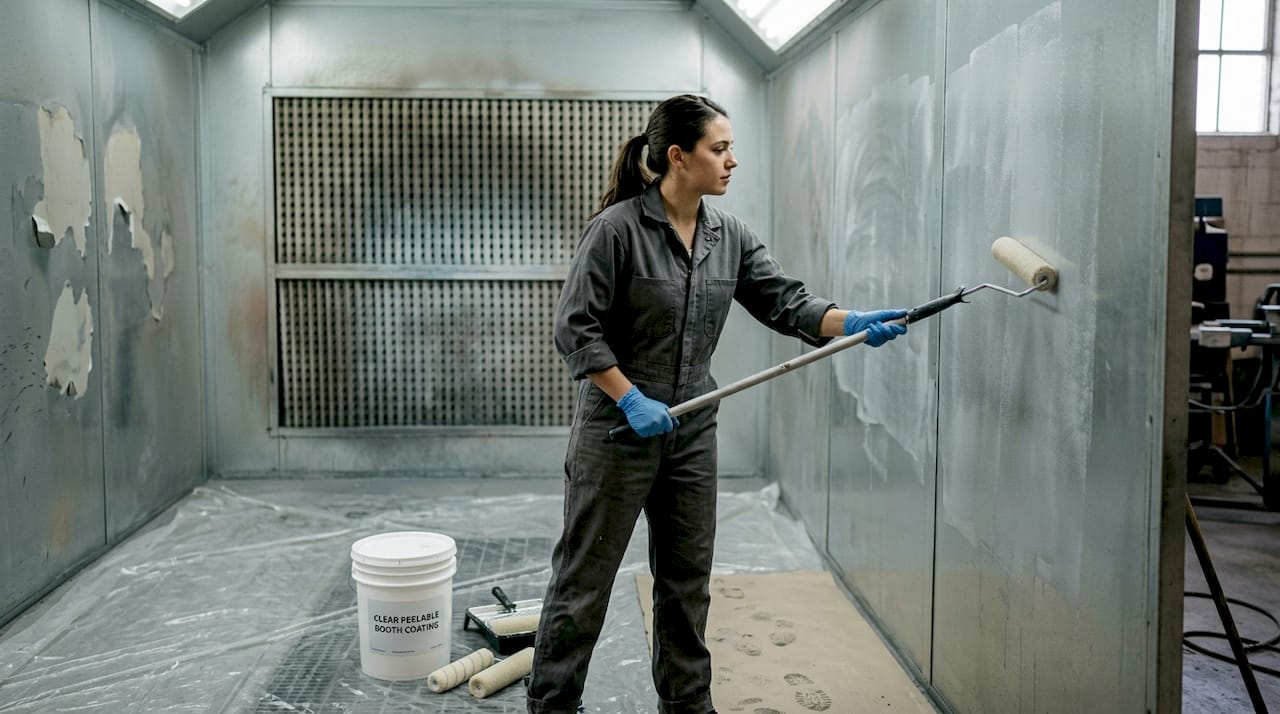
Peelable spray booth coatings represent an innovative approach to managing overspray accumulation on booth surfaces. These specialized products apply as liquid films that dry to form protective barriers over walls, windows, and equipment. Popular brands include 3M Booth Coating, ProtectaPeel, and Spraymask, each formulated for automotive refinishing environments. Unlike permanent paint that requires chemical strippers for removal, peelable coatings protect surfaces for 300 to 500 cycles or approximately six months before peeling away with accumulated overspray.

Application methods vary by product formulation and booth size. Spray application using HVLP equipment provides fast coverage for large booth interiors, typically requiring 2 to 3 coats for adequate thickness. Roll-on application works well for smaller areas or touch-up zones, offering more control in tight spaces. Both methods require clean, dry surfaces for proper adhesion. Most coatings cure within 30 to 60 minutes, allowing shops to resume painting operations quickly. The dried film remains flexible enough to conform to surface contours while providing a smooth, non-stick finish that repels overspray.
The lifecycle of peelable coatings depends on paint volume and booth usage intensity. High-volume shops spraying 10 to 15 vehicles daily may need replacement every three months. Lower-volume operations extending to six months between applications. Visual indicators signal replacement time: heavy overspray buildup, difficulty peeling, or coating degradation. Planning reapplication during slower periods minimizes operational disruption.
Benefits extend beyond simple cleanup convenience:
- Drastically reduced labor hours spent scraping and chemical cleaning
- Preserved booth wall brightness maintaining optimal lighting conditions
- Protected windows and light fixtures extending equipment lifespan
- Minimal downtime during coating removal and reapplication
- Eliminated chemical stripper costs and associated disposal fees
Peelable coatings integrate seamlessly with existing filtration and airflow systems rather than replacing them. Coatings handle surface contamination while filters capture airborne particles. This complementary relationship maximizes protection by addressing overspray at multiple points. Shops combining both approaches report the cleanest booth conditions and most consistent finish quality.
Pro Tip: Schedule coating reapplication before overspray accumulation becomes excessive. Waiting too long makes peeling difficult and may require chemical assistance, negating the labor-saving benefit. Mark calendar reminders based on your shop’s typical cycle count to maintain easy removal. Implementing proper spray booth cleaning practices between coating applications extends protection effectiveness. Products like 3M Booth Coating offer proven performance in demanding automotive environments.
Advanced considerations and best practices for optimal overspray protection
Several nuanced factors influence overspray control effectiveness beyond basic equipment and technique. Paint viscosity affects atomization characteristics, with thicker materials requiring higher pressure that generates more overspray. Adjusting reducer ratios and nozzle sizes compensates for viscosity variations. Nozzle pressure must balance adequate atomization against excessive mist generation. Filter compatibility matters because water-based paints require different media than solvent-based products to prevent chemical degradation or reduced capture efficiency.
High-viscosity paints need adjusted pressure and nozzles to maintain proper flow without creating excessive mist. Clogged filters cause poor airflow that leaves particles suspended rather than captured. Water-based versus solvent paints demand compatible filter materials to prevent chemical breakdown. Extreme overspray on soft trim requires gentle removal methods like clay bars rather than aggressive scraping that damages surfaces.
Removing overspray from delicate vehicle components presents unique challenges. Soft plastic trim, rubber seals, and textured surfaces trap dried paint particles that resist standard cleaning. Clay bar treatment with lubricant safely lifts contamination without scratching. Chemical removers formulated for automotive finishes dissolve overspray but require careful application to avoid damaging underlying materials. Testing removal methods on inconspicuous areas prevents costly mistakes.
Regulatory compliance adds another dimension to overspray management. Environmental regulations mandate specific filter efficiency levels and replacement schedules to control VOC emissions. OSHA standards require adequate ventilation to protect worker health from paint fumes and particulates. Documentation of filter changes and air quality monitoring demonstrates compliance during inspections. Shops operating without proper controls face fines and potential shutdown orders.
Maintaining a reliable overspray protection system requires consistent attention:
- Monitor filter pressure differential weekly to identify degradation early
- Clean booth walls and equipment monthly even with protective coatings
- Calibrate spray equipment quarterly to maintain optimal settings
- Train operators annually on technique fundamentals and new products
- Review air quality data monthly to verify ventilation effectiveness
- Schedule professional booth inspections annually for comprehensive assessment
Expert refinishers emphasize that prevention through proper technique and maintenance proves more effective and economical than remediation after contamination occurs. Investing time in operator training and equipment upkeep reduces rework and material waste significantly. The cost of prevention remains a fraction of the expense associated with defect correction and customer dissatisfaction.
Pro Tip: Install air quality monitors that provide real-time feedback on particulate levels and ventilation performance. Modern sensors alert operators when conditions drift outside optimal parameters, enabling immediate corrective action before finish quality suffers. Understanding how to maintain automotive spray booths systematically prevents common issues. Learning to optimize booth efficiency reduces operating costs while improving results. Industry resources like I-CAR overspray removal techniques provide detailed guidance for challenging situations.
Explore dust-free film solutions for spray booth overspray protection
Dust Free Film manufactures premium peelable protective coatings specifically engineered for automotive spray booth environments. Our multi-layer electrostatic films adhere to booth walls and floors without adhesives, creating a barrier that captures overspray for easy removal. The patented dispenser system enables quick, bubble-free installation that minimizes booth downtime. When accumulated overspray reaches capacity, simply peel away the film and apply fresh protection in minutes.

Our heat-resistant, static-free formulations withstand the demanding conditions of high-volume refinishing operations. European manufacturing standards ensure consistent quality and durability across every roll. Custom configurations accommodate unique booth dimensions and layouts. Shops using Dust Free Film spray booth protection report dramatically reduced cleaning times and improved finish consistency. Explore our complete product line or request a quote tailored to your facility’s specific needs. Early adoption of protective films streamlines operations and enhances paint quality from the first application.
Frequently asked questions
What is overspray protection and why is it important?
Overspray protection prevents atomized paint particles from contaminating booth surfaces, equipment, and vehicle panels during spray application. It matters because uncontrolled overspray causes finish defects requiring costly rework, reduces booth lighting efficiency, and creates safety hazards from flammable paint accumulation.
How often should spray booth filters be replaced to control overspray?
Replace booth filters based on pressure differential monitoring rather than fixed schedules, typically when pressure drop exceeds manufacturer specifications. High-volume shops may need monthly replacement while lower-volume operations extend to quarterly intervals. Clogged filters reduce airflow velocity and allow overspray particles to remain airborne longer.
What are peelable coatings and how do they work?
Peelable coatings are liquid films applied to booth surfaces that dry into protective barriers capturing overspray accumulation. After 300 to 500 paint cycles or six months, the coating peels away with trapped overspray, eliminating scraping and chemical cleaning. Fresh coating reapplication restores protection in under an hour.
Which spray gun technology offers the best overspray reduction?
HVLP spray guns provide the best overspray reduction with 65 to 75% transfer efficiency compared to conventional guns at 35 to 50%. HVLP technology atomizes paint at lower pressure, creating larger droplets that travel to the surface rather than becoming airborne mist. This efficiency reduces material waste and booth contamination simultaneously.
Can overspray be removed from soft trim without damage?
Yes, clay bar treatment with lubricant safely removes overspray from soft trim, rubber seals, and textured surfaces without scratching. Automotive-specific chemical removers also work but require careful application and testing on inconspicuous areas first. Avoid aggressive scraping that damages delicate materials and creates more problems than it solves.