
TL;DR:
- European-made protective films utilize advanced aliphatic polyurethane chemistry, ensuring superior optical clarity and self-healing properties that last the vehicle’s lifetime. They operate under certified quality systems like ISO 9001 and IATF 16949, which significantly reduce regulatory and operational risks through documented compliance and traceability. These films also benefit from software-driven precision cutting, decreasing waste and installation errors, making them the preferred choice for professional automotive and industrial applications.
When it comes to protective films in automotive and industrial settings, the question of why choose European made protective films often gets dismissed as a branding exercise. That assumption costs professionals money. The reality is that European film manufacturers operate under certified quality management systems, use advanced polymer chemistry, and deliver documented compliance that directly affects performance, installation cost, and regulatory risk. This article breaks down the specific technical, operational, and compliance advantages that make European-made films the preferred choice for serious professionals.
Table of Contents
- Key takeaways
- Why choose European made protective films: the material science case
- Certified quality management and compliance
- Software-driven precision and operational efficiency
- European vs. non-European films: a practical comparison
- Selecting the right European film for your application
- My take on what actually separates good films from great ones
- Dustfreefilm’s European-quality protective films for your operation
- FAQ
Key takeaways
| Point | Details |
|---|---|
| Material science drives performance | Aliphatic polyurethane films from European manufacturers offer optical clarity and self-healing properties that protect surfaces over a full vehicle lifetime. |
| Certifications reduce risk | ISO 9001 and IATF 16949 compliance plus documented traceability directly lower financial and reputational exposure from product failure. |
| Precision cutting saves money | Software-driven millimeter templates reduce material waste, installation errors, and labor costs in professional applications. |
| Compliance is built in | European films certified to DOT-C2 and ECE 104 simplify downstream regulatory audits and certifications. |
| Selection requires verification | Choosing the right film means checking technical documentation and weathering data, not just country of origin. |
Why choose European made protective films: the material science case
The first real advantage is not marketing. It is chemistry. European-made car paint protection films use aliphatic polyurethane technology with permanent acrylic adhesives engineered specifically for high-impact areas. This matters because aliphatic PUR films maintain high optical clarity and resist yellowing across the entire visible spectrum, including on white and light-colored paint systems where any discoloration is immediately obvious.
Self-healing surface properties are perhaps the most underappreciated benefit of European film quality advantages. When a film with a self-healing top coat sustains a light scratch, ambient heat causes the polymer network to reflow and close the mark. Installers working on luxury vehicles regularly see this in action after a warm summer day. No buffing. No replacement. The damage simply disappears.
UV resistance compounds that benefit over time. UV resistance and self-healing coats on European car paint films prevent discoloration and gloss loss, protecting warranties and customer satisfaction for years after installation.
Key material advantages of European-made protective films include:
- Optical clarity: Films remain visually invisible and do not alter the underlying paint’s appearance, even on white finishes throughout the vehicle lifetime.
- Self-healing topcoats: Minor scratches repair at ambient temperatures, reducing maintenance calls and customer complaints.
- UV stabilization: Advanced UV inhibitors prevent the yellowing and embrittlement that shorten film lifespan in sun-exposed applications.
- Adhesive precision: Permanent acrylic adhesives bond securely without damaging paintwork on removal, critical for OEM and aftermarket applications.
- Durability in industrial use: Material durability in protective films for spray booths demands heat resistance and static control, both areas where European polymer engineering excels.
Pro Tip: When evaluating UV resistance claims, request weathering test data specific to your climate zone. A film tested to 1,000 hours of xenon arc weathering may perform very differently in Arizona versus northern Germany.
Certified quality management and compliance
The benefits of European protective films extend well beyond raw material performance. European manufacturers operate under quality management frameworks that generate documented, auditable proof of performance. This is not a soft advantage. For automotive suppliers and industrial contractors, compliance documentation is a hard operational requirement.
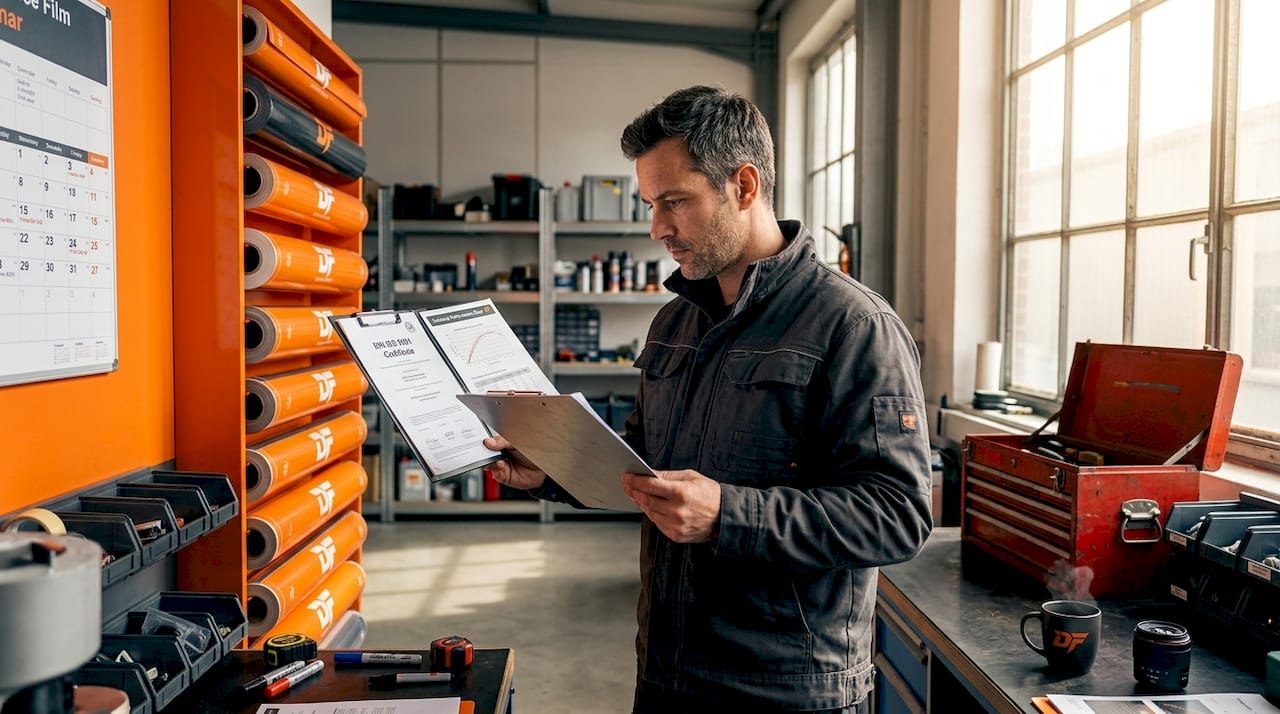
Certified material supply and documented QC data simplify final certification processes and reduce the financial and reputational risks that come from product failure or regulatory non-compliance. Professionals who have dealt with a failed certification audit understand exactly how expensive that lesson is.
The compliance chain for properly certified European films typically works like this:
- ISO 9001 certification: Covers the manufacturer’s quality management system, confirming that processes for design, production, and testing follow internationally recognized standards.
- IATF 16949 certification: Builds on ISO 9001 specifically for automotive supply chains, adding requirements for defect prevention, reduction of variation, and waste minimization.
- Product-level certifications: Films for specific applications carry standard-specific marks. Reflective safety films, for example, are certified to DOT-C2 and E-MARK standards under ECE 104, covering both North American and European regulatory requirements.
- Full traceability documentation: Every production lot includes test reports, material batch records, and application guidance that support downstream audits without extra legwork from the installer or contractor.
“Compliance with standards like DOT-C2 and ECE 104 is critical for safety-sensitive film applications. Documented test reports and traceability provided by European manufacturers simplify certification and reduce financial exposure significantly.” — Rina Technology
European manufacturers like Neoxum produce protective films under strict DIN ISO 9001 certification with short supply chains that reduce ecological footprints while maintaining consistent quality across industrial markets. Every film undergoes contour, surface, and functional testing before shipment. That level of pre-delivery verification is not standard practice everywhere. Understanding these requirements thoroughly is well served by reviewing industry standards for spray booth films and how European compliance protocols integrate into operational workflows.
Software-driven precision and operational efficiency
One of the most tangible advantages of using European films is the precision workflow that the best European suppliers bundle with their products. This is where the advantages of using European films translate directly into shop-floor cost savings.
Proprietary cutting software from suppliers like Puris Europe generates millimeter-precise PPF templates for an enormous range of vehicle models. Those templates feed directly into automated cutting machines, producing film cuts that fit exactly the first time. The result: fewer reworks, less wasted material, and faster installation times on every job.
Operational benefits for professional installers include:
- Reduced material waste: Precision templates eliminate the guesswork that leads to trimming errors and discarded film.
- Consistent results: Automated cutting removes human variability from the most error-prone step of the installation process.
- Faster turnaround: Installers at automotive paint protection film shops report measurable reductions in per-vehicle time when working with software-generated patterns versus manual templates.
- Lower labor costs per job: Fewer reworks and corrections directly reduce the billable hours absorbed by mistakes.
- Scalability: Software integration with automated cutters ensures consistent fit across high-volume production lines, not just individual custom installations.
Pro Tip: Before committing to a film supplier, ask specifically whether their cutting software database includes your most common vehicle makes and model years. Gaps in coverage mean your team is back to manual fitting for those vehicles, which eliminates the efficiency advantage.
European vs. non-European films: a practical comparison
The decision to invest in European films comes down to lifecycle value and risk management, not just the price per roll. Here is an honest side-by-side look at the critical factors:
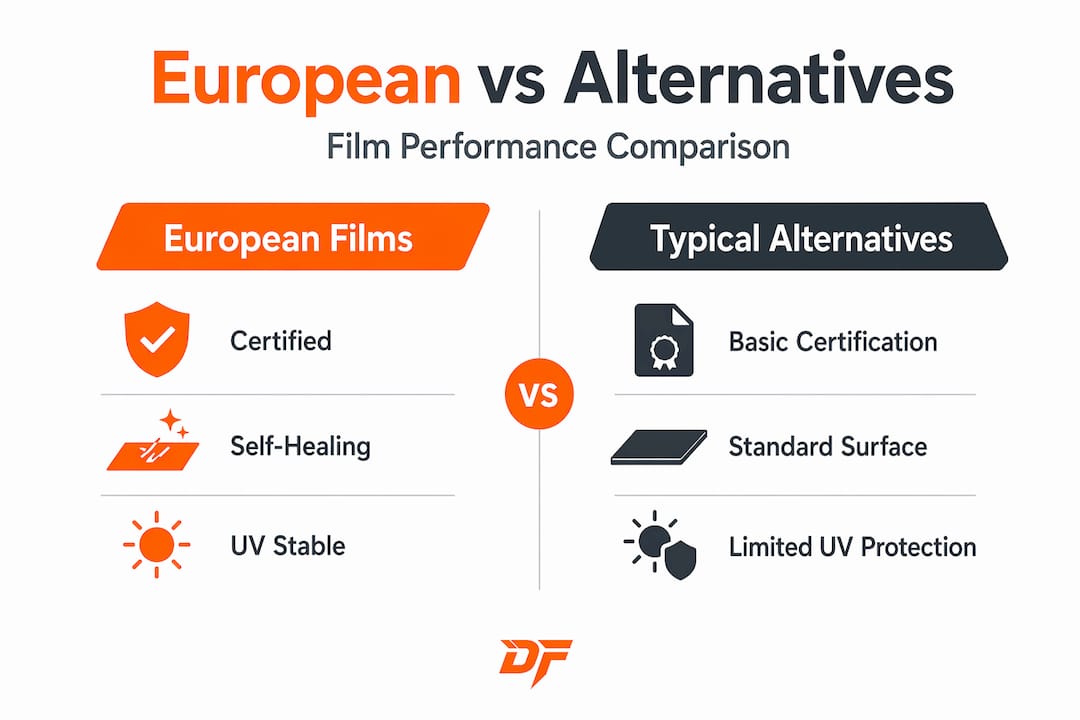
| Factor | European-made films | Typical alternatives |
|---|---|---|
| Material technology | Aliphatic PUR with UV stabilization and self-healing topcoat | Often standard PVC or basic polyurethane without advanced coatings |
| Optical clarity | Maintained throughout vehicle lifetime, no yellowing | Variable; yellowing and haze common within 2-3 years |
| Compliance documentation | Full ISO, IATF, DOT-C2, E-MARK certification with traceability | Often limited; certification depth varies widely |
| Cutting precision | Proprietary software templates, millimeter accuracy | Manual templates or basic digital patterns with higher error rates |
| Installation waste | Low, due to precision pre-cut patterns | Higher, due to fit inconsistencies and manual trimming |
| Rework rate | Low, documented through quality management data | Higher, especially for complex body panels |
| Industrial corrosion protection | VCI films combining mechanical containment and vapor inhibition | Typically single-function; less effective under fluctuating conditions |
| Long-term cost | Higher upfront, lower total cost of ownership | Lower upfront, higher total cost from failures and reworks |
The long-term arithmetic is straightforward. A film that fails after eighteen months, triggers a warranty claim, or causes a certification audit failure costs far more than the premium on a certified European product. VCI stretch films illustrate this clearly in industrial shipping contexts: their dual function of load containment plus active corrosion inhibition through vapor release prevents rust and oxidation on metal surfaces during storage, reducing product damage claims that single-layer alternatives simply cannot address.
The reasons why select European protective films over alternatives also include supply chain transparency. Short supply chains from European manufacturers mean faster problem resolution, accessible technical support, and a consistent product formulation that does not shift batch to batch without notice.
Selecting the right European film for your application
Understanding the European made film features available is only useful if you can translate them into the right product selection for your specific application. Here is a practical framework:
-
Define your primary protection requirement. Paint protection on high-impact zones like hoods and front bumpers demands the optical clarity and self-healing properties of aliphatic PUR films. Industrial corrosion protection during shipping demands VCI functionality. Spray booth protection demands heat resistance, static control, and multi-layer durability.
-
Assess your environmental exposure. UV load, temperature cycling, humidity, and chemical exposure all affect film performance. Request weathering test data matched to your conditions. As deep knowledge in this field confirms, vehicle lifetime durability claims must be validated against specific paint types, climates, and maintenance regimes before you commit.
-
Verify regulatory requirements upfront. For safety-sensitive applications, confirm that the film carries the specific certifications required in your market. A film certified to DOT-C2 in the United States and E-MARK under ECE 104 in Europe covers most professional needs, but specialty industrial applications may require additional documentation.
-
Evaluate the supplier’s installation support. A supplier who provides cutting software, template libraries, and technical support transforms from a vendor into a workflow partner. The operational cost savings from efficient spray booth protection are only fully realized when the film and the application process work together.
-
Plan for maintenance and warranty. Confirm what the manufacturer’s warranty covers, what maintenance the film requires, and whether the supplier provides technical support for issues after installation. Certified European manufacturers carry comprehensive warranty documentation backed by traceable production records.
My take on what actually separates good films from great ones
I’ve spent years watching professionals in auto body shops and industrial facilities buy protective films on price and regret it within a season. The conversation about why invest in European films usually starts after an expensive failure, not before.
Here is what I’ve learned: “Made in Europe” on its own tells you almost nothing. What matters is whether the supplier can hand you a certification package that includes ISO or IATF scope, product-specific test reports, and weathering data. If they cannot produce that documentation in thirty minutes, the compliance advantage does not exist in practice.
The precision cutting software story is the one that surprises most professionals. I’ve seen shops cut their per-vehicle film waste by over 20% simply by switching to a supplier whose template library covered their most common models. That is not a marginal improvement. At volume, it changes the economics of the whole operation.
My advice: start with your compliance requirement, then verify the material performance data, then evaluate the installation workflow support. The origin label follows naturally once you run that checklist. European manufacturers dominate the top of that list because the standards environment they operate in demands it, not because geography is a proxy for quality.
— Dust
Dustfreefilm’s European-quality protective films for your operation
Dustfreefilm has built its product line around exactly the standards and performance criteria covered in this article. Since 2012, Dustfreefilm has manufactured premium dust protection films for spray booths that meet the heat resistance, static control, and multi-layer durability requirements of professional automotive refinishing and industrial painting operations.
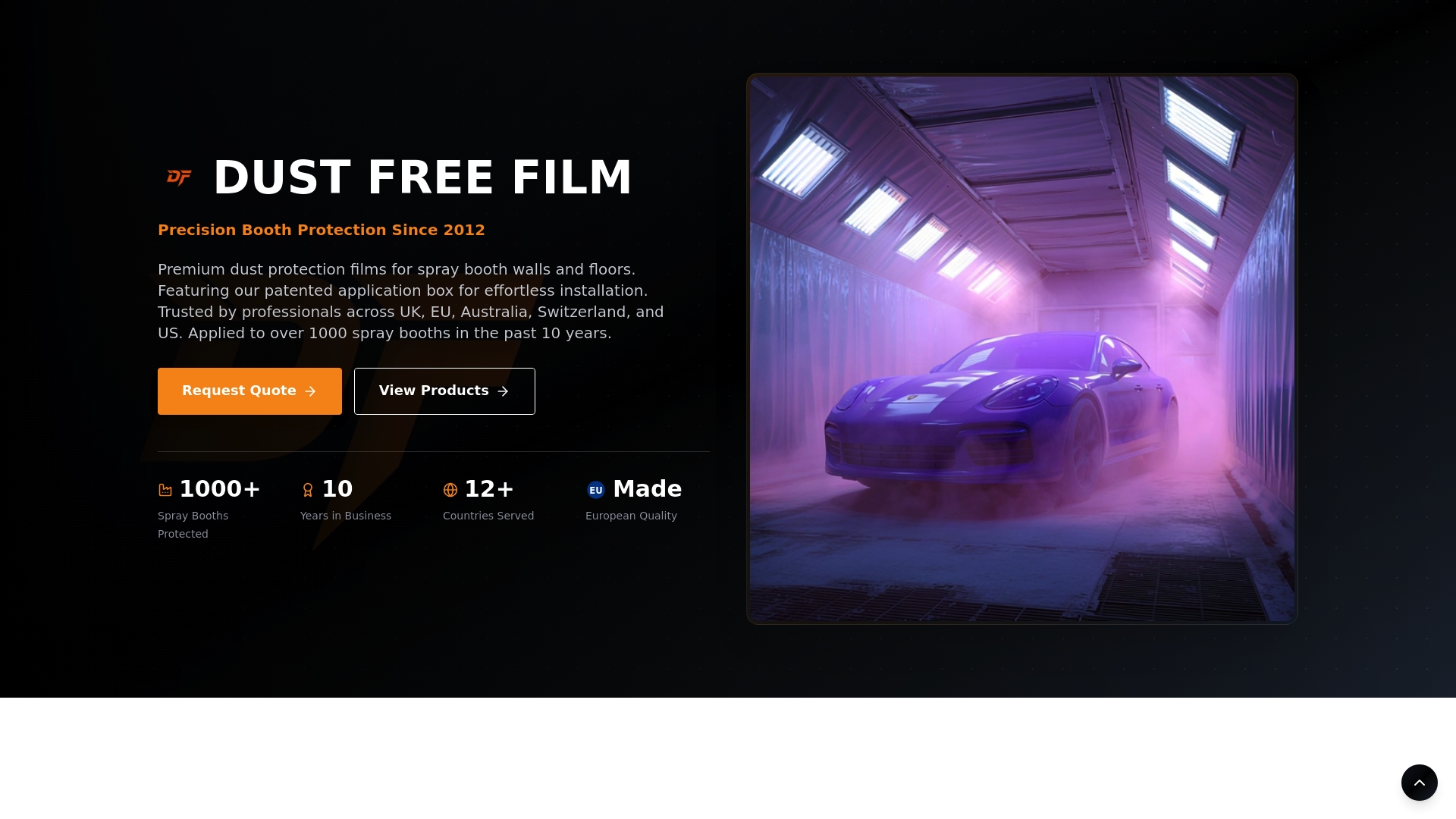
Every Dustfreefilm product reflects European manufacturing standards, with patented multi-layer booth wall and floor protectors engineered for quick, bubble-free installation and high-traffic industrial durability. Custom configurations and bulk purchasing options are available for large-scale operations. Whether you need tailored guidance on product selection or want to discuss a high-volume order, visit Dustfreefilm’s spray booth protection page or go directly to the request a quote page to connect with the team.
FAQ
What makes European protective films better than other options?
European films combine aliphatic polyurethane chemistry, UV stabilization, and self-healing surface technology with certified quality management systems. That combination delivers measurably better optical clarity, durability, and documented compliance than most alternatives.
How do I verify that a European film is properly certified?
Ask the supplier for ISO 9001 or IATF 16949 certification scope, product-level test reports, and traceability documentation. Certified manufacturers provide this package readily; those without genuine certification cannot.
Are European protective films worth the higher upfront cost?
Yes, in most professional applications. Reduced rework rates, lower material waste from precision cutting, and avoided compliance failures produce a total cost of ownership that typically justifies the premium within the first contract cycle.
What certifications should I look for in automotive protective films?
For automotive applications, look for ISO 9001 or IATF 16949 quality management certification, plus product-level marks like DOT-C2 for North American use or E-MARK under ECE 104 for European markets.
Can European films be used in industrial spray booth applications?
Yes. European-made films designed for spray booths are engineered for heat resistance, static control, and multi-layer durability. Spray booth installation processes using European-quality films deliver cleaner finishes and longer protection cycles than standard alternatives.