

TL;DR:
- Dust poses serious fire, health, and quality risks often overlooked in workshops.
- Effective dust control reduces defects, rework costs, and enhances profitability through layered strategies.
- Ongoing monitoring and a cultural shift are essential for maintaining a dust-free, compliant environment.
Most workshop managers assume that a clean-looking floor and a good ventilation system are enough to keep dust under control. That assumption is costing shops real money, real downtime, and in some cases, real lives. Dust is not just a housekeeping issue. It is a fire risk, a quality killer, and a compliance liability that compounds quietly until something goes very wrong. This article breaks down the actual data behind workshop dust hazards, shows you how dust directly eats into your profit margins, and lays out the layered strategies that separate high-performing shops from ones stuck in a cycle of rework and reactive fixes.
Table of Contents
- The real risks of dust accumulation in workshops
- How dust control impacts workshop quality and profitability
- Best practices: Multi-layered dust control strategies
- Common mistakes and overlooked nuances in workshop dust control
- Why dust control is more than compliance — our view
- Take your workshop’s dust control to the next level
- Frequently asked questions
Key Takeaways
| Point | Details |
|---|---|
| Major safety risks | Unchecked dust leads to fire and explosion hazards that can shut down a workshop. |
| Quality and cost impact | Dust increases paint defects and costly rework, harming both profit and reputation. |
| Layered control is vital | Combining source capture, airflow management, and housekeeping achieves the best results. |
| Beware common mistakes | Sweeping or visible cleaning alone rarely solves the underlying dust issue. |
The real risks of dust accumulation in workshops
Now that we have challenged the assumption that dust is just a minor nuisance, it is crucial to understand the serious risks lurking in workshop environments. Most people think of dust as a surface problem. Wipe it down, sweep it up, and you are done. But in automotive refinishing, industrial painting, and manufacturing environments, dust behaves very differently from what you see on a shelf at home.
Combustible dust, which refers to fine solid particles that can ignite when suspended in air at sufficient concentrations, is one of the most underestimated hazards in industrial settings. The particles themselves are not always visible to the naked eye, and that is exactly what makes them dangerous. A surface that looks clean can still harbor enough airborne particulate to create explosive conditions.
The numbers make this concrete. In 2023 alone, there were 53 explosions and 263 fires attributed to combustible dust accumulation in industrial facilities. These are not freak accidents. They are predictable outcomes of underestimated risk.
“Dust control is not optional in industrial environments. It is the difference between a managed workspace and a liability waiting to be triggered.”
Regulatory bodies have taken notice. NFPA 660, the consolidated standard for combustible dust, now requires facilities to conduct a formal Dust Hazard Analysis (DHA). A DHA is a structured review of where combustible dust is generated, how it travels, and what conditions could trigger ignition. Many workshop managers are unaware that this requirement applies to them, particularly in spray painting and sanding operations.
Beyond fire and explosion, the risks branch out into other costly territory:
- Health exposure: Fine particulate matter causes respiratory disease over time, increasing worker sick days and long-term liability
- Equipment damage: Dust infiltrates motors, filters, and precision tools, shortening their service life
- Production downtime: A single dust-related incident can shut down a production line for days
- Legal liability: Non-compliance with NFPA 660 or OSHA standards can result in significant fines and civil exposure
One of the most common patterns we see is that workshops focus on visible cleanliness while ignoring airborne particle counts. Understanding how dust affects paint quality is the first step toward recognizing that the problem is three-dimensional, not just surface-level. The dust you cannot see is often the dust doing the most damage.
How dust control impacts workshop quality and profitability
With safety and compliance risks clear, let’s examine how dust control directly affects operational outcomes, from paint quality to profit margins.
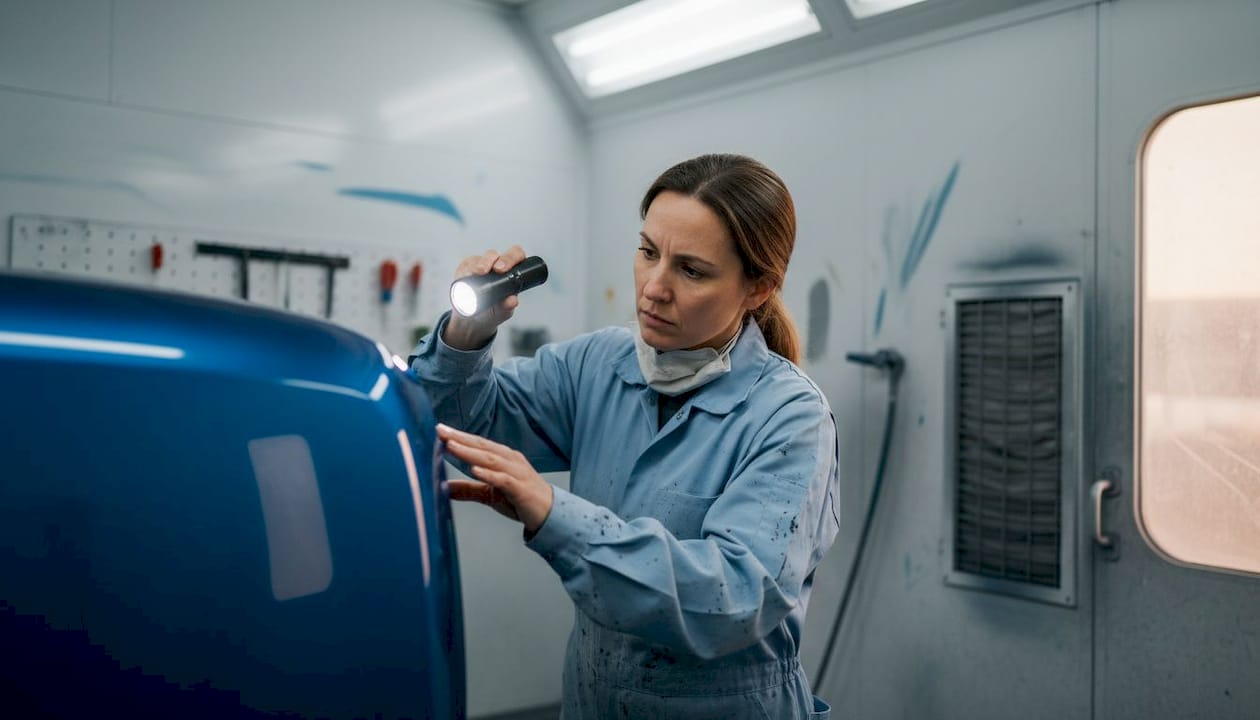
Every particle that lands on a freshly painted surface is a defect. In automotive refinishing, even microscopic contamination creates fish-eye, cratering, or texture irregularities that require sanding and repainting. In high-volume industrial painting, these defects multiply fast. Paint defect rates of 5 to 15% are common across the industry, and in a plant producing 1,000 vehicles per day, rework costs can reach $50,000 to $150,000 daily. That is not a rounding error. That is a structural drain on profitability.
Here is a simplified view of how dust control levels translate to operational outcomes:
| Dust control level | Defect rate | Estimated daily rework cost | Finish quality |
|---|---|---|---|
| Minimal (reactive only) | 12 to 15% | $100,000 to $150,000 | Inconsistent |
| Moderate (partial controls) | 7 to 11% | $50,000 to $100,000 | Acceptable |
| Strong (layered, proactive) | Below 5% | Under $50,000 | Consistently high |
The connection between cleaner environments and better finishes is not theoretical. Shops that implement consistent, verified dust controls see measurable reductions in rework cycles. That means faster throughput, lower material waste, and stronger customer satisfaction scores.
Technology is accelerating this shift. AI-powered defect detection systems now identify paint surface anomalies in real time, flagging contamination issues before a vehicle leaves the booth. These systems are only as effective as the environment they operate in. A dusty booth generates so many false signals and real defects that even the best detection software cannot compensate.
Here is a practical sequence for moving from a reactive to a proactive dust control posture:
- Audit your current defect rate and trace the root cause back to contamination sources
- Map dust generation points including sanding stations, entry zones, and HVAC returns
- Install source capture systems at the highest-risk generation points
- Verify airflow performance under actual operating conditions, not just during idle checks
- Add physical barriers such as booth wall and floor protection films to prevent particle migration
For a deeper look at how this plays out in practice, the connection between industrial painting dust control solutions and finish quality is well-documented. Shops that treat dust control as a quality system, not just a safety checkbox, consistently outperform those that do not. Exploring elevating paint quality with dust management and preventing paint defects gives you a clearer picture of what best-in-class looks like.
Best practices: Multi-layered dust control strategies
Knowing dust’s impact on quality and profit, an intentional, multi-layered strategy is essential. Here is how experts recommend building your protocol.
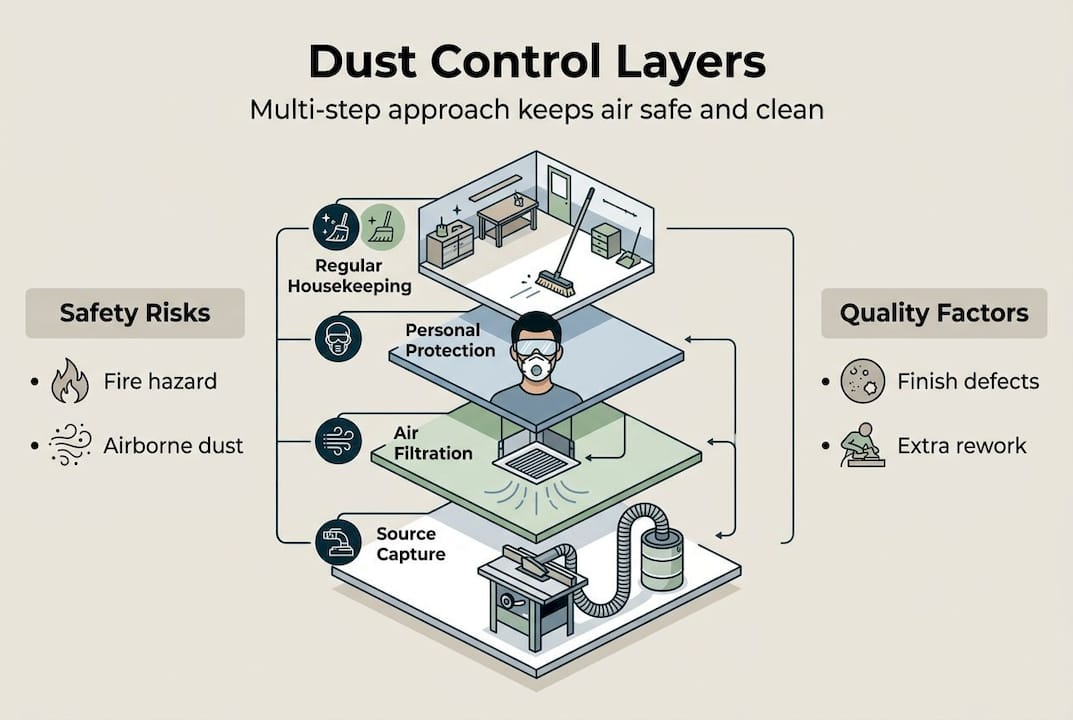
The single biggest mistake in workshop dust control is treating it as a single-point solution. One filter, one exhaust fan, one cleaning schedule. Real dust control requires overlapping layers, each one catching what the previous layer misses.
Experts at CCOHS spray painting safety guidance are explicit: verify airflow under actual operating load, not during idle conditions. A ventilation system that performs well when the booth is empty can fail to maintain adequate air changes when painters, equipment, and heat sources are all active simultaneously.
| Approach | Method | Effectiveness |
|---|---|---|
| Reactive | Sweep after shifts, replace filters when clogged | Low: misses airborne particles |
| Proactive | Source capture, verified airflow, protective films | High: addresses dust at origin and in transit |
Here is the layered approach that consistently delivers results:
- Source capture first: Install local exhaust ventilation directly at sanding and grinding stations to pull dust before it becomes airborne
- Airflow verification: Test your booth’s air changes per hour under full operational load, not just on paper
- Physical protection: Use multi-layer booth wall and floor films to prevent settled dust from being re-suspended
- Housekeeping with the right tools: Use HEPA-equipped vacuums. Never sweep dry dust or use compressed air to blow surfaces clean
- Scheduled monitoring: Check filter loading, air pressure differentials, and surface contamination on a fixed schedule
Pro Tip: Banning compressed air for cleaning is one of the fastest wins available to any workshop. Blowing compressed air across a surface does not remove dust. It launches it into the air, where it stays suspended for hours and settles directly onto wet paint.
For shops working toward achieving flawless finishes, the layered approach is not optional. It is the baseline. Reviewing paint booth dust control methods gives you a practical framework for implementing each layer systematically.
Common mistakes and overlooked nuances in workshop dust control
Even well-intentioned dust control plans can fall short due to common assumptions and missed details. Here is what often goes wrong, and how you can get it right.
The most persistent mistake is equating visible cleanliness with actual air quality. A booth can look spotless and still have airborne particle counts that will ruin a finish. Visible dust is the fraction that has already settled. The particles still suspended in the air are the ones contaminating your paint.
General cleaning methods are frequently misapplied. Street sweeping is inconsistent for PM reduction, and the same principle applies inside workshops. Dry sweeping, blowing, or using standard mops redistributes fine particulate rather than removing it. Source control must be prioritized over general cleaning.
Here are the most common errors we see across automotive and industrial painting facilities:
- Checking airflow at idle: Systems that pass idle inspections can still underperform when the booth is fully loaded with heat, personnel, and active spray equipment
- Skipping filter schedules: Clogged filters reduce airflow efficiency and allow particle bypass, often without triggering any visible alarm
- Relying on visual inspection: Air quality requires measurement, not observation. Particle counters give you actual data
- Ignoring re-entry points: Dust tracked in on shoes, clothing, and equipment wheels is a major contamination source that most protocols overlook
- One-time setup thinking: Dust control is not a one-time installation. It requires ongoing monitoring, adjustment, and team training
Pro Tip: Build dust control verification into your pre-shift checklist, not just your monthly maintenance log. A five-minute check of filter pressure, air movement, and surface condition before each shift catches problems before they affect production.
Creating dust-free environments requires a cultural shift as much as a technical one. Every person who enters the booth is either part of the solution or part of the contamination problem. Training matters as much as equipment.
Why dust control is more than compliance — our view
Having examined the technical and operational sides, let us step back and address the bigger strategic opportunity that dust control presents.
Most workshops approach dust control the same way they approach fire extinguisher inspections: do the minimum required, check the box, move on. That mindset is leaving serious competitive advantage on the table.
When you treat dust control as a strategic investment rather than a regulatory obligation, the returns are compounding. Fewer defects mean faster cycle times. Faster cycle times mean more vehicles processed. More vehicles processed with better finishes mean stronger customer retention and word-of-mouth referrals. The math is not complicated, but it requires a shift in how you frame the investment.
We have seen shops that cut paint defects by 90% simply by upgrading their booth protection and tightening their airflow protocols. That is not a marginal improvement. That is a transformation in output quality that customers notice immediately.
The uncomfortable truth is that dust control is one of the few areas where doing it right is also doing it profitably. The cost of protection is a fraction of the cost of rework, downtime, and reputation damage. Shops that understand this are not just safer. They are more competitive, more efficient, and more trusted by their customers.
Take your workshop’s dust control to the next level
Ready to go from theory to impact? Here is how you can implement world-class dust control in your workshop today.
The evidence is clear: dust control is not a background task. It is a core operational discipline that directly determines your finish quality, your rework costs, and your team’s safety. The good news is that the right tools make implementation straightforward.

At Dust Free Film, we have been engineering premium booth protection solutions since 2012, built specifically for the demands of automotive refinishing and industrial painting. Our multi-layer electrostatic films install quickly without bubbles, resist heat, and eliminate the static that attracts airborne particles back onto surfaces. Whether you manage a single bay or a large-scale production facility, we have configurations that fit your operation. Request a quote today and take the first concrete step toward a cleaner, more profitable workshop.
Frequently asked questions
What is combustible dust and why is it dangerous in workshops?
Combustible dust consists of fine particles that can ignite and cause fires or explosions when suspended in air at sufficient concentrations. In 2023, 53 explosions and 263 fires were linked to combustible dust in industrial facilities, making it a well-documented and serious hazard.
How does dust affect painted finishes and workshop production quality?
Dust causes surface defects including cratering and texture irregularities that require costly rework. Paint defect rates of 5 to 15% are typical across the industry, translating to tens of thousands of dollars in daily rework costs at high-volume plants.
What are the most effective dust control strategies for workshops?
A layered approach combining source capture ventilation, verified airflow under operating load, and proper housekeeping delivers the strongest results. CCOHS guidance specifically advises against sweeping or using compressed air, as both worsen airborne particle counts.
Why isn’t general cleaning or street sweeping enough for dust control?
General cleaning methods redistribute fine particulate rather than removing it, and street sweeping is inconsistent for PM reduction. Source control at the point of dust generation must be the foundation of any effective workshop dust management plan.