

TL;DR:
- Controlling surface dust is essential for defect-free refinishing, reducing rework, and protecting shop reputation. Regulatory standards, such as EPA NESHAP 6H and ISO 8502, mandate high-efficiency filtration and surface cleanliness to ensure compliance. Implementing dust-free systems improves efficiency, quality, safety, and long-term profitability for automotive and industrial paint facilities.
Surface dust is the hidden saboteur in every refinishing operation, and most shops don’t realize how much it’s costing them until a job comes back. Even a single contaminated pass through a spray booth can produce defects that require full rework, wasted materials, and unhappy customers. Dust doesn’t discriminate between a quick single-stage job and a high-value multi-step restoration. If airborne particles are present when coatings go down, quality suffers. This guide breaks down exactly why dust-free refinishing is no longer a luxury for high-end shops but a baseline requirement for any facility serious about efficiency, compliance, and reputation.
Table of Contents
- How dust causes paint defects and costly problems
- Regulatory and industry standards: Compliance isn’t optional
- Dust-free refinishing: The business case for efficiency, safety, and quality
- Implementing dust-free refinishing: Practical steps for shops and facilities
- Why the obsession with dust-free refinishing is justified — but not for the reasons you think
- Ready for flawless results? Start your shop’s dust-free transformation
- Frequently asked questions
Key Takeaways
| Point | Details |
|---|---|
| Dust causes major paint flaws | Airborne particles are a leading cause of finish defects, rework, and lost revenue in refinishing operations. |
| Compliance is essential | Modern regulations make dust control mandatory, with steep penalties for non-compliance. |
| Dust-free boosts efficiency | Facilities using dustless systems see faster turnaround, fewer health issues, and improved reputation. |
| Implementation needs focus | Success means investing in the right equipment, climate control, and staff training as a cohesive strategy. |
How dust causes paint defects and costly problems
To understand the true impact, let’s look at the damage even a little dust can do in a refinishing environment.
Airborne dust particles don’t need to be visible to the naked eye to ruin a finish. Micro particles as small as 10 microns can settle into wet coatings within seconds, and once they’re embedded, your options are limited: cut, buff, sand, and repaint, or live with a defective finish. Neither option is good for your bottom line or your reputation.
Preventing paint defects starts with understanding where contamination enters the process. Dust doesn’t only come from the outside. It comes from walls, floors, previous sanding operations, clothing, and even the vehicle itself. Each of these sources contributes to a constantly replenished pool of airborne particles just waiting to land on your freshly applied topcoat.
Dust-free refinishing prevents paint defects such as nibs, fisheyes, and uneven sheen caused by airborne particles settling in wet coatings. The impact is not just cosmetic. Structural adhesion can fail, clearcoat can delaminate prematurely, and the overall lifespan of the finish is compromised. A customer who returns with peeling paint six months after a repair is rarely satisfied with an explanation that “dust happened.”
Contaminants like silicone or oils cause fisheyes in paint, often from poor dust control or prep, leading to adhesion failure. Fisheyes appear as small craters or circular depressions in the paint film. They’re one of the most frustrating defects because they show up after the paint is already applied, meaning you don’t catch the problem until it’s already a problem.
The most damaging outcomes of uncontrolled dust in refinishing operations include: nibs that require sanding and buffing after cure, fisheyes that require stripping and reapplication, uneven sheen that reads as an obvious quality failure to customers, and adhesion failures that create liability exposure for your shop. Each of these defects carries a real dollar cost in labor, materials, and lost shop time.
Common paint flaws caused by poor dust control include:
- Nibs: Hardened dust particles embedded in the clear or basecoat, visible as tiny bumps
- Fisheyes: Circular craters caused by contamination breaking the surface tension of wet paint
- Orange peel amplification: Dust disrupts the leveling process, making orange peel worse
- Cloudiness or milky sheen: Particularly in clearcoats, dust scatter creates a diffused, dull appearance
- Adhesion failure: Contamination between layers prevents proper bonding, leading to peeling
- Runs and sags: Dust can redirect paint flow, contributing to uneven film thickness
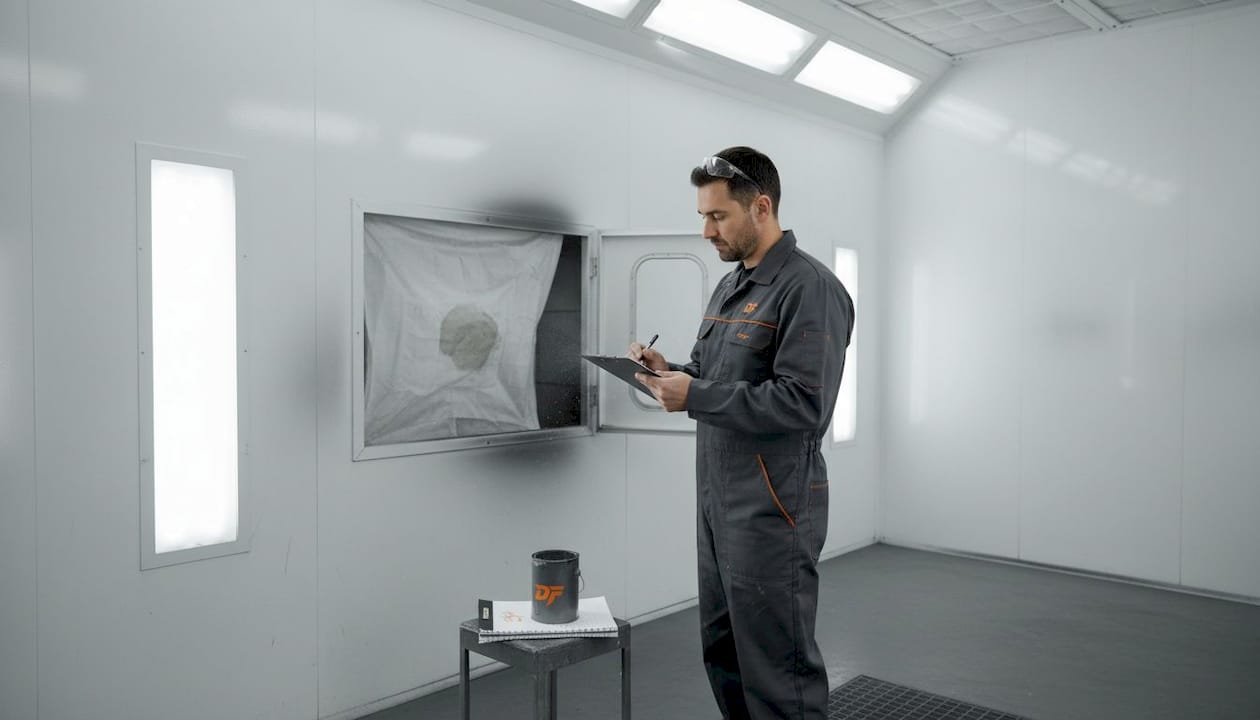
Understanding air quality in spray booths is a direct prerequisite for reducing these defects. If you haven’t audited your booth’s air cleanliness recently, now is the time.
Regulatory and industry standards: Compliance isn’t optional
Beyond financial risks, failing to control dust can put your shop at risk of non-compliance with strict air quality and surface standards.
The regulatory landscape for automotive refinishing has tightened considerably over the past decade, and it will only get more demanding. EPA NESHAP 6H requires spray booths in automotive refinishing to use filters achieving at least 98% capture efficiency for paint overspray to control hazardous air pollutants (HAPs). Falling below this threshold puts your facility in violation territory, with consequences that go beyond a warning letter.
ISO 8502 standards address surface dust testing before painting to ensure cleanliness and prevent contamination-related defects. For shops doing industrial coatings work or working with clients who require documented quality assurance, meeting ISO 8502 isn’t optional, it’s a contractual requirement.
| Standard | Scope | Key Requirement | Consequence of Failure |
|---|---|---|---|
| EPA NESHAP 6H | Auto refinishing spray booths | 98% filter capture efficiency | Fines, mandatory shutdown |
| ISO 8502 | Surface cleanliness pre-paint | Dust level testing and documentation | Lost certification, contract disputes |
| OSHA 1910.94 | Spray finishing operations | Ventilation and enclosure standards | Citations, liability exposure |
| Local Air District Rules | Regional emissions | VOC and particulate limits vary by state | Operating permit revocation |
Steps to maintaining compliance in your facility:
- Audit your booth filters monthly. Replace or clean filters before efficiency drops below the 98% threshold required by NESHAP 6H.
- Document everything. Keep dated logs of filter changes, booth pressure readings, and inspection results. Regulators want to see the paper trail.
- Train staff on contamination protocols. Technicians need to know why contamination control matters, not just that it’s required.
- Invest in surface cleanliness testing. Use adhesive tape tests (per ISO 8502-3) before applying coatings to document surface readiness.
- Schedule third-party inspections annually. External audits catch compliance gaps before regulators do.
Pro Tip: Create a compliance binder for each spray booth that lives in the booth area. Include filter change logs, inspection records, and staff training dates. If an inspector shows up unannounced, you want to hand them that binder in under two minutes.
Effective dust control solutions are the practical backbone of any compliance strategy. The dust-free paint benefits extend well beyond finish quality to include regulatory security and certification maintenance.
Dust-free refinishing: The business case for efficiency, safety, and quality
Understanding what you have to do is one thing. Seeing the real business and workflow benefits of dust-free refinishing is another.
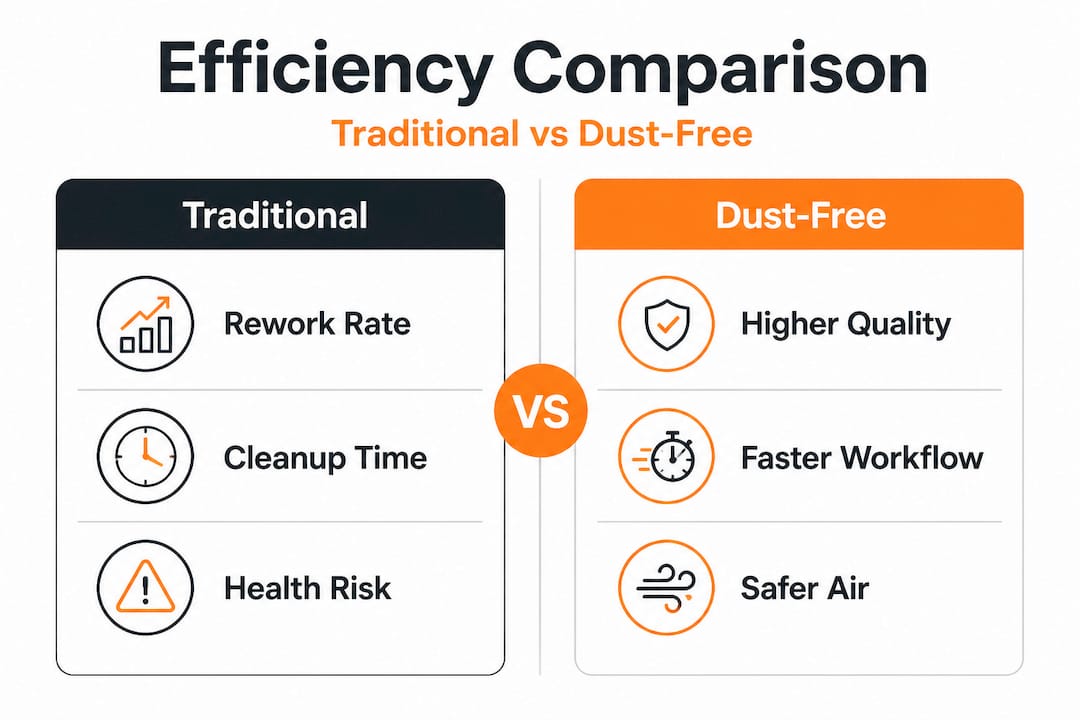
Dustless systems reduce airborne particulates by 99%, minimizing rework, cleanup time, and health risks while improving operational efficiency. That single statistic translates to meaningful changes across every aspect of your operation: fewer do-overs, faster turnaround, lower material costs, and a healthier team.
| Factor | Traditional Refinishing | Dust-Free Refinishing |
|---|---|---|
| Rework rate | 15-25% of jobs require touch-ups | Less than 5% with proper dust control |
| Cleanup time per job | 45-90 minutes | 10-20 minutes |
| Filter change frequency | Every 2-3 weeks | Monthly with maintained systems |
| Technician sick days | Higher due to particulate exposure | Significantly reduced |
| Customer complaint rate | Moderate to high | Low to negligible |
| Material waste | High (rework consumes extra product) | Minimal |
The productivity math is straightforward. If your shop runs 20 refinishing jobs per week and reduces rework from 20% to 4%, you’re recovering four jobs worth of labor and materials every single week. At an average repair cost of $800 per panel, that’s $3,200 in weekly recovered revenue, or roughly $166,000 annually. The Dustless Blaster System is one example of equipment designed around this principle, integrating water and abrasive to suppress dust at the source.
Beyond the numbers, improving paint quality has a compounding effect on customer relationships. Customers who receive a flawless finish the first time come back. They refer friends. They leave positive reviews. These outcomes don’t appear on a rework cost spreadsheet, but they absolutely appear on your revenue line over time.
Pro Tip: Don’t overlook the impact on technician morale. Refinishers who consistently produce clean, defect-free work take pride in their craft. Shops with strong dust control protocols report lower turnover because technicians aren’t frustrated by avoidable rework. Fewer sick days from reduced particulate exposure is an added bonus that reduces your HR headaches significantly.
The principles behind industrial dust prevention and best dust-free practices consistently point to the same conclusion: facilities that control dust operate more profitably and more predictably than those that don’t.
Implementing dust-free refinishing: Practical steps for shops and facilities
With the business case established, what practical steps can your facility take right now to become truly dust-free?
Transitioning to genuine dust-free refinishing doesn’t happen overnight, but it doesn’t require tearing down your booth and starting over either. It requires a structured approach that addresses contamination at every stage of the workflow.
Steps for transitioning to dust-free refinishing:
- Conduct a contamination audit. Walk your facility and identify every potential dust source: sanding stations, HVAC intakes, unsealed floors, wall surfaces, and traffic patterns. Map where contamination enters the booth.
- Upgrade booth filtration first. Replace aging booth filters with high-efficiency units that meet or exceed the 98% capture standard. Filtration is your first line of defense and the highest-leverage upgrade you can make.
- Install protective booth films. Multi-layer electrostatic wall and floor protection films seal contamination sources directly within the booth envelope. They’re quick to install, replace in minutes, and eliminate the dust that migrates off walls and floors into the spray zone.
- Evaluate HVAC systems. Ensure intake air is filtered and that booth pressure balance prevents unfiltered outside air from entering. Positive-pressure booths perform better, but only when intake filtration is clean.
- Implement pre-spray protocols. Tack cloth all surfaces immediately before application. Blow down the vehicle with filtered compressed air. Never skip this step, even on seemingly clean vehicles.
- Train every technician. Protocols only work if the whole team follows them. Train staff on contamination sources, the cost of rework, and the correct use of protective equipment and films.
- Build in routine maintenance schedules. Dust control degrades over time without attention. Assign ownership of filter checks, film replacements, and booth cleaning to specific team members.
Spray booth workflow optimization is about more than equipment. It’s about building habits. In humid industrial settings, dust combines with moisture to exacerbate fisheyes; dust-free systems with humidity control prevent this. Facilities in coastal regions or high-humidity climates need to address dehumidification as part of their dust-control strategy, not as an afterthought.
Ongoing maintenance and workflow habits that sustain dust-free performance:
- Replace wall and floor protection films on a regular schedule, not just when they look dirty
- Vacuum sanding residue immediately rather than allowing it to settle and become airborne again
- Use gowns and booth-specific footwear to prevent technicians from tracking contamination into the spray zone
- Monitor humidity levels within the booth and maintain 40-60% relative humidity
- Inspect and replace booth seals and door gaskets quarterly
Dust barriers are a practical and underutilized tool for isolating the spray zone from adjacent work areas. If your shop runs sanding and painting in close proximity, physical separation is non-negotiable. Finally, reviewing dust control techniques specific to your coating types and substrate materials helps you tailor your approach rather than applying a generic solution. The Dustless Blasting DB225 represents the kind of equipment investment that integrates dust suppression directly into surface prep, reducing contamination before it ever reaches the booth.
Why the obsession with dust-free refinishing is justified — but not for the reasons you think
Most of the industry conversation about dust-free refinishing focuses on obvious metrics: fewer defects, better compliance scores, lower rework costs. Those benefits are real. But they’re also just the beginning.
The deeper ROI of a truly dust-free operation shows up in places most managers don’t measure. Technicians who work in consistently clean environments develop a professional identity around quality. That matters more than most shop owners realize. When your team expects their work to be flawless because the environment supports it, their standards rise. Mistakes that used to be tolerated as “just the way it is” become unacceptable. That cultural shift produces a quality floor across all your work, not just refinishing.
“What most managers miss is the long-term snowball effect: clean workspaces attract better staff, better staff produce fewer defects, and fewer defects mean more loyal clients.”
There’s also a forward-looking compliance argument that rarely gets made. While dustless adds upfront cost of 10-15% more, it saves on labor, materials, and customer satisfaction via flawless finishes. Shops that have already built rigorous dust control systems don’t panic when new regulations are announced. They’re already there, or close to it. The facilities scrambling to comply are typically the ones that tolerated poor practices for years and now face both the compliance cost and the operational disruption simultaneously.
Traditional sanding is cheaper initially but leads to dust contamination, health issues, and inferior paint jobs compared to dust-free methods. This isn’t just a quality argument. It’s a talent retention argument and a business longevity argument. The shops that will still be operating profitably in ten years are the ones investing in cleaner, more efficient systems today.
The shop benefits that accumulate over time are compounding rather than linear. Every improvement to your dust control infrastructure makes the next improvement easier and cheaper.
Ready for flawless results? Start your shop’s dust-free transformation
If you’ve read this far, you already know that dust is costing your shop more than it should. The question is what to do about it, and the good news is that meaningful improvements don’t require a complete facility overhaul.
At Dust Free Film, we’ve been helping auto body shops and industrial painting facilities eliminate contamination at the source since 2012. Our multi-layer electrostatic booth wall and floor protection films install quickly, replace in minutes, and immediately reduce the contamination load inside your spray environment. Our patented dispenser system makes even large-scale booth preparation fast and bubble-free, so you spend more time painting and less time prepping. Whether you’re managing a single booth or a multi-bay production facility, explore our range of spray booth protection solutions and see what a cleaner operation looks like in practice. Even one upgrade to your dust control stack delivers measurable results from day one.
Frequently asked questions
What paint defects are most commonly caused by dust?
Nibs, fisheyes, craters, and uneven sheen are the most frequent paint defects caused by airborne dust. Dust-free refinishing prevents these defects by eliminating particles before they settle into wet coatings.
What are the basic compliance rules for dust control in automotive refinishing?
Spray booths must use filters that capture 98% of paint overspray to comply with EPA NESHAP 6H regulations, which target hazardous air pollutant emissions from auto body facilities.
How much does switching to dust-free refinishing reduce airborne particulates?
Dustless refinishing systems reduce airborne particulates by up to 99%, dramatically cutting rework rates, cleanup time, and health risks for your technicians.
Does humidity affect dust-related paint problems in industrial shops?
Yes, in high-humidity environments dust and moisture combine to worsen fisheye defects. Dust-free systems paired with active humidity control effectively prevent this problem.
Is dust-free refinishing more expensive than traditional methods?
It adds a 10-15% upfront cost over traditional methods, but the savings in reduced labor, lower material waste, and fewer customer callbacks make it the more cost-effective choice over time.
Recommended
- Best practices for dust-free painting: achieve flawless finishes
- How dust barriers improve auto refinishing quality
- Top Paint Finish Improvement Tips for Dust-Free Spray Booths
- Dust Management: How It Elevates Paint Quality
- Workflow préparation bois : 6-12% humidité pour projets parfaits - RALI outils bois pour les pros