

TL;DR:
- Grounding is a legal requirement for spray booths handling flammable coatings to prevent static discharge ignition.
- Regulations mandate bonding and grounding of all conductive parts, including booth structures, ducts, and spray equipment.
Grounding is a legal requirement for any spray booth handling flammable or combustible coatings, and the reason is straightforward: static electricity builds during atomization, and a single uncontrolled discharge can ignite solvent vapors. OSHA 29 CFR 1910.107 mandates that all metal parts of spray booths, exhaust ducts, and piping systems conveying flammable liquids be permanently and effectively grounded. NEC Article 250 and NFPA 33 add bonding requirements that close every gap in the conductive path. If you haven’t verified continuity to your building’s grounding electrode system recently, that’s the first call to make today.
A static discharge carrying only a fraction of a millijoule is enough to ignite solvent vapors — far below the threshold a person can feel. In a booth running solvent-based coatings, that means an ungrounded paint pot or insulated dolly isn’t just a code violation. It’s a loaded ignition source.
Table of Contents
- Why spray booths build dangerous static charge
- What U.S. standards actually require
- What must be grounded or bonded inside a spray booth
- How grounding and bonding are actually installed
- How to test and document your grounding system
- Daily and seasonal steps that keep static under control
- Who is responsible, and when to call for help
- Your immediate grounding checklist
- Key Takeaways
- Grounding is a life-safety system, not a checkbox
- Dustfreefilm keeps your booth clean and static-safe
- Authoritative sources and further reading
Why spray booths build dangerous static charge
Paint atomization is the core problem. As liquid coating breaks into fine droplets and accelerates through a spray gun, the triboelectric effect separates charge between the droplets and the gun body. Air movement across nonconductive surfaces compounds this, and so does the simple act of pulling masking film off a panel or sliding a part onto a rubber-tired dolly.
Static energies far below what people notice can be hazardous in a vapor-laden booth. A painter who feels nothing when touching an ungrounded container may have just discharged enough energy to ignite the vapor cloud around them. Low humidity makes it worse: dry air slows charge dissipation, so winter months and climate-controlled facilities with low moisture content carry elevated risk.
The finish-quality angle matters too. A charged part attracts airborne dust and overspray particles to wet paint, producing contamination that shows up as nibs and texture defects. Grounding and bonding eliminate that attraction, which is why static electricity in spray booths affects both safety and finish quality simultaneously.
What U.S. standards actually require
Three regulatory frameworks govern grounding requirements for paint booths in the United States.
| Standard | Scope | Core grounding requirement |
|---|---|---|
| OSHA 29 CFR 1910.107 | General industry spray finishing | All metal booth parts, ducts, piping, containers, and spray guns must be permanently grounded or bonded |
| NEC Article 250 (NFPA 70) | Electrical installations | Equipment enclosures and metal structures bonded to the building grounding electrode system; traceable conductor required |
| NFPA 33 / NFPA 77 | Spray application processes / static hazards | Bonding and grounding of all conductive components; humidity and process controls to limit static generation |
OSHA 1926.66 applies the same grounding rule to construction-context booths and temporary spray setups, so the requirement follows the work, not just the building.
The Authority Having Jurisdiction (AHJ) — your local fire marshal or building inspector — interprets these standards for your specific facility. AHJ expectations vary: some want a visible, labeled conductor running to the grounding electrode; others require a documented continuity test on file. Coordinate with your AHJ before final installation, and ask specifically what they want to see during an inspection.
What must be grounded or bonded inside a spray booth
OSHA’s grounding-general clause covers every electrically conductive object in the spraying area. In practice, that means:
- Booth shell and frame: all structural steel panels, door frames, and access hatches
- Exhaust ducts and plenums: full duct runs from booth to fan and stack
- Piping systems: any metallic line carrying flammable liquid, solvent, or compressed air (when the hose is conductive)
- Spray guns: the gun body and, for airless guns, the fluid path; bonding cables or conductive hoses provide the path
- Paint containers and wash cans: bonding straps between containers and to the booth structure before any transfer of flammable liquid
- Conveyors, hangers, and racks: continuous contact between the part being coated and the conveyor or hanger is required; hangers must be regularly cleaned and contact areas kept to sharp points or knife edges where possible
- Metallic guards, railings, and fencing placed around spray equipment
Rubber-tired dollies, nonconductive plastic hangers, and composite fixtures create insulated objects. If a part sits on an insulated support, it accumulates charge with no path to earth. The fix is either a conductive support, a bonding cable clipped to the part, or an ionization system for parts that cannot be directly bonded.
How grounding and bonding are actually installed
Bonding and grounding are related but distinct. Bonding equalizes potential between two conductive objects so no spark can jump between them. Grounding provides a path from those objects to earth so accumulated charge dissipates. Both are required.
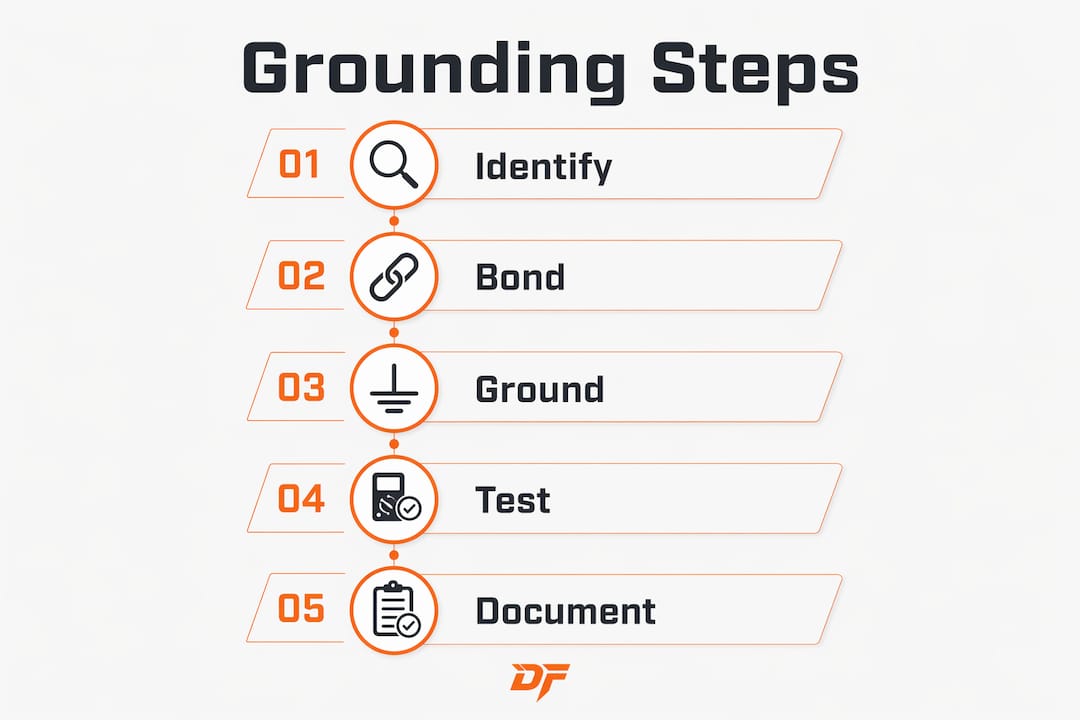
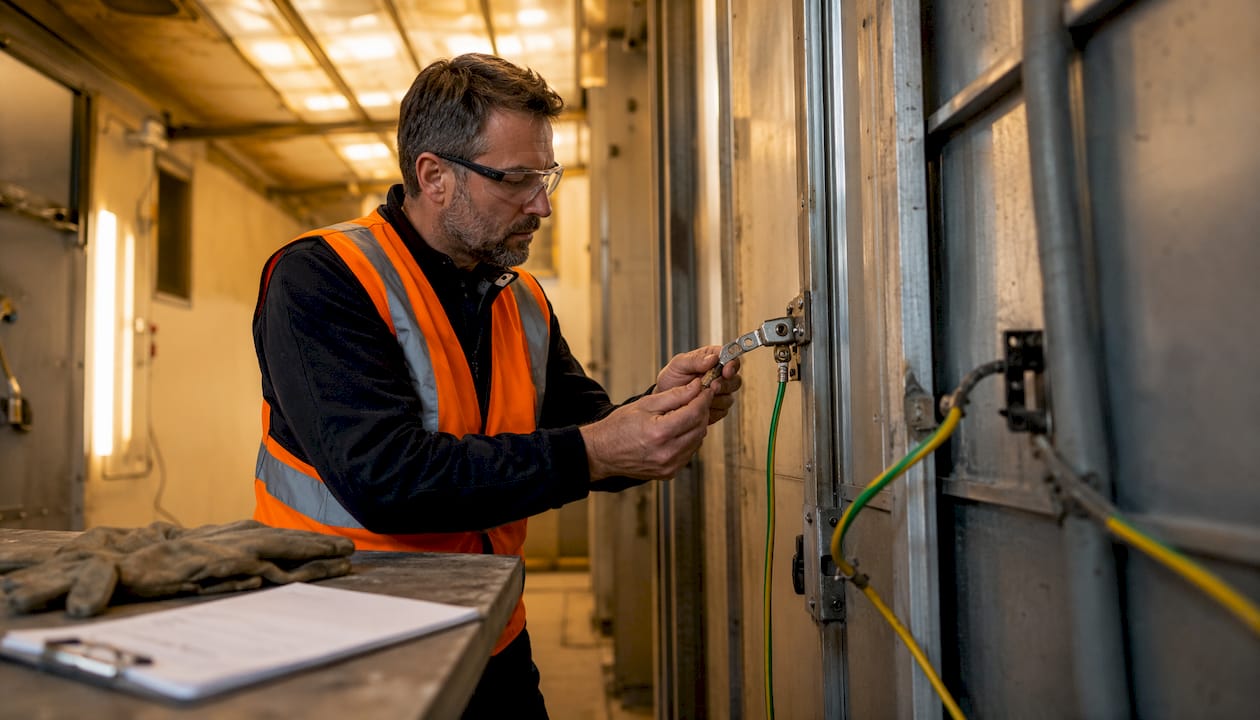
A licensed electrician installs the system in a logical sequence: identify all conductive components, run bonding conductors between them using welded connections or listed lugs, then tie the entire bonded assembly to the building’s grounding electrode system via a continuous conductor. NEC Article 250 requires that connection to be visible and traceable, which is why inspectors look for a labeled green or bare conductor running from the booth frame to the electrode.
A few installation details matter more than most:
- Keep contact points free of paint and overspray. Coating buildup at a lug or hanger contact point breaks the conductive path.
- Specify conductive hoses for fluid and air lines where metallic pipe is not used.
- Use sharp contact points or knife edges on hangers to cut through any residual coating on parts.
Pro Tip: Include grounding conductor specifications and connection-point locations in your electrician’s purchase order before work begins. Vague specs produce vague installations that fail AHJ inspections.
How to test and document your grounding system
Testing is where compliance becomes provable. Measure resistance between the booth structure and the building ground: NEC guidance sets 25 ohms as the maximum acceptable resistance for a grounding electrode, with values below 5 ohms preferred where achievable. High readings mean a poor connection, a corroded lug, or an inadequate electrode — all of which require a licensed electrician to resolve.
| Test type | Frequency | Who performs it | What to record |
|---|---|---|---|
| Visual inspection of clips, lugs, and hangers | Daily | Maintenance staff | Pass/fail log with date and initials |
| Continuity check on critical bonding paths | Monthly | Maintenance staff (calibrated meter) | Resistance value, test points, date |
| Full resistance-to-earth measurement | Annually (minimum) | Licensed electrician | Ohm reading, electrode location, corrective actions |
| AHJ-ready compliance report | Per AHJ schedule or after modification | Licensed electrician | All of the above plus system diagram |
Documenting continuity and contact-resistance checks creates the paper trail an AHJ expects. Keep records for at least three years and store them where the fire marshal can access them during an inspection.
Daily and seasonal steps that keep static under control
Grounding handles the structural side of static control. Operations handle the rest.
- Inspect hangers and contact points at the start of every shift. Overspray accumulates overnight; a quick wipe with a solvent rag restores conductivity before the first part goes up.
- Verify bonding clips and conductive hoses are connected before any spray operation begins.
- Monitor relative humidity. Paint atomization and airflow across nonconductive surfaces generate more charge at low humidity, and dissipation slows. Keep relative humidity above 40% when the process allows it. In dry winter months, add a humidifier or increase the frequency of continuity checks.
- Use conductive or static-dissipative footwear for anyone working inside the booth.
- Replace nonconductive dollies and fixtures with grounded alternatives or add bonding cables.
Static-dissipative floor and wall films fit directly into this program. They prevent charge accumulation on booth surfaces, reduce dust attraction to wet paint, and don’t interfere with the underlying ground path. Dustfreefilm’s static-free booth films are designed specifically for this environment, adding a layer of dust control that works alongside a properly grounded structure.
Who is responsible, and when to call for help
The facility manager owns the grounding program: setting the inspection schedule, maintaining records, and making sure every person in the booth understands the rules. Maintenance staff execute daily checks and log results. A licensed electrician handles all installations, any failed resistance reading, and the annual verification report.
Call a licensed electrician immediately when:
- Any continuity or resistance test fails
- Unexplained sparking occurs anywhere in the booth
- You modify the booth structure, add conveyors, or change the spray process
Contact your AHJ (fire marshal or building inspector) when:
- You make significant changes to the booth or its grounding system
- An incident or near-miss occurs
- You need confirmation that your verification method meets local acceptance criteria
Pro Tip: Ask your AHJ for their inspection checklist before your first formal inspection. Most will share it. Knowing exactly what they look for turns a stressful visit into a straightforward walkthrough.
Note that OSHA 1926.66 applies to construction-context and temporary booths, so contractors running portable spray setups face the same grounding obligations as permanent facilities.
Your immediate grounding checklist
Run through this on your next shift or hand it to your supervisor today.
- [ ] Clip test: attach a continuity tester between the booth frame and a known building ground point — confirm continuity
- [ ] Hanger inspection: check all hangers for paint buildup at contact points; clean any that show coating accumulation
- [ ] Gun bonding: confirm the spray gun has a bonding cable or conductive hose connected and that the connection is secure
- [ ] Container bonding: verify bonding straps are in place between paint pots, wash cans, and the booth structure
- [ ] Humidity check: read the booth hygrometer; if below 40%, flag for supervisor review
- [ ] Footwear check: confirm all booth personnel are wearing conductive or static-dissipative footwear
- [ ] Dolly and fixture audit: identify any rubber-tired or nonconductive supports and either replace or add bonding cables
- [ ] Schedule electrician verification if any item above fails or has not been tested within the past 12 months
Key Takeaways
Grounding is a mandatory life-safety requirement under OSHA 29 CFR 1910.107, and every conductive object in a spray booth must be bonded and grounded to eliminate spark risk.
| Point | Details |
|---|---|
| Legal requirement | OSHA 29 CFR 1910.107 requires permanent grounding of all metal booth parts, ducts, piping, containers, and spray guns. |
| Bonding vs. grounding | Bonding equalizes potential between objects; grounding dissipates charge to earth. Both are required to eliminate sparks. |
| Resistance target | NEC guidance sets 25 ohms as the maximum for a grounding electrode; below 5 ohms is preferred where achievable. |
| Verification cadence | Daily visual checks, monthly continuity tests, and annual licensed-electrician measurement keep the system compliant and documented. |
| Dustfreefilm’s role | Static-dissipative booth films from Dustfreefilm reduce dust attraction and surface charge accumulation, complementing a properly grounded structure. |
Grounding is a life-safety system, not a checkbox
Most facilities treat grounding as something the electrician handles once during installation and then forgets. That’s the wrong frame. A grounding system degrades: hangers accumulate overspray, lugs corrode, bonding cables get disconnected during cleaning and never reattached. The standard doesn’t just require installation — it requires maintenance, testing, and records.
The connection to dust control is direct and underappreciated. A charged part in an ungrounded booth pulls airborne particles out of the air and onto wet paint. Fix the grounding, and you fix a significant source of contamination that no amount of filtration or housekeeping fully compensates for. That’s why Dustfreefilm designs its films to be static-free: the film supports the grounding program rather than working against it.
Facilities that treat grounding as a living system — with daily checks, monthly tests, and annual electrician sign-off — rarely have incidents. Those that treat it as a one-time installation eventually face either an OSHA citation or something worse.
Dustfreefilm keeps your booth clean and static-safe
Proper grounding handles the electrical side of static control. Dustfreefilm handles the surface side.

Dustfreefilm’s multi-layer electrostatic dust protection films line booth walls and floors with static-dissipative surfaces that prevent charge buildup on the booth interior, reduce dust attraction to wet paint, and peel away cleanly when contaminated. The patented dispenser system installs film in minutes without tape or bubbles, so your booth is back in production fast. Films are heat-resistant and built for high-traffic industrial and automotive environments, with custom configurations and bulk pricing available for facilities running multiple booths or high shift volumes.
These films support your grounding and dust-control program. They do not replace bonding, grounding, or licensed electrical work — and Dustfreefilm is clear about that distinction. Request specs or a bulk quote at dustfreefilm.com and ask about technical support for your specific booth configuration.
Authoritative sources and further reading
Use these when briefing your electrician, preparing for an AHJ inspection, or building your facility’s grounding SOP.
- OSHA 29 CFR 1910.107 — The primary federal standard for spray finishing with flammable and combustible materials. Bring this to any AHJ meeting; it is the document inspectors cite.
- OSHA 1926.66 — Applies to construction-context and temporary spray booths; give this to contractors running portable setups.
- NEC Article 250 (NFPA 70) — Governs bonding to the building grounding electrode system; your licensed electrician will work from this standard during installation.
- NFPA 33 — Standard for spray application using flammable or combustible materials; covers process controls, bonding, and static hazard management beyond what OSHA specifies.
- NFPA 77 — Recommended practice on static electricity; useful background for understanding charge generation, dissipation, and humidity controls.
- PaintBoothDoctors grounding guide — Practical maintenance-focused reference covering bonding methods, hanger cleaning, and operational checks.
For Dustfreefilm technical sheets or to reach the technical support team, visit dustfreefilm.com.