

Most American facility managers face relentless challenges keeping spray booths free of dust and contaminants. With nearly 40 percent of finish defects directly linked to airborne particles, effective dust control has become a top priority in every automotive refinishing and industrial painting facility. This article uncovers proven strategies and technical insights to optimize booth cleanliness, support regulatory compliance, and deliver the flawless paint results your business demands.
Table of Contents
- Spray Booths And Their Critical Role
- Types Of Contamination And Booth Protection
- How Clean Booths Ensure Quality Finishes
- Safety, Compliance, And Regulatory Standards
- Risks And Costs Of Poor Maintenance
- Best Practices For Sustained Cleanliness
Key Takeaways
| Point | Details |
|---|---|
| Importance of Spray Booths | Spray booths are essential for safety, controlling contaminants, and ensuring quality finishes in various industrial sectors. |
| Maintenance is Critical | Regular maintenance and inspections are vital to prevent costly operational risks and ensure compliance with safety regulations. |
| Multilayered Protection | Implementing advanced filtration and strict environmental controls is key to minimizing contamination and maintaining high-quality production standards. |
| Training and Protocols | Comprehensive employee training and standardized cleaning protocols enhance booth cleanliness and operational efficiency. |
Spray booths and their critical role
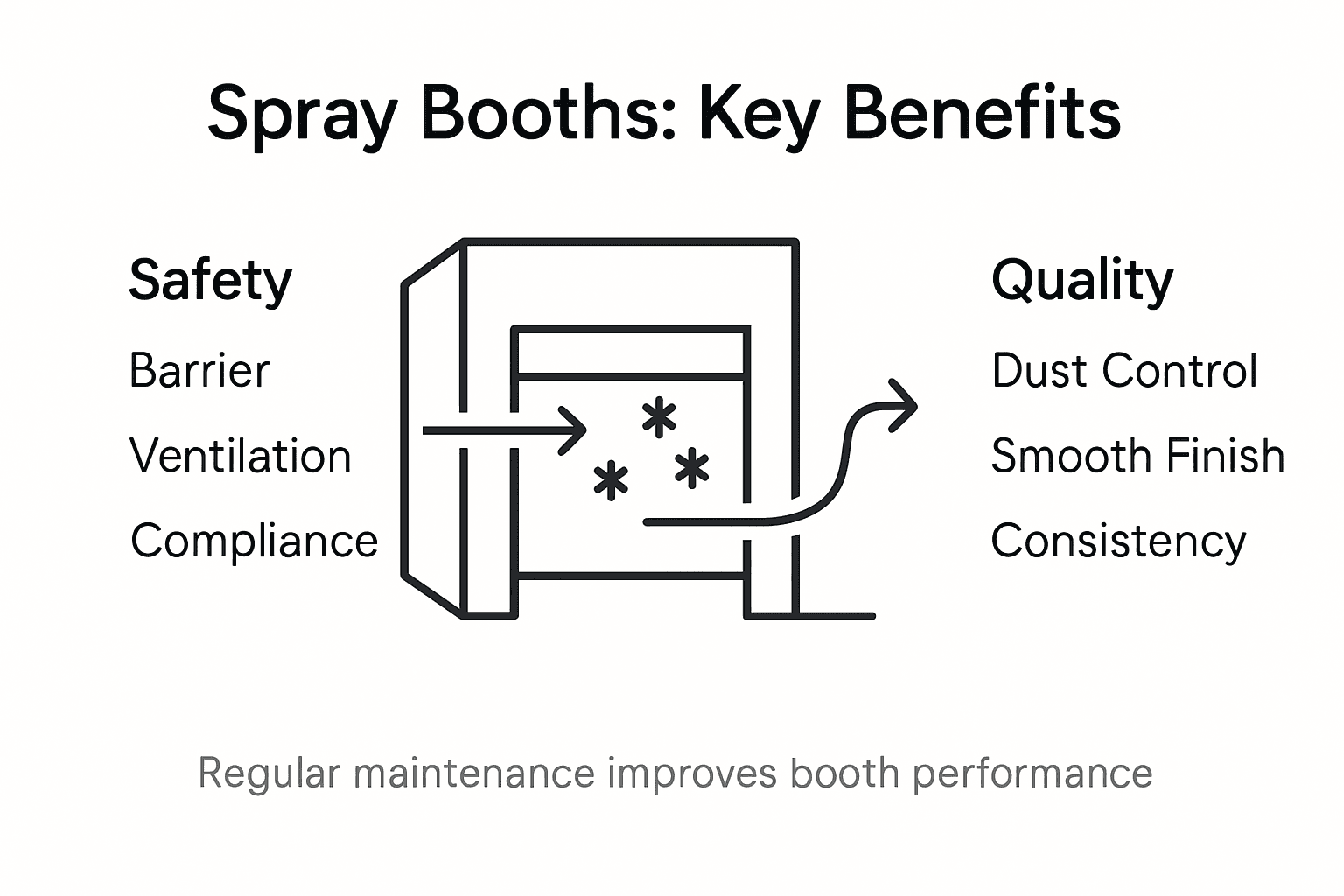
Spray booths represent far more than simple enclosed spaces in industrial settings - they are sophisticated safety systems designed to protect workers and ensure superior manufacturing processes. According to OSHA regulations, these power-ventilated enclosures serve multiple critical functions: containing hazardous vapors, controlling dangerous airborne contaminants, and creating controlled environments for precision work.
At their core, spray booths function as comprehensive safety barriers that physically separate potentially dangerous spray operations from surrounding workspaces. Scientific research confirms their essential role in preventing fires, explosions, and toxic substance exposure across industries like automotive manufacturing, aerospace engineering, and industrial coatings. By implementing robust ventilation systems and strategic design, these specialized enclosures manage multiple environmental variables simultaneously.
The technical complexity of modern spray booths involves several key engineering considerations. They must effectively manage air circulation, filter contaminants, control temperature and humidity, and provide adequate lighting for precise work. Advanced spray booths integrate multiple filtration stages, ensuring that particulate matter, chemical vapors, and potential ignition sources are systematically trapped and neutralized before being safely expelled from the facility.
Here’s a summary of key spray booth engineering features and their impact:
| Booth Feature | Purpose | Business Impact |
|---|---|---|
| Multi-stage Filtration | Removes contaminants and vapors | Improves finish quality |
| Ventilation System | Controls airflow and temp/humidity | Reduces health and fire risks |
| Sealed Lighting | Ensures visibility, prevents leaks | Enhances precision, safety |
| Controlled Airflow | Maintains particle-free zones | Lowers defect and rework rates |
Pro tip: Always conduct regular maintenance checks on your spray booth’s ventilation and filtration systems to maintain optimal performance and workplace safety.
Types of contamination and booth protection
Spray booth contamination represents a complex challenge that extends far beyond simple aesthetic concerns. Comprehensive research reveals that contamination sources include volatile organic compounds (VOCs), paint overspray, microscopic dust particles, and potentially harmful microbial agents. These contaminants can significantly compromise both workplace safety and the quality of industrial finishing processes.
The sources of contamination are diverse and multifaceted. Paint overspray can create uneven surfaces, dust particles can interrupt smooth finishes, and airborne microbes can introduce unexpected chemical interactions. Institutional studies have documented risks of microbial contamination within spray environments, highlighting the need for rigorous cleaning and control protocols. These contaminants can potentially introduce health risks, reduce product quality, and compromise the integrity of industrial coating processes.
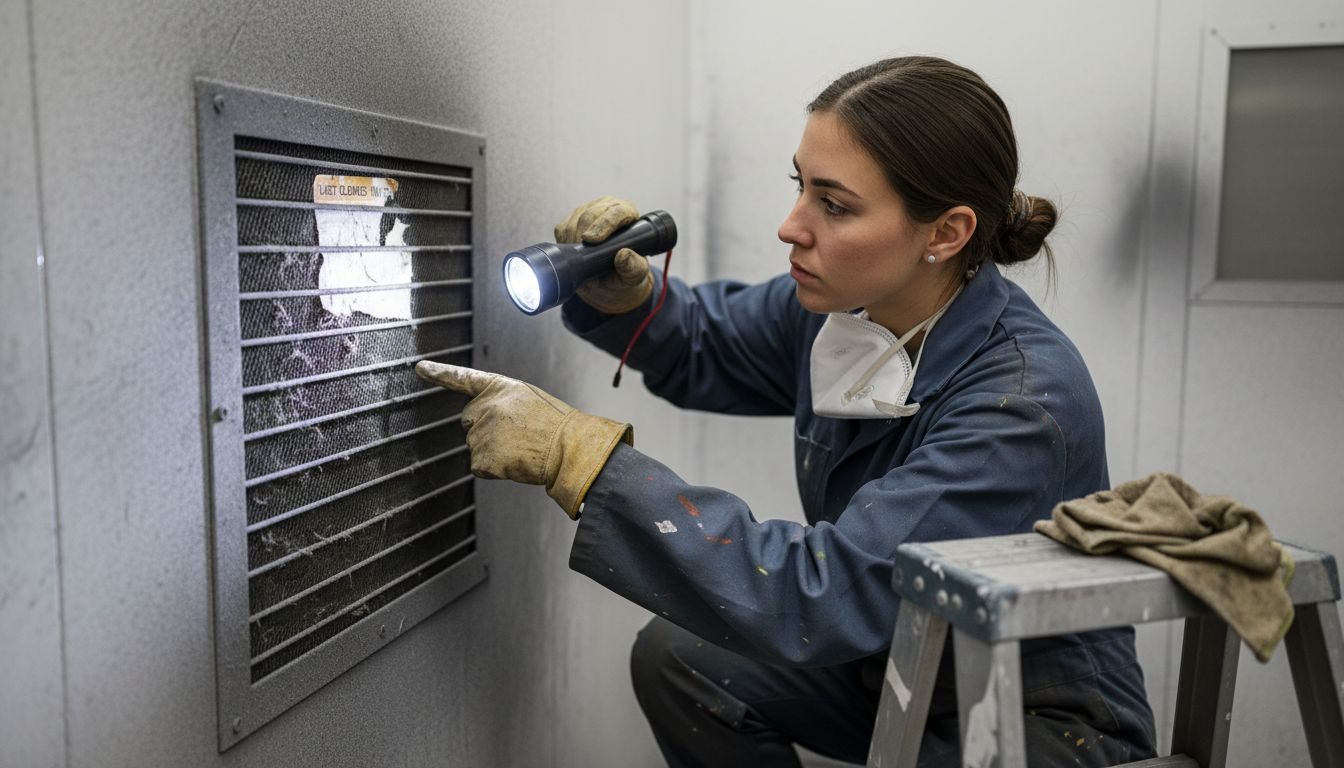
Effective booth protection requires a multilayered approach that addresses different contamination vectors. This involves implementing advanced filtration systems, maintaining strict environmental controls, utilizing high-efficiency particulate air (HEPA) filters, and establishing regular cleaning and maintenance schedules. Technicians must focus on creating a controlled environment that minimizes external particle introduction, manages air circulation, and maintains precise temperature and humidity levels to prevent contamination.
Pro tip: Implement a comprehensive daily inspection routine that systematically checks filtration systems, air intake points, and surface cleanliness to proactively identify and mitigate potential contamination sources.
How clean booths ensure quality finishes
Achieving superior paint finishes is fundamentally dependent on maintaining an immaculately clean spray booth environment. Professional research demonstrates that clean booths are critical for maintaining optimal conditions such as precise humidity control, particle management, and paint viscosity preservation. These environmental parameters directly impact the consistency and quality of industrial coating applications across diverse manufacturing sectors.
The precision of paint application hinges on multiple interconnected factors within the spray booth. Contaminant-free environments enable uniform paint distribution, prevent surface imperfections, and reduce the likelihood of costly rework. Advanced filtration systems work to eliminate microscopic particles that could potentially compromise finish quality, ensuring that each coating application meets stringent industrial standards. Temperature and humidity regulation further contribute to creating ideal painting conditions that support repeatable, high-quality results.
Technical professionals understand that clean spray booths are more than just aesthetic requirements - they represent complex engineering solutions designed to control multiple environmental variables simultaneously. This includes managing airflow dynamics, implementing multi-stage filtration technologies, maintaining consistent temperature gradients, and creating controlled particle-free zones. By systematically addressing these environmental parameters, manufacturers can significantly reduce defect rates, minimize material waste, and improve overall production efficiency.
Pro tip: Develop a standardized daily cleaning protocol that includes comprehensive surface sanitization, filter inspection, and airflow calibration to maintain optimal booth performance.
Safety, compliance, and regulatory standards
Regulatory standards for spray booth operations are comprehensive frameworks established by national safety organizations to protect workers and ensure industrial workplace integrity. These guidelines, developed by agencies like OSHA, NFPA, and EPA, create universal benchmarks that address critical safety concerns including fire prevention, hazardous material handling, and worker exposure protection across multiple industrial sectors.
The technical specifications for spray booth compliance are intricate and multifaceted. Legal standards mandate specific requirements for booth construction, including noncombustible materials, effective ventilation systems, strict airflow management, and accessible cleaning provisions. These regulations are not merely bureaucratic checklists but carefully designed protocols that directly impact worker safety, environmental protection, and operational efficiency. Industrial facilities must implement comprehensive safety measures that go beyond basic structural requirements, encompassing ongoing maintenance, personnel training, and systematic risk assessment.
Compliance is a dynamic process that requires continuous monitoring and adaptation. Facility managers must stay updated on evolving regulatory standards, conduct regular safety audits, and implement proactive risk management strategies. This involves maintaining detailed documentation, ensuring all safety equipment meets current standards, providing comprehensive worker training, and developing emergency response protocols that address potential hazards specific to spray booth environments.
Pro tip: Develop a comprehensive compliance checklist that tracks regulatory updates, schedules regular safety inspections, and documents all maintenance and training activities to maintain ongoing regulatory adherence.
Risks and costs of poor maintenance
Industrial case studies reveal that neglecting spray booth maintenance can lead to catastrophic operational and financial consequences. Poor maintenance creates a cascading series of risks that extend far beyond simple equipment deterioration, impacting everything from product quality and worker safety to regulatory compliance and overall manufacturing efficiency.
Systematic failures in spray booth maintenance can trigger multiple critical problems, including filter blockages, hazardous vapor accumulation, dramatically reduced finish quality, and significantly elevated workplace safety risks. These issues manifest through direct costs such as expensive equipment repairs, shortened machinery lifespan, and potential regulatory fines, as well as substantial indirect expenses related to production interruptions, decreased operational productivity, and increased worker compensation claims.
The financial implications of poor maintenance extend beyond immediate repair costs. Substandard spray booth upkeep can result in increased volatile organic compound (VOC) emissions, persistent overspray accumulation, and compromised environmental performance. Manufacturing facilities that fail to implement rigorous maintenance protocols risk substantial long-term economic penalties, including potential facility shutdowns, legal liabilities, and irreparable damage to organizational reputation. Proactive maintenance represents not just an operational requirement, but a critical strategic investment in sustainable manufacturing practices.
The table below compares maintenance lapses with resulting risks and costs:
| Maintenance Lapse | Direct Risk | Financial Impact |
|---|---|---|
| Filter Neglect | Blockage and contamination | Expensive repairs, downtime |
| Poor Cleaning | Microbe, particle buildup | Regulatory fines, lowered quality |
| Ignored Audits | Undetected hazards | Insurance claims, legal liabilities |
| Delayed Repairs | Escalating equipment loss | Rising costs, possible shutdowns |
Pro tip: Implement a comprehensive digital tracking system that monitors maintenance activities, schedules predictive interventions, and provides real-time alerts for potential equipment degradation.
Best practices for sustained cleanliness
Comprehensive automotive industry research provides a strategic framework for maintaining optimal spray booth cleanliness through systematic, proactive maintenance protocols. Effective maintenance goes beyond superficial cleaning, requiring a holistic approach that integrates technical precision, employee training, and structured operational workflows to ensure consistent performance and quality standards.
The core of sustained cleanliness involves implementing a multifaceted maintenance strategy. This includes establishing regular cleaning schedules featuring techniques such as water blasting, precise filter replacement protocols, and targeted solvent applications. Technicians must develop comprehensive inspection routines that assess not just visible surfaces, but also evaluate airflow dynamics, filter integrity, and potential contamination points that could compromise booth performance. Advanced facilities integrate digital tracking systems that monitor equipment condition, schedule predictive maintenance, and provide real-time performance analytics.
Professional maintenance requires a blend of technical expertise and disciplined execution. Key practices include comprehensive employee training programs that standardize cleaning procedures, implementing strict personal protective equipment (PPE) protocols, and creating clear documentation systems that track maintenance activities. Organizations must develop a culture of preventative maintenance, where every team member understands their role in maintaining a clean, safe, and efficient spray booth environment. This approach transforms maintenance from a reactive task to a strategic operational advantage that directly impacts product quality, workplace safety, and overall manufacturing efficiency.
Pro tip: Create a standardized maintenance checklist with photographic documentation and digital verification steps to ensure consistent, high-quality cleaning procedures across all shifts and personnel.
Elevate Your Spray Booth Cleanliness for Outstanding Finish Quality
Maintaining a dust-free spray booth is essential to controlling contamination, ensuring safety, and achieving superior paint finishes as highlighted in “Why Maintain Clean Spray Booths for Superior Results”. Persistent challenges like airborne particles, overspray, and microbial buildup directly affect product quality and operational efficiency. At Dust Free Film, we understand these pain points and offer innovative solutions such as multi-layer electrostatic booth wall and floor protectors designed to create controlled, dust-free environments that support precise paint application and reduce costly rework.
Our patented application systems guarantee quick, bubble-free installation while our heat-resistant and static-free films hold up in demanding industrial settings. These premium protective films help you maintain the optimal conditions detailed in the article — from managing airflow and filtering contaminants to preserving paint viscosity. Explore how our advanced dust protection technologies, built to European manufacturing standards, can safeguard your spray booth and enhance quality control at Dust Free Film.
Ready to transform your spray booth maintenance routine and safeguard your results? Discover how our durable, cost-effective protective films simplify cleanliness protocols and reduce contamination risks starting today.
Experience the difference in your facility now.
Protect your investment with proven dust control solutions.
Explore Clean Booth Solutions

Visit Dust Free Film to learn more and request a custom quote tailored to your spray booth needs.
Frequently Asked Questions
Why is it important to maintain cleanliness in spray booths?
Maintaining cleanliness in spray booths is crucial for ensuring high-quality finishes, preventing contamination, and safeguarding worker safety. A clean environment helps control humidity, manage particles, and preserve paint viscosity, impacting the overall quality of coatings applied in manufacturing processes.
What are the risks associated with poor maintenance of spray booths?
Poor maintenance can lead to multiple risks including filter blockages, contamination from microbial agents, and hazardous vapor accumulation. These issues can result in costly repairs, decreased productivity, and regulatory fines, as well as negatively affecting product quality and worker safety.
What best practices should be followed to keep spray booths clean?
Best practices include establishing regular cleaning schedules, employing techniques like water blasting, ensuring filter replacement protocols are followed, and conducting comprehensive inspections. Additionally, training employees on proper cleaning procedures and maintaining documentation of maintenance activities can significantly enhance cleanliness and functionality.
How does the quality of a spray booth impact manufacturing efficiency?
The quality of a spray booth directly affects manufacturing efficiency by minimizing defects, lowering rework rates, and improving production flow. A well-maintained booth ensures a controlled environment for painting applications, which leads to consistent quality and can reduce material waste and operational costs.