

TL;DR:
- Booth floor films prevent contaminants from causing paint defects and reduce cleaning time.
- Installing and replacing films enhances safety, compliance, and overall spray booth performance.
- Regular use of floor films offers significant return on investment by protecting finishes and booth value.
Even the most disciplined cleaning routine cannot fully protect a spray booth floor from the invisible enemies of a perfect finish. Dust, lint, dried paint flakes, and overspray settle fast, and the moment your spray gun fires, airborne particles find their way into wet paint. Booth floor films provide a protective barrier that captures overspray, dust, and contaminants before they become airborne again. This guide walks you through the real operational, financial, and quality benefits of making booth floor films a standard part of your facility workflow.
Table of Contents
- Understanding the problems with unprotected spray booth floors
- What are booth floor films and how do they work?
- Key benefits of booth floor films: Quality, efficiency, and compliance
- How to implement and maintain booth floor films effectively
- Our take: The overlooked ROI of booth floor films
- Protect your booth investment with the right films
- Frequently asked questions
Key Takeaways
| Point | Details |
|---|---|
| Eliminate hidden contamination | Booth floor films capture dust and overspray that routine cleaning misses, protecting your paint jobs. |
| Boost efficiency and safety | They help reduce cleaning time and keep your shop compliant with safety standards. |
| Preserve booth value | High-quality films maintain your booth’s brightness and can even increase its resale price. |
| Simple integration | Installing and maintaining floor films is easy and delivers quick, visible improvements. |
Understanding the problems with unprotected spray booth floors
Most shop managers assume that sweeping and mopping before a job is enough. It is not. Paint particles, sanding dust, and lint accumulate in floor seams, corners, and textured surfaces faster than any manual cleaning cycle can keep up with. The moment airflow kicks on inside the booth, those particles lift off the floor and land directly in your fresh paint.
The contamination types that cause the most damage include:
- Sanding dust from prep work that migrates into the booth on clothing and equipment
- Dried paint flakes that break off walls and floors when air pressure shifts
- Lint and fiber particles from cleaning cloths or technician clothing
- Overspray buildup that hardens and then chips back into the air during future jobs
Every one of these contaminants creates defects that require touch-ups or full rework. Rework is expensive. It burns materials, occupies booth time, and delays vehicle delivery. For high-volume shops, even a 5% rework rate translates to significant lost revenue and customer frustration every single month.
“Booth floor films capture overspray, dust, and contaminants, preventing them from contaminating wet paint finishes.”
Beyond paint quality, unprotected floors carry safety risks that are easy to overlook. Paint overspray buildup is flammable, and accumulated solvent residue on bare floors increases fire hazard. Static electricity is another real concern. In solvent-based painting environments, an uncontrolled static discharge near flammable vapors is not a theoretical risk. It is a documented cause of booth fires.
For shop owners focused on reducing booth dust at the source, the floor is often the most neglected surface. Walls get attention. Filters get changed. But the floor, which acts as the primary collection zone for all falling particles, is frequently left bare. Understanding floor protection methods that go beyond mopping is the first step toward real contamination control.
The operational headaches pile up quickly. Technicians spend time cleaning instead of painting. Inspectors flag defects. Managers schedule extra booth time to redo jobs. All of this is avoidable with the right protective layer on the floor.
What are booth floor films and how do they work?
Booth floor films are thin, flexible sheets of protective material applied directly to the spray booth floor surface. They act as a sacrificial layer, meaning they absorb all the contamination so your actual floor does not. When the film is saturated or visibly loaded with debris, you peel it off and replace it. Clean floor, zero scrubbing.
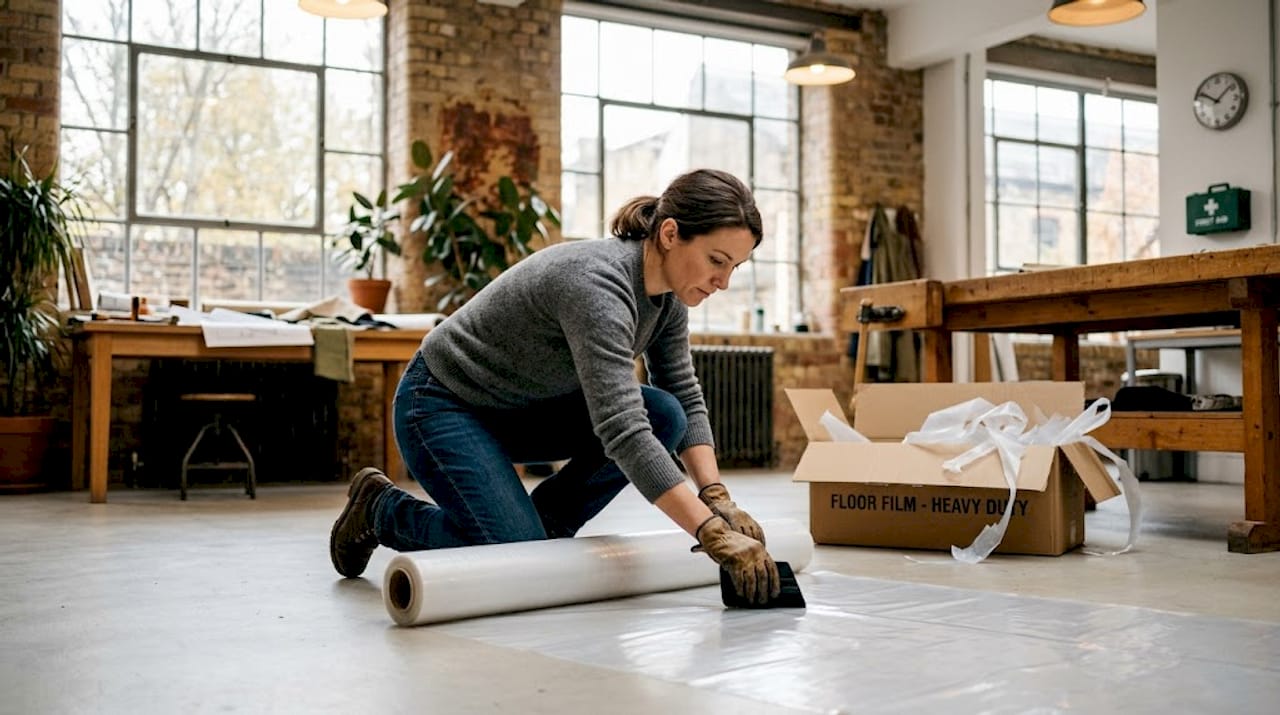
Most quality films are made from polyethylene or multi-layer composite materials. Some feature a light adhesive backing that keeps them flat and wrinkle-free during use. Others rely on static-dissipative properties, which means they neutralize static charge rather than allowing it to build up and attract more airborne dust. Static-dissipative simply means the film safely conducts away any electrical charge before it can accumulate.
Here is a quick comparison of what changes when you add floor film protection:
| Factor | Bare floor | Film-protected floor |
|---|---|---|
| Airborne dust after air startup | High | Minimal |
| Cleaning time per job | 20-40 minutes | 5-10 minutes |
| Slip risk from overspray buildup | Elevated | Low |
| Maintenance interval | Daily | Weekly or per film change |
| Paint defect rate from floor particles | Frequent | Rare |
Installing booth floor film is straightforward. Here is the general process:
- Clean and dry the floor thoroughly before first application to remove existing debris and oils
- Measure and cut the film to fit your booth dimensions, overlapping seams by at least 5 cm
- Lay the film flat starting from one end, pressing out air pockets as you go
- Secure edges with the adhesive backing or approved tape rated for booth environments
- Inspect before each job for tears, lifted edges, or visible saturation
- Peel and replace when discoloration, debris buildup, or loss of tack is visible
Understanding the protective floor film purpose helps you select the right product for your environment. High-volume shops spraying solvent-based coatings need thicker, solvent-resistant films. Waterborne coating environments may tolerate lighter options. Check out the full applying floor film steps guide for a detailed walkthrough specific to different booth types.
Pro Tip: Always choose a film rated as static dissipative if your booth uses solvent-based paints. This single specification reduces both contamination risk and fire hazard simultaneously, giving you safety and quality in one product.
Key benefits of booth floor films: Quality, efficiency, and compliance
The most immediate benefit shop owners notice is fewer paint defects. When the floor stops shedding particles into the air, finish quality becomes dramatically more consistent. Fewer fish eyes, less grit, and smoother clear coat results mean fewer vehicles going back into the booth for correction work.
Here is how the numbers shift when floor films become standard practice:
| Metric | Without floor films | With floor films |
|---|---|---|
| Paint defect incidents per month | 8-15 | 1-3 |
| Booth cleaning labor per week | 6-10 hours | 1-2 hours |
| Booth floor condition after 1 year | Stained, pitted | Clean, protected |
| Resale or appraisal impact | Negative | Neutral to positive |
Beyond defect reduction, the time savings are real and compounding. A booth that takes 30 minutes to clean after every job versus one that takes 8 minutes is a booth that runs more jobs per day. Over a full week, that recovered time adds up to multiple additional paint cycles.
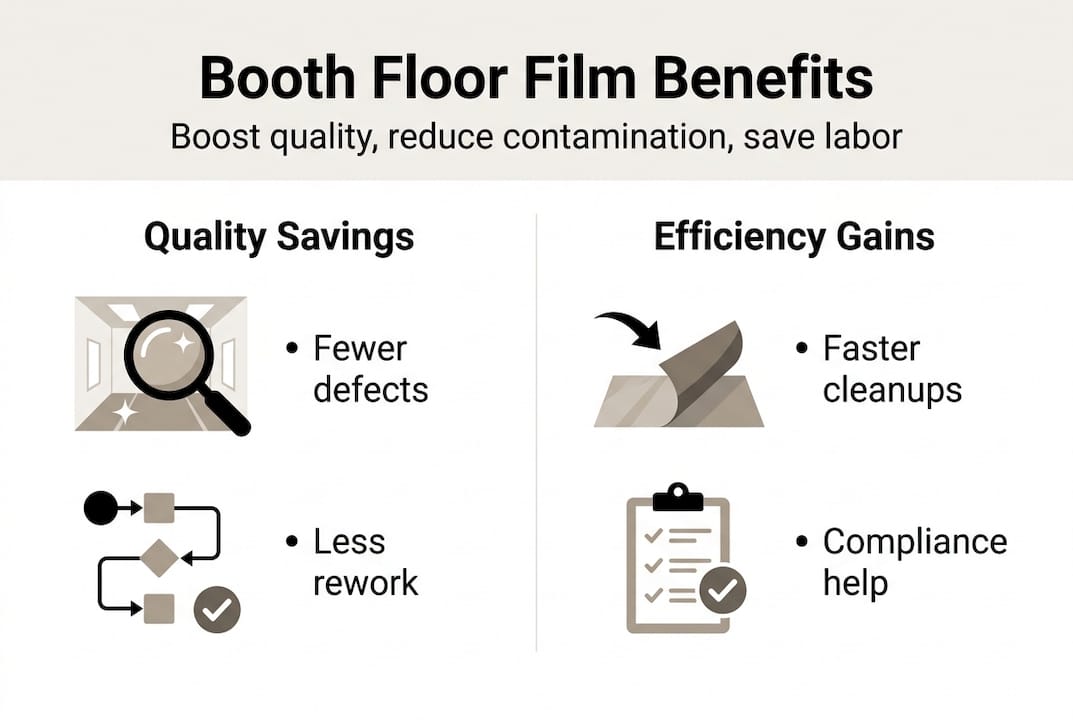
Safety compliance is another area where films deliver measurable value. Many quality floor films are designed to meet or support NFPA33 requirements, which govern spray application of flammable and combustible materials. NFPA33 is the National Fire Protection Association standard specifically for spray finishing operations. Floor films maintain booth brightness and professional appearance, which also supports compliance inspections and resale value.
Key operational benefits at a glance:
- Reduced rework costs from cleaner, more consistent finishes
- Faster turnaround with simplified post-job cleaning
- Lower slip and fall risk by preventing slick overspray buildup
- Compliance support for NFPA33 and static control requirements
- Preserved booth condition that holds value over time
For a full breakdown, the spray booth film benefits guide covers quality and efficiency gains in detail. If you want to understand the deeper reasoning, enhancing booth quality with protective films explains the science behind particle capture. For operations managers focused on throughput, optimizing booth efficiency is worth reading alongside this article.
How to implement and maintain booth floor films effectively
Getting results from booth floor films requires more than just laying them down. Consistent implementation and smart maintenance habits make the difference between marginal improvement and a genuinely cleaner, more productive operation.
Follow these steps to build a reliable floor film program:
- Select the right film for your booth type, coating chemistry, and traffic volume
- Prepare the surface by deep-cleaning the floor before the first installation
- Install with care, eliminating air bubbles and securing all edges
- Inspect before every spray job to catch tears or lifted sections early
- Log replacement dates so you can establish a predictable change schedule
- Train all technicians on what a film in good condition looks like versus one that needs replacing
Common mistakes to avoid include skipping surface prep on the first install, which causes the film to lift and wrinkle during use. Using the wrong film thickness for your environment is another frequent error. A film that is too thin tears under foot traffic. A film that is too thick can create trip hazards at seams if not properly overlapped.
Pro Tip: Schedule film changes to coincide with your regular maintenance workflow intervals. Pairing film replacement with filter changes and booth inspections keeps your whole system running clean without adding extra downtime.
Knowing when to replace film is just as important as knowing how to install it. Replace immediately when you see any of the following: visible discoloration from heavy overspray saturation, edges lifting or bubbling, loss of tack on adhesive-backed films, or visible layers of debris that cannot be swept off the surface. Waiting too long means the film stops doing its job and contaminants start migrating back into the air.
For shops evaluating specific products, the top floor protection choices guide compares the leading options for 2026 with specs relevant to different spray environments. Integrating protective films with regular booth maintenance increases compliance and safety across the entire facility.
Our take: The overlooked ROI of booth floor films
Here is something most shop owners do not fully account for: the cost of NOT using floor films. You see the price of a roll of film and weigh it against your current cleaning supplies. That comparison misses the real math entirely.
The actual ROI calculation includes reduced labor hours on cleaning, fewer materials wasted on rework jobs, lower risk of a safety incident that shuts down your operation, and a booth that holds its value when you eventually sell or upgrade. When you add those numbers together, floor films are not a cost. They are a return.
We have seen shops run meticulous cleaning routines and still struggle with inconsistent finishes. The reason is almost always the floor. It is the one surface that collects everything and gets the least protection. Spending 45 minutes scrubbing a floor that will be contaminated again within one spray cycle is the definition of working harder instead of smarter.
Films are not glamorous. They do not require a big investment or a long learning curve. But the shops that treat them as standard operating procedure consistently outperform those that rely on cleaning alone. The real-world booth ROI data backs this up. For any quality-focused, safety-conscious facility, floor films are one of the highest-leverage upgrades you can make.
Protect your booth investment with the right films
Your spray booth represents a serious capital investment, and every contaminated paint job chips away at the return on that investment. At Dust Free Film, we manufacture premium booth floor and wall protection films built specifically for the demands of automotive refinishing and industrial spray environments.
Our films are heat-resistant, static dissipative, and engineered for quick installation with minimal disruption to your workflow. Whether you run a single-bay body shop or a multi-booth industrial facility, we have configurations that fit your operation. Visit Dust Free Film solutions to explore our full product range, or request a customized quote tailored to your booth size, coating type, and replacement frequency. Protecting your finishes starts at the floor.
Frequently asked questions
How often should booth floor films be replaced?
Most shops replace booth floor films every 1 to 3 months, but frequency depends on spray volume and visible buildup. Since films capture overspray and contaminants continuously, high-volume operations may need more frequent changes to maintain peak performance.
Do booth floor films comply with safety standards?
Many quality films are static dissipative and support NFPA33 fire safety compliance. Always verify the film’s technical specifications before purchase to confirm it meets your facility’s regulatory requirements.
Can booth floor films help with paint booth resale value?
Yes. Using floor films consistently maintains booth brightness and professional appearance, which preserves the booth’s condition and supports a stronger resale or trade-in value over time.
Are booth floor films hard to install or remove?
Properly designed films are easy to apply and peel, making swaps during scheduled maintenance quick and straightforward. A simple, effective barrier that installs without special tools keeps downtime minimal and staff training simple.