

For most spray-booth walls and viewing windows, specify anti-static film, not static-dissipative. Anti-static grades sit in the resistivity band that controls dust attraction without over-engineering the spec. Reserve static-dissipative film for edge cases: electrostatic coating lines, panels near ionizing equipment, or processes generating unusually high charge that needs near-instant neutralization.
Copy this into your RFP:
- Surface resistivity: target 10^10–10^12 Ω/sq for anti-static wall and window film (tighten toward 10^6–10^12 Ω/sq only if a process specifically demands static-dissipative behavior)
- Substrate: PE for general walls, PET for viewing windows and light fixtures, PP for elevated-temperature zones
- Thickness: 40 to 80 microns for walls, thinner and clearer for windows, heavier for floor or high-traffic protection
Ask any supplier, including Dust Free Film, for resistivity data tested to IEC 61340-2-3 and referenced against the EN/IEC 61340-5-1 framework before you sign off on a purchase order.
Key Takeaways
Anti-static film in the 10^10 to 10^12 Ω/sq range covers most spray-booth walls and windows, while static-dissipative film is reserved for high-charge or ATEX-classified processes.
| Point | Details |
|---|---|
| Default to anti-static | Most booth walls and windows only need the 10^10–10^12 Ω/sq band, not static-dissipative. |
| Match substrate to purpose | Use PET for window clarity, PP for heated booths, PE for general wall coverage. |
| Choose non-migratory additives near optics | Migratory antistats risk residue on coated glass and freshly painted panels. |
| Verify before you buy in bulk | Request IEC 61340-2-3 resistivity data and run Hold-See-Release tests on your actual window material. |
| Work with a supplier that documents lots | Dust Free Film provides lot resistivity data and patented dispenser systems built for spray-booth installation. |
Standards and Documents to Request Before You Order
Ask suppliers for resistivity data tested to IEC 61340-2-3, reference against EN/IEC 61340-5-1, and require a current lot resistivity report plus residue or extractables test results for any film touching optical or coated surfaces.
Table of Contents
- Anti Static vs Static Dissipative: What the Numbers Actually Mean
- How Do You Choose the Right Film for Your Booth?
- PE, PP, or PET: Which Substrate Fits Your Booth?
- Migratory or Non-Migratory Additives: Which One Contaminates Less?
- Installing, Storing, and Verifying Film Before It Fails on You
- When Is Anti-Static Enough, and When Do You Need More?
- Get Lot-Tested Film Instead of Guessing at Resistivity
- Sources
- FAQ
Anti Static vs Static Dissipative: What the Numbers Actually Mean
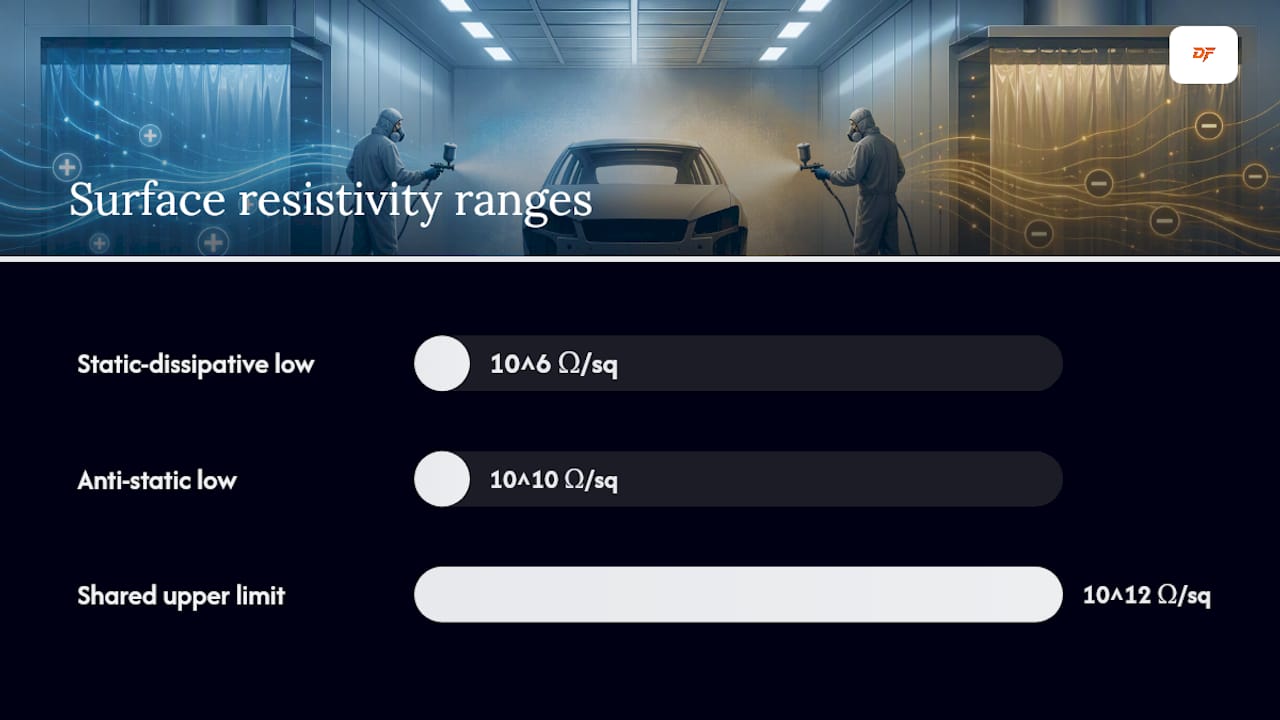
The difference between these categories comes down to one number: surface resistivity, measured in ohms per square (Ω/sq). It tells you how fast a static charge bleeds off a film’s surface, which in a spray booth translates directly into how much airborne dust that film pulls toward wet paint.
Industry classification puts anti-static film in the 10^10 to 10^12 Ω/sq range, static-dissipative in 10^6 to 10^12 Ω/sq, and conductive materials below 10^6 Ω/sq. Notice the overlap: static-dissipative is a broader band that dips lower, meaning it discharges faster and handles more aggressive charge buildup. Anti-static film discharges more slowly and gradually, which is exactly what most booth walls and windows need. Too conductive, and you risk rapid discharge events near sensitive components. Too resistive, and the film stops controlling particle attraction at all.
Specify resistivity to match your component sensitivity class. A film that discharges too fast can trigger the same kind of static event it was meant to prevent, while a film that’s too resistive lets dust cling to every surface it touches.
Request the actual test report, not just a marketing claim. A datasheet that says “anti-static” with no Ω/sq figure attached isn’t a spec, it’s a guess.
How Do You Choose the Right Film for Your Booth?
Work through these decisions in order, because each one narrows the field before you ever call a supplier.
- Identify the sensitivity class. Does the film touch paint-critical surfaces like windows, light diffusers, or freshly sprayed panels? If yes, tighten your resistivity tolerance and lean toward non-migratory additive chemistry.
- Check environmental exposure. Humidity, booth temperature, and whether you run any electrostatic coating process all shift your requirements. Dry climates and temperature-controlled facilities tend to generate more static, which pushes the case toward anti-static film with verified low-end resistivity.
- Confirm ATEX or classified-zone status. If any part of your booth falls under an ATEX designation, static-dissipative or conductive specs may be mandated, and distance rules from electrostatic coating guns often apply, as Colad’s Film4Booth documentation outlines for PP-based booth films.
- Set the physical parameters. Substrate, thickness, tack level, and expected service life all need to be locked before you request quotes.
Your final checklist should include:
- Target resistivity range in Ω/sq, with test method noted
- Substrate (PE, PP, or PET) matched to temperature and clarity needs
- Thickness appropriate to wall, window, or floor use
- Tack level: aggressive for capture films, low-tack for viewing windows
- Non-migratory additive confirmation if the film contacts optical or coated surfaces
- Lot-to-lot resistivity reporting from the supplier
- Expected replacement interval based on exposure and bake cycles
If your booth runs standard solvent or waterborne paint with no electrostatic gun and no ATEX zone, anti-static film covers you. If you run electrostatic coating equipment or operate in a classified zone, move to static-dissipative or conductive grades and confirm compliance with your process engineer.
Pro Tip: Ask for a sample roll before committing to a bulk order, and run it through your own booth cycle for a week. Lot-to-lot resistivity can drift, and a supplier’s spec sheet only tells you what one batch tested at.
PE, PP, or PET: Which Substrate Fits Your Booth?
Substrate choice determines how the film behaves under heat, how clear it stays, and how well it survives the physical abuse of a working booth.
- Polyethylene (PE) is flexible, inexpensive, and conforms well to uneven wall surfaces. It’s the default for general wall protection but softens at lower temperatures than PP.
- Polypropylene (PP) handles heat better, with some booth films rated near a 120°C melting point, making it the better call for booths that run hot bake cycles.
- Polyethylene terephthalate (PET) offers the best optical clarity, which is why it dominates viewing windows and light fixture covers, though it’s stiffer and less forgiving on curved or irregular surfaces.
| Substrate | Clarity | Heat resistance | Conformability | Best use |
|---|---|---|---|---|
| PE | Moderate | Lower | High | General walls |
| PP | Moderate | Higher (up to ~120°C) | Moderate | Heated booths |
| PET | High | Moderate | Low | Windows, lights |
Wall protection generally runs 40 to 80 microns thick. Viewing windows favor thinner, clearer stock in the 25 to 50 micron range. Anything exposed to scraping, cart traffic, or tool contact should move toward the heavier end, or a purpose-built floor-grade product entirely.
Migratory or Non-Migratory Additives: Which One Contaminates Less?
Antistatic performance in film comes from an additive, and the additive’s chemistry matters as much as the resistivity number on the datasheet.
Migratory (surfactant-based) antistats work by bleeding to the film surface over time. They’re cheap and effective, but they can leave a residue on sensitive optical or coating surfaces, which is a real problem if that film sits against a booth window or a freshly painted panel for days.
Non-migratory, polymer-bonded antistats are locked into the film structure and don’t transfer to what they touch. For coated glass, polarized lenses, or any surface where haze and adhesive transfer are unacceptable, this is the safer specification.
- Ask for extractables or residue test data before ordering film for optical-adjacent applications
- Confirm whether the antistatic agent is compounded into the resin or applied as a surface coating
- For freshly painted panels, treat non-migratory chemistry as the default, not the upgrade
A few extra cents per roll on non-migratory film is cheap insurance against a scrapped panel or a hazy showroom window.
Installing, Storing, and Verifying Film Before It Fails on You
Getting the spec right on paper doesn’t help if installation or storage undoes it. Build these steps into your receiving and application process.
- Test resistivity on incoming lots. Request supplier data measured per IEC 61340-2-3 and spot-check with your own meter if you run high volumes.
- Run Hold-See-Release trials on windows. Test at initial application, 24 hours, and 72 hours, then confirm the film releases cleanly at your planned removal date, ideally on the actual window material rather than a generic test panel.
- Check adhesion before full rollout. Never assume films are interchangeable across surfaces; aged or uneven walls can cause lift or haze that a fresh test panel won’t reveal.
- Store within the manufacturer’s temperature range. Cold storage can stiffen adhesive and cause poor initial tack; excess heat can pre-activate it.
- Set replacement intervals based on bake cycles and exposure, not a fixed calendar date.
- Verify the film’s rated temperature against your booth’s actual bake temperature, not its nominal setting
- Keep a lot certificate on file for every roll installed on critical surfaces
- Log removal force at each interval to catch adhesive drift early
Pro Tip: Keep a small offcut of every lot taped to a clipboard near the booth entrance. When a panel comes out hazy or a window won’t release clean, you’ll have a same-lot sample to test against instead of guessing which roll caused it.
When Is Anti-Static Enough, and When Do You Need More?
Most auto-body shops running standard spray guns and waterborne or solvent basecoats do fine with anti-static wall and window film. The charge levels generated are moderate, and anti-static’s gradual discharge is enough to keep overspray from clinging to every surface.
Small-batch custom paint shops and display glazing areas fall into the same category, generally anti-static, with PET substrate for the glazing itself.
- Precision coating or lens-finishing areas: lean toward non-migratory anti-static, tightened resistivity tolerance
- Electrostatic coating lines: move to static-dissipative or conductive, and keep film a safe distance from the charged gun per your equipment manufacturer’s guidance
- ATEX-classified zones: static-dissipative or conductive is often mandated, not optional
- Direct contact with extremely sensitive optics: skip film-based static control and consult your optics supplier directly
Layered film systems solve a practical problem here: a statically-charged outer layer captures overspray while a separate clear layer over lights and windows keeps visibility without attracting the same buildup.
As a rule of thumb, replace capture-layer film every few bake cycles or when tack visibly degrades, whichever comes first.
Manufacturer Perspective: Where Specs Go Wrong
The most common failure isn’t picking the wrong category, it’s skipping the resistivity number entirely and buying on the word “anti-static” alone. The second most common: matching tack level to the wrong surface, which either tears fresh paint or lets film sag off the wall. Dust Free Film’s multi-layer designs and patented dispenser systems exist because installation speed and consistent lot-to-lot resistivity solve both problems at once, not because either one is easy to get right by accident.
Get Lot-Tested Film Instead of Guessing at Resistivity
Every point in this guide comes down to one procurement problem: getting film that actually performs at the resistivity number printed on its spec sheet, batch after batch. Dust Free Film builds multi-layer electrostatic protectors specifically for spray booths, with a patented dispenser system that installs bubble-free without the trial-and-error most crews go through with tape and loose rolls.
When you contact the team, ask for three things: a lot resistivity report matched to your target Ω/sq range, a sample panel sized for your actual wall or window dimensions, and the recommended thickness and tack level for your booth’s temperature and process. Heat-resistant, static-controlled options are available for both standard and elevated-temperature booths, in custom configurations for bulk or multi-site orders. Request a sample or a quote from Dust Free Film and get the resistivity data in writing before your next purchase order goes out.
Sources
- Protective Film for Spray Booth Viewing Windows: Installation and Replacement Guide — FilmsProtection
- Types of window protection film and their uses — Trimaco
FAQ
What Is the Difference Between Anti-Static and Static-Dissipative Film?
Anti-static film has surface resistivity typically between 10^10 and 10^12 Ω/sq and discharges gradually, while static-dissipative film spans a broader 10^6 to 10^12 Ω/sq range and discharges faster, making it suited to higher-charge processes.
Which Film Should I Use for a Standard Auto-Body Spray Booth?
Anti-static film covers most auto-body booths running standard spray guns and waterborne or solvent basecoats without electrostatic coating equipment.
Does Dust Free Film Provide Resistivity Test Data?
Yes, Dust Free Film supplies lot-to-lot resistivity data alongside its multi-layer electrostatic protectors, which lets procurement teams verify the film meets spec before installation.
How Often Should Booth Protection Film Be Replaced?
Replacement depends on exposure and bake cycles rather than a fixed calendar, and tacky capture-layer film generally needs changing every few bake cycles once tack visibly degrades.
Can Migratory Antistatic Additives Damage Painted Surfaces?
Migratory, surfactant-based antistats can leave residue on sensitive coated or optical surfaces over time, so non-migratory, polymer-bonded additives are the safer choice near freshly painted panels or glass.