
Use flexible, thicker LDPE multi-layer films for industrial booths with complex contours and heavy coatings, and reserve thinner multi-layer PE/BOPP films for standard automotive refinish booths with flat walls. Mixed-use booths, ATEX-classified zones, and high-heat curing setups need verification against the higher industrial spec rather than the automotive default. Get the substrate wrong and you’re paying for it in premature peeling and surface defects within weeks.
TL;DR:
- Use LDPE multi-layer films for complex industrial booth geometries and heavy coatings, and choose thinner PE/BOPP films for flat automotive walls.
- Verify film’s heat tolerance, static control, and layer count against actual curing temperatures and electrostatic requirements before procurement.
- Do not assume automotive-grade films suffice for industrial applications, as heavier throughput and chemical diversity demand higher-specification materials.
- Dispenser systems can significantly reduce labor and downtime compared to manual taping, especially for high-frequency peel cycles.
- Regularly re-evaluate film specs based on current coating chemistries, airflow patterns, and throughput, rather than sticking with previous vendor choices.
Table of Contents
- Automotive vs Industrial Booth Film: How the Environments Differ
- Which Film Material Fits Which Booth: LDPE, BOPP, and PE
- How Coating Chemistry Changes Film Performance
- Airflow, Filtration, and Where Film Wears Fastest
- Manual Taping vs Dispenser Systems: What Actually Saves Time
- How to Choose the Right Booth Film: A Procurement Checklist
- What Pavlos Filippakis Recommends for Procurement Teams
- Why Procurement Discipline Beats Brand Loyalty Here
- Get the Right Film Specified the First Time
- Sources
- FAQ
Automotive vs Industrial Booth Film: How the Environments Differ
The film question actually starts upstream, with what’s moving through the booth. A body shop processes vehicles: predictable shapes, a handful of panel geometries, and a workflow built around single vehicles cycling through in hours. An industrial paint booth processes parts, and parts are unpredictable by comparison. Brackets, castings, fixtures, and assemblies come in wildly different shapes, and material handling equipment adds its own scuffing and impact risks that a car body never sees.
That variability changes everything downstream. A shop repainting sedans and pickups can standardize film specs around flat panels and moderate overspray. A manufacturing plant running three shifts of parts with six different coating chemistries can’t.
Throughput compounds the gap. Automotive collision work typically runs one shift, moderate booth cycles, and predictable film wear. Industrial finishing often runs multiple shifts with continuous or near-continuous booth use, which drives up cost-per-cycle and shortens replacement intervals. Consider what actually diverges:
- Geometry: flat vehicle panels versus irregular parts, fixtures, and racked assemblies
- Throughput: single-shift repair cadence versus multi-shift or continuous production runs
- Coating diversity: one or two refinish coating systems versus five or more industrial chemistries, including epoxies and specialty powders
- Documentation: automotive shops rarely need paper trails on film specs, while industrial buyers frequently answer to OEM audits, ISO requirements, or customer-mandated material data sheets
None of this is a hierarchy of difficulty. It’s a difference in what the film has to survive and prove.
Which Film Material Fits Which Booth: LDPE, BOPP, and PE
Substrate choice is where most procurement mistakes start. Low-density polyethylene (LDPE) stretches and conforms, which makes it the natural choice for corners, bends, and irregular part geometry. Biaxially oriented polypropylene (BOPP) is stiffer and holds its shape on flat surfaces, which is exactly what most automotive booth walls are. LDPE flexes into contours while BOPP performs better on flat expanses, and picking the wrong one for your geometry shows up fast as gaps, bubbling, or dust traps at seams.
Multi-layer construction adds another variable. A film built from several bonded layers gives you tear resistance during application and a built-in maintenance system: peel off the top contaminated layer and a clean surface is underneath. Anti-static layers matter more than most buyers realize, particularly in electrostatic spray environments where a static charge can attract overspray back onto the part being coated.
Statistic callout: Static-control performance isn’t a marketing claim you should take on faith. Professional-grade booth films increasingly get tested against EN 60079-0 and EN 60079-32-1, the European standards covering equipment and electrostatic processes in explosive atmospheres. If a supplier can’t produce test data against those standards for a hazardous-area application, that’s a red flag, not an oversight.
Heat tolerance rounds out the technical picture. Booths using infrared lamps or oven-cure cycles push film surface temperatures well above ambient, and a film’s melting point and rated application temperature range need to clear that margin with room to spare. Key specs to request from any supplier:
- Substrate type (LDPE, BOPP, or blended PE) and layer count
- Melting point and maximum continuous-use temperature
- Antistatic rating and any hazardous-area test certification
- Tear resistance and elongation figures for contour applications
How Coating Chemistry Changes Film Performance
Automotive refinish coatings and industrial finishing systems are not chemically interchangeable, and treating them that way is how films fail early. Standard automotive basecoats and clearcoats are formulated for moderate solvent strength and ambient-to-mild cure temperatures. Industrial epoxies, polyurethanes, and specialty coatings used in manufacturing routinely run hotter cures and carry more aggressive solvents, and a film rated for collision work can soften, lift, or embrittle under that load.
Heat exposure during cure cycles is the other half of the equation. A film that handles flash-off at room temperature can still fail in a 140°F bake cycle if its rated tolerance tops out lower than that. This is a genuine compatibility issue with how coatings interact with surrounding materials, whether that’s a protective film or a finished coating layer being removed later.
Watch for these failure signals before they become a bigger problem:
- Edge lifting where film meets wall or floor seams, usually the first sign of adhesive failure under heat or solvent stress
- Embrittlement, where film that should peel cleanly instead cracks or shatters, signaling the polymer has degraded past its rated tolerance
- Surface tackiness after cure cycles, which suggests chemical incompatibility between the coating and the film’s top layer
Catching these early with a quick visual check after each shift beats discovering a wall failure mid-production run.
Airflow, Filtration, and Where Film Wears Fastest
Booth configuration decides where overspray actually lands, and that should decide where you reinforce film coverage. Downdraft booths pull overspray straight down through floor grating, which concentrates contamination on lower walls and floors. Semi-downdraft and crossdraft designs push more overspray laterally, loading up back walls and corners instead. Open-face booths, common in some industrial settings, spread contamination more broadly across every surface.
Filtration cadence tracks closely with booth type and throughput. Industrial finishing operations typically run heavier filter specs and shorter replacement intervals than collision shops, because higher-volume, multi-coating production simply loads filters faster. When filters saturate faster, more overspray escapes onto walls between changes, and film wears faster in exactly the zones that airflow pattern predicts.
Match placement to your actual airflow, not a generic wall-to-wall default:
- Downdraft booths: prioritize floor and lower-wall film thickness
- Crossdraft or semi-downdraft: reinforce back walls and corner zones
- Light fixtures and windows: use thinner, higher-clarity film that won’t distort illumination
- Open-face industrial booths: budget for full-coverage film given broader overspray distribution
Manual Taping vs Dispenser Systems: What Actually Saves Time
Manual taping still shows up in plenty of booths, and it’s the slowest way to protect a wall. Cutting, aligning, and taping film sheet by sheet eats labor hours every time contamination builds up, and seams taped by hand are exactly where overspray finds a gap.
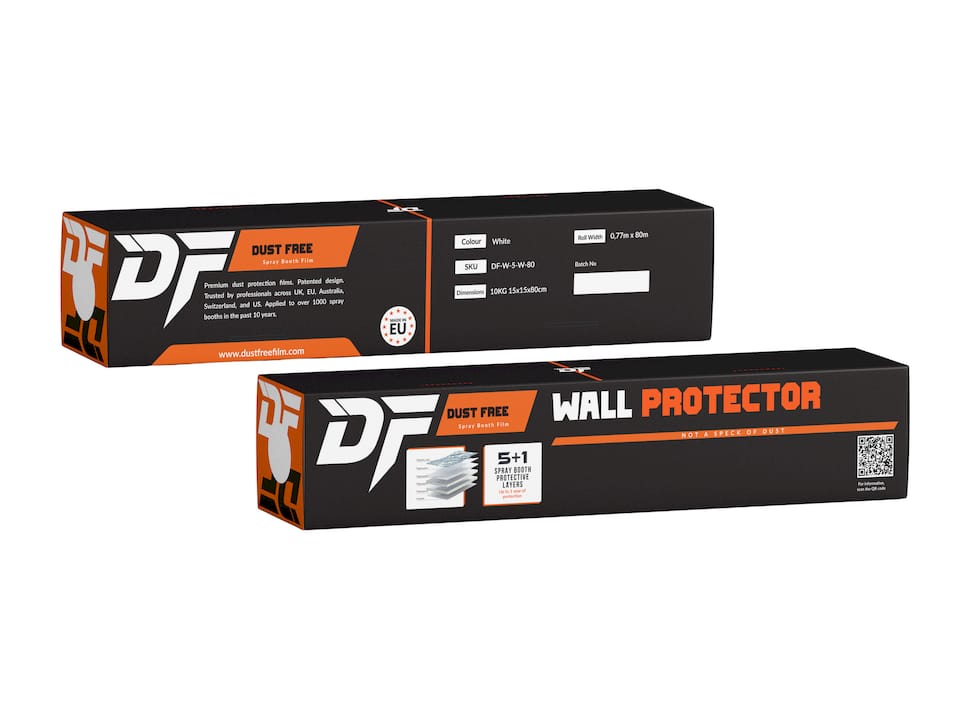
Dispenser-based multi-layer systems flip that equation. A patented application box feeds pre-loaded, multi-layer film across a wall or floor in one continuous, bubble-free pass, and maintenance becomes a peel cycle instead of a teardown. Practitioner experience consistently points to real uptime gains when shops move from tape-heavy setups to dispenser systems, since restoring a wall to a clean surface takes minutes of peeling rather than hours of re-taping.
Here’s the practical sequence for getting the most out of a dispenser system:
- Map your problem zones first — corners, light fixtures, and window frames need slower, more careful application than open wall space.
- Install with slight tension across flat runs to avoid bubbling, then work contours by hand where the film needs to conform.
- Set a peel schedule based on visible contamination, not a fixed calendar date, since throughput varies week to week.
- Track layer consumption against production volume so you can forecast reorder timing instead of scrambling.
Pro Tip: Keep a peel-cycle log for 30 days after switching to a dispenser system. Comparing logged downtime against your old manual-taping records is the fastest way to prove the labor savings to whoever signs off on the budget.
How to Choose the Right Booth Film: A Procurement Checklist
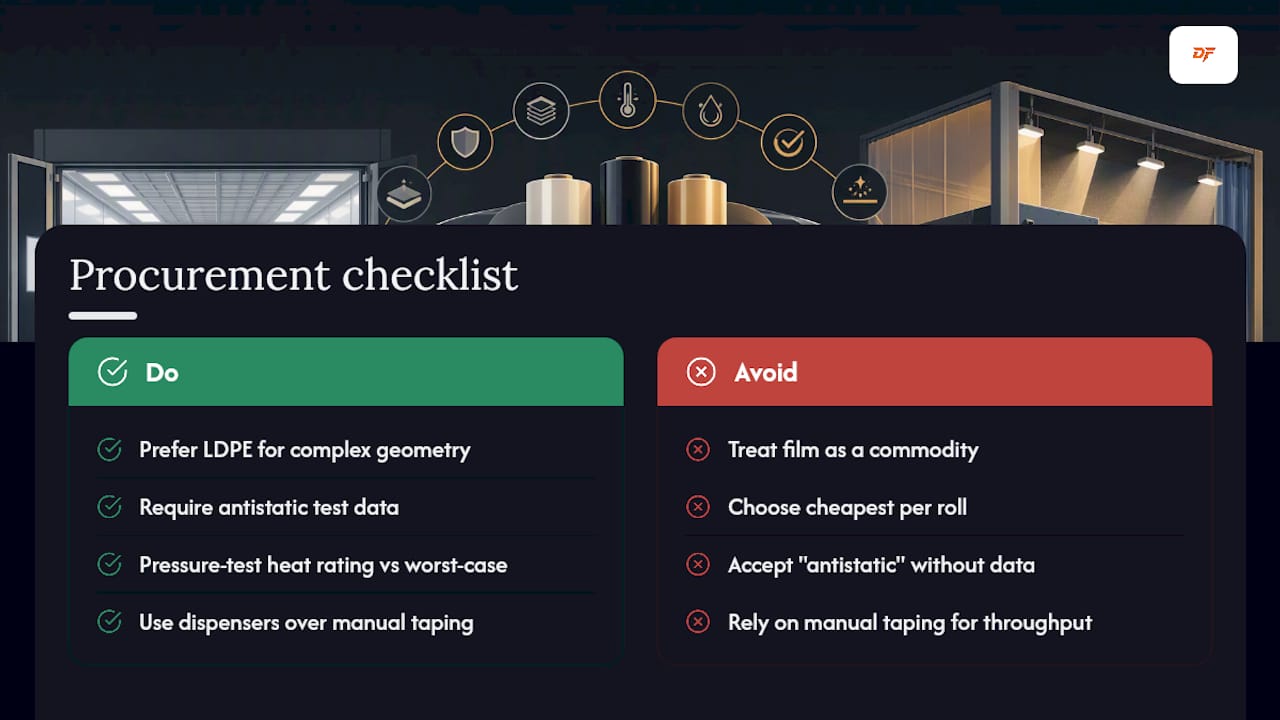
Specifying film correctly means working through your booth’s actual variables in order, not defaulting to whatever the last vendor shipped. Run through this sequence before you request a quote:
- Define booth use. Single-purpose automotive refinish, industrial production, or mixed-use handling both. Mixed-use booths should default to the higher industrial spec.
- Map coating chemistries. List every coating type that goes through the booth, including cure temperatures and solvent strength, since that determines chemical resistance requirements.
- Confirm airflow type. Downdraft, crossdraft, semi-downdraft, or open-face changes where contamination concentrates and where you need heavier film.
- Pick your substrate. LDPE for contours and irregular geometry, BOPP or stiffer PE blends for flat automotive walls.
- Verify antistatic and ATEX ratings if the process involves electrostatic spray application or falls under a hazardous-area classification.
- Check heat ratings against your actual cure or bake temperatures, with margin, not just the nominal spec.
- Choose your application method. Manual taping for occasional low-volume use, dispenser systems for production booths with frequent peel cycles.
- Request material data sheets and antistatic test data in writing before committing to a bulk order.
Ask any vendor these questions directly: what’s the melting point, what’s the tested antistatic rating and against which standard, and what’s the expected peel-cycle count before replacement. A vendor who can’t answer with numbers is guessing along with you.
| Decision factor | Automotive booth baseline | Industrial booth baseline |
|---|---|---|
| Best for | Flat panel refinish, single-shift | Complex parts, multi-shift production |
| Substrate | Thinner multi-layer PE / BOPP | Thicker LDPE-based multi-layer |
| Heat & chemical resistance | Moderate, standard refinish coatings | High, epoxies/polyurethanes/specialty coats |
| Flexibility for contours | Low to moderate | High |
| Application method | Manual taping or basic dispenser | Dispenser system strongly preferred |
| Replacement cadence | Standard, moderate cycle count | Shorter cycles, higher cost-per-cycle |
Cost-per-cycle framing matters more here than sticker price. A film that costs less per roll but tears twice as often or requires more labor hours to install will cost more over a quarter than a pricier, purpose-matched film. Compare quoted price against expected lifespan and labor time, not against the invoice line alone. For a deeper walkthrough of this framing, how to choose protection films for spray booth efficiency covers the math in more detail.
What Pavlos Filippakis Recommends for Procurement Teams
Treating booth film as a commodity is the single most expensive mistake facility managers make, and it usually isn’t caught until a wall fails mid-shift. Industrial operators who grab automotive-grade film because it’s cheaper or already in inventory often find it degrades fast against harsher coatings and heavier throughput, and the replacement cost plus downtime erases whatever they saved upfront.
The right film spec isn’t the one that costs least per roll. It’s the one that survives your actual coating chemistry, your actual airflow pattern, and your actual peel schedule without surprising you three weeks in.
Prefer LDPE carriers for any booth with real geometric complexity, and don’t accept an “antistatic” label without the test data behind it, particularly in electrostatic or ATEX-classified environments. Pressure-test heat ratings against your worst-case cure cycle, not the average one. For production booths running multiple shifts, dispenser systems consistently outperform manual taping on both labor hours and consistency of coverage.
Track three numbers over your next quarter: replacement cadence, film consumption per production volume, and downtime hours saved after switching application methods. Those numbers will tell you more than any vendor’s spec sheet.
Why Procurement Discipline Beats Brand Loyalty Here
The conventional advice on booth film treats it as a maintenance supply, something you reorder without much thought once you’ve settled on a brand. That’s backwards. Film is a process variable, as much a part of your booth engineering as your filter bank or your airflow design, and it should get re-evaluated every time your coating chemistry or throughput changes, not just when a roll runs out.
Where most facilities go wrong is skipping the diagnostic step entirely. They ask “what film do we usually buy” instead of “what does this specific booth need this year.” A shop that added a new epoxy line six months ago but never revisited its film spec is running on borrowed time, and the failure, when it comes, looks like a maintenance problem rather than the procurement gap it actually is.
Prioritize the checklist over the habit. Map your coatings, confirm your airflow, verify your heat and antistatic ratings, and only then compare vendors on price. Get that sequence right and the film choice becomes obvious. Get it backwards and you’ll keep replacing walls more often than you should.
— Pavlos Filippakis
Get the Right Film Specified the First Time
Dust Free Film builds multi-layer electrostatic protective films with LDPE carrier options for complex geometries, alongside patented dispenser systems that turn wall restoration into a peel cycle instead of a re-taping job. Every checklist item above, heat resistance, antistatic performance, contour flexibility, and dispenser compatibility, maps directly to what the product line is built to answer.
If you’re mid-procurement, don’t guess on specs. Request material data sheets and antistatic test data before you commit to a bulk order, ask about dispenser compatibility for your booth layout, and get a demo of the peel-cycle system if you’re still running manual tape. Start by requesting a quote from Dust Free Film and bring your coating chemistry list and airflow type to that conversation. You’ll get a spec recommendation instead of a generic sales pitch.
Sources
- ProTect Spray Booth Liner: Paint Perfection & Protection Solutions | DRYTAC
- Paintbooth
- Body shop vs industrial finishing filter selection | BoothFilterPro
FAQ
What Is the Best Type of Spray Booth Film for My Facility?
It depends on your booth’s geometry and coatings: LDPE-based multi-layer film suits complex industrial contours and heavy coating chemistries, while thinner multi-layer PE or BOPP film handles flat automotive refinish walls well.
What Do NFPA 33 Requirements Mean for Booth Film Selection?
Standards like those covering equipment and electrostatic processes in explosive atmospheres govern spray application using flammable and combustible materials, including ventilation and material handling in booths, so any film used in an electrostatic or solvent-heavy process should have documented static-control performance to support compliance.
How Much Does an Automotive Paint Booth Cost to Operate?
Operating costs vary heavily by shift count, filter cadence, and film replacement frequency, and industrial finishing operations generally run higher cost-per-cycle than standard collision-repair booths due to heavier filtration needs and coating diversity.
What Are the Two Main Types of Automotive Paint?
Automotive refinish work generally uses basecoat/clearcoat systems and single-stage (solid color) paints, both of which run cooler cure cycles than most industrial coating chemistries.
Can I Use the Same Film for Both Automotive and Industrial Booths?
For mixed-use booths, default to the higher industrial-spec film, since it’s built to handle the widest range of coating chemistries and throughput demands, protecting against the automotive-grade film underperforming on tougher industrial jobs.