
For finish-critical shops, multi-layer electrostatic booth films deliver the lowest lint and the fastest turnover between jobs, which is why they’re the professional standard over disposable paper or basic polyethylene sheeting. A lower-cost paper or plain LDPE liner can still work for occasional touch-up bays with light throughput, but any shop chasing consistent, defect-free finishes should build its liner spec around electrostatic film performance.
TL;DR:
- Choosing multi-layer electrostatic booth films reduces lint contamination, speeds up turnover, and minimizes rework, especially in high-volume shops.
- Verifiable specs like solvent resistance and bake-cycle tolerances are critical before selecting a liner, rather than relying on marketing claims of “lint free.”
- Proper installation, routine refresh, and regular floor cleaning extend liner effectiveness and maintain a dust-free environment.
- High-throughput shops benefit most from electrostatic films due to quick, consistent surface renewal without booth downtime.
- Reputable vendors should provide detailed testing data, clear warranty terms, and custom options for bulk or custom-sized orders.
Table of Contents
- Why Lint-Free Booth Liners Matter for Finish Quality and Uptime
- What to Look for in Technical Features and Specs That Matter
- How Common Liner Materials Compare in Practical Use
- Installation and Maintenance Steps to Keep a Booth Truly Lint-Free
- Safety, Compliance, and Vendor Claims Worth Verifying
- Why Dust Free Film’s Multi-Layer Electrostatic Films Are a Professional Choice
- What Warranty and Return Terms Should Cover
- What This Guide Gets Right That Most Buying Advice Misses
- How to Order Dust Free Film and What to Prepare for a Quote
- Sources
- FAQ
Why Lint-Free Booth Liners Matter for Finish Quality and Uptime
A single loose fiber landing in wet clear coat means a rework cycle: sanding, buffing, sometimes a full repaint. That cost compounds fast in a shop running multiple vehicles or panels a day. Lint isn’t cosmetic noise, it’s a measurable driver of labor hours and rejected finishes.
Booth walls and floors shed contamination every time a technician walks past, a fan cycles, or overspray dries and flakes. A lint-free booth fabric or film stops that particulate from becoming airborne again mid-spray.
What consistent liner performance actually buys a shop:
- Fewer buffed-out defects per vehicle, which directly cuts labor hours
- Predictable booth turnaround between jobs instead of surprise cleaning delays
- Lower reject and rework rates, which protects margin on flat-rate jobs
- A cleaner baseline for warranty-grade finish work
Vendor literature routinely cites NFPA 33 compliance and “lint free” as selling points, but that phrase means little without test evidence behind it. Treat it as a starting point for questions, not a finished answer.
What to Look for in Technical Features and Specs That Matter
Picking the best spray booth liner comes down to specs you can actually verify, not adjectives on a spec sheet. Run every candidate liner through the same checklist before it goes on your booth walls or floor.
- Material and construction. Multi-layer film, coated paper, and woven polyester all capture particulate differently, and construction determines how much lint the liner itself contributes.
- Solvent resistance. Ask for MEK rub or wipe test data. A liner that softens or lifts under common booth solvents will contaminate your next job.
- Heat and bake tolerance. Confirm the operating temperature ceiling matches your bake cycle, not just ambient booth conditions.
- Static and slip behavior. Anti-static surfaces reduce particle attraction to freshly painted panels, while floor liners need enough grip to keep technicians from sliding.
- Installation design. Tape-free overlapping edges, numbered layers, and integrated length markings all cut install time and reduce seams where lint hides.
Pro Tip: Before committing to a bulk order, request a sample roll and run a white-glove wipe test across a section after 24 hours of booth exposure. If the glove picks up visible fiber, that liner fails before it ever reaches your paint line.
Buyers should also ask vendors to walk through their own receipt-inspection and sample-testing procedure rather than accepting a spec sheet at face value.
How Common Liner Materials Compare in Practical Use
Every material on the market solves a different piece of the contamination problem, and matching material to shop volume matters more than chasing a single “best” answer.
- Disposable floor paper in 80# and 100# flame-retardant weights is cheap and fast to lay down, making it reasonable for low-volume or occasional-use booths, but it tears under foot traffic and needs frequent replacement.
- Peelable coatings work especially well on grate floors or irregular surfaces where an adhesive-backed film can’t lie flat, and large-sheet peel removal restores booth brightness fast between heavy-overspray cycles.
- Multi-layer electrostatic film suits high-throughput shops that need to expose a fresh, static-charged surface in seconds without shutting the booth down for a full recoat or reinstall.
Occasional-use booths can lean on paper or basic polyethylene. Production shops running multiple vehicles daily get more value from peelable coatings or electrostatic film, where the labor saved on cleaning offsets the higher per-roll cost.
Installation and Maintenance Steps to Keep a Booth Truly Lint-Free
A liner is only as clean as the process around it. Get the install and refresh routine right and the liner does its job for its full rated life.
- Wipe down walls and floor before the first install so the liner adheres to a clean substrate, not existing overspray residue.
- Apply using a dispenser or boxed-roll system, working top to bottom on walls and following any tape-free overlap markings.
- Peel and refresh the top layer on a fixed schedule tied to job count or shift count, not guesswork.
- Sweep or vacuum floor liners between jobs rather than waiting for visible buildup.
- Log roll usage against job volume so you can calculate a true cost-per-vehicle rather than judging price by the roll alone.
Boxed dispenser systems that speed single-person installation cut labor time significantly compared to manual taping, which matters when a booth’s downtime is the real cost driver, not the liner’s sticker price. Track that labor delta over a month and bulk ordering usually pays for itself.
Safety, Compliance, and Vendor Claims Worth Verifying
Marketing copy loves the phrases “lint free” and “NFPA 33 compliant,” but those claims deserve a paper trail before you trust them on a working booth.
- Request actual flame and char test data behind any NFPA 33 reference, not just a mention of the standard on a spec sheet.
- Ask for static-dissipation evidence if the liner is marketed as anti-static, especially for solvent-heavy environments where OSHA flammability guidance applies.
- Confirm solvent-compatibility testing against the specific solvents your shop uses, including MEK, and get bake-cycle performance data in writing.
- Check floor liners for slip resistance ratings before they go under foot traffic, and confirm boxed dispensers are rated for safe one-person handling.
None of this is paperwork for its own sake. It’s the difference between a liner that performs as advertised and one that fails mid-shift.
Why Dust Free Film’s Multi-Layer Electrostatic Films Are a Professional Choice
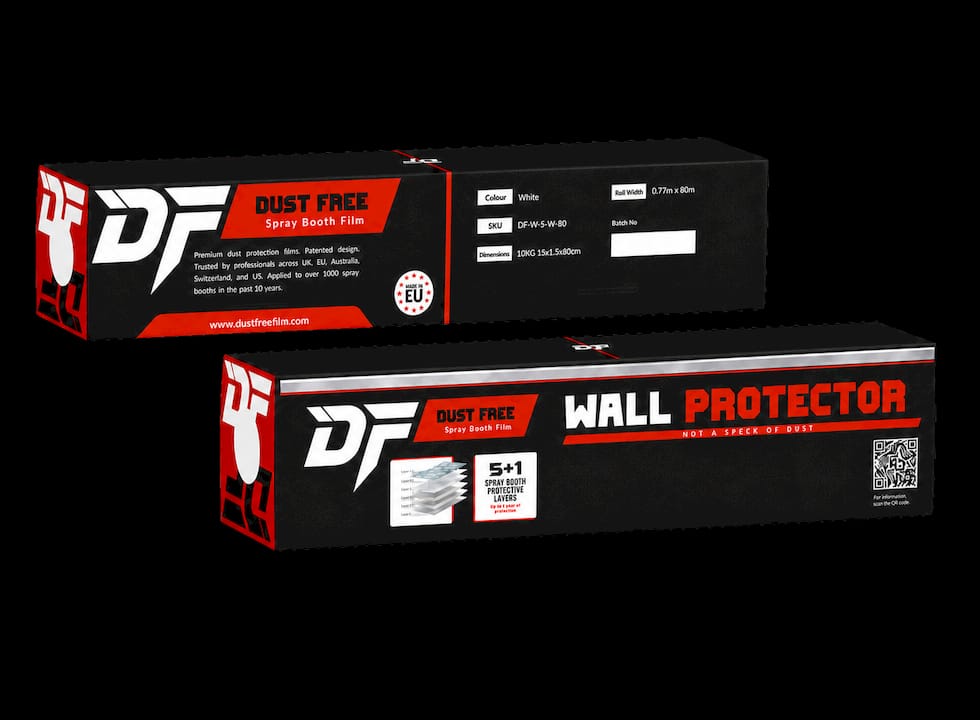
Some manufacturers build their Wall Protector and Floor Protector lines around features professionals actually test for: electrostatically charged surfaces that attract and hold contamination, tape-free overlapping edges, visible layer numbering, and integrated length markings that make install and refresh fast and repeatable. Both products may carry heat resistance to approximately 80°C, covering typical bake-cycle demands in automotive and industrial finishing.
Some patented application boxes use a freely rotating roll, reinforced wooden sides, and an integrated metal cutting bar, letting one installer steady the box with a foot and dispense a straight, clean line without a second set of hands.
Some manufacturers perform solvent-resistance testing against MEK to support durability claims under booth conditions, and technical documentation may be available for facility managers who need specifics before a purchase order.
What Warranty and Return Terms Should Cover
Warranty and return policy rarely gets asked about until something goes wrong, and that’s the wrong time to find out a vendor won’t stand behind a defective roll.
Ask any manufacturer three direct questions before ordering: what counts as a manufacturing defect versus normal wear, how long the warranty window runs from delivery date, and whether returns are accepted on unopened bulk rolls if a configuration doesn’t match your booth. Reputable industrial film and coating suppliers typically warranty against material defects like inconsistent adhesive, tearing under normal handling, or coating failure, but they don’t cover damage from improper installation or solvent exposure outside the product’s rated tolerance.
For custom configurations, ordering, and private-label runs, get the warranty terms in writing before the run ships, not after. Bulk orders and custom widths are harder to return once cut, so confirm sizing and specs against your actual booth dimensions before the order is finalized. A vendor willing to put warranty terms in a quote, rather than a generic “satisfaction guaranteed” line, is telling you something about how confident it is in its own testing.
Facility managers evaluating multiple vendors should treat warranty clarity as a filter, not an afterthought. A supplier that answers defect and return questions specifically, with actual timeframes and conditions, is easier to hold accountable than one that waves at “industry standard” terms.
What This Guide Gets Right That Most Buying Advice Misses
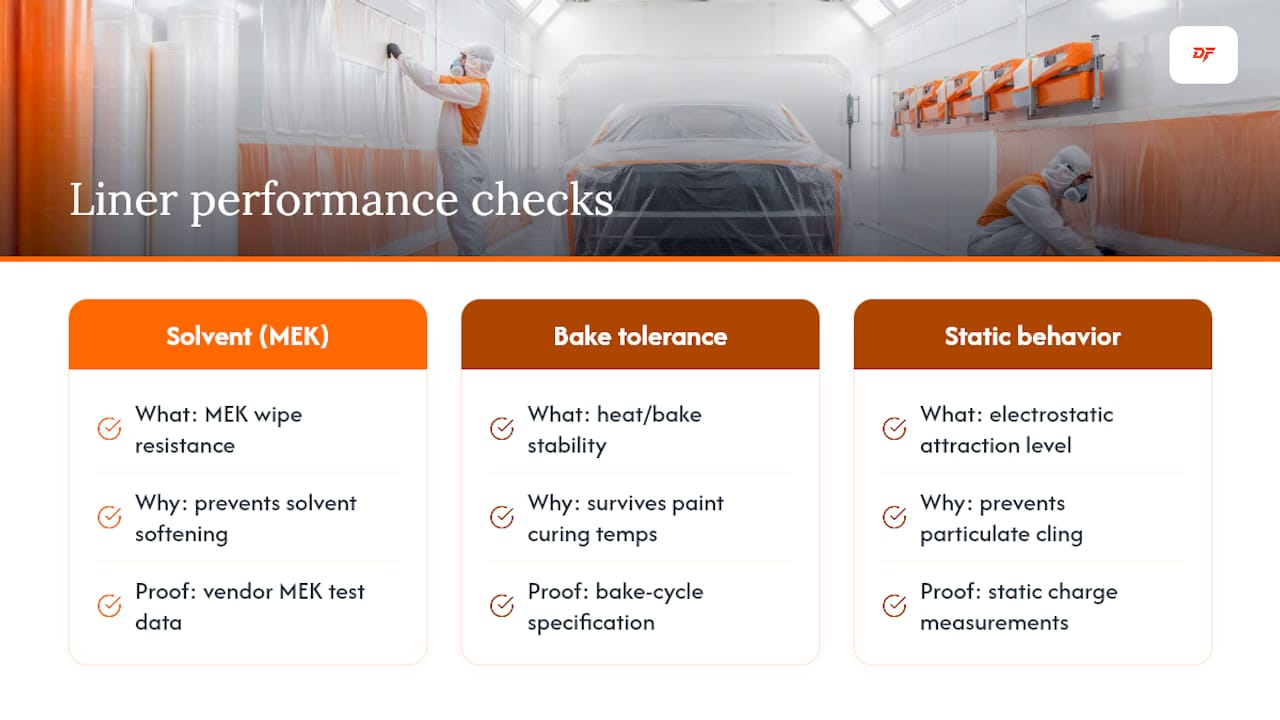
Most advice on booth liners treats “lint free” as a binary label instead of a spectrum of measurable performance. That’s backwards. The research behind this guide points to a simpler judgment: liner quality is only as good as the test data a vendor is willing to hand over. Solvent resistance, bake tolerance, and static behavior are all verifiable. A shop that skips that verification step and buys on price alone is gambling with rework labor it doesn’t need to lose.
The conventional advice to “just buy the cheapest paper that says lint free” ignores throughput. A high-volume shop burning through paper rolls weekly is paying more in labor and downtime than it would on a multi-layer film with a faster refresh cycle. Occasional-use booths are the exception, not the rule, and most professional operations don’t fit that description.
If you take one thing from this guide, prioritize the MEK wipe test and the bake-cycle spec over the marketing copy. Everything else, from dispenser ergonomics to layer numbering, matters for convenience. Those two specs are what actually protect your finish.
— Pavlos - Angelos Filippakis
How to Order Dust Free Film and What to Prepare for a Quote
Wall Protector and Floor Protector lines may cover surfaces professionals need protected, and the products might be available factory-direct or through regional distribution partners depending on location and order size. Bulk orders, custom configurations, and private-label production can be options for facility operators running multiple booths or standardizing across locations.
Before requesting a quote, have your booth dimensions, typical bake-cycle temperatures, primary solvent exposure, and expected monthly throughput ready. That information lets Dust Free Film recommend the right film thickness and layer count for your actual workload instead of a generic size. Shops managing multiple booths or planning ahead for maintenance cycles can also review practical booth cleanliness strategies and routine maintenance checklists while sizing an order.
Visit the Dust Free Film product page to start a quote, and mention bulk or custom configuration needs upfront so pricing reflects your actual order volume from the first conversation.
Sources
- Clean Booth Kit - White Out Paint Booth Covering
- Paint Booth Protection Floor Paper and Covering
- Protective Spray Booth Liners
- Lint free 100% polyester cleanroom fabric and wipe specs
FAQ
What Is a Good Lint-Free Cloth for Paint Prep?
Cleanroom-grade 100% polyester wipes are commonly specified for contamination-control prep work because they shed far less fiber than cotton rags during wipe-down before spraying.
What Type of Flooring Is Best for a Spray Booth?
A slip-resistant, solvent-tolerant floor protector, such as a heavy-duty multi-layer film or a chemical-resistant mat, holds up better under foot traffic and overspray than uncoated paper in production environments.
What Is a Lint-Free Liner and Why Does It Matter?
A lint-free liner is a wall or floor covering engineered so its own material doesn’t shed fibers into the booth air during spraying, which prevents that fiber from landing in wet finish and causing rework.
How Often Should Booth Liners Be Replaced?
Replacement cadence depends on job volume rather than a fixed calendar date. High-throughput shops typically refresh top layers every shift or every few jobs, while lower-volume booths can stretch that interval based on visible buildup.
Which Booth Liner Type Suits High-Volume Body Shops Best?
Multi-layer electrostatic film generally suits high-volume shops best because a single installer can peel and expose a fresh surface in seconds without shutting the booth down for a full recoat.