
The best powder-coating booth film is a multilayer electrostatic system like the Dust Free Film Wall Protector and Floor Protector, because their tacky, charged surfaces capture powder overspray before it settles on parts or clogs filtration. That translates into fewer rejected finishes, faster changeovers between shifts, and cleaner booths without stopping production for a full scrub-down. Start by measuring your booth’s wall and floor square footage, then order a sample roll to confirm charge behavior with your gun settings before a full rollout.
TL;DR:
- Multilayer electrostatic booth films like Dust Free Film Wall and Floor Protectors specifically capture powder overspray, reducing rework and cleaning time.
- Proper product choice depends on surface type, with tacky multilayer films for walls and durable, slip-resistant films for floors, and testing charge behavior before full deployment.
- Matching the film’s temperature rating, electrostatic threshold, and layer thickness to your booth’s operation ensures optimal performance and durability.
- Peelable multilayer films significantly decrease downtime by enabling quick changeovers and reducing manual cleaning compared to traditional scrapes and washes.
- Higher upfront costs for engineered multilayer systems are offset by longer lifespan, fewer replacements, and reduced labor hours, especially for facilities with frequent color changes.
Table of Contents
- Which Booth Film Should You Order First?
- Why Do Powder Booths Need Different Film Than Wet-Paint Booths?
- How Do You Choose the Right Film for Powder Operations?
- How Do You Install Booth Film Without Slowing Down Production?
- What Technical Specs Actually Matter for Powder Compatibility?
- How Much Downtime and Rework Does Film Actually Save?
- How Do Leading Booth Film Brands and Product Lines Compare?
- What Do Powder-Coating Booth Films Cost, and Are They Worth It?
- How Long Does Booth Film Actually Last?
- What Safety and Compliance Factors Apply to Booth Films?
- What the Industry Still Gets Wrong About Booth Film
- Where to Order Dust Free Film Wall and Floor Protectors
- Sources
- FAQ
Which Booth Film Should You Order First?
Wall Protector and Floor Protector solve different problems, and buying the wrong one wastes money fast. Walls need a film that catches airborne powder drifting off the spray pattern; floors need something that survives foot traffic, cartwheels, and dropped hardware without tearing.
Match the product to the surface first:
- Vertical booth walls and ceiling panels: the multilayer Wall Protector, designed with a slightly tacky electrostatic surface to grab drifting particulate and reduce settling.
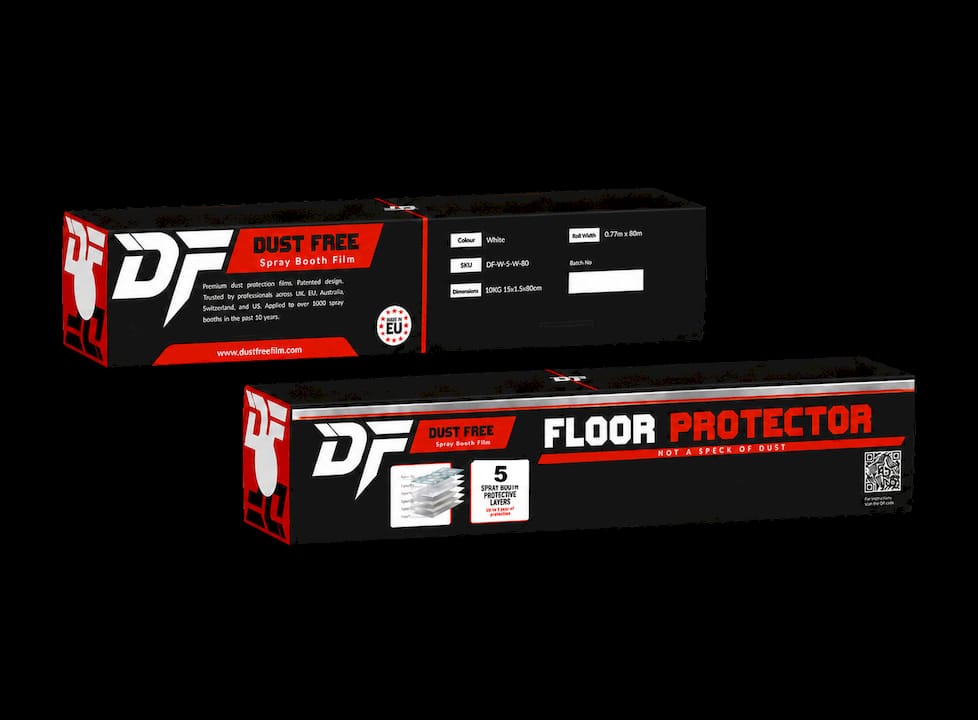
- Walkways, load zones, and high-traffic floor areas: the heavy-duty Floor Protector, designed for slip resistance and durability under rolling loads.
- Both surfaces in a new or converted booth: order both, sized to the same layer count so changeovers happen on the same schedule.
To estimate rolls, measure booth wall height and perimeter, then floor square footage, and add 10 to 15% for overlap and trim waste. Your order checklist should include roll width, layer count, whether you need the dispenser box, and confirmation that the film’s heat rating matches your cure oven’s radiant exposure near the booth entrance.
Why Do Powder Booths Need Different Film Than Wet-Paint Booths?
Powder does not behave like liquid overspray. It is heavier, drier, and settles differently, which is why powder booths are commonly built with floor-mounted exhaust and multi-stage cartridge filtration rather than the wall-mounted extraction typical of wet-paint setups. Film has to work with that airflow pattern, not against it.
Multilayer film gives powder somewhere to go besides your filters or your parts. The electrostatic surface intercepts stray particulate close to where it lands, so less of it recirculates through the booth or gets pulled into cartridge media that then needs premature replacement.
Facilities that skip protective film typically spend more labor hours on manual booth teardown and scraping between color changes. The payoff of a peelable multilayer system shows up in three places: fewer rework cycles from contaminated finishes, shorter downtime between cleanings, and steadier color and texture consistency from one batch to the next, since the booth surfaces underneath stay clean regardless of how many layers have been peeled away.
How Do You Choose the Right Film for Powder Operations?
Selecting film for a powder booth is not the same exercise as picking a wet-paint liner. Powder’s sensitivity to static fields and its narrower thermal tolerance during cure make a few specs non-negotiable.
- Confirm electrostatic behavior with real data. Ask the supplier for the safe charge threshold rather than accepting a generic “static” label. Films engineered to a safe static level attract overspray without disrupting coating transfer, but an unspecified or excessive charge can actually steer powder off target.
- Check tack level. The surface needs enough grab to hold particulate through a shift without leaving adhesive residue when a layer peels away.
- Match the temperature rating to your cure cycle. Some spray booth protection films resist operating temperatures up to 80°C, which covers most bake-oven radiant zones near booth openings.
- Look for peelable multilayer construction with visible numbering. Layer counters and integrated length marks let one technician track changeovers without guesswork.
- Confirm the overlap system is tape-free. Seams that rely on tape can bunch, lift, or create edges that disturb airflow paths through the booth.
- Request samples and a technical datasheet before committing to volume. A short in-booth trial confirms compatibility with your specific gun type and powder chemistry.
Pro Tip: Run a sample roll on one wall panel for a full shift before ordering pallet quantities. Watch for any drift in transfer efficiency near that panel. If the powder behaves the same as it does on bare metal, the film’s charge is tuned correctly.
How Do You Install Booth Film Without Slowing Down Production?
Installation speed matters as much as the film itself, especially in booths running multiple color changes a day. A patented application box with a freely rotating roll, reinforced sides, and an integrated cutting bar lets one installer steady the box with a foot and dispense a straight line without a second set of hands.
Good installation habits keep the film doing its job instead of fighting the booth:
- Unroll along the visible length markings so each panel goes on straight the first time.
- Overlap edges using the tape-free system and check that layer numbers line up before cutting.
- Keep film seams clear of the gun-to-part travel path so no local field forms that could pull powder off course.
- Peel one exposed layer per changeover rather than reinstalling the whole system, which is the entire point of the multilayer design.
- Set a changeover cadence based on throughput: daily for high-volume lines with heavy soiling, weekly for moderate runs, and monthly for lighter-use booths.
For a full walkthrough of the sequence, see this step-by-step application guide, and for configuration examples across different booth layouts, check these field application examples.
What Technical Specs Actually Matter for Powder Compatibility?
Three numbers determine whether a film will work in your specific booth: temperature resistance, electrostatic threshold, and how thin your powder film build runs.
Temperature resistance up to 80°C covers most booth conditions, but confirm your oven’s proximity to the booth doesn’t push local temperatures higher during longer bake cycles. Electrostatic threshold is a trade-off: enough charge to capture overspray, not so much that it interferes with deposition, which is why supplier test data matters more than a marketing claim of “anti-static.”
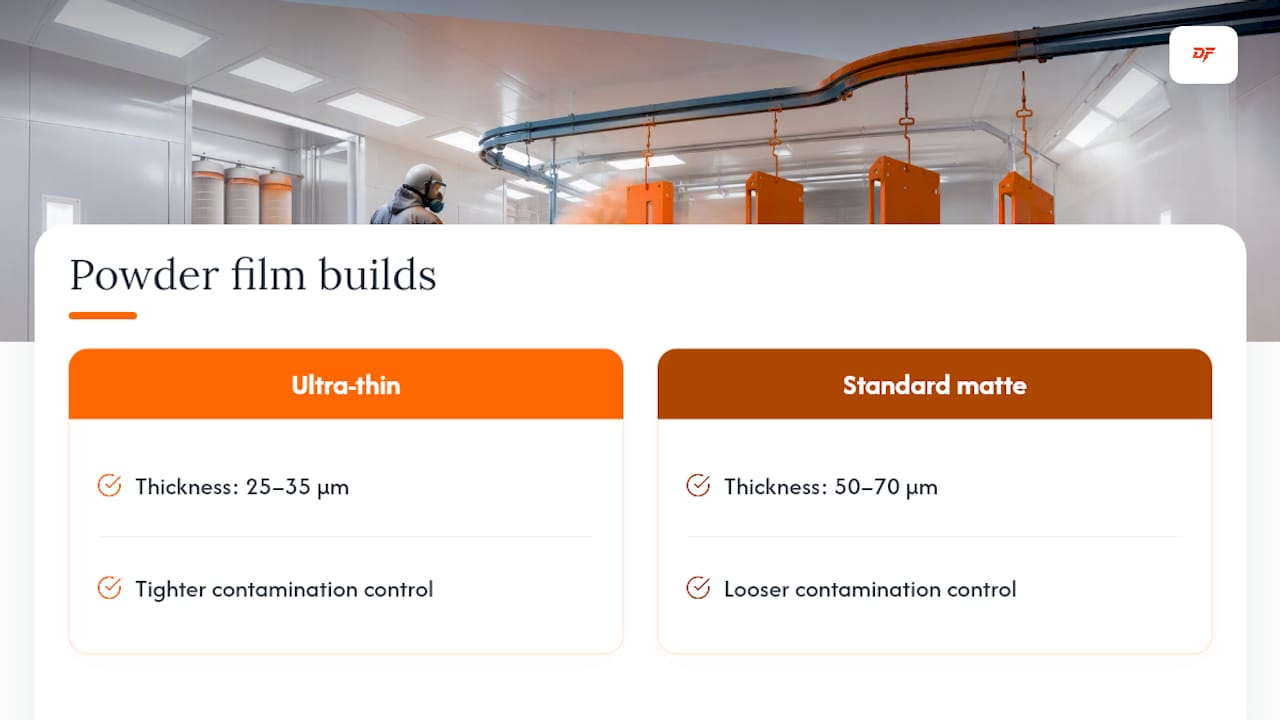
Powder film thickness is the variable most managers overlook. Standard matte finishes commonly run in the 50 to 70 micron range, while ultra-thin powder processes can drop to 25 to 35 microns. Thinner builds mean less powder covering any contaminating particle that lands mid-spray, so booths running thin-film processes need tighter contamination control, not looser.
How Much Downtime and Rework Does Film Actually Save?
The clearest ROI signal is what stops happening: full booth teardowns for scraping and degreasing. Multilayer film turns that into a peel-and-go changeover, often in minutes instead of the hours a manual clean requires.
- Fewer full cleanings per month means fewer labor hours diverted from production to maintenance.
- Peeling a soiled layer takes a fraction of the time of scraping dried powder off bare booth walls.
- Keep at least one spare dispenser box and a buffer of rolls on hand so a production run never stalls waiting on a reorder.
- Payback depends on your specific mix of throughput, current defect rate, and local labor cost, but the direction is consistent: less manual cleaning time, fewer rejected parts from contamination.
Facilities running multiple color changes daily typically see the fastest payback, since that is where manual cleaning time adds up quickest.
How Do Leading Booth Film Brands and Product Lines Compare?
Booth film products generally fall into three tiers: basic single-layer disposable sheeting, mid-tier multilayer films with limited electrostatic properties, and engineered multilayer systems built specifically for coating environments.
Single-layer sheeting is the cheapest option and the least suited to powder work. It has no electrostatic pull, tears easily under foot traffic, and usually needs tape at the seams, which creates edges that can disrupt airflow near filtration intakes.
Mid-tier multilayer products improve on durability and offer some tack, but many are adapted from wet-paint booth use rather than engineered for powder’s static sensitivity. That distinction matters when a supplier can’t produce charge-threshold data on request.
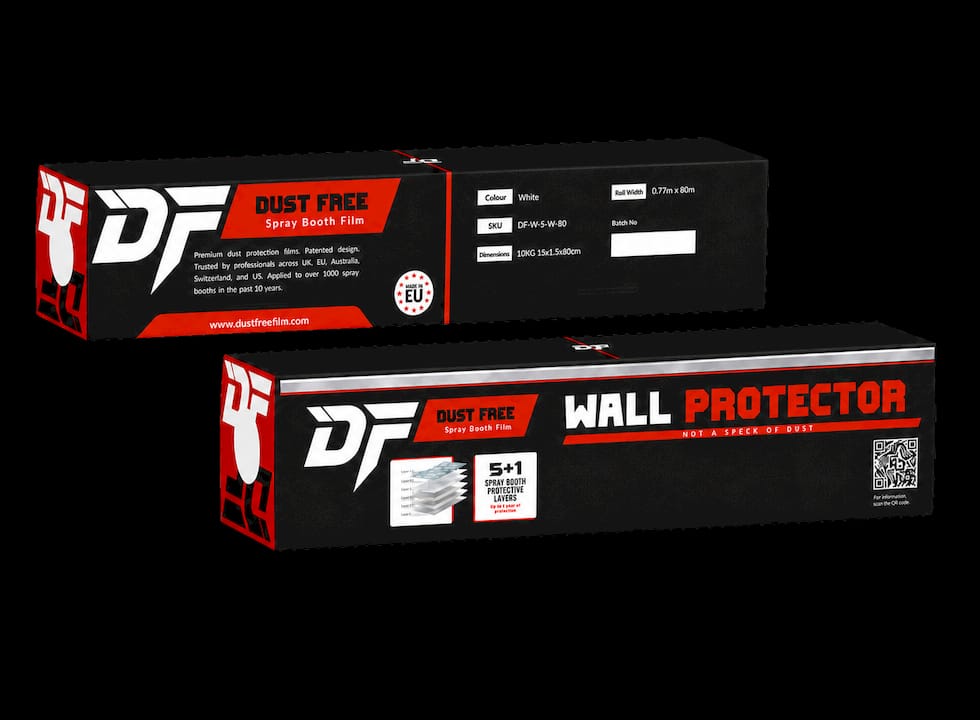
Engineered systems such as multilayer spray booth protection films with purpose-built electrostatic surfaces, tape-free overlapping edges, visible layer numbering, and dispenser boxes designed for one-person installs sit at the top tier. The product line also supports custom widths and private-label configurations, which matters for facilities running nonstandard booth dimensions or multiple sites under one brand standard. Manufacturing origin and consistency across batches also separate premium lines from generic imports, since inconsistent tack or charge from batch to batch is a common complaint with lower-tier sheeting.
What Do Powder-Coating Booth Films Cost, and Are They Worth It?
Booth film pricing scales with roll width, layer count, and whether the order includes a dispenser box or custom sizing. Basic single-layer sheeting sits at the low end of the market but requires more frequent replacement and tape, which adds hidden labor cost over a month of use.
Multilayer electrostatic systems cost more per roll upfront, but the layer count changes the math: one roll delivers many changeovers instead of one. Facility managers should compare cost per changeover, not cost per roll, since a film that lasts twenty peels at a higher unit price often beats a cheaper roll that needs full replacement after two or three uses.
Bulk and factory-direct purchasing also affects the equation. Buying rolls and dispenser boxes in volume, or negotiating a custom configuration for a nonstandard booth, generally lowers per-unit cost more than buying single rolls repeatedly from a regional distributor. Some manufacturers offer bulk orders and custom configurations directly from the factory, along with VAT-free international shipping, which changes the total cost picture for facilities ordering on a recurring schedule. Exact pricing depends on roll specifications and order volume, so requesting a quote based on your booth’s actual dimensions gives a far more accurate number than any published price range.
How Long Does Booth Film Actually Last?
Lifespan depends less on calendar time and more on changeover frequency and how much particulate a shift generates. A high-volume booth running frequent color changes will peel through layers faster than a low-volume operation running the same product for weeks.
Multilayer construction is what makes durability predictable: each peel exposes a fresh surface, so the film’s working life is really the sum of every layer’s individual life, not one continuous surface degrading over time. Some spray booth protection films hold up under enhanced tack for particle capture, while others feature heavier construction designed to resist tearing under cart wheels and foot traffic across a longer service window.
Two things shorten effective lifespan faster than normal wear: exceeding the film’s temperature rating near oven-adjacent booth zones, and skipping scheduled changeovers until visible soiling reduces tack performance on the exposed layer. Facilities that track changeover cadence against actual throughput, rather than a fixed weekly habit, get more consistent performance out of each roll and fewer surprises when a layer underperforms mid-shift.
What Safety and Compliance Factors Apply to Booth Films?
Booth film sits in a straightforward compliance category compared to the coatings themselves, but a few factors still need attention before installation. Slip resistance on floor film matters for workplace safety, particularly in walkways where carts, ladders, or foot traffic cross regularly.
Fire and heat exposure near cure ovens is the other major consideration. A film rated for lower temperatures than your booth’s radiant exposure near the oven entrance can degrade, curl, or release residue onto parts, which creates both a quality problem and a potential safety issue. Confirming the film’s temperature rating against your specific oven proximity avoids that failure mode entirely.
Electrostatic behavior also intersects with safety when charge levels are unspecified. A film with an engineered, documented charge threshold behaves predictably; one with a vague “anti-static” claim introduces uncertainty into a process where static already plays a functional role. Facilities should keep supplier datasheets on file as part of standard documentation, both for internal quality control and for any customer or auditor asking how contamination risk is managed on the line.
What the Industry Still Gets Wrong About Booth Film
Most facility managers treat booth film as an afterthought, something ordered reactively when the current roll runs out, rather than a variable in their contamination and airflow planning. That is backward. Film choice interacts directly with how powder settles, how filters load up, and how much rework a shift generates.
The bigger mistake is assuming any “static” film works the same in a powder booth as it does in a wet-paint booth. It does not. Powder is more sensitive to local electrostatic fields, and a film with an unspecified charge level can quietly steer particulate off target for weeks before anyone traces a finish problem back to the wall. Two lessons come up again and again from operators switching to a properly engineered system: dispenser ergonomics matters more than most buyers expect going in, since a clumsy box turns a five-minute changeover into a twenty-minute one, and testing electrostatic behavior on a real part before full deployment catches problems no datasheet alone will reveal.
— Pavlos - Angelos Filippakis
Where to Order Dust Free Film Wall and Floor Protectors
Dust Free Film is the direct-from-factory alternative to buying generic booth sheeting through a regional distributor markup. That means bulk pricing, custom widths, and a patented dispenser box built for one-person installs, without the guesswork of matching mismatched products from multiple vendors.
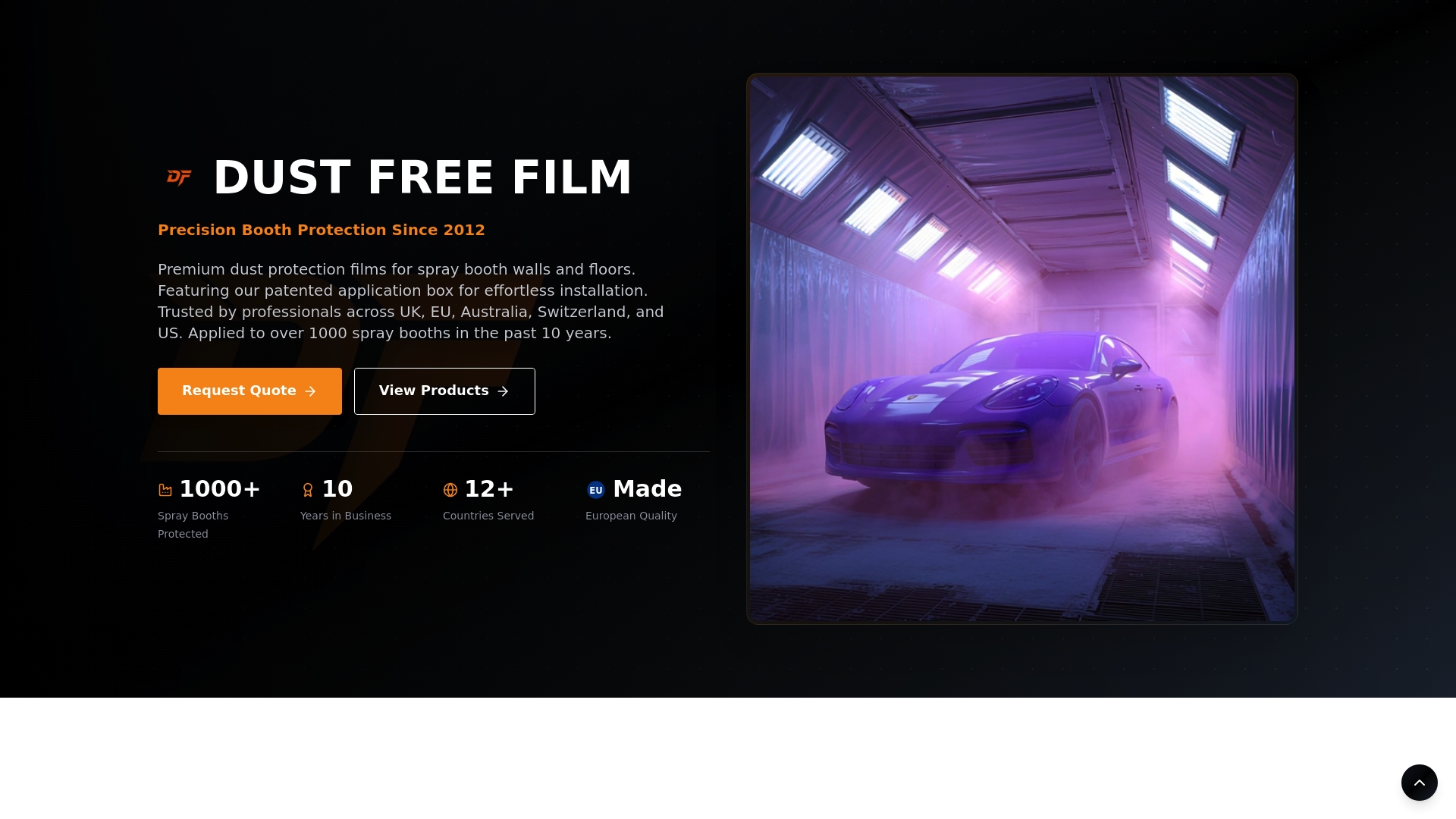
If you’re ready to move past sample estimates, start with the Wall Protector product page or the Floor Protector product page to check roll widths and dispenser options against your booth’s dimensions. For facilities running nonstandard booth sizes or needing private-label runs, the full product catalog covers custom configuration options. Request a technical sample or a quote based on your booth’s actual wall and floor measurements, and confirm the heat-resistant variant matches your cure oven’s proximity before placing a bulk order.
Sources
- 10x10x25 Powder Coating Booth - Reliant Finishing Systems
- IGP-DURA®mix 3303A-T0 | Matte Thin-Film Powder Coating | IGP Technical Data Sheet
- POLYFLEX UDS brochure
FAQ
Which Brand Is Considered Best for Powder Coating Booth Film?
Engineered multilayer electrostatic systems, like Dust Free Film’s Wall Protector and Floor Protector, are generally considered the strongest option because their charge levels and tack are tuned specifically for coating environments rather than adapted from generic sheeting. Look for documented electrostatic threshold data and tape-free seam design as the deciding factors, not just brand recognition.
What Is the Best Material for Powder Coating Booth Protection?
Multilayer peelable film with an electrostatically tuned, slightly tacky surface performs best for walls, while a heavier, slip-resistant multilayer film suits floors and high-traffic zones. The key is matching material construction to the surface’s actual stress: airborne capture on walls, abrasion resistance on floors.
How Thick Is Powder Coat Film Typically?
Standard powder coating film thickness commonly falls in the 50 to 70 micron range for matte and smooth finishes, while ultra-thin powder processes run closer to 25 to 35 microns. Thinner builds are more sensitive to surface contamination, which raises the stakes for booth film quality.
How Much Does a Powder Coating Booth Cost?
Booth cost varies widely based on size, filtration type, and airflow design, and depends on your specific facility requirements rather than one universal figure. Protective film and dispenser systems for an existing booth are priced separately by roll specification and volume, and current pricing is available by requesting a quote directly from Dust Free Film.