

Booth protection film doesn’t carry a universal expiration date. Usable life depends on surface energy (dyne) decay and the storage history of that specific roll, not a printed date on the packaging. A roll sitting in a hot warehouse for eight months can be worse off than one that’s been refrigerated for two years.
Rough brackets, backed by Arrhenius-based aging models: film held at normal room temperature stays reliable for a few weeks to a few months once dyne treatment starts fading. Cool or refrigerated storage stretches that to a year or more. Cold or frozen stockpiles, handled correctly, can remain usable for several years.
None of that matters if you skip the one step that actually protects your production line:
- Label every roll with receipt date, batch number, and treatment method (corona or plasma).
- Before running any roll that has been stored for a couple of months or longer, or any roll from unknown storage conditions, test it.
- Run a quick dyne or adhesion check on a sample before committing a full roll to the booth.
- Reject or boost-treat anything that fails, rather than gambling on a production run.
Key Takeaways
Booth film shelf life depends on dyne decay and storage history, not a printed expiration date, and testing an older roll before use is the single most reliable safeguard.
| Point | Details |
|---|---|
| No fixed expiration | Usable life ranges from weeks at room temperature to years when refrigerated or frozen. |
| Dyne level is the real metric | Test surface energy with a dyne pen before trusting any roll older than 60 days. |
| Storage conditions control decay | Keep rolls between 30 and 50% relative humidity, away from heat and direct sunlight. |
| Handling matters at install | Use gloves, handle by the edges, and let cold stock warm sealed before opening. |
| Choose treatment method wisely | Plasma-treated film holds dyne level longer than corona-treated film in storage. |
| Dust Free Film reduces risk | Its multi-layer electrostatic film and patented dispenser system cut handling errors that shorten usable life. |
Table of Contents
- Does Booth Film Go Bad? What Drives the Decay
- Booth Film Storage Conditions That Actually Extend Life
- How to Test Booth Film Before You Trust It on the Line
- Handling Booth Film Without Wrecking Its Performance
- What Dust Free Film Does to Reduce Shelf-Life Risk
- What Actually Matters, and What Gets Overstated
- Get Sample Film and Technical Data From Dust Free Film
- Sources
- FAQ
Does Booth Film Go Bad? What Drives the Decay
Booth film doesn’t “go bad” the way food spoils. It degrades because its surface energy, measured in dyne levels, drops over time. Dyne level determines how well the film’s electrostatic charge holds and how aggressively its adhesive layer grips a wall or floor. When dyne level falls below the threshold the film was engineered for, adhesion weakens and the electrostatic pull that traps overspray dust starts to fail.
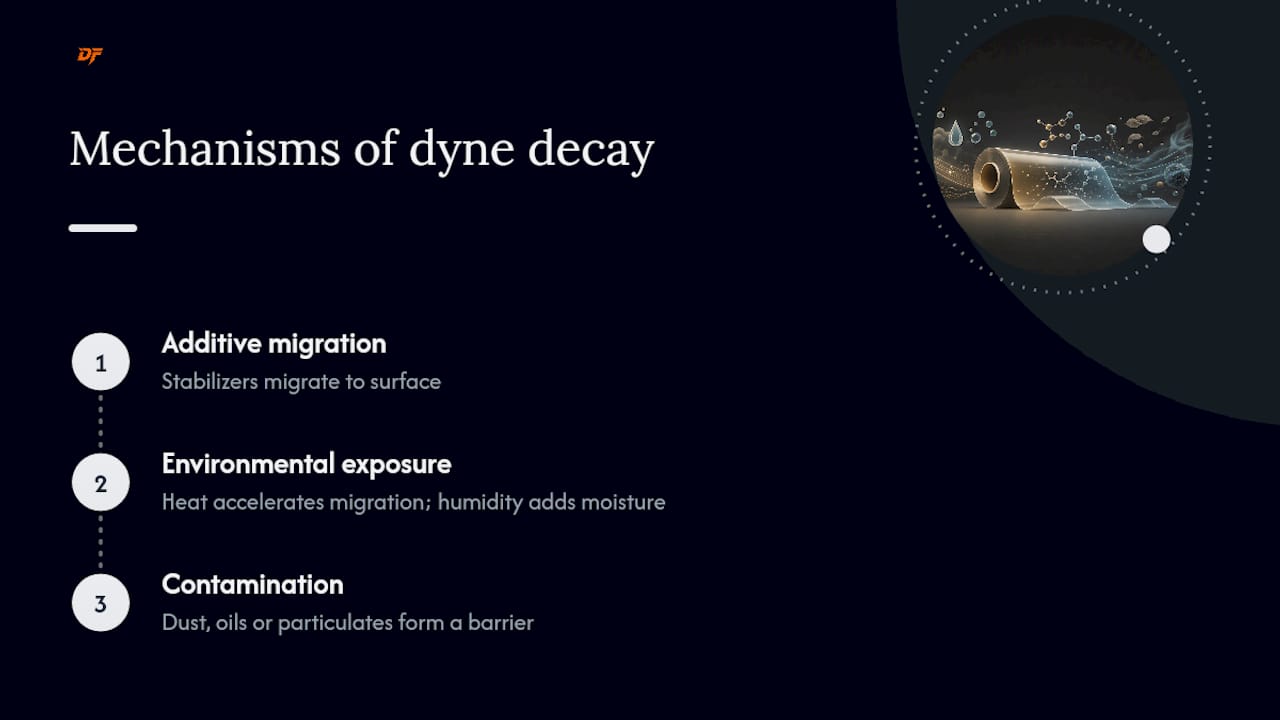
Three mechanisms drive that decline, including additive migration, which requires careful management as outlined in a step-by-step migration guide for coating additives. First, additive migration: stabilizers and slip agents built into the polymer slowly migrate to the surface, changing its chemistry and, according to Vetaphone’s shelf-life research, altering both adhesion and electrostatic performance well before the film looks any different. Second, environmental exposure: heat accelerates migration, and humidity introduces moisture that interferes with the treated surface. Third, contamination: dust, oils, or airborne particulates settling on stored rolls create a barrier between the film and the substrate it’s supposed to grip.
Treatment method matters more than most buyers realize. Plasma-treated films hold their dyne level significantly longer in storage than corona-treated films, which tend to decay faster once removed from ideal conditions, per the same Vetaphone analysis. If your rolls sit in a distribution warehouse for months before reaching your shop, that difference in treatment method can be the gap between a clean install and a film that won’t hold static charge on day one.
The operational cost is real. A roll that fails mid-application means stopped production, wasted labor pulling and re-hanging film, and in the worst cases, overspray contamination reaching a finish that’s already in the booth. That’s not a minor inconvenience on a paint line running tight schedules.
Booth Film Storage Conditions That Actually Extend Life
Temperature and relative humidity control degradation more than any other variable you can manage on-site. Archival film preservation research shows that even modest drops in storage temperature slow chemical decay substantially, and the same principle applies to industrial protective films, per National Archives preservation guidance.
Here’s a workable framework for shop and warehouse storage:
- Short-term stock (used within 60 days): Standard climate-controlled warehouse space, ideally 60 to 75°F, with relative humidity between 30 and 50%.
- Medium-term stock (60 days to a year): A cooler storage room, below 60°F where possible, with the same RH band. Avoid direct sunlight or proximity to heat sources like compressors or HVAC exhaust.
- Long-term stockpiles (multi-year reserves): Refrigerated or frozen storage, double-bagged and sealed against moisture, following the same low-humidity principles used in professional film archives, which recommend roughly 20 to 50% RH with ventilation to prevent trapped off-gassing, according to film preservation storage standards.
Keep rolls wrapped in their original packaging until use. Don’t seal them inside airtight bins for “extra protection.” Trapped off-gassing from the polymer itself can accelerate surface changes rather than prevent them. Stack rolls horizontally on shelving, not stood on end where the core can deform under weight.
Run inventory on a strict first-in, first-out basis with batch tags visible on every roll. Facility managers switching between just-in-time ordering and bulk purchasing should note that JIT reduces storage risk but increases price exposure, while bulk buying demands the storage discipline above to avoid ending up with degraded stock nobody wants to use.
Pro Tip: Never pull a frozen or refrigerated roll straight into a warm, humid booth environment. Let it warm up sealed in its packaging first. Opening cold film immediately invites condensation on the surface, which can ruin dyne treatment before the roll ever gets unrolled.
How to Test Booth Film Before You Trust It on the Line
A five-minute test beats a four-hour cleanup. Storage history, not the calendar, is the real predictor of whether a roll will perform, which is exactly why Vetaphone’s guidance treats batch testing as standard practice for older stock rather than an optional precaution.
- Run a dyne test. Use dyne test pens or markers, drawn across a clean section of the film. If the ink beads or pulls back within two seconds, the surface energy has likely dropped below the level needed for stable electrostatic and adhesive performance.
- Check adhesion with a peel sample. Apply a small section to a clean wall or floor patch, press firmly, and attempt to peel it after a few minutes. Weak, inconsistent resistance signals a problem before you commit a full roll.
- Document and decide. Log the dyne reading, batch number, and storage duration. Anything below the treated threshold gets boost-treated, downgraded to a lower-priority use, or rejected outright.
| Test | Tool Needed | Pass Signal |
|---|---|---|
| Dyne level | Dyne pens or markers | Ink holds an even film for 2+ seconds |
| Adhesion/peel | Sample patch, timer | Even resistance, no delamination |
| Visual/contamination | None (visual inspection) | No surface haze, dust, or oil residue |
Keep these results on file. A traceable log turns a mystery production failure into a fixable storage or supplier issue.
Handling Booth Film Without Wrecking Its Performance
How you handle a roll in the last ten minutes before install matters almost as much as how it was stored for the prior year. Skin oils, dust, and rough handling introduce the same contamination problems that hurt film sitting in a warehouse, according to audiovisual preservation handling standards, a principle that applies directly to industrial protective film.
- Wear nitrile gloves and handle rolls by the core or edges, never the treated face.
- Unroll in a clean area away from active grinding, sanding, or overspray.
- If the roll came from cold storage, let it warm sealed for several hours before opening. Cold-storage warm-up protocols exist for exactly this reason: opening a chilled roll too early invites condensation that damages the treated surface before it ever touches the booth wall.
- Use a dispenser system for tension-controlled, bubble-free application rather than pulling film by hand.
- Press a test section immediately after install and confirm adhesion before walking away.
Pro Tip: Keep a box of nitrile gloves at the dispenser station, not in a supply closet. The rolls that get contaminated are almost always the ones handled by whoever grabbed bare hands because gloves were three aisles away.
What Dust Free Film Does to Reduce Shelf-Life Risk
Buying film that starts with a higher dyne treatment and a design built for consistent application gives you more margin before decay becomes a production problem. That’s the thinking behind Dust Free Film’s multi-layer electrostatic construction.
- Multi-layer electrostatic film designed to hold charge and adhesion longer under normal shop storage conditions.
- A patented dispenser system that reduces handling errors, one of the contamination pathways covered above.
- Heat-resistant, static-free construction suited to high-traffic booths where temperature swings are routine.
- Technical resources on electrostatic film performance and static-free design for procurement teams doing due diligence.
Ask any supplier for treatment method and measured dyne level at time of shipment before committing to a bulk order. That single data point tells you more about a roll’s real shelf life than any date printed on the box.
Requesting a sample test kit before a large purchase costs you almost nothing and tells you exactly how a given batch performs against your own booth conditions, not a lab’s.
What Actually Matters, and What Gets Overstated
Most advice on protecting spray booths obsesses over the film’s specs on day one, thickness, tack level, static rating, and treats storage as an afterthought. That’s backward. The research is fairly clear that storage history and dyne decay, not the initial spec sheet, decide whether a roll performs when it finally gets unrolled.
The conventional wisdom to “use film within its shelf-life window” is technically true and practically useless. Nobody tracks exact receipt dates against a fuzzy printed range, and plenty of film labeled fine on paper has already lost dyne treatment because it sat near a loading dock heater for a summer. A dyne pen costs less than a single wasted roll. Testing beats trusting a date every time.
If you take one thing from this, prioritize the testing habit over the storage upgrade. Better storage helps, but a shop that tests every questionable roll and stores film carelessly will waste less film than a shop with a climate-controlled warehouse and no testing discipline at all. Build the habit first. Fix the warehouse second.
Get Sample Film and Technical Data From Dust Free Film
Guessing at dyne levels and storage windows is a bad way to run a paint booth. Dust Free Film supplies multi-layer electrostatic protection with a patented dispenser system built specifically to cut down the handling errors and bubbled installs that waste film and production time.

If you’re placing a bulk order, ask for the treatment method (plasma or corona) and the measured dyne level at time of shipment. That one request gives your team a real baseline to test against later, instead of relying on guesswork six months down the line. You can request a sample kit or technical datasheet directly from Dust Free Film to see how a batch performs in your own booth conditions before committing to a larger order.
Sources
- Shelf Life & Packaging | Vetaphone
- Motion picture film storage (NARA guidance)
- Film Expiration Calculator | RapidToolSet
- Good storage practices (Film Preservation)
FAQ
How long does booth protection film last in storage?
At room temperature, expect reliable performance for a short period. Refrigerated storage extends usable life for longer, and properly frozen stock can last a much longer time.
Does booth film actually expire?
Not in the way food does. It degrades through dyne decay and additive migration, so a printed date matters less than actual storage conditions and a pre-use test.
What is a dyne test and why does it matter?
A dyne test uses marker pens to check a film’s surface energy, which determines how well it holds electrostatic charge and adhesive grip. Failing the test before application prevents a costly mid-production failure.
What humidity level is best for storing booth film?
Most protective films hold up best between 30 and 50% relative humidity with some ventilation, avoiding both damp storage and fully sealed, airtight containers.
Can I use film straight out of a freezer?
No. Let it warm sealed in its packaging for several hours first. Opening cold film too soon causes condensation that can damage the treated surface before installation.