
Apply a multi-layer electrostatic protective film to booth walls and floors using a patented dispenser for tape-free, bubble-free coverage. This single step catches overspray and dust before it reaches your finish, which is the entire point of any coatings application preparation guide worth following. It also aligns with NAFA-style filtration guidance on multi-stage exhaust filtration and reduces the load on your downstream filters.
- Why it works: electrostatic film captures overspray and dust at the source, before it ever settles on a panel.
- What to order now: correctly sized film rolls, a dispenser kit, and basic PPE (gloves, eye protection, respirator rated for solvent vapors).
Facilities that pair source-capture film with proper exhaust filtration see fewer surface defects and less pressure on filter media, according to particulate filtration guidance for spray finishing, which recommends final-stage efficiencies reaching levels recommended for abated booth systems, roughly equivalent to a high MERV rating, for abated booths.
Key Takeaways
Multi-layer electrostatic film applied with a patented dispenser and paired with properly maintained exhaust filtration is the most reliable way to prevent overspray defects and reduce rework in a spray booth.
| Point | Details |
|---|---|
| Order the right specs | Confirm layer count, heat rating, adhesive type, and roll size before purchase to avoid mid-install shortages. |
| Follow the installation sequence | Clean, test adhesion, apply top to bottom, and overlap every seam to prevent air bypass. |
| Pair film with filtration | Multi-stage exhaust filtration with high ASHRAE efficiency works alongside film, not instead of it. |
| Set an inspection cadence | Daily visual checks and weekly seam inspections catch failures before they cause rework. |
| Order factory-direct | Dust Free Film supplies patented dispenser kits and multi-layer electrostatic film with bulk and custom configuration options. |
Table of Contents
- Why Booth Prep With Protective Film Cuts Costs and Defects
- What Specs Should You Check Before Ordering Film?
- How Do You Install Protective Film Correctly?
- Does Protective Film Affect Booth Filtration and Airflow?
- When Should You Replace Protective Film?
- What Installation Mistakes Cause Film to Fail Early?
- What Safety and Compliance Rules Apply to Booth Prep?
- What We’ve Learned From Watching Booths Fail and Succeed
- Get the Right Film Configuration for Your Booth
- Frequently Asked Questions
- Sources
Why Booth Prep With Protective Film Cuts Costs and Defects
Dust and overspray don’t just ruin one panel. They accumulate on booth walls, get kicked back into the air by fan turbulence, and land on the next job. That’s the defect cycle a proper coatings application preparation guide is built to break.
Multi-stage exhaust filtration paired with source-capture film addresses the problem at both ends. The film stops particulate before it becomes airborne debris; the filtration stack catches whatever the film misses. Filtration guidance notes that intake filters reduce incoming dirt particles while diffusion filters help distribute airflow evenly across the booth, and secure filter installation prevents air bypass that would otherwise undo all of that work.
- Fewer reworks mean fewer booth cycles wasted on sanding and refinishing defective panels.
- Reduced particulate load extends the service interval on your filter media.
- Cleaner walls mean less downtime for emergency deep cleans between jobs.
Pairing source-capture film with the right filtration stack extends filter life and protects finish quality at the same time, one of the more consistent findings in spray finishing filtration guidance. It’s a compounding effect. A booth that isn’t fighting overspray buildup every shift runs closer to its rated throughput.
What Specs Should You Check Before Ordering Film?
Not every protective film is built the same way, and the difference shows up fast once a booth is running two or three shifts a day. Before you place an order, confirm these specs against your booth’s actual conditions:
- Layer count: multi-layer construction lets technicians peel away a soiled outer layer instead of stripping the whole wall, which is standard on quality electrostatic films.
- Static/electrostatic charge: a statically charged surface actively attracts overspray rather than waiting for it to settle.
- Heat resistance: confirm the bake-temp rating matches your booth’s cure cycle; a film rated below your bake temperature will degrade early.
- Adhesive type: self-adhesive, tape-free systems install faster and leave no residue on removal.
- Roll width and length: measure booth wall height and floor run before ordering. Undersized rolls mean extra seams, and every seam is a potential gap.
- Dispenser compatibility: confirm the roll fits your dispenser box, since a mismatched core diameter slows every install.
- Clear vs. white options: clear film for light fixtures and windows, white or opaque for general wall coverage.
Pro Tip: *Don’t just buy for the lowest price per roll. Calculate cost per bake cycle.
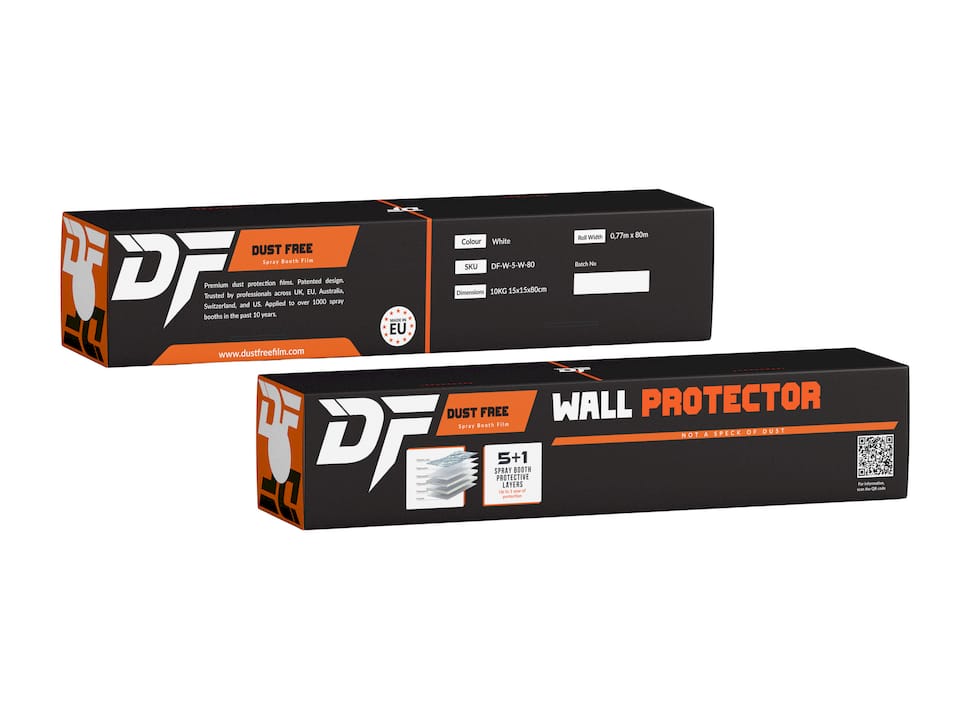
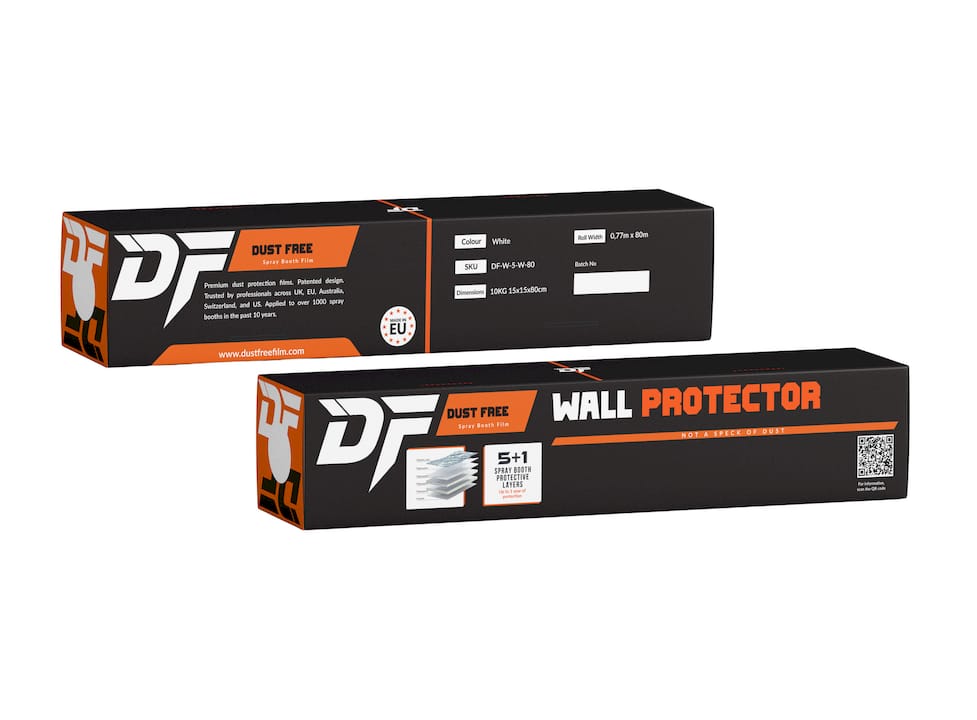
Sizing rolls to your booth dimensions and shift throughput up front avoids the mid-week scramble for a partial roll that doesn’t quite reach the ceiling, especially when working with an industrial equipment and components manufacturer in China that can customize your dispenser hardware and film to exact specifications. Dust Free Film supplies multi-layer electrostatic film with a patented dispenser system built specifically for tape-free, bubble-free installs, and the company supports bulk ordering and custom configurations for facilities running high-volume production.
How Do You Install Protective Film Correctly?
A rushed install is the single most common reason film fails early. Follow this sequence for walls and floors:
- Pre-clean the surface. Remove loose dust, grease, and old overspray residue with a non-abrasive cleaner suited to the contaminant, since booth cleaning best practices note that water-based, solvent-based, and powder residues each need different cleaning chemistry.
- Run an adhesion test. Apply a small patch first to confirm the film bonds to your specific wall material before committing to a full run.
- Start top to bottom. Apply from the ceiling line down, letting gravity help you avoid sagging and wrinkles.
- Overlap every seam. Leave enough overlap at each join to prevent airflow from sneaking behind the film, a step multi-stage filtration guidance treats as critical to preventing bypass contamination.
- Smooth with a spatula. Work air pockets out toward the nearest edge rather than trapping them in the middle of a panel.
- Trim around fixtures. Cut clean lines around lights and windows, using clear film where visibility matters.
- Remove the clear protective layer when required. Some films ship with a temporary top layer meant to come off before the first bake cycle.
- Run your first bake with the film in place. Confirm no lifting or bubbling occurs at seams or fixture edges before returning to full production.
Installation materials checklist: dispenser box, spatula, utility blades, surface cleaner, disposable gloves, and eye protection.
Pro Tip: Air pockets are almost always a temperature problem, not a technique problem. Let film acclimate to booth temperature for 30 minutes before application, especially in colder plants during winter months. Film applied cold shrinks slightly as it warms, which is what pulls seams apart weeks later.
Dust Free Film’s installation guide documents this exact sequence with photo callouts for overlap detail and dispenser use, worth reviewing before your first install if your team is new to the process.
(Photo placement suggested here: before/after wall comparison, close-up of overlap seam, and dispenser box in active use.)
Does Protective Film Affect Booth Filtration and Airflow?
Film and filtration aren’t competing systems. They’re two stages of the same defense. The film handles source capture on walls and floors; your intake and exhaust filters handle everything that becomes airborne. Particulate filtration guidance recommends multi-stage exhaust filtration for dry overspray collectors, with final-stage efficiency up to the high efficiency range associated with MERV 15, on booths using abatement systems.
Watch for these issues after film installation, since a poor seal at the wall or ceiling line can undermine an otherwise solid filtration setup:
- Check for gaps at the top and bottom edges where film meets the ceiling or floor line.
- Verify overlap junctions are sealed tight enough to stop air from bypassing the filtered path.
- Confirm booth pressure and airflow readings after install match your pre-install baseline. A drop usually signals a bypass point somewhere in the film seams.
If your facility runs partial recirculation or an abatement system, follow the abatement supplier’s specific filtration efficiency targets rather than assuming a standard MERV rating applies. Film prep supports the filtration system, but it doesn’t replace engineering specs from your abatement vendor.
When Should You Replace Protective Film?
Set a two-tier inspection cadence: a quick daily visual check for sagging, tears, or heavy buildup, and a more detailed weekly inspection of seams and fixture edges. Replacement triggers include visible sagging, heavy overspray saturation, or approaching your film’s rated bake-cycle limit, commonly cited around 150 cycles for multi-layer products before a layer should come off.
- Daily: scan for visible tears, peeling edges, or heavy buildup near spray zones.
- Weekly: inspect seams, fixture trim lines, and floor traffic areas for wear.
- Replace when: bake-cycle count approaches the rated maximum, or buildup starts affecting light reflectance and finish visibility.
Roll life depends heavily on throughput. A single-shift shop might stretch a layer for months; a three-shift operation may need to peel a layer weekly. For disposal, handle contaminated film as general industrial waste per your local regulations. VOC abatement is a separate discipline entirely. If your booth uses a VOC abatement system, consult a filtration or abatement specialist for those specs rather than treating film disposal as a VOC control measure.
What Installation Mistakes Cause Film to Fail Early?
Most film failures trace back to one of these five mistakes, and each has a fast fix.
- Skipping surface cleaning: film won’t adhere to dust or grease. Fix: re-clean and reapply.
- Insufficient overlap at seams: creates air bypass gaps. Fix: add a wider overlap strip over the seam.
- Poor fastening on flexible surfaces: film sags off curved or non-rigid panels. Fix: use a stronger dispenser-applied adhesive pass.
- Applying during active spraying: overspray contaminates fresh film before it sets. Fix: schedule installs during downtime only.
- Ignoring bake-cycle limits: film degrades and bubbles under heat it wasn’t rated for. Fix: check the bake-temp rating before your next order.
What Safety and Compliance Rules Apply to Booth Prep?
Follow all applicable federal, state, and local regulations for your facility. Compliance responsibility rests with the end user, not the film manufacturer.
- Wear PPE (gloves, eye protection, and a respirator rated for solvent vapors) during both application and removal.
- Maintain adequate ventilation whenever removing old film or handling contaminated waste.
- VOC removal and abatement system specifications fall outside this guide. Consult a filtration or abatement specialist for those requirements.
What We’ve Learned From Watching Booths Fail and Succeed
Most film failures we’ve seen trace back to rushing the overlap step, not the film itself. Technicians under deadline pressure skip the extra two inches of seam coverage, and three weeks later that seam is the entry point for bypass contamination.
Pro Tip: Stage two spare rolls and a backup dispenser cartridge for every high-throughput booth. Running out mid-shift costs more in downtime than the inventory ever costs to hold.
Dust Free Film has supplied patented dispenser systems and multi-layer electrostatic film to facility operators since 2012, and that installation base is where these lessons come from.
Get the Right Film Configuration for Your Booth
Dustfreefilm is the direct route to a properly specified booth prep kit, not a distributor markup or a generic hardware-store roll that doesn’t match your booth dimensions. For a typical mid-size automotive booth, a solid starting configuration is multi-layer electrostatic wall film paired with a matching floor protector and a patented dispenser kit sized to your wall height, ordered as one bundle instead of piecing it together from separate suppliers.
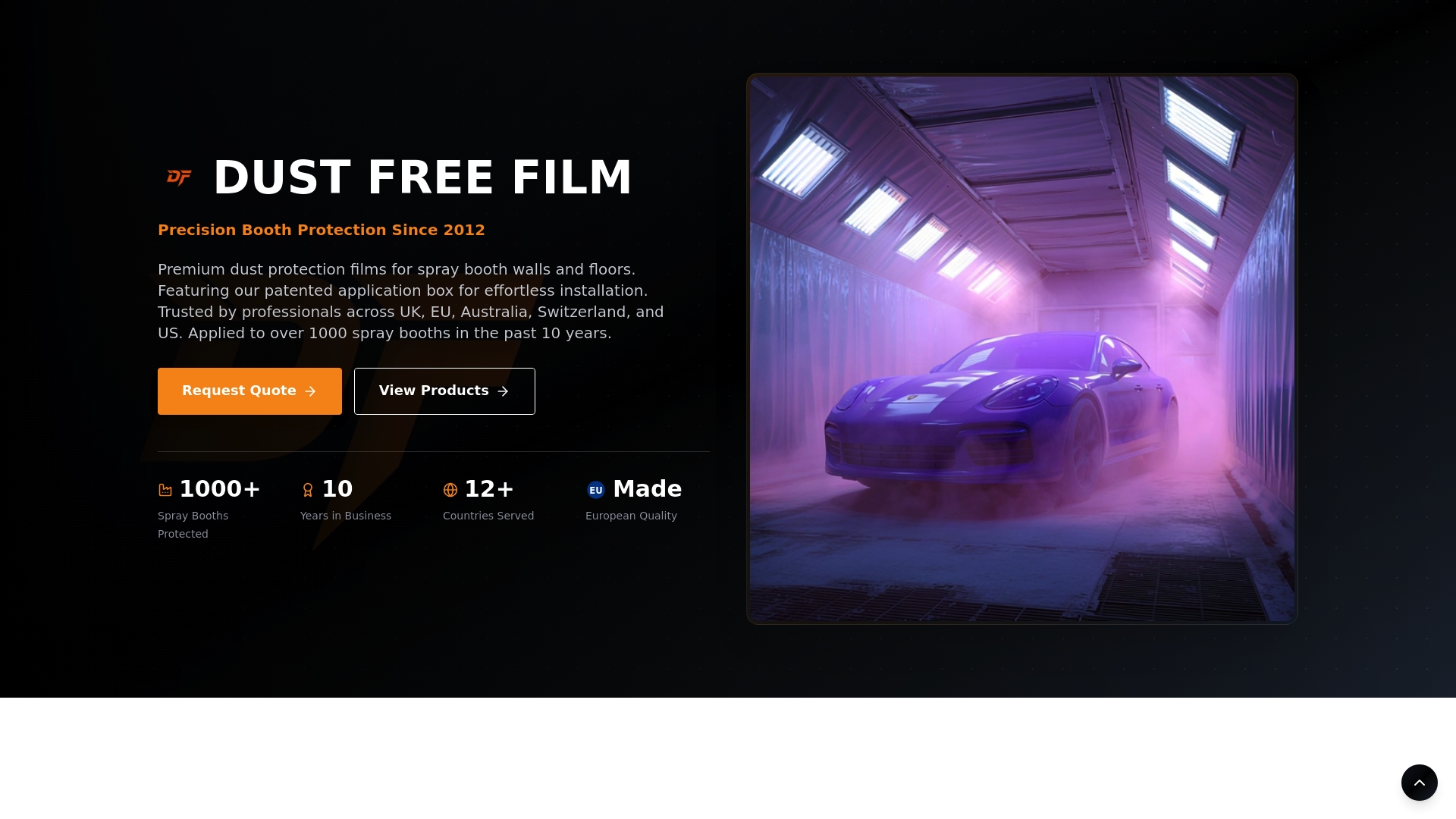
Facilities running higher volume can request bulk pricing or a custom roll configuration sized exactly to their booth run, which cuts down on seam count and wasted material. If you’re ready to spec your next order, get a quote from Dust Free Film and have the right rolls and dispenser kit staged before your next install window.
Frequently Asked Questions
What is the fastest way to install protective film without bubbles? Use a patented dispenser system and apply from the top down, smoothing with a spatula toward the nearest edge rather than trapping air in the middle of a panel.
How often should spray booth protective film be replaced? Replace a layer when it approaches its rated bake-cycle limit, commonly around 150 cycles, or sooner if you see heavy overspray buildup or sagging.
Does protective film reduce the need for exhaust filtration? No.
Can protective film help with VOC control? No. Film addresses dust and overspray contamination only. VOC abatement requires a separate filtration or abatement system specified by a qualified specialist.
Sources
- Spray finishing particulate filtration guidance (NAFA-style)
- Spray Booth Cleaning Best Practices - Industrial Finishing Systems
Multi-stage filtration and source-capture film work as one system: the film reduces particulate before it ever reaches your exhaust filters, extending their service life while protecting the finish underneath.