

Booth contamination control is the combination of engineered systems and written procedures that make a spray, paint, or weighing booth hit a defined cleanliness or containment target, whether that target protects the product on the line or the person standing next to it. That’s the whole definition. Everything else in this article is about how you turn that sentence into a working specification.
Before you touch a filter spec or call a booth manufacturer, you need answers to five questions. Use this as your working checklist:
- Target outcome: Are you chasing an ISO cleanliness class, an occupational exposure limit (OEL), or both?
- Airflow and pressure direction: Does air need to push contamination away from the product (positive pressure) or contain it away from the operator (negative pressure)?
- Filter stack baseline: What combination of pre-filters and HEPA filtration gets you to that target, and where does each stage sit in the airflow path?
- Work practices: What procedures (tool dedication, container sealing, cleaning cadence) does the hardware assume will happen every shift?
- Monitoring KPIs: Which numbers will you capture routinely to prove the booth is still doing its job six months from now?
Get those five answers on paper first. The rest of this guide walks through how each one gets built out into a real specification, an operating procedure, and a monitoring plan you can defend in an audit.
Key Takeaways
Booth contamination control succeeds when the containment outcome, airflow direction, and filter stack are fixed in writing before equipment selection, and verified continuously afterward.
| Point | Details |
|---|---|
| Define the outcome first | Fix your ISO class or OEL target and pressure direction before contacting an equipment vendor. |
| Airflow is the primary control | Filtration, pressure, and exhaust design all exist to support the airflow pattern you choose. |
| Track three KPIs consistently | Particle counts, differential pressure, and airflow velocity at the work plane catch drift early. |
| Match controls to contamination type | Particulate, overspray, biological, and cross-contamination each need a distinct engineering response. |
| Films support, not replace, engineering controls | Dustfreefilm’s electrostatic wall and floor protectors cut cleaning time and reduce surface-dust defects, but airflow and filtration remain the certified controls. |
Table of Contents
- Why Defining Booth Contamination Control Matters More Than General Shop Cleanliness
- Types of Contamination That Actually Matter Inside a Booth
- Core Engineering Controls Every Booth Specification Needs
- Spray and Paint Booth Specifics: Protecting the Finish
- Weighing and Sampling Booth Specifics: Containing Powder, Not Chasing It
- Designing and Specifying Booth Equipment: What Goes in the URS
- Operational Controls: The Procedures That Make Hardware Work
- Verifying Performance: KPIs, Tests, and Alarms
- Standards and Documentation You Need on File
- Timeline and Cost Drivers for Implementation
- Where Multi-Layer Dust-Protection Films Fit in the Program
- A Practitioner’s View on Getting Booth Contamination Control Right
- A Practical Next Step for High-Throughput Booth Operations
- Sources
Why Defining Booth Contamination Control Matters More Than General Shop Cleanliness
A booth is not a room you sweep more often. It’s a governed system with a stated purpose, and that purpose splits into two mandates that often pull in opposite directions: protecting the product from the environment, or protecting the environment (and the operator in it) from the product.
Spray a car panel and you’re worried about airborne particulate landing on wet paint. That calls for positive pressure and downflow airflow that pushes dust away from the work surface. Weigh out a potent active pharmaceutical ingredient and the priority flips: you need negative pressure and a containment envelope that keeps powder from escaping into the operator’s breathing zone. Choosing the wrong pressure direction for the job isn’t a minor error. It’s a booth that fights its own purpose every time it runs.
Cost and compliance risk both track this decision. Over-specify cleanliness (chasing an ISO 5 result when your process only demands ISO 8) and you pay for filtration, airflow velocity, and monitoring you never needed, permanently, not once. Under-specify it, and you get finish defects, failed batches, or an exposure incident that triggers a much more expensive retrofit. Neither error shows up until the booth is already installed, which is exactly why the decision needs to happen on paper, early, not on the shop floor after the ductwork is welded.
Pro Tip: Write the process sequence and the containment requirement down before you call an equipment vendor. A one-page description of what happens, in what order, and what must not escape the process is worth more than any spec sheet a manufacturer hands you.
Types of Contamination That Actually Matter Inside a Booth
Not every kind of dust or residue deserves the same response. Four contamination modes show up repeatedly in booth environments, and each one points to a different control.
Particulate contamination is airborne or settled solid matter, dust, fiber, grit, that lands where it shouldn’t. It’s the dominant concern in spray and paint booths, where a single dust particle trapped in wet finish becomes a visible defect. Technical guidance on environmental control facilities treats particulate load as the primary driver behind HEPA-filtered air handling unit selection, pressure sensor placement, and interior material choice.
Chemical and overspray contamination covers the aerosolized coating material itself, plus solvents and cleaning agents that migrate where they aren’t wanted. This is a paint-booth-specific problem: overspray that escapes the capture zone settles on the next panel, on the floor, or on equipment that then becomes a secondary contamination source.
Biological or organic contamination includes microbial growth, skin cells, and organic residue that accumulate on surfaces, particularly relevant where cleaning frequency is low or materials trap moisture.
Cross-contamination happens when one product lot, color batch, or active ingredient transfers into another, usually through shared tools, inadequate cleaning between runs, or airflow that doesn’t fully clear a booth before the next job starts.
Match the mode to the fix:
- Particulate load → HEPA filtration and controlled airflow velocity
- Overspray/chemical drift → capture geometry (downflow or crossdraft design) and exhaust sizing
- Biological buildup → cleaning cadence and material selection that resists microbial growth
- Cross-contamination → tool dedication, container sealing, and documented changeover procedures
Core Engineering Controls Every Booth Specification Needs
Airflow is the primary mechanism. Everything else, filtration, pressure control, exhaust sizing, is built to support the airflow pattern you’ve chosen. Get airflow direction and velocity wrong, and no amount of filter upgrade will fix it.
The controls that matter, in rough order of leverage:
- Airflow pattern: unidirectional (laminar) flow for high-containment work; turbulent or mixed flow acceptable for lower-risk general paint work.
- Filter stack: a graduated series from coarse pre-filters through HEPA, sized to the ISO target rather than picked off a catalog.
- Pressure differential: positive to protect product, negative to protect operator and surrounding space, with the direction locked in before ductwork is designed.
- Exhaust design and VFDs: variable frequency drives let exhaust volume adjust to maintain a stable pressure differential as filters load and resistance climbs.
- Interior surface material: smooth, non-porous, easy-to-clean finishes reduce particle trapping in seams and corners.
Cleanbooth design guidance is explicit that HEPA filtration paired with smooth, easy-to-clean interior finishes is what actually delivers a declared ISO classification, not just the filter rating on its own. Booth geometry backs this up in practice: arc-profiled interior corners eliminate the unreachable accumulation zones that sharp 90 degree corners create, cutting cleaning validation time measurably compared with boxy interiors.
Facility teams looking to tighten particulate control on existing equipment can start with practical tactics for improving spray booth air quality without a full booth replacement.
Spray and Paint Booth Specifics: Protecting the Finish
Paint booths live or die on overspray capture. The two dominant geometries, downdraft and crossdraft, solve this differently. Downdraft pulls air (and overspray) straight down through a filtered floor grate, which keeps the work zone cleanest but costs more to install and run. Crossdraft pushes air horizontally toward a rear exhaust wall, cheaper to build but more prone to overspray drifting across the panel before it clears.
Surface protection does real work here too. Booth walls and floors accumulate overspray buildup that eventually flakes off and becomes the exact particulate contamination you’re trying to prevent. That’s the logic behind film-based wall and floor protectors: instead of scraping and repainting booth interiors, you strip and replace a film layer, and the underlying surface stays sealed and smooth.
Operationally, a few disciplines separate a clean booth from a defect-prone one:
- Replace tack mats and entry-point filters on a fixed schedule, not “when they look dirty.”
- Match pre-filter grade to your paint’s overspray characteristics, heavier solids need coarser first-stage capture.
- Treat transfer points (doors, pass-throughs) as contamination entry risks and control how often they open mid-cycle.
- Set a film or surface-protector replacement interval tied to job volume, not calendar time alone.
Correct material and cleaning-agent choice measurably affects how well routine cleaning actually performs, and dwell time on disinfectants and cleaning agents matters as much as the product you choose. A five-second wipe with the right chemical does less than a proper contact time with a weaker one.
Pro Tip: Sync your film replacement schedule to your filter-change schedule, not to a separate calendar. When both happen in the same maintenance window, you get one downtime event instead of two, and you catch airflow problems while the booth is already open for service. Facilities running high panel volume often lean on a documented spray booth maintenance workflow to keep this cadence consistent across shifts.
Weighing and Sampling Booth Specifics: Containing Powder, Not Chasing It
Weighing booths solve a different problem than paint booths: the material itself is the hazard, and containment decisions hinge on how potent it is. A benign excipient might only need an open-front downflow booth. A high-potency active ingredient with a low OEL might require a fully closed isolator with glove ports and no open interface to the room at all.
The operational rule that matters most: keep the sampling device inside the laminar airstream at every step. Sampling booths must [seal samples under filtered air](https://youthfilter.com/news/sampling-booth-how-to-choose-containment-airflow-and-booth type-for-pharmaceutical-powder-handling/) rather than exposing an open container to room air even briefly, and the user requirement specification (URS) needs to describe that intake workflow explicitly, not leave it to operator judgment on the day.
A few configuration cues that shape whether a weighing booth actually contains what it’s supposed to:
- Booth depth needs to accommodate the full reach of a weighing operation without forcing the operator’s hands, or the material, outside the protected zone.
- Pass-through arrangements for materials in and product out should never break the laminar airflow pattern mid-transfer.
- Placement relative to material intake flow matters: a booth fed from a busy corridor invites more airflow disruption at the doorway than one in a quieter dead-end layout.
- Tools stay dedicated per lot. A scoop used across two different materials is a cross-contamination event waiting to happen.
GMP-compliant weighing operations run on a defined set of interdependent parameters. Eight critical parameters covering containment target, airflow pattern, HEPA integrity, pressure control, and PLC/HMI logging need to be validated together, not signed off one at a time in isolation. Supplier-level guidance on sampling booths reinforces the same basics from an operations angle: airflow control, enclosure sealing, and HEPA filtration only work if daily cleaning and tool maintenance actually happen on schedule.
Designing and Specifying Booth Equipment: What Goes in the URS
The URS is where good booth decisions get locked in, or where bad ones get baked into concrete and ductwork. Before you send a request for quote to any manufacturer, fix these inputs:
- Target ISO class or OEL, stated as a number, not a general phrase like “clean environment”
- Pressure direction (positive or negative) and the magnitude of differential required
- Container and material dimensions the booth must physically accommodate
- Automation and data-logging integration needs (PLC/HMI, batch records, alarm thresholds)
- Expected throughput, because a booth sized for ten batches a day behaves differently at fifty
Filter stack choices should be treated as a design decision tied directly to your ISO target, not a checklist of components you tick off. A G4 pre-filter, F8 secondary filter, and H14 HEPA terminal stage is a common combination, but the actual grades you need depend entirely on the cleanliness class you declared in step one.
| URS Input | Downstream Engineering Choice | Typical Impact |
|---|---|---|
| ISO class or OEL target | Filter stack grade (pre-filter through HEPA) | Sets minimum filtration efficiency required |
| Pressure direction | Exhaust sizing and VFD control logic | Determines containment vs. protection priority |
| Container/material dimensions | Booth working depth and door placement | Affects reachability inside the protected zone |
| Expected throughput | Airflow velocity band and recovery time | Higher throughput demands faster recovery after door openings |
Facility teams setting up a new line often find it useful to walk through a full industrial spray booth setup guide before finalizing layout, since intake flow and booth placement decisions made at this stage are expensive to reverse later.
Operational Controls: The Procedures That Make Hardware Work
A perfectly specified booth still fails if the people running it treat procedures as optional. Contamination control at the process level rests on a few non-negotiable disciplines.
- Document the process sequence. Write down every step from material intake to finished product exit, and identify exactly where the containment boundary sits at each step.
- Dedicate tools per lot or per color. A shared scoop, brush, or transfer container is the single most common cause of cross-contamination in both paint and weighing operations.
- Control container handling. Seal containers immediately after use, and never leave an open container inside or outside the protected airflow zone longer than the task requires.
- Set door-opening rules. Define when doors can open during operation and how long the booth needs to recover pressure and airflow stability afterward.
- Match cleaning cadence to usage intensity. High-frequency, high-throughput booths need daily cleaning; lower-volume operations can extend that interval, but only with data to support it.
- Qualify personnel on a schedule. New operators should demonstrate correct gowning, tool handling, and sampling technique before running a booth solo, and requalify periodically, not just once at hire.
Facilities that have formalized this into a repeatable routine often reference a spray booth cleaning best-practices checklist to keep cleaning frequency and technique consistent across shifts and operators.
Verifying Performance: KPIs, Tests, and Alarms
You can’t claim a booth meets its containment target without measuring it. Verification splits into two categories: at-rest testing (booth idle, confirming baseline performance) and in-situ or operational testing (booth running, confirming real-world performance holds up).
| KPI | Method | Typical Acceptance Criterion |
|---|---|---|
| Airborne particle count | Particle counter at defined sampling points and moments | Matches declared ISO class limits |
| Differential pressure | Pressure sensor/gauge, continuous logging | Stays within specified range, alarms on deviation |
| Filter differential (load) | Pressure drop measurement across filter stack | Triggers replacement before efficiency drops |
| Airflow velocity at work plane | Anemometer reading at defined grid points | Within specified velocity band for the airflow pattern |
| OEL-relevant exposure | Personal or area air sampling for the specific compound | Below the compound’s defined exposure limit |
Testing cadence matters as much as the test itself. At-rest ISO classification testing establishes your baseline. In-situ HEPA leak testing confirms the filter installation itself isn’t compromised. Periodic particle counting during actual operation catches problems that only show up under real workflow conditions, and routine airflow or pressure spot checks between full requalification cycles catch drift before it becomes failure.
Continuous monitoring matters more than periodic snapshots for one simple reason: a loss-of-containment event that lasts ten minutes between quarterly checks never shows up in your records. Real-time alarms tied to pressure sensors and VFD-controlled exhaust close that gap, flagging deviation the moment it happens rather than the next time someone walks by with a clipboard.
Standards and Documentation You Need on File
Auditors and internal quality teams both expect a specific paper trail, and it needs to trace cleanly from your original process requirement through to your current monitoring data.
The standards that matter most:
- ISO 14644-1 and 14644-3 define cleanroom and clean-zone classification and the test methods used to confirm it, forming the backbone of most classification reports.
- GMP Annex expectations (where pharmaceutical or regulated manufacturing applies) drive qualification protocol structure and change-control documentation.
- HEPA integrity testing standards govern how filter leak testing is performed and recorded, feeding directly into your commissioning protocol.
The minimum record set any well-run facility keeps on file: the original URS, commissioning and qualification reports, routine monitoring logs (particle counts, pressure, airflow), filter-change records with dates and grades, and cleaning validation documentation showing your cleaning procedure actually removes what it’s supposed to.
Ownership matters as much as existence. Quality or validation teams typically own classification and qualification reports; facility maintenance owns filter-change and cleaning logs; operations owns daily monitoring data. Retain records long enough to cover at least one full audit cycle, and longer where regulatory guidance for your industry specifies a minimum.
Timeline and Cost Drivers for Implementation
A realistic booth contamination-control project runs through five phases: URS and process mapping, procurement and fabrication lead time, installation and commissioning, formal qualification testing, and operator ramp-up. Skipping or rushing the first phase is the single biggest cause of schedule overruns later, because every downstream decision depends on it.
Cost drivers worth planning around:
- Filter specification and replacement frequency, HEPA filters aren’t a one-time cost; budget for the ongoing replacement cadence your ISO target demands.
- Control system complexity, a booth with PLC/HMI logging and automated alarms costs more upfront but reduces labor spent on manual monitoring.
- Booth geometry and interior finish, arc-profiled, seamless interiors cost more to fabricate than boxy sheet-metal construction but cut cleaning validation time over the booth’s working life.
- Integration with existing facility HVAC, retrofitting a booth into a building with marginal HVAC capacity adds engineering cost that a purpose-built facility avoids.
- Validation and testing services, third-party HEPA leak testing and classification testing are recurring line items, not one-time commissioning costs.
Spending more upfront on interior finish and filter-stack quality tends to reduce long-term maintenance burden, while cutting corners on control system logging tends to shift cost into labor hours spent on manual checks later. A well-documented booth cleanliness strategy for industrial facilities can help facility teams weigh those tradeoffs before committing budget.
Where Multi-Layer Dust-Protection Films Fit in the Program
Films are not a substitute for airflow, filtration, or validated testing. They’re a surface-level mitigation that reduces how much particulate accumulates on hard-to-clean booth interiors between full cleaning cycles, and that reduction has a real downstream effect on both cleaning time and finish quality.
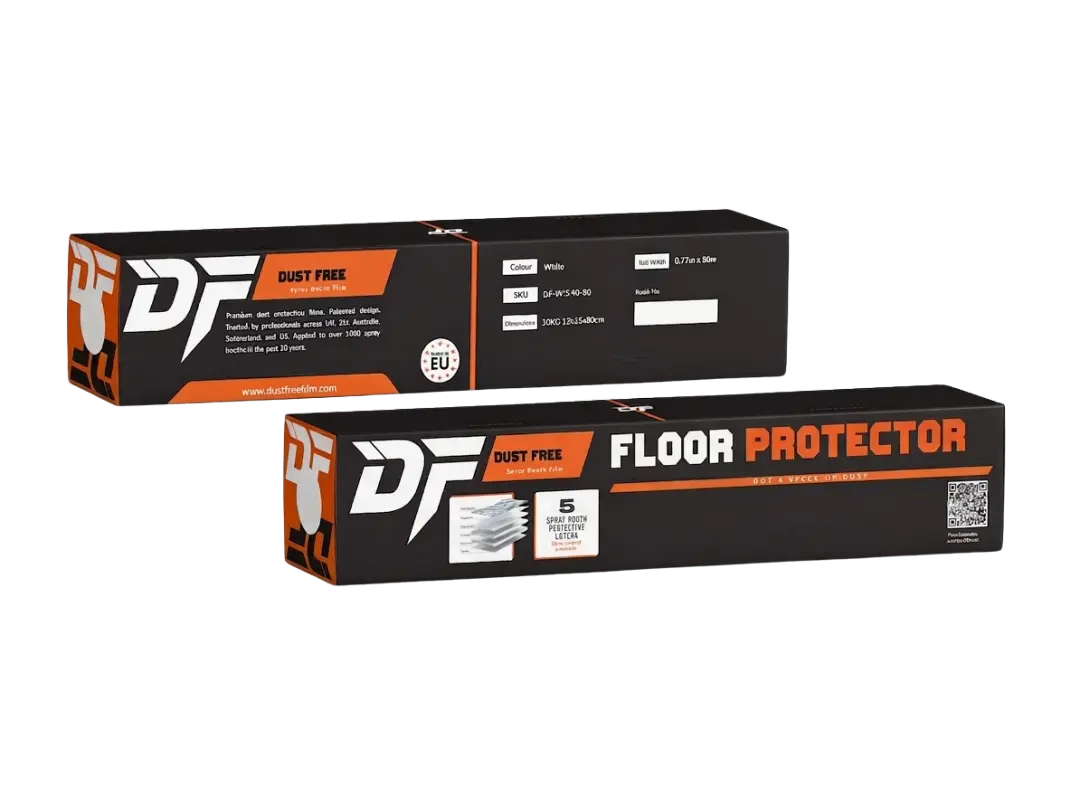
Multi-layer electrostatic films work by clinging to booth walls and floors through static attraction rather than adhesive, which means dust and overspray that would otherwise bake onto a bare surface instead settles on a film layer you strip and discard. That shortens cleaning cycles measurably, since scraping dried overspray off bare metal or sheetrock takes far longer than peeling a film layer. It also protects surfaces, corners, and seams that are genuinely difficult to clean by hand, the exact geometry where particulate tends to accumulate unnoticed.
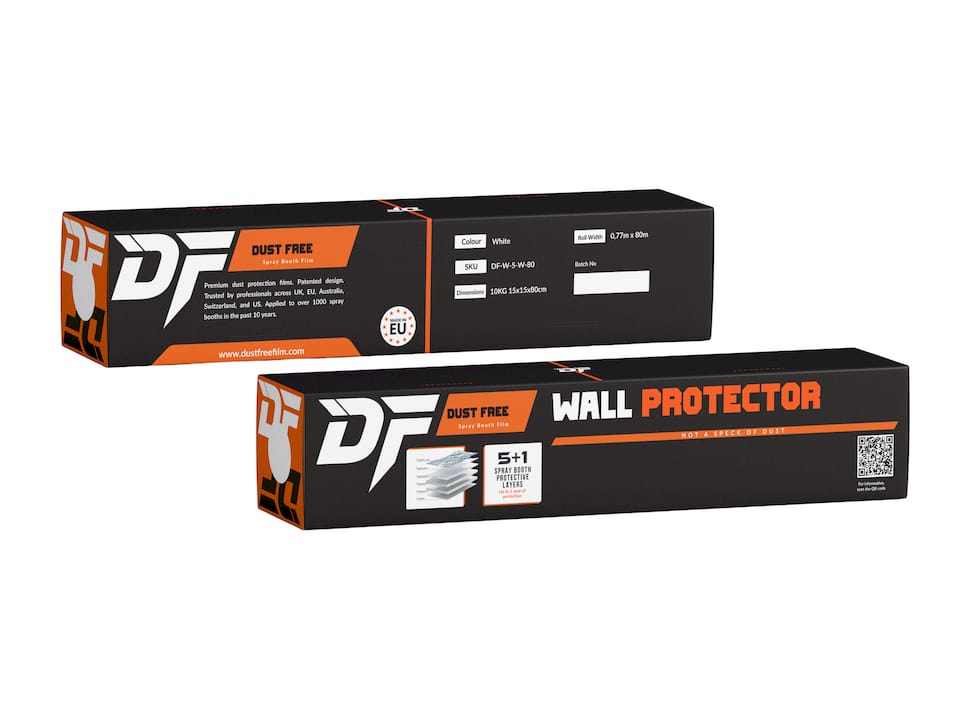
What films don’t do: they don’t replace HEPA filtration, they don’t establish or maintain your pressure differential, and they don’t substitute for certified classification or leak testing. A booth wrapped in film but running degraded airflow is still an out-of-spec booth. Films reduce the burden on your cleaning and maintenance program; they don’t reduce the burden on your engineering controls.
Dustfreefilm’s product line was built around this specific gap in booth maintenance programs:
- Multi-layer electrostatic wall and floor protectors that cling without adhesive and lift away in a single sheet.
- Heat-resistant, static-free construction suited to the temperature swings and dust conditions of active spray and paint booths.
- Patented dispenser system for fast, bubble-free installation without the labor overhead of taping and trimming.
Specify a film replacement interval in your URS or maintenance schedule the same way you’d specify a filter-change interval, tied to throughput, not guesswork. Facilities using electrostatic film protection alongside standard filtration report meaningfully fewer paint-quality defects tied to surface dust that would otherwise transfer from booth walls back onto finished work.
Pro Tip: Schedule film replacement in the same maintenance window as your filter change. You’ll cut total booth downtime, and you’ll have the booth open and accessible at exactly the moment you need to inspect airflow components anyway.
A Practitioner’s View on Getting Booth Contamination Control Right
The most common mistake facility teams make isn’t a bad filter choice or a wrong pressure reading. It’s sequence. Too many projects start with a booth catalog instead of a process map, which means pressure direction, airflow pattern, and even booth geometry get decided by whatever the vendor had in stock rather than by what the process actually requires.
Pressure direction is the decision that punishes you hardest for getting it backward. Once ductwork is built and exhaust is sized around a positive-pressure assumption, converting to negative pressure containment isn’t a settings change, it’s a redesign. That’s why the process sequence and containment requirement need to exist in writing before a single piece of hardware gets ordered.
Treating booths as interchangeable hardware is the second-most common failure. A booth that performs beautifully for automotive refinish work will not automatically perform for high-potency powder handling, even if both are labeled “spray booth” on a spec sheet. The airflow pattern, containment strategy, and validation requirements diverge sharply once potency or finish sensitivity enters the picture.
If you’re starting from scratch, three steps get you further than any equipment brochure will: walk the physical intake sequence from raw material to finished output and mark where contamination risk actually lives, confirm the booth’s working depth against the real reach requirements of the task, not a generic spec, and lock your filter stack choice to your declared ISO target before you let procurement negotiate on price. Do those three things in writing, and the rest of the specification tends to fall into place with far fewer surprises during commissioning.
A Practical Next Step for High-Throughput Booth Operations
If you’re running high panel volumes or managing frequent changeovers, engineering controls and cleaning procedures only get you partway there. The surfaces inside your booth still take the brunt of overspray and airborne particulate day after day, and scraping or repainting those surfaces eats into production time you don’t have.
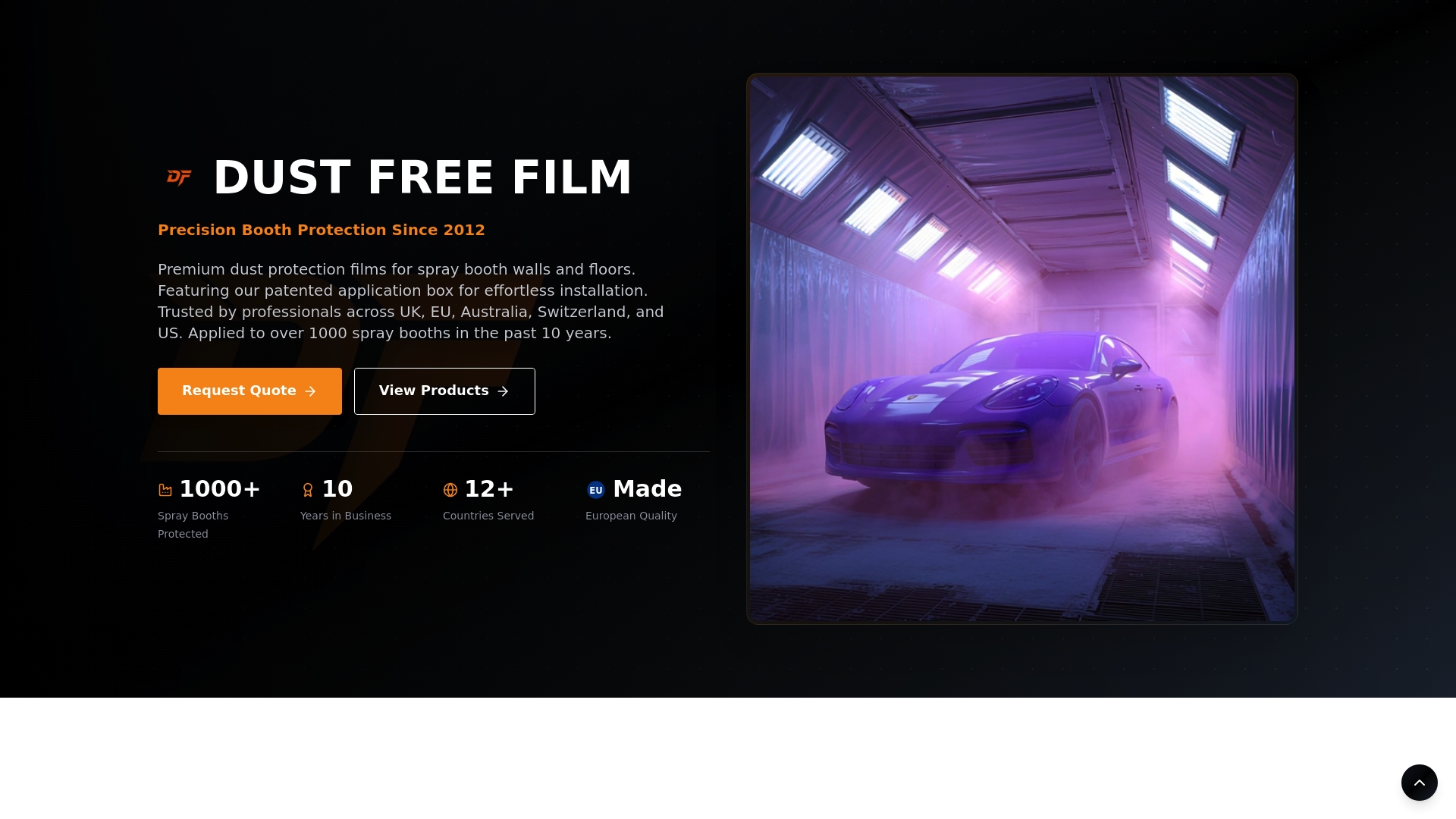
Dustfreefilm makes that maintenance burden smaller, not by replacing your airflow or filtration system, but by giving you a surface layer you strip and discard instead of scrub and repaint. The multi-layer electrostatic film clings to walls and floors without adhesive, installs fast through a patented dispenser system, and holds up against the heat and static conditions of an active spray booth. For facilities running bulk operations across multiple booths, custom configurations and bulk procurement options mean you’re not paying retail prices per roll or waiting on single-unit orders.
The practical outcome: less time spent scraping booth interiors between jobs, fewer surface-dust defects showing up on finished panels, and faster changeovers when you’re switching colors or clients. If your current booth maintenance routine still involves scraping and repainting interior surfaces, request a quote or explore configurations at Dust Free Film and see what a film-based protection layer would look like for your specific booth dimensions and throughput.
Sources
Booth contamination control decisions hold up best when they’re grounded in named standards and documented technical guidance, not general assumptions about what “clean” means.
- Essential Weighing Booth Performance Specifications for GMP Compliance: 8 Critical Parameters Checklist - YOUTH Clean Tech
- International Cleanliness Standards Cleanroom standards are used worldwide to maintain a consistent level of cleanliness. Some common cleanliness standards used for cleanrooms include ISO 14644, Federal Standard 209E, and GMP.
- How to keep your trade-show booth sanitary and tidy (Exhibitor Online)