
Wall film and floor protectors solve different problems in a spray booth. Multi-layer electrostatic wall film is built for brightening, static-based overspray capture, and color-matching accuracy. Heavy-duty floor protectors are built for abrasion resistance, chemical exposure, slip control, and protecting concrete or epoxy surfaces under vehicle and equipment traffic. Most production booths need both, running simultaneously.
- Wall film: color-matching support, overspray interception, dust attraction via static charge, panel and light protection
- Floor protector: wheel and foot traffic resistance, solvent/chemical tolerance, slip resistance when wet, thermal tolerance through bake cycles
- Both categories are available from Dustfreefilm, along with patented dispenser systems for fast, tape-free installation
Key Takeaways
Wall film and floor protectors serve distinct functions in a spray booth, and specifying the wrong product for either surface creates quality and safety problems that cost more to fix than the film itself.
| Point | Details |
|---|---|
| Primary functional split | Wall film handles brightening and overspray capture; floor film handles traffic, chemicals, and heat. |
| Critical floor film spec | Confirm a minimum 200°F heat rating and clean-removal guarantee before ordering any floor protector. |
| Wall film and color accuracy | Contaminated wall film dims the booth and increases color-mismatch rework; peel a layer to restore reflectivity in minutes. |
| Replacement cadence | Floor film typically runs 60 days in moderate-volume operations; wall layers refresh as needed between full replacements. |
| Dustfreefilm’s offering | Multi-layer electrostatic wall film, heat-resistant floor protectors, and a patented dispenser system available factory-direct with bulk pricing. |
Table of Contents
- What is the difference between wall and floor protectors in a spray booth?
- How wall and floor films are actually built
- How installation and removal actually work
- How each film performs under real booth conditions
- How to choose the right protector for your booth
- Sizing, coverage math, and cost factors
- Why wall brightness directly affects color accuracy
- Why Dustfreefilm’s multi-layer system fits these requirements
- The manufacturer’s perspective on real-world deployments
- Dustfreefilm is ready to quote your booth now
- Sources
What is the difference between wall and floor protectors in a spray booth?
The functional split is straightforward: wall film manages light and contamination, floor film manages physical punishment.
Wall film’s primary job is reflectivity and dust control. A fresh white surface bounces light back into the booth, which directly affects how technicians read color. The electrostatic surface attracts airborne particles before they settle on the vehicle, reducing contamination events. Wall film also protects booth panels and light fixtures from permanent overspray buildup.
Floor protectors handle a completely different set of stresses. Vehicles roll in and out, dollies drag across the surface, and solvents drip during prep. The film has to grip the floor without sliding, resist chemical penetration, and survive bake-cycle temperatures without lifting or off-gassing. Industrial painting best practices consistently list surface protection for walls, floors, and lights as a core contamination-control measure, not an optional add-on.
The two products overlap in one area: both intercept overspray and reduce how often you deep-clean the booth. But their construction, attachment method, and performance specs are entirely different.
Pro Tip: Run wall film and floor protectors on the same replacement schedule whenever possible. Replacing one while the other is heavily contaminated defeats the purpose of maintaining a bright, clean booth environment.
How wall and floor films are actually built
The technical differences explain why you cannot swap one for the other.
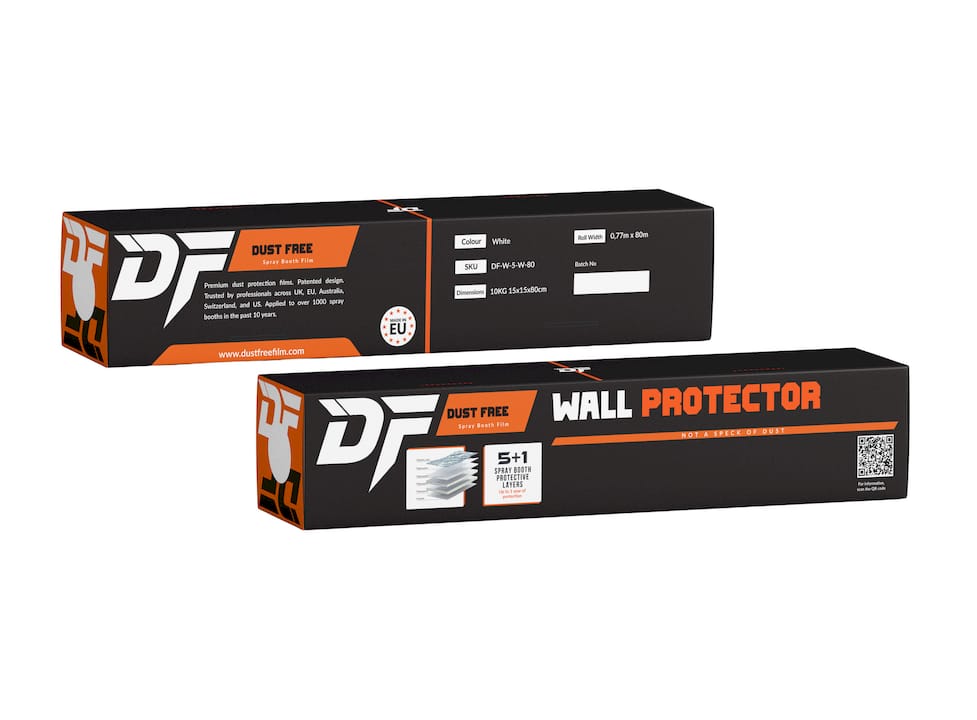
Multi-layer electrostatic wall film uses a five-layer peel-away construction with a statically charged tacky surface. That static charge is the mechanism that pulls overspray particles toward the wall rather than letting them drift onto the vehicle. The layered design means you peel one contaminated layer to expose a fresh surface without removing the entire installation. A clear-film variant protects lights and windows while preserving illumination. The insulating properties of the layered construction also reduce heat loss during bake cycles, which matters for energy cost in high-volume shops.
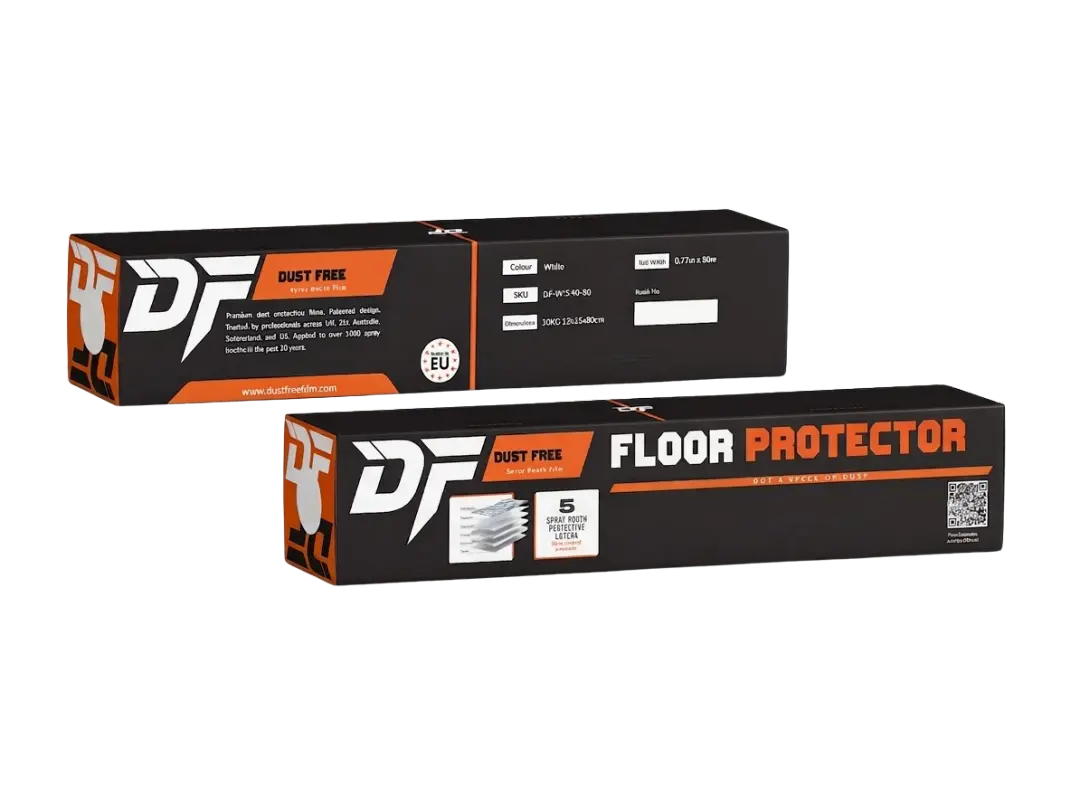
Floor film is a different animal. It is thicker, adhesive-backed or tacky-free with a textured top sheet, and rated for sustained traffic loads. Good floor film withstands temperatures up to 200°F and peels off without solvent-based cleanup, which keeps replacement fast and avoids chemical exposure for technicians.
Key specs to confirm with any vendor before ordering:
| Spec | Wall Film | Floor Protector |
|---|---|---|
| Thickness | Confirm mil rating per layer | Heavier gauge; confirm mil for traffic class |
| Temperature rating | Rated for booth bake cycles | Up to 200°F minimum for most booths |
| Attachment method | Electrostatic / tacky surface | Adhesive-backed or textured tacky-free |
| Residue on removal | Clean peel, no adhesive residue | Confirm clean-removal guarantee |
| UV/yellowing resistance | Required for light reflectivity | Less critical; confirm for long runs |
| Layer count | 5-layer standard; numbered layers | Single-layer; replacement-based |
Roll sizes for wall film commonly run 30" wide by 262’ long, per JTAPE’s multi-layer product specs. Confirm width against your booth panel dimensions before ordering.
How installation and removal actually work
The two products install differently, and that gap in labor time is where dispenser systems pay for themselves.
Wall film installation (dispenser-fed):
- Mount the dispenser box at the top of the wall panel at the correct height
- Feed the film from the roll, align to the panel edge
- Peel the backing halfway, press the center outward with a spreader to eliminate bubbles
- Trim with a cutter at the bottom; overlap adjacent pieces by at least 1–2 inches for full coverage
- Remove the outer protective film to expose the active electrostatic layer
- Test adhesion on a small section before committing to the full wall
This dispenser-fed SOP produces a bubble-free, wrinkle-free surface in minutes per panel. Manual tape-and-roll without a dispenser takes significantly longer and introduces more bubble risk.
Floor film installation is simpler mechanically: unroll, position, and press down. The adhesive or tacky backing holds without tape on most sealed concrete and epoxy floors. Seams should overlap and be pressed flat to prevent edge lifting under wheel traffic.
Removal: Wall film refresh means peeling one layer, which takes a few minutes per panel. Floor film replacement requires pulling the entire sheet, which takes longer and may need a floor scraper if adhesive has bonded tightly. Plan 30–60 minutes of downtime for a full floor replacement in a standard single-car booth.
Pro Tip: Number your wall film layers with a marker at installation. When a layer is peeled, you know immediately how many remain before you need to reorder.
How each film performs under real booth conditions
Wall film’s reflectivity degrades faster than most shops expect. Overspray accumulates on the outermost layer within days in a high-volume booth, and that buildup dims the workspace measurably. Protective booth films preserve brightness and reduce maintenance time compared to repeated solvent scrubbing, which also risks damaging panel surfaces over time. Peeling a layer restores reflectivity in minutes rather than the hours a manual clean requires.
Floor film faces a harder physical environment. Solvents drip during prep, wheels roll across the surface under load, and bake cycles push temperatures that can cause cheaper films to lift at the edges or off-gas. Films that lift create a slip hazard and expose the floor to chemical penetration. Regular replacement of floor film is common in moderate-volume operations, though high-traffic shops may replace more frequently.
Films fail in predictable ways: edge peeling from inadequate overlap or adhesive failure, yellowing from UV or heat exposure that signals the film is past its useful life, and puncture from sharp debris. Any of these is a replacement trigger, not a patch-and-continue situation.
How to choose the right protector for your booth
Work through this checklist before drafting an RFQ:
- Map your booth temperature profile. What is the peak bake temperature? Confirm the floor film’s rating exceeds it.
- Assess traffic type and frequency. Dollies, lifts, and rolling carts demand a heavier floor film gauge than foot traffic alone.
- Check paint chemistry. Waterborne and solvent-borne systems have different chemical exposure profiles; confirm film compatibility with your specific coatings per contamination-control best practices.
- Measure roll widths against booth dimensions. Wall panels and floor areas rarely match standard roll widths exactly; calculate overlap and waste before ordering.
- Confirm dispenser system compatibility. Not all wall films feed cleanly through all dispenser boxes; ask the vendor for confirmed pairings.
- Require a clean-removal guarantee. Any vendor who hedges on residue-free removal is telling you something.
- Ask about layer count and numbered layers. Numbered layers let technicians track remaining life without guesswork.
Red flags to walk away from:
- Vague heat-resistance specs (“suitable for most booths” without a °F rating)
- No documented clean-removal test results
- No dispenser compatibility confirmation
- Lifespan estimates given as ranges so wide they are meaningless (“weeks to months”)
Sizing, coverage math, and cost factors
A standard single-car spray booth runs roughly 14’ wide × 26’ long × 9’ tall. Wall surface area on the two long walls alone is approximately 468 sq ft before accounting for doors and lights. At a 30" roll width and 262’ length, one roll covers roughly 65 sq ft per run, meaning you need approximately 7–8 rolls to cover those two walls with a single layer, plus additional rolls for the end walls.
| Cost factor | Wall film | Floor film |
|---|---|---|
| Unit price driver | Layer count, roll width, static treatment | Gauge, adhesive type, heat rating |
| Bulk discount trigger | Typically at case or pallet quantity | Same; confirm breakpoints with vendor |
| Labor savings | Dispenser cuts install time significantly vs. manual | Simpler install; savings come from fast removal |
| Replacement cadence | Layer peel as needed; full replacement less frequent | Every 60 days in moderate-volume operations |
| Disposal cost | Minimal; peeled layers are compact waste | Larger volume per replacement cycle |
Scheduled surface protection and replacement reduces long-term repair spend by avoiding the permanent surface damage that accumulates when floors and walls go unprotected. Factor dispenser capital cost into year-one TCO, then amortize it across the labor savings on every subsequent installation.
Why wall brightness directly affects color accuracy
Overspray-coated walls do not just look neglected. They reduce the effective illumination inside the booth, and that light loss changes how technicians perceive color. A booth that was calibrated for color matching with fresh white walls will produce different visual results once those walls have absorbed two weeks of overspray.
Practical signs that wall condition is affecting quality: technicians requesting more reworks than usual, difficulty matching metallic flakes under booth lighting, or visible dimming in the corners of the booth. Measure light levels at the work surface with a lux meter before and after a wall film refresh. The difference is often significant enough to justify the film cost on quality grounds alone, separate from any cleaning-labor savings. Spray booth wall protectors designed for reflectivity are purpose-built for this function.
Why Dustfreefilm’s multi-layer system fits these requirements
Dustfreefilm has manufactured dust protection films for spray booths since 2012, with products covering both wall and floor applications for automotive, industrial, marine, and manufacturing facilities.
- Multi-layer peel-away wall film: fresh surface in minutes, no booth downtime for cleaning
- Electrostatic surface: active overspray capture, sustained wall brightness, better color-matching conditions
- Heat-resistant floor film: rated for bake cycles, clean removal without solvents, chemical-resistant top surface
- Patented dispenser system: bubble-free installation, consistent overlap, reduced labor per panel
- Custom configurations: roll widths, layer counts, and bulk pricing matched to facility scale
- Bulk ordering channels: factory-direct and distributor options for large-scale operations
Explore the full range at Dustfreefilm’s product pages and request a quote for your booth dimensions and volume.
The manufacturer’s perspective on real-world deployments
Shops that switch from periodic deep cleaning to a scheduled film-replacement program consistently report faster booth turnaround and fewer contamination-related reworks. The transition is straightforward: measure the booth, confirm roll widths, install the dispenser box once, and train technicians on the peel-layer workflow in under an hour.
The detail most buyers underestimate is the wall film’s role in color accuracy. Floor protection is intuitive because the damage is visible. Wall film’s contribution to light quality is less obvious until you measure it, and by then you have already absorbed the rework costs. Start with the walls.
Dustfreefilm is ready to quote your booth now
Dustfreefilm supplies multi-layer electrostatic wall film and heavy-duty floor protectors directly to auto body shops, industrial facilities, and manufacturing plants across the United States. The concrete advantage over generic film suppliers: every product is engineered specifically for spray booth conditions, with heat ratings, static properties, and dispenser compatibility confirmed before it ships.
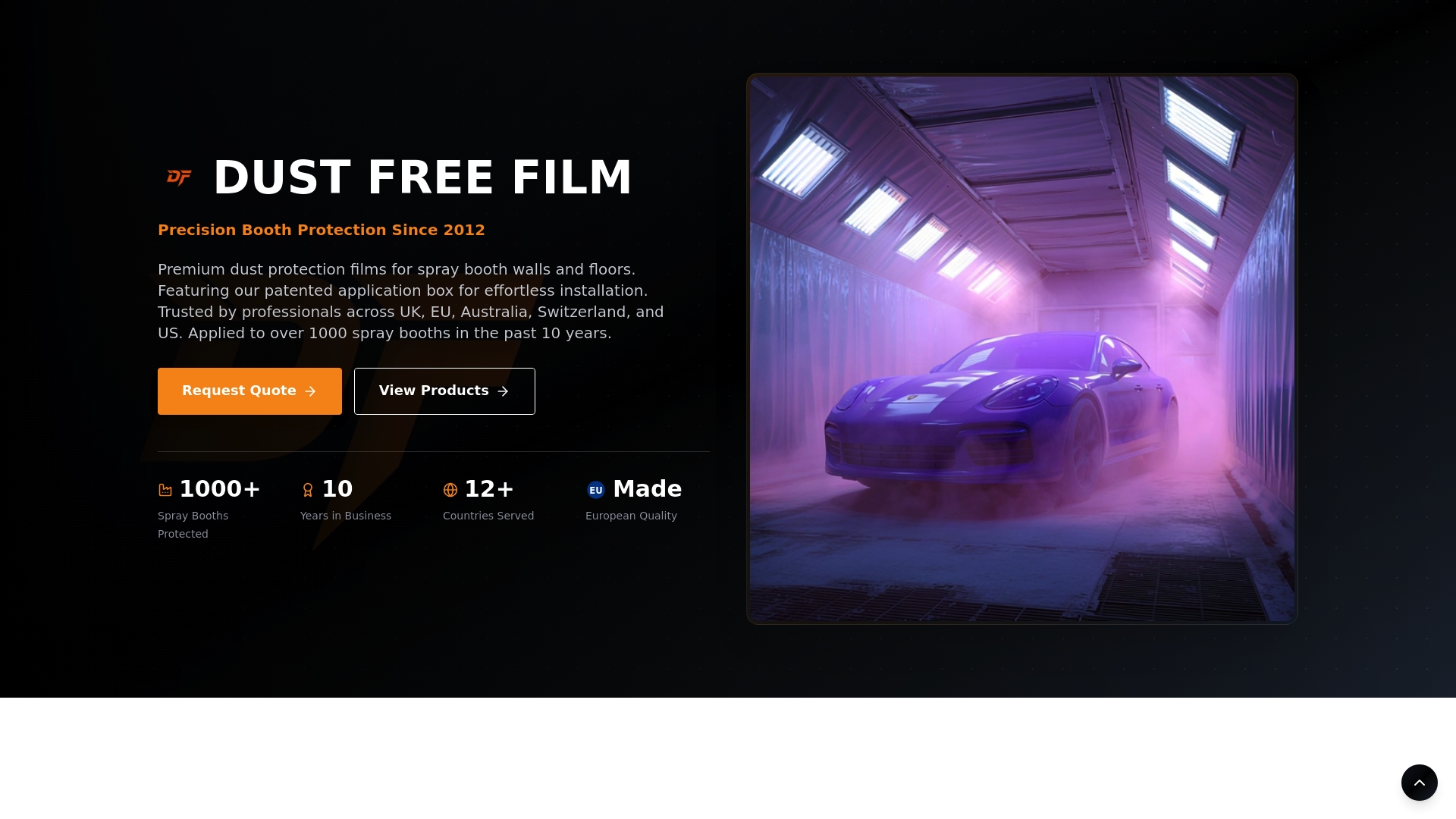
Request a quote with your booth dimensions and monthly spray volume, and Dustfreefilm will return a coverage calculation, roll count, and bulk pricing within one business day. Custom roll widths, dispenser box configurations, and distributor partnerships are available for high-volume operations. Contact the team directly at Dustfreefilm to get started.
Sources
- Paint Booth Protective Film: Why It’s Essential For Your Floor And Walls - The DailyMoss
- technical
- Paint Booth Protection Tips - Finishing Systems
- Best Practices for Industrial Painting 2025 Guide