

Spray-booth dust prevention — multi-layer protective films plus properly selected intake and exhaust arrestors — substantially cuts particulate overspray and housekeeping emissions but does not, by itself, reduce solvent VOCs emitted to outdoor air. That distinction matters for every compliance decision you make. Three actions to prioritize right now:
- Verify your exhaust arrestors carry documented capture efficiency, with ≥98% required for certain NESHAP-covered operations.
- Characterize used films and filters as hazardous or non-hazardous before disposal — the EPA is explicit that operators must consult suppliers and local authorities before discarding booth protection waste.
- Pair dust controls with low-VOC coatings or solvent-recovery practices; filtration alone leaves your VOC emissions unchanged.
Key Takeaways
Spray-booth dust prevention controls particulate overspray and housekeeping emissions effectively, but VOC reduction requires separate action on coating chemistry and transfer efficiency.
| Point | Details |
|---|---|
| Films vs. VOCs | Protective films and filters cut particulate emissions; they do not reduce solvent VOCs exhausted to outdoor air. |
| 98% capture threshold | NESHAP-covered operations must document exhaust filter capture efficiency of at least 98% for paint overspray. |
| Waste characterization | Solvent-saturated or HAP-laden films and filters may be hazardous waste; characterize before disposal and consult your SDS. |
| Manometer monitoring | Log pressure-drop readings weekly; a rising reading signals declining capture efficiency before finish quality suffers. |
| Dustfreefilm | Multi-layer electrostatic films with SDS documentation reduce housekeeping emissions and support waste characterization records. |
Table of Contents
- What does spray-booth dust prevention actually capture?
- Regulatory compliance: what EPA and NESHAP require
- How do lifecycle tradeoffs affect net environmental impact?
- What should you measure and monitor daily?
- Best practices that lower your total environmental footprint
- How to choose the right films and filters for your operation
- The tradeoff most shops get wrong
- Dustfreefilm’s films address the particulate side of the equation
- Sources
What does spray-booth dust prevention actually capture?
Three control types work in a spray booth, and each stops at a different point in the emission chain.
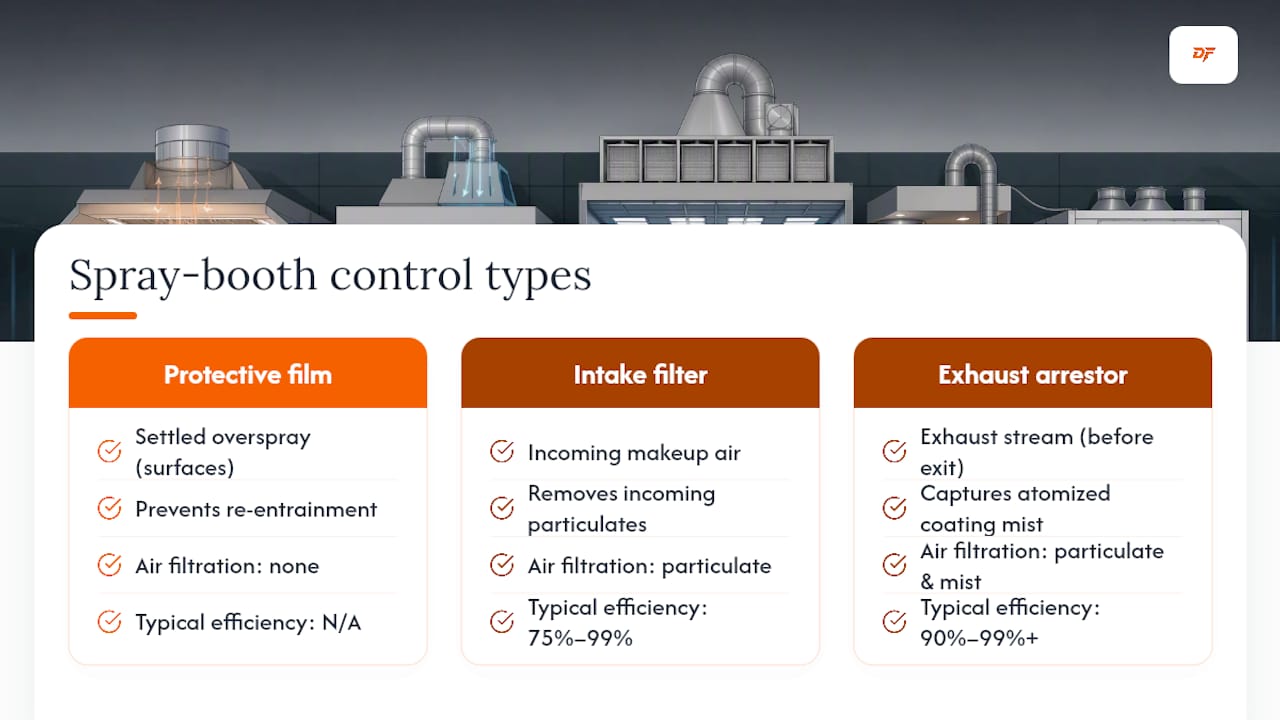
Protective films (multi-layer polyethylene or similar barrier materials applied to walls and floors) do not filter air at all. They intercept settled overspray before it can be re-entrained by booth airflow, and they dramatically cut the cleaning frequency that generates its own fugitive dust. The environmental benefit is indirect but real: less mechanical disturbance of dried paint residue means fewer particles mobilized into the exhaust stream.
Intake filters remove incoming particulates from makeup air before it enters the booth. According to the EPA fact sheet on spray booth filters, typical intake media removes 75%–99% of incoming particles depending on media grade and maintenance condition. Cleaner incoming air reduces contamination on fresh paint surfaces and lowers the particle load the exhaust system must handle.
Exhaust arrestors (overspray arrestors) capture atomized coating mist in the exhaust stream before it exits the booth. The same EPA guidance puts typical exhaust arrestor efficiency at 90%–99%+ for particulate and mist, again depending on media type and upkeep.
None of these controls touch solvent vapors. VOCs pass straight through mechanical and electrostatic filter media and exit with the exhaust air. That gap is why the MassDEP spray-booth compliance guidelines identify only two levers for actually reducing VOC emissions: changing coating chemistry (waterborne, high-solids, or low-VOC products) and improving transfer efficiency through equipment and technique choices such as HVLP guns or electrostatic application.
Pro Tip: Install a manometer on your exhaust arrestor and log the pressure drop reading at every filter change. A rising pressure drop tells you the media is loading up and capture efficiency is declining — catching it early protects both your finish quality and your compliance posture, since a clogged filter can create recirculation pockets that push overspray back toward the work surface.
Regulatory compliance: what EPA and NESHAP require
The EPA’s final NESHAP rulemaking sets a clear threshold: for certain covered coating operations, exhaust filters must be demonstrated to achieve at least 98% capture efficiency for paint overspray. That is not a target — it is the floor for compliance in those categories. If your filter documentation does not show a tested, certified capture rate, you have a gap that an inspector will find.
Beyond capture efficiency, 40 CFR §63.3094 requires covered facilities to develop and implement a work practice plan addressing organic HAP emissions across storage, mixing, conveying, cleaning, and waste handling. Practically, that means closed containers for solvents, solvent recovery during cleaning operations, and documented housekeeping procedures. Protective films support this by reducing the frequency and intensity of cleaning, but the plan itself must exist in writing.
MassDEP guidance is worth reading even if you operate outside Massachusetts, because it illustrates how state-level rules can trigger VOC recordkeeping at relatively low material-use thresholds. Smaller shops often assume they are below the regulatory radar — that assumption is increasingly wrong.
Immediate compliance checks to run this month:
- Confirm exhaust arrestor certification documents show tested capture efficiency (target ≥98% for NESHAP-covered operations).
- Pull your filter change-out log; if it does not exist, start one today.
- Review your work practice plan for storage, mixing, and cleaning procedures under 40 CFR §63.3094.
- Determine whether your VOC usage triggers state recordkeeping thresholds.
- Verify PPE protocols for removing and bagging used filters and films.
How do lifecycle tradeoffs affect net environmental impact?
The environmental story of dust prevention does not end when you pull a used film off the wall. It continues through storage, characterization, and disposal — and that chain carries real risk if you treat contaminated booth media as ordinary trash.
The lifecycle flow runs: capture on film surface or in filter media → temporary on-site storage → waste characterization → disposal or recycling. Where it goes wrong is at the characterization step. Teams routinely skip it, assuming spent film is just plastic and spent filters are just cardboard and fiberglass. But if the coating residues contain HAPs or if solvent saturation is visible, the waste profile changes. The EPA guidance is direct: operators must determine whether used booth protection waste is hazardous before disposal and consult suppliers, jobbers, and local authorities.
A product SDS can trigger that determination before you even open a bag. The Finixa spray-booth protection SDS lists skin sensitization and aquatic chronic hazard statements, with disposal precautions against release to drains or waterways. Any film product with similar SDS language warrants a closer look at your disposal stream.
Practical indicators that shift waste from ordinary to potentially hazardous:
- Visible solvent saturation or liquid dripping from filter media.
- SDS hazard statements for the film or adhesive system covering aquatic toxicity or HAP content.
- Coating residues from isocyanate-containing products (common in two-stage automotive refinishing).
- High-solids or specialty coatings with elevated HAP concentrations.
On the material side, polyethylene film carries a manufacturing footprint, but multi-layer products that extend service life before change-out reduce the per-job waste volume compared with single-use alternatives. Recyclability depends on contamination level — clean trim waste from installation may qualify for PE recycling streams; heavily coated film generally does not. Check with your waste hauler before assuming either way.
What should you measure and monitor daily?
A spray booth maintenance checklist built around measurable metrics is your best defense in an inspection and your best early-warning system for finish quality problems.
Daily checks: Visual inspection of film surface for overspray buildup, tears, or lifting edges; confirm booth lighting is adequate to spot contamination.
Weekly checks: Read and log the manometer pressure drop (in. w.c.) on both intake and exhaust systems. A rising reading means the media is loading; a sudden drop can indicate a bypass or media failure. Check film adhesion at edges and seams.
Monthly checks: Review the full filter change-out log against manufacturer recommended pressure-drop limits. Confirm waste characterization records are current. Audit VOC/coating-use logs if state thresholds apply.
Sample log structure for your records:
Pressure-drop thresholds vary by media manufacturer, but a general rule: when the reading exceeds the manufacturer’s stated maximum by 10%–15%, schedule an immediate change-out rather than waiting for the next scheduled interval.
Best practices that lower your total environmental footprint
The highest-leverage actions, roughly in priority order:
- Switch to lower-VOC coatings where your coating supplier offers compliant alternatives. This is the only way to reduce VOC mass emissions — films and filters cannot do it.
- Improve transfer efficiency with HVLP or electrostatic application equipment. Less overspray generated means less particulate to capture and less waste to dispose of.
- Maintain intake and exhaust filters on a manometer-driven schedule, not a calendar one. A step-by-step maintenance workflow tied to pressure-drop readings keeps capture efficiency at its rated level.
- Use multi-layer protective films on walls and floors to reduce cleaning frequency and the fugitive dust that cleaning generates.
- Implement solvent capture or recycling for gun-cleaning and surface-prep operations covered by your work practice plan.
Short-term (this month): start manometer logging, pull SDS files for all films and filters in use, and confirm waste characterization status.
Mid-term (next quarter): audit coating chemistry against available low-VOC alternatives; update your work practice plan to reflect current cleaning procedures.
Long-term (next procurement cycle): build capture-efficiency documentation and SDS review into supplier qualification requirements.
Pro Tip: Ask your filter supplier for the actual test method behind their capture-efficiency claim — ASHRAE 52.2, EN 779, or a booth-specific test protocol. The test method determines whether the number is comparable across products. Pair that documentation with your manometer logs and you have a defensible environmental record that holds up under inspection.
How to choose the right films and filters for your operation
Procurement questions that reveal environmental performance, not just price:
- What is the tested capture efficiency, and which test method was used?
- Does the filter media carry a documented ≥98% particulate removal rating for NESHAP-covered applications?
- What is the film’s material composition, and does the SDS identify any aquatic or HAP-related hazard statements?
- Does the supplier offer disposal guidance or a takeback program for contaminated media?
- What is the heat resistance rating, and is the film static-dissipative to avoid attracting particles during installation?
- How does the dispenser system work — does it allow tape-free, bubble-free installation that avoids gaps where overspray can settle?
Scoring the options: weight environmental risk (SDS hazard profile, waste classification) and compliance fit (documented capture efficiency, available certification) equally with total cost of ownership. A cheaper filter with no capture documentation is a liability, not a saving.
Documentation to require from every supplier: filter performance test report, SDS for the film and any adhesive system, and written handling and disposal guidance. Keep these on file alongside your manometer logs — together they form the core of a defensible environmental compliance record. For booth air quality improvements that go beyond filtration, pairing supplier documentation with coating-chemistry choices gives you the full picture.
The tradeoff most shops get wrong
Most facility managers treat dust prevention and VOC control as the same problem. They are not. Films and filters solve a particulate problem with measurable, documentable efficiency. VOCs are a chemistry and process problem that no filter media currently on the market resolves at the exhaust level for typical automotive refinishing operations.
The practical consequence: shops that invest heavily in premium booth films and high-efficiency arrestors, then assume their environmental compliance is covered, are exposed. Their particulate emissions may be excellent. Their VOC emissions are exactly what they were before the film went up.
The smarter framing is to treat dust prevention as one layer of a three-layer control plan: particulate capture (films + filters), VOC reduction (coating chemistry + transfer efficiency), and organic HAP minimization (work practice plan under 40 CFR §63.3094). Each layer has its own metrics, its own documentation, and its own regulatory exposure if neglected.
High-throughput booths with heavy overspray — production-line automotive plants, fleet refinishers, industrial coaters — get the most immediate return from protective films. The reduction in cleaning frequency alone can cut fugitive dust emissions meaningfully and reduce the labor and solvent use that cleaning requires. For lower-volume shops, the coating chemistry investment often delivers more regulatory value per dollar than upgrading film specification.
Dustfreefilm’s films address the particulate side of the equation
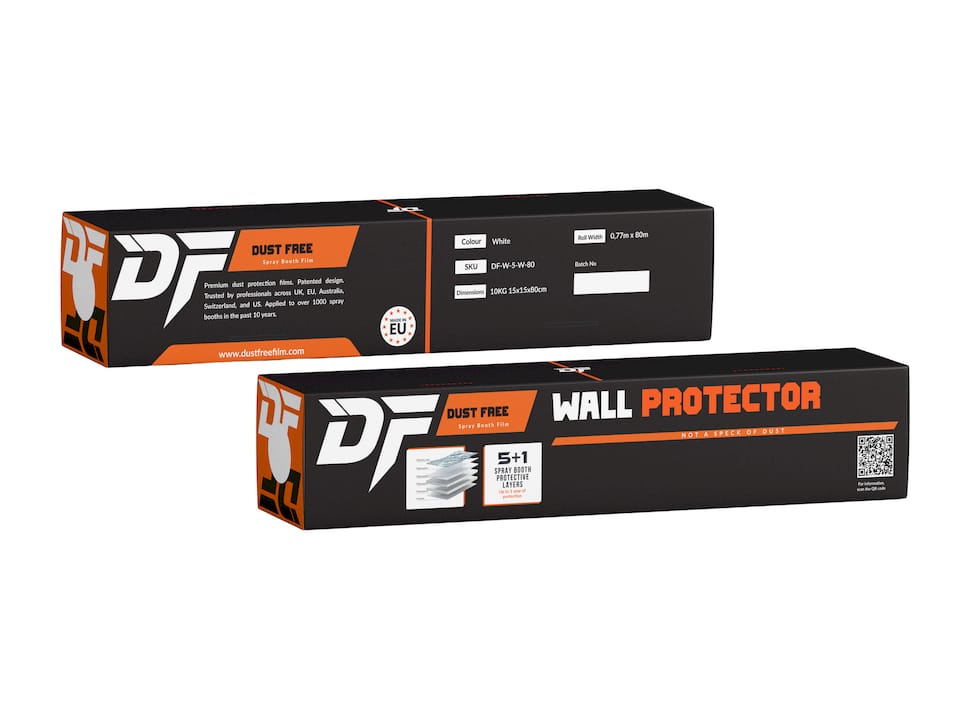
Dustfreefilm’s multi-layer electrostatic protective films are built specifically for the conditions described in this article: heat-resistant, static-free surfaces that capture settled overspray on walls and floors, reduce cleaning frequency, and install in minutes with the patented dispenser system — no tape, no bubbles, no gaps where overspray can accumulate undetected.

Every Dustfreefilm product ships with full SDS documentation to support your waste characterization process, and the multi-layer construction extends service life compared with single-layer alternatives, reducing per-job waste volume. The dispenser system makes change-outs fast enough that your team will actually do them on schedule rather than deferring to the next slow day.
Dustfreefilm does not replace your exhaust arrestors or your VOC reduction strategy — it handles the particulate and housekeeping side so those systems can do their jobs. For bulk orders, custom configurations, or samples to evaluate in your booth, request a quote at Dustfreefilm and get the documentation package alongside it.
Sources
- Spray Booth Filters (EPA fact sheet)
- Mass
- FR-PaintStripping_Final Rule (EPA rulemaking document)
- 40 CFR §63.3094 (work practice plan requirements)