
For professional spray booths that need extra-wide protection, a multi-layer, dispenser-ready film system delivers the best mix of contamination control, uptime, and light compatibility. Some products cover widths from roughly 90 cm (36 inches) up, handling walls, light covers, and floors without seams cutting across inspection zones. Request a sample roll and a dispenser demo before you commit to a bulk order.
TL;DR:
- The best films are multi-layer, about 36 inches or wider, with documented light transmissivity, heat resistance, and a high cycle rating tailored to booth conditions.
- A dispenser with a rotating roll and integrated cutter ensures faster, cleaner installation, reducing labor hours and minimizing wrinkles or misaligned seams.
- Confirm the film’s performance with a sample roll tested in your own booth to evaluate peel behavior, light clarity, and contamination handling before bulk purchase.
- Vendor transparency on manufacturing, cycle ratings, support, and customization options is crucial for reliable, long-term booth protection solutions.
Table of Contents
- What Is Extra Wide Multi-Layer Booth Film?
- How Do You Choose the Right Booth Film?
- What Sizes and Specs Should You Expect?
- Why Do Dispenser Systems Matter for Wide Film?
- What Drives Film Lifetime and Total Cost?
- Why Manufacturer-Backed Proof Points Matter
- What Happens to Booth Film After Use?
- Can You Get Custom Sizes or Branded Film?
- How Do You Vet a Booth Film Supplier?
- The Real Lesson Buyers Miss About Booth Film
- How Dust Free Film Fits Your Booth Film Checklist
- Sources
- FAQ
What Is Extra Wide Multi-Layer Booth Film?
“Extra wide” in this category generally means rolls starting around 90 cm (36 inches) and running wider, built to cover a booth wall, light bank, or floor section without stitching together narrow strips. The narrow-roll approach creates seams, and seams are where overspray finds gaps and where light coverage gets patchy. Multi-layer film solves a different problem: instead of one sheet you scrape and reinstall, you get a stack of numbered layers bonded together. Once the top layer loads up with overspray and dust, you peel it off and the next clean layer is already in place underneath.
That single design choice changes the economics of booth maintenance. Instead of a crew stripping walls, scrubbing residue, and taping up a new sheet, one person peels a layer in seconds. The multi-layer design also supports an electrostatically charged, slightly tacky surface that actively pulls airborne particles out of the air rather than just catching what happens to settle.
Benefits worth weighing against generic masking paper or shrink film:
- Continuous particle capture instead of passive coverage
- A fresh surface in seconds, not a full teardown and reinstall
- Fewer rework cycles from dust nibs and fisheyes in the finish
- Clear enough to cover lamps and inspection windows without killing visibility
- Dispenser-based installation that keeps rolls straight and seams tight
Wide-format coverage over lights only works if the film stays optically clean. A film that clouds interior lighting defeats the purpose of covering it in the first place, which is why light transmissivity belongs on your spec sheet, not just width and thickness.
How Do You Choose the Right Booth Film?
Picking booth film by price per roll alone is how shops end up with the wrong product. The specs that actually predict performance are width, layer count, thickness (mil), clarity, dispenser compatibility, and heat rating. A film rated for 60°C will not hold up near booth lamps or in a facility running elevated bake cycles, so match the temperature rating to your actual booth conditions, not the average.
Before you sign a purchase order, run through this checklist:
- Width and seam count. Can one roll span your wall or light bank without a seam crossing an inspection zone?
- Layer count and cycle rating. How many peels per roll, and how many booth cycles is that rated for?
- Dispenser availability. Does the vendor supply an applicator box, or are you taping by hand?
- Clarity documentation. Will the vendor share light transmittance data, not just a marketing claim?
- Heat resistance. Does the film hold up at your booth’s peak surface temperature near lamps and bake zones?
- Sample availability. Will they send a trial roll before you commit to a bulk order?
Operationally, ask what changeover time the vendor’s system actually achieves with your crew size, not a lab technician’s best case. A one-person changeover target is realistic with the right dispenser; anything requiring two or three people to hold, align, and tape a wide sheet is going to eat labor hours every single cycle.
Pro Tip: Ask for a sample roll and run it through one full contamination cycle in your own booth before ordering pallets. Peel behavior, overlap adhesion, and light performance all look different under your actual spray pattern than they do on a vendor’s demo video.
What Sizes and Specs Should You Expect?
Professional-grade wall protection film commonly ships in widths of 90 cm (about 36 inches) or wider, with roll lengths engineered to cover a full wall section without a mid-height seam. Wide-format film substrates from general manufacturers such as HP and Kodak run in similar ranges, 36 to 50 inches and beyond, at 4 to 5 mil thickness for heavy-duty use, which tells you this width range is an established market standard, not a proprietary quirk.
Thickness and clarity trade off against each other. Thicker film resists punctures and holds up longer under heavy traffic, but push thickness too far and you lose the light transmittance that makes lamp coverage viable. For high-throughput booths, look for:
- Multi-layer rolls rated for roughly 250 cycles or about three months of typical use
- Heat resistance up to approximately 80°C for placement near booth lighting
- Documented light transmissivity figures, not just a “clear” label
- Layer counts that match your actual changeover frequency, so you’re not buying capacity you’ll never peel through
Match roll length to wall height and width before ordering, so seams land in low-visibility corners instead of across a light bank or inspection window.
Why Do Dispenser Systems Matter for Wide Film?
Width alone doesn’t save you time. Efficiency depends on how the film goes up, and a wide roll installed by hand with tape is often slower and messier than a narrower roll on a proper dispenser. A dispenser box with a freely rotating roll, reinforced sides, and an integrated cutting bar lets one installer brace the box with a foot and pull a straight, aligned line across the entire wall in one pass.
Compare that against the manual tape-roll method: two people holding a sheet level, taping edges, fighting wrinkles and bubbles, then repeating the process every time the surface loads up with overspray. Tape residue builds up over repeated cycles, and misaligned seams become the entry point for contamination.
Dispenser features worth requesting specifically:
- Freely rotating roll for consistent tension
- Integrated metal cutting bar for clean, straight cuts
- Reinforced box structure for one-person operation
- Visible layer numbering so installers know exactly which sheet is next
- Tape-free overlapping edges that seal without adhesive residue
The numbers back this up. Measured operational cases show tear-off film systems cutting booth changeover time from about 45 minutes down to roughly 8 minutes. That is not a marginal improvement. It’s the difference between a changeover that eats a chunk of a shift and one that barely interrupts production flow.
What Drives Film Lifetime and Total Cost?
Film lifetime depends on overspray load, foot and equipment traffic, and how many layers you’ve bought per roll. A booth running high-volume metallic basecoats will chew through layers faster than one doing occasional touch-up work, so cycle estimates should come from your own throughput, not a generic average.
Maintenance is simple in principle: peel a layer when contamination visibly affects the surface, store unused rolls flat and away from heat sources, and handle rolls with clean gloves to avoid transferring grease onto an unused layer. Skipping storage discipline is a common way shops shorten a film’s effective life before it ever gets used.
For total cost of ownership, ask vendors for:
- Price per square meter, not just price per roll
- Labor hours saved per changeover versus your current method
- Expected defect or rework reduction based on comparable shop data
A higher upfront price on a dispenser-based system usually pays for itself through fewer labor hours per changeover and longer effective protection between replacements, which is the real comparison procurement should be running.
Pro Tip: Don’t compare roll price to roll price. Compare cost per booth cycle, factoring in labor. A cheaper roll that needs replacing twice as often rarely wins that math.
Why Manufacturer-Backed Proof Points Matter
Some manufacturers have produced spray booth protection film in Europe since 2012, including both wall and heavy-duty floor protector lines. Its patented application box includes the rotating roll, reinforced sides, and integrated cutter described above. Ask any vendor, including Dust Free Film, for documented changeover data and a live dispenser demonstration before you buy at scale.
What Happens to Booth Film After Use?
Used booth film carries whatever it captured, which usually includes paint overspray, solvent residue, and dust, so it typically can’t go into standard recycling streams without pretreatment. Most facilities dispose of spent film alongside other booth waste under existing hazardous or industrial waste procedures, since the contamination profile matters more than the plastic substrate underneath it.
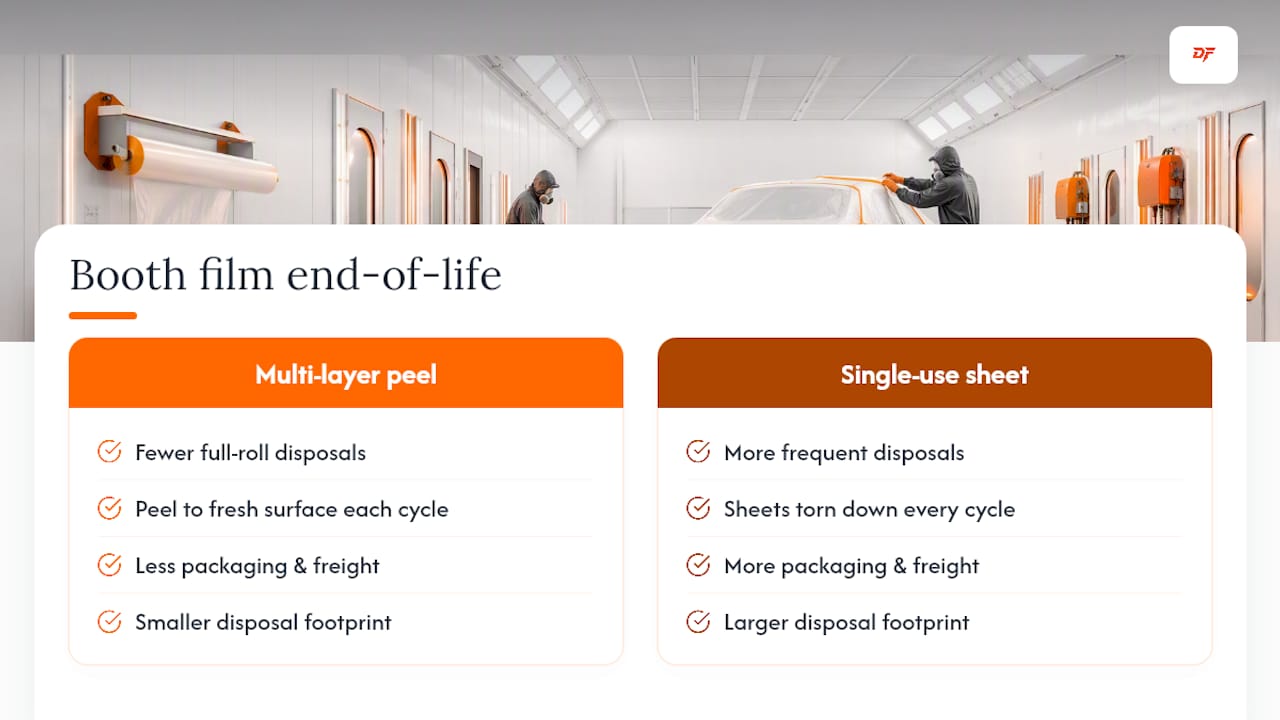
That said, the film itself matters less for waste volume than how often you’re replacing it. A multi-layer system that peels down to a fresh surface generates fewer full-roll disposal events over a given period than a single-use sheet system that gets torn down and thrown out every cycle. Fewer full changeovers means less packaging waste, less freight for replacement rolls, and a smaller disposal footprint overall.
Facilities working toward waste-reduction targets should ask vendors two direct questions: how many peel cycles per roll before full disposal, and whether the base substrate qualifies for any regional recycling program once fully spent. Some polypropylene-based films can enter industrial plastic recycling streams once cleaned of major contamination, but this depends entirely on local waste-handling rules and the facility’s own disposal contracts. Don’t assume recyclability. Confirm it with your waste hauler and the film manufacturer’s technical documentation.
Can You Get Custom Sizes or Branded Film?
Yes, and for shops with nonstandard booth dimensions or a multi-location brand identity, this matters more than it sounds. Standard extra-wide rolls cover most booth configurations, but some facilities have unusually tall walls, oversized light banks, or floor layouts that don’t match off-the-shelf roll widths.
Manufacturers with in-house production capability, rather than resellers repackaging someone else’s stock roll, are generally better positioned to offer custom widths, custom layer counts, or private-label branding on the packaging and dispenser box itself. That last point matters for larger operators managing multiple facilities under one brand: private-label film keeps ordering, training, and vendor management consistent across every location instead of each site sourcing whatever’s locally available.
If your shop runs a nonstandard booth size or you’re evaluating a multi-site rollout, ask specifically whether the vendor manufactures in-house or resells, and whether custom configurations require a minimum order quantity. Factory-direct suppliers typically have more flexibility here than distributors working off pre-cut inventory.
How Do You Vet a Booth Film Supplier?
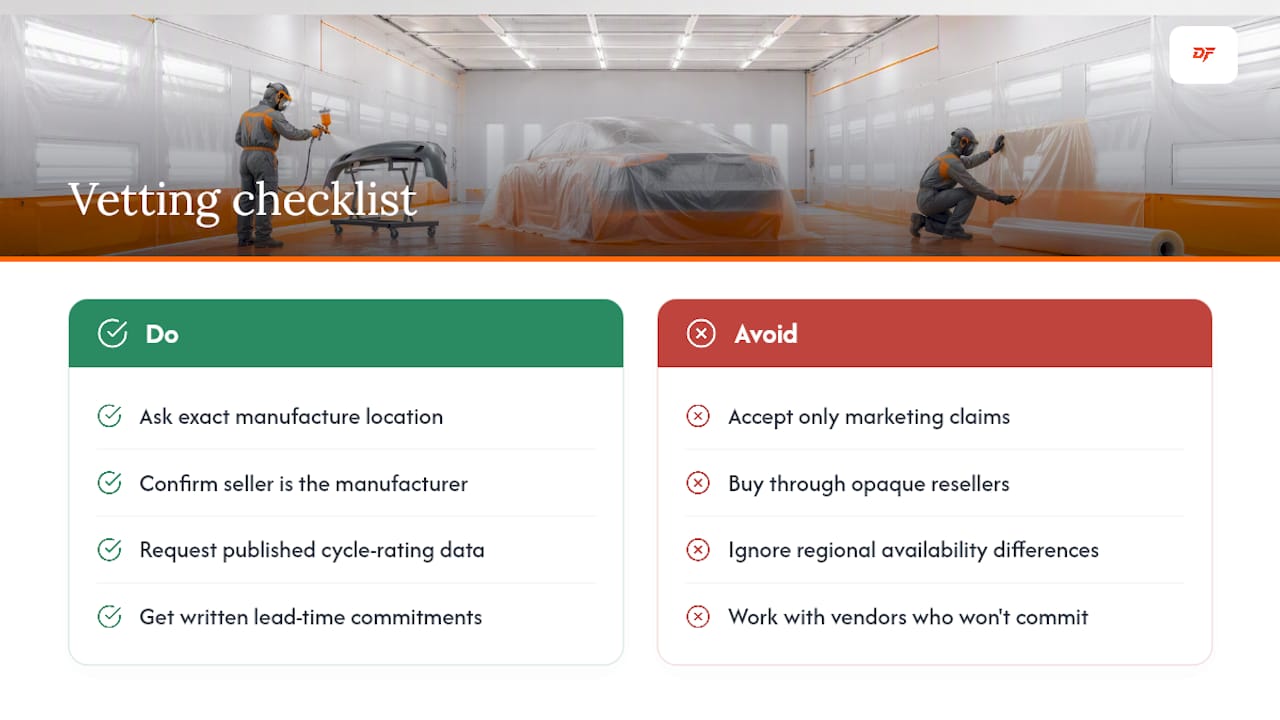
Warranty terms, manufacturing transparency, and support responsiveness separate a reliable long-term supplier from one that looks fine on a spec sheet and disappears after the sale. Start by asking exactly where the film is manufactured and whether the company producing it is also the one you’re negotiating with, or whether you’re buying through a reseller layer that adds cost without adding accountability.
Reliability shows up in the details: does the vendor publish actual cycle-rating data, or just marketing language like “long-lasting”? Will they commit to lead times in writing for bulk or custom orders? Can they support multiple facility locations with consistent product, or does availability vary by region? A supplier that can’t answer these plainly is a supplier that will leave you scrambling during a production crunch.
Support and warranty coverage matter just as much as the film itself. Ask what happens if a roll arrives damaged, whether technical support is available for dispenser troubleshooting, and whether the company offers on-site evaluation for larger accounts. Facilities in the automotive and industrial finishing space often lean on established industry equipment and service partners for cross-checking vendor reliability before signing multi-year supply agreements, and that kind of due diligence is worth the extra week it takes.
The Real Lesson Buyers Miss About Booth Film
Most procurement teams shop for booth film the way they’d shop for masking tape: compare price per roll, pick the cheapest option that meets a minimum spec, move on. That’s backwards. The evidence here points to installation efficiency as the variable that actually determines whether extra-wide film saves money or just shifts the cost from materials to labor.
A wide roll with no dispenser system is a wide roll that still needs two people, tape, and twenty extra minutes per changeover. The conventional advice, “buy the widest roll you can afford,” skips the part that matters more: how does that roll actually go up on the wall? Cycle ratings and mil thickness are easy to compare on paper. Installation time is where the real savings or losses show up, and it rarely gets asked about until after the purchase order is signed.
If you take one thing from this guide, make it this: request changeover time data before you request pricing. A vendor who can’t tell you how long their system takes to install, with real numbers from real facilities, hasn’t earned your bulk order yet.
— Pavlos - Angelos Filippakis
How Dust Free Film Fits Your Booth Film Checklist
Every spec covered above maps directly to Dust Free Film’s two product lines. The Multiple-Layer Spray Booth Wall Protector handles walls, light banks, and inspection zones with the extra-wide, multi-layer, peel-off design and patented dispenser box detailed throughout this guide. The Multiple-Layer Spray Booth Floor Protector covers the heavy-duty, slip-resistant floor side of the same booth, built for foot and cart traffic rather than overspray capture alone.
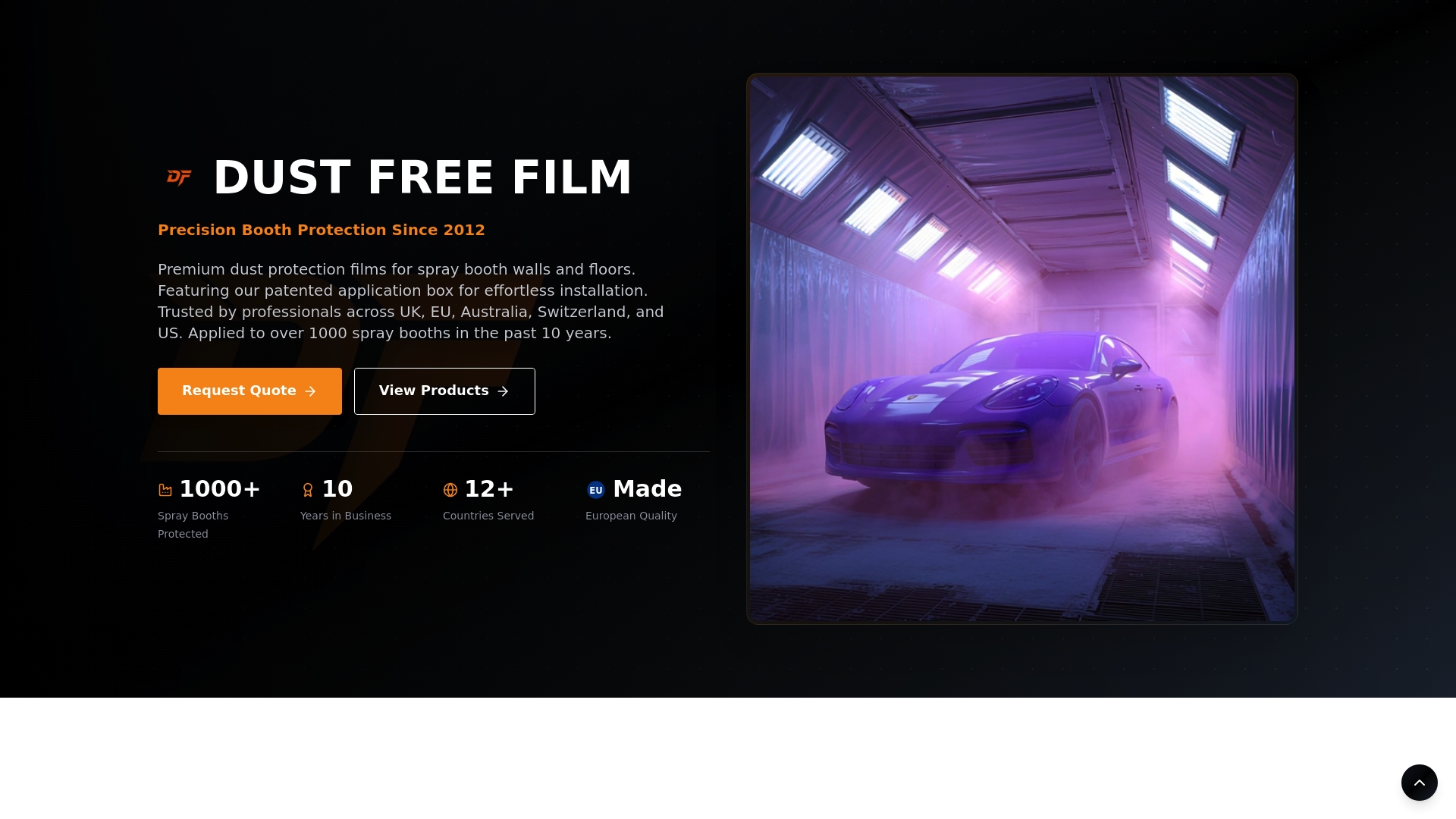
Both lines are manufactured factory-direct in Europe, which means custom widths, private-label configurations, and bulk pricing go through the same production line you’re already evaluating, not a reseller adding a markup on top. If your booth has nonstandard dimensions or you’re comparing options across multiple facilities, that direct manufacturing relationship is worth more than another line item on a spec sheet.
Before committing to a bulk order, request a sample roll, ask for documented cycle-rating data, and schedule a dispenser demonstration for your own crew. Browse the full product catalog or reach out directly to get pricing and lead times for your facility’s exact configuration.
FAQ
What Width Counts as Extra Wide Booth Film?
Extra-wide booth film generally starts around 90 cm, or roughly 36 inches, and runs wider depending on the manufacturer. That range lets one roll span most booth walls or light banks without a seam cutting through an inspection zone.
Can Extra Wide Film Cover Booth Lights Without Blocking Visibility?
Yes, but only film specifically engineered for high light transmissivity works over lamps without dulling inspection lighting. Always request clarity documentation before covering lights, since standard opaque masking material will hide defects rather than help you spot them.
How Long Does Multi-Layer Booth Film Last?
Multi-layer wall protection is typically rated for about 250 booth cycles, or roughly three months, in high-throughput conditions, though actual lifetime depends on overspray volume and traffic. Facilities running heavier finishing schedules should confirm cycle counts against their own booth throughput rather than relying on a generic estimate.
Why Does a Dispenser System Matter More Than Roll Width?
Installation efficiency, not width alone, determines whether extra-wide film actually cuts downtime. Dispenser systems have helped reduce booth changeover time from about 45 minutes to roughly 8 minutes in measured cases, which is the real driver of labor savings.
Does Dust Free Film Offer Sample Rolls Before a Bulk Order?
Buyers should request a small sample roll to test peel behavior, overlap adhesion, and light performance in their own booth before committing to bulk quantities. Contact Dust Free Film directly through its product pages to arrange a sample or dispenser demonstration.