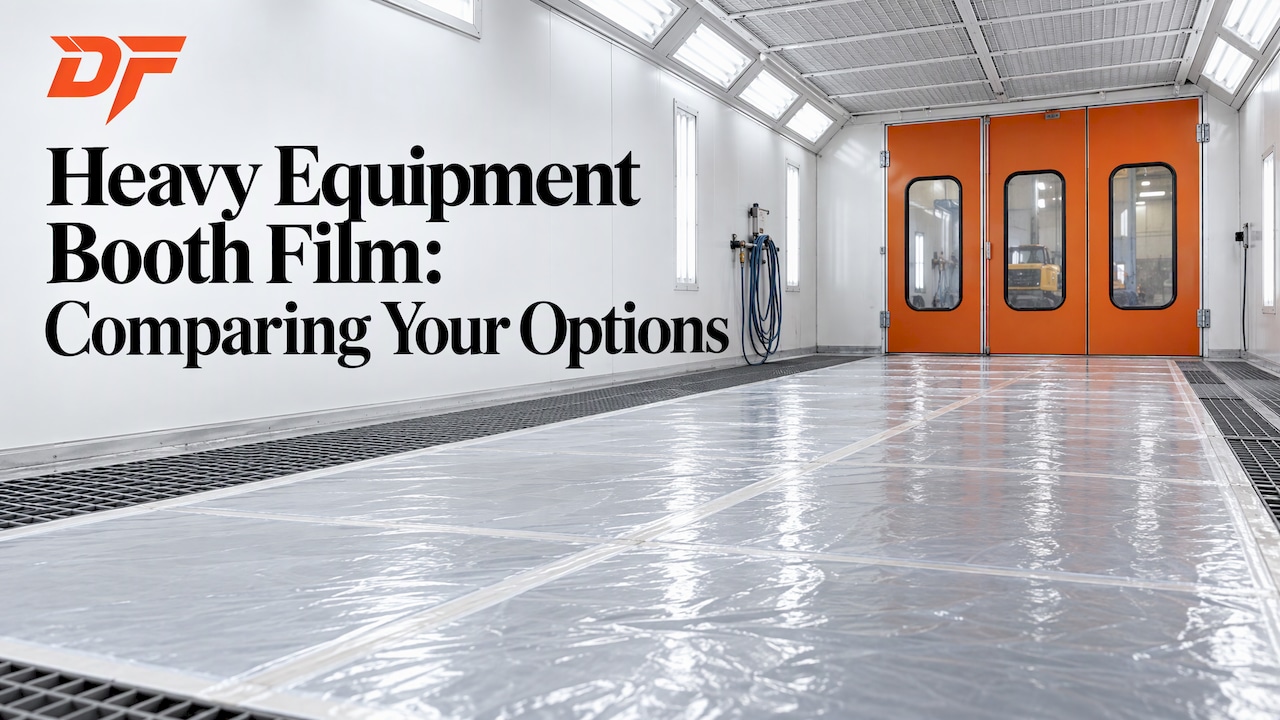
For a heavy-equipment paint booth, the best booth film is a multi-layer electrostatic film that you peel layer by layer, not a coating you roll on and strip off later. Large machines mean large wall and floor areas, long dwell times and heavy foot and lift traffic. The product has to go down fast, hold its position and come off in a few minutes. Dust Free Film makes multi-layer Wall Protector and Floor Protector films for this job. Below we compare them with the other ways shops protect a booth, so you can judge the trade-offs on your own booth.
TL;DR
- Booth film comes in three broad types: multi-layer peel-off film, liquid peelable coatings and single-layer sheeting. Multi-layer film is the one that lets you refresh a surface without reinstalling anything.
- Large equipment booths put the most strain on the floor, so slip resistance and durability matter as much as dust capture.
- Fire codes such as OSHA 1910.107 require smooth, cleanable booth interiors. Confirm your local code before you choose any covering.
- Compare options on installation labor, refresh time, heat rating, floor grip and waste. The film’s price per roll is only part of the cost.
- Dust Free Film’s Wall Protector and Floor Protector are made in Greece, ship worldwide and can be ordered in bulk or custom configurations.
Table of Contents
- What booth film does in a heavy-equipment booth
- The four options compared
- What to check before you buy
- Installing film in a large booth
- Who this is for
- Ordering for a heavy-equipment shop
- Perspective
- FAQ
- Sources
What booth film does in a heavy-equipment booth
A spray booth has two contamination problems. Airborne dust lands on wet paint and causes nibs and defects. Overspray builds up on walls and floors, then gets kicked back into the air. Booth film addresses both by giving dust and overspray a surface to stick to, one you can throw away instead of scrubbing.
Heavy-equipment refinishing makes this harder than car work:
- Size. Excavator booms, dozer blades, truck frames and rail or aerospace components need big booths. More wall area means more surface to protect and more time lost cleaning.
- Traffic. Lifts, carts, scaffolds and boots cross the floor all day. A floor covering that slides or lifts at the edge is a trip hazard and a source of contamination.
- Long jobs. A large machine can stay in the booth much longer than a car, so a surface that is clean at the start can be loaded with particles by the end.
- Cost of rework. A defect on a large panel means a large area to sand and repaint.
The film is a consumable, so the real question is how much time and labor it takes to put down and renew, and how well it holds up between changes.
The four options compared
Most buyers end up choosing between these approaches.
| Option | How it works | Refresh | Strengths | Watch for |
|---|---|---|---|---|
| Multi-layer electrostatic film (Dust Free Film) | Stacked layers with a charged, slightly tacky surface on the wall film and a slip-resistant heavy-duty floor film | Peel off the top layer to expose a fresh one | No reinstall between refreshes, tape-free overlapping edges, numbered layers and length markings | Choose the wall or floor grade that matches the surface |
| Liquid peelable coating | Sprayed or rolled on, cures to a skin | Strip the whole skin, reapply coats | Covers odd shapes | Applied in several coats, cure time, solvent and disposal rules |
| Single-layer plastic or paper sheeting | Taped to the surface | Remove and replace the whole sheet | Low entry cost per sheet | Tape on every seam, no fresh layer underneath |
| Bare surface, wash and scrape | Clean walls and floor directly | Scrub or scrape | Nothing to buy up front | Highest cleaning downtime |
Multi-layer film: where we put it first
The design logic is simple. Each layer is a complete surface. When the top one is loaded with dust and overspray, you peel it and the next one is already in place. Dust Free Film’s layers are numbered, so the crew can see how many fresh layers are left and plan changes before the surface gets overloaded. The films also carry integrated length markings, which helps you cut to size without a tape measure.
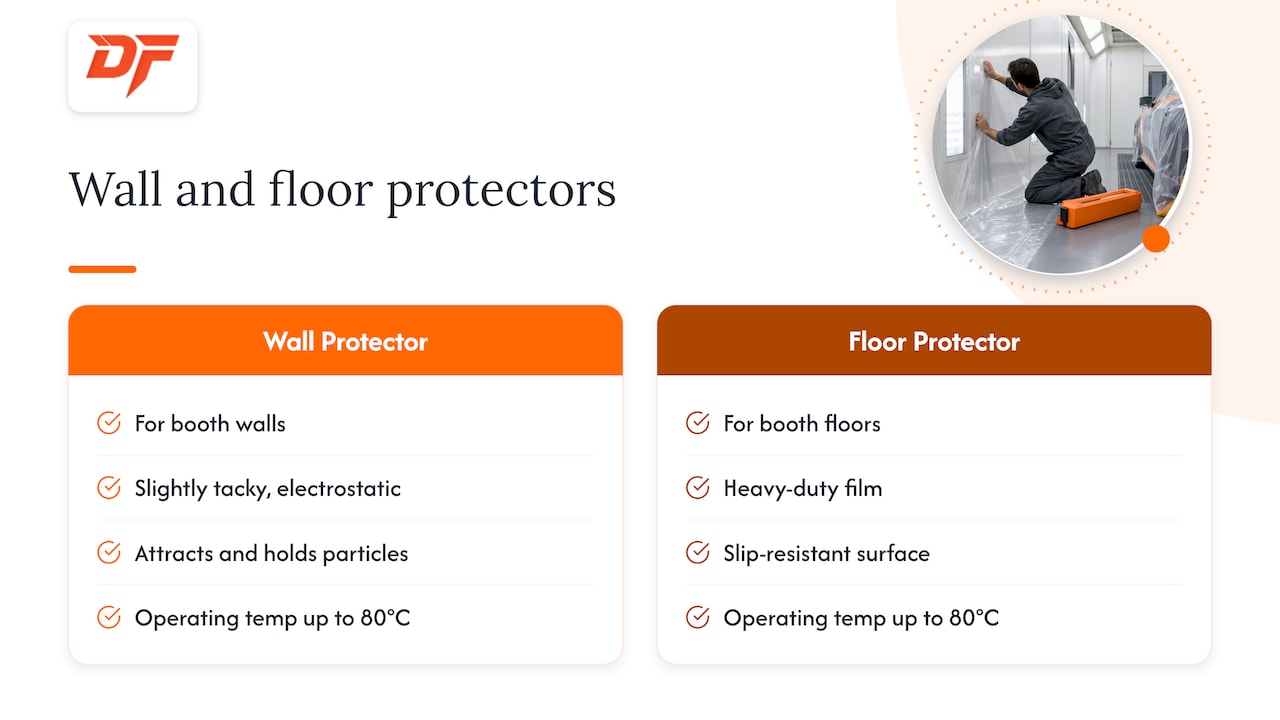
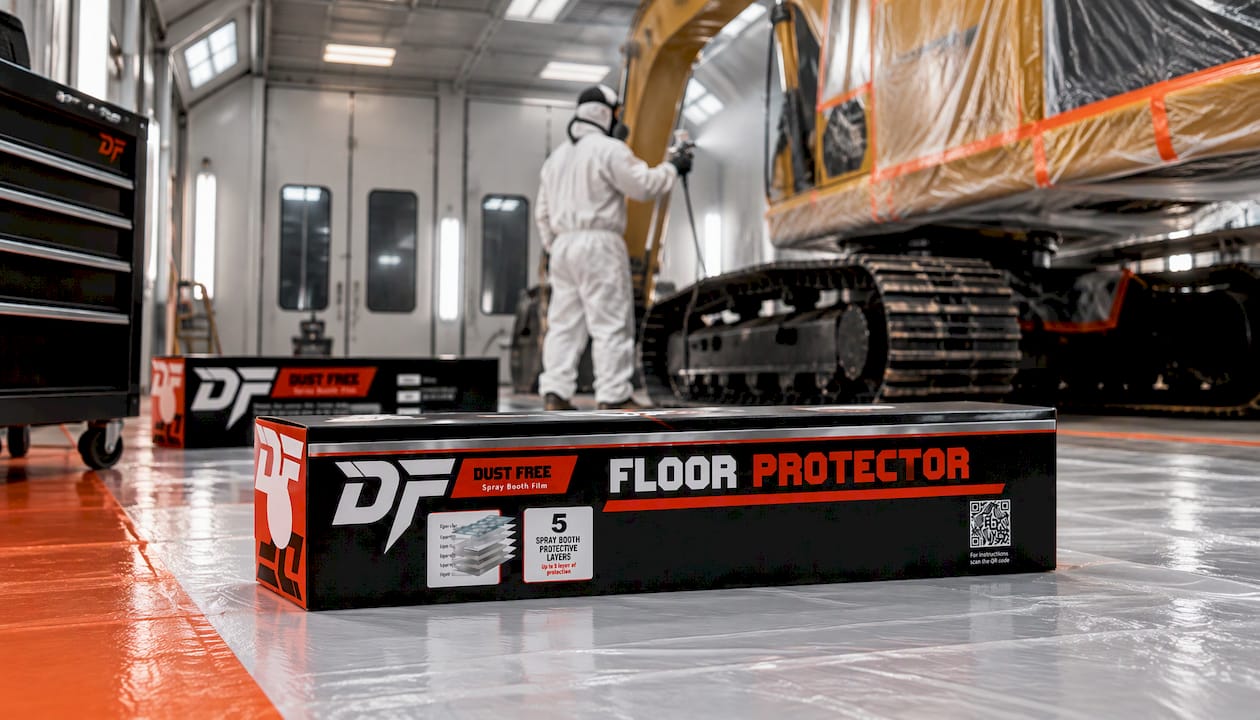
The Wall Protector is slightly tacky and electrostatically charged to attract and hold particles. The Floor Protector is a heavy-duty film with a slip-resistant surface for demanding work areas. Both are rated for operating temperatures up to 80°C, which covers typical bake and curing cycles in booths that combine spraying and baking.
The edges are tape-free: strips overlap instead of being taped. In a big booth that removes hundreds of feet of tape work and the residue it leaves on walls.
See the Multiple-Layer Spray Booth Wall Protector and the 5-Layer Spray Booth Floor Protector for the product lines.
Liquid peelable coatings
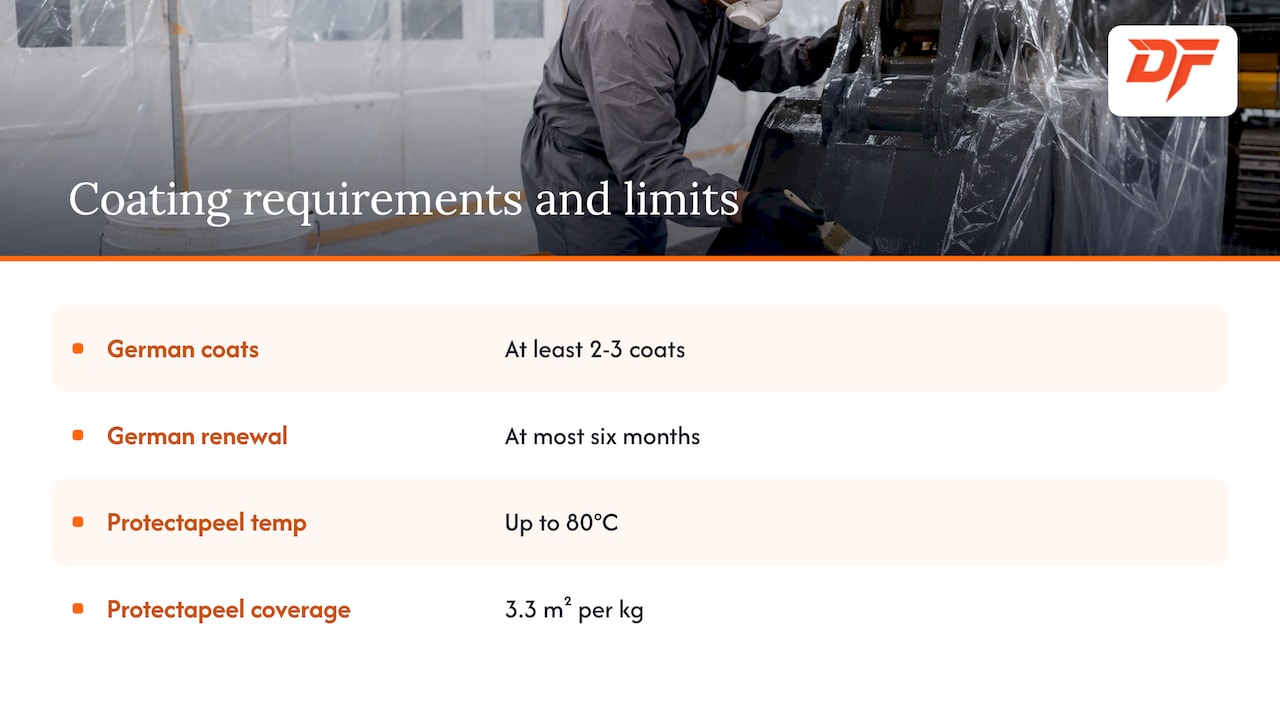
Strippable coatings are applied like paint and later peeled off. They suit awkward geometry. Manufacturers publish their own limits. One German coatings maker’s technical data sheet calls for at least two to three coats, a respirator during application and renewal after six months at most. UK-based Protectapeel states its booth coating withstands up to 80°C and covers 3.3 m² per kg. These are those makers’ own figures, and they show what the approach involves: coats to apply, cure time and a respirator for the applicator. The film route skips those steps because the layers are already made.
Single-layer sheeting
Plastic or paper sheeting is the traditional stopgap. It is cheap per sheet, but each seam needs tape, and once the sheet is loaded you replace the whole thing. For a heavy-equipment booth with big walls, the labor and tape consumption usually overtake the price advantage.
No covering
Doing nothing means every cleaning cycle is a wash-down or scrape. The booth is out of production while that happens, which is the cost film is meant to cut.
What to check before you buy
Heat
If the booth also bakes, confirm the film’s stated operating temperature against your booth’s cycle. Dust Free Film’s films are rated up to 80°C.
Floor grip
On heavy-equipment floors, walking, lifting and cart traffic is constant. Look for a floor film built with a slip-resistant surface, and look at how the edges stay down. Our guide on how to run a 90° peel test on floor film walks through checking edge adhesion in practice, and the piece on film adhesion strength covers what a film that peels clean should do.
Code and safety
Booth interiors are regulated in the US. OSHA’s spray finishing standard says interior surfaces must be smooth and continuous without edges and designed to prevent pocketing of residues and to facilitate cleaning. Local fire codes add detail. Seattle’s 2018 Fire Code, for example, permits thin paper or plastic coverings and strippable coatings over noncombustible spray booth floors to make cleaning easier. Your fire marshal and insurer set what applies to your booth, so involve your EHS manager and confirm the covering before a large order.
Waste
Used film carries whatever you sprayed. Check your paint and coating waste classification and disposal route with your EHS manager, and plan one routine for layers peeled off. Because multi-layer film is removed in sheets, it is easy to bag and handle compared with scraped skins.
Replacement cost
Compare cost per booth cycle rather than cost per roll. Add up the labor hours to install, the hours to refresh, tape, and the downtime. Our 2026 buyer’s comparison of industrial spray booth film sets out the criteria, and the guide to high-durability film covers wear in more detail.
Installing film in a large booth
Installation speed is where multi-layer film pays back in a big booth.
- Prepare the surface. Clean, dry and free of loose residue so the film seats properly.
- Set the dispenser. Dust Free Film’s patented application box has a freely rotating roll, reinforced wooden sides and an integrated metal cutting bar. One installer can steady it with a foot and pull a straight line of film.
- Run the first strip, then overlap. The edges are tape-free, so the next strip overlaps the first. No tape seams to run.
- Cut to length. Use the integrated length markings and the cutting bar.
- Refresh by peeling. When the surface is loaded, remove the top layer. The numbering shows how many are left.
Because one person can do the install, a crew can start on walls while others prepare the machine. For ceilings, see how to protect a spray booth ceiling, and for application ideas across booth types see examples of protective film applications.
Who this is for
The buyers who gain most are the ones who own the booth budget: body-shop owners, paint-shop and production managers, facility and maintenance managers, purchasing managers and EHS managers at heavy-equipment, commercial-vehicle, rail and industrial painting operations. Painters and technicians benefit on the floor, but the choice of film is usually made at these desks, which is why the comparison above is in terms of labor, downtime and cost per cycle.
Ordering for a heavy-equipment shop
Heavy-equipment booths rarely match a standard size, so ordering flexibility matters. Dust Free Film, established in 2012 and manufacturing in Greece, supplies body shops, booth operators, manufacturers and distributors internationally. You can buy through regional partners or directly from the factory, with support for bulk orders, custom configurations, private-label production and worldwide shipping. Our shipping is VAT-free worldwide. The product pages list no prices, so you request a quote based on your booth size and volume.
Start with the Wall Protector for walls and the Floor Protector for the floor, then reach out through dustfreefilm.com with your booth dimensions and annual volume.
If you also supply or distribute to shops, the same channels cover wholesale agreements and exclusive distributorship opportunities.
Perspective
We built Dust Free Film around one idea: a booth should not have to stop for a rebuild every time the surface fills up. Multi-layer film means the next clean surface is already there, under the one you just peeled.
In large booths the costs hide in the small things: the tape on every seam, the second person holding the roll, the hours spent trimming to length. That is why our application box lets a single installer dispense a straight line, and why the edges overlap without tape. The layer numbers and length markings are there so a crew can plan work instead of guessing.
For heavy equipment we pair a slightly tacky, electrostatically charged wall film with a heavy-duty, slip-resistant floor film. Each does one job well, and both are made to handle operating temperatures up to 80°C.
If your booth is an unusual size, we would rather configure the product to it than ask you to adapt your booth to the product.
Pavlos - Angelos Filippakis
FAQ
What is the best booth film for heavy-equipment painting?
For most shops it is a multi-layer electrostatic film: a tacky wall film and a slip-resistant floor film that you refresh by peeling a layer. Dust Free Film’s Wall Protector and Floor Protector are built this way. They install with a single-person dispenser and need no tape at the seams.
Can booth film go on both walls and floors?
Yes, but use the grade made for each surface. The Wall Protector is slightly tacky to capture particles. The Floor Protector is heavy-duty with a slip-resistant surface for traffic. Our guide to floor protection films goes deeper on floors.
Does film work in a booth that bakes?
Dust Free Film’s films are rated for operating temperatures up to 80°C. Match that figure to your booth’s cycle, and confirm with your booth manufacturer.
Is booth film allowed under fire codes?
It depends on the jurisdiction. OSHA 1910.107 requires smooth, cleanable booth interiors, and some local codes expressly allow thin coverings over noncombustible floors. Check your local fire code with your fire marshal and EHS manager before ordering.
Can I order a custom size or private label?
Yes. Dust Free Film supports bulk orders, custom configurations and private-label production, with worldwide shipping from the factory or through regional partners.
Sources
- OSHA 1910.107, Spray finishing using flammable and combustible materials
- Seattle SDCI, 2018 Seattle Fire Code Chapter 24