
First pass yield (FPY) in painting is the share of jobs that leave the booth in spec on the first attempt, with no sanding, respray, polish-out or touch-up. You raise it by counting rework honestly, sorting rejects by defect family, and removing the largest cause first. In most booths that cause is contamination, so the surfaces that collect and release dust deserve as much attention as the spray gun. Our Wall Protector and Floor Protector films are built for exactly that job.
TL;DR
- FPY counts only units that pass first time. A reworked unit that eventually passes is a first-pass failure, so a shop can show 100% final yield and still run at 91%.
- Log every reject by cause (contamination, film build, mixing, cure, handling) and fix the biggest family each week.
- Documented gains are real: 78% to 92% in a refinishing process, 79% to 91% in an automotive paint shop, 82% to 93% in a rack-paint booth.
- Booth conditions matter: humidity and temperature drift, dirty air and dusty walls and floors all turn into visible defects.
- Multi-layer protective films on booth walls and floors give you a fresh, dust-holding surface in minutes instead of a cleaning shift.
Table of Contents
- What first pass yield actually measures
- Where first-pass failures come from
- A routine that raises yield, step by step
- What the evidence shows
- Dust is the defect you can remove at the source
- Booth protection built for the job
- Our perspective
- FAQ
- Sources
What first pass yield actually measures
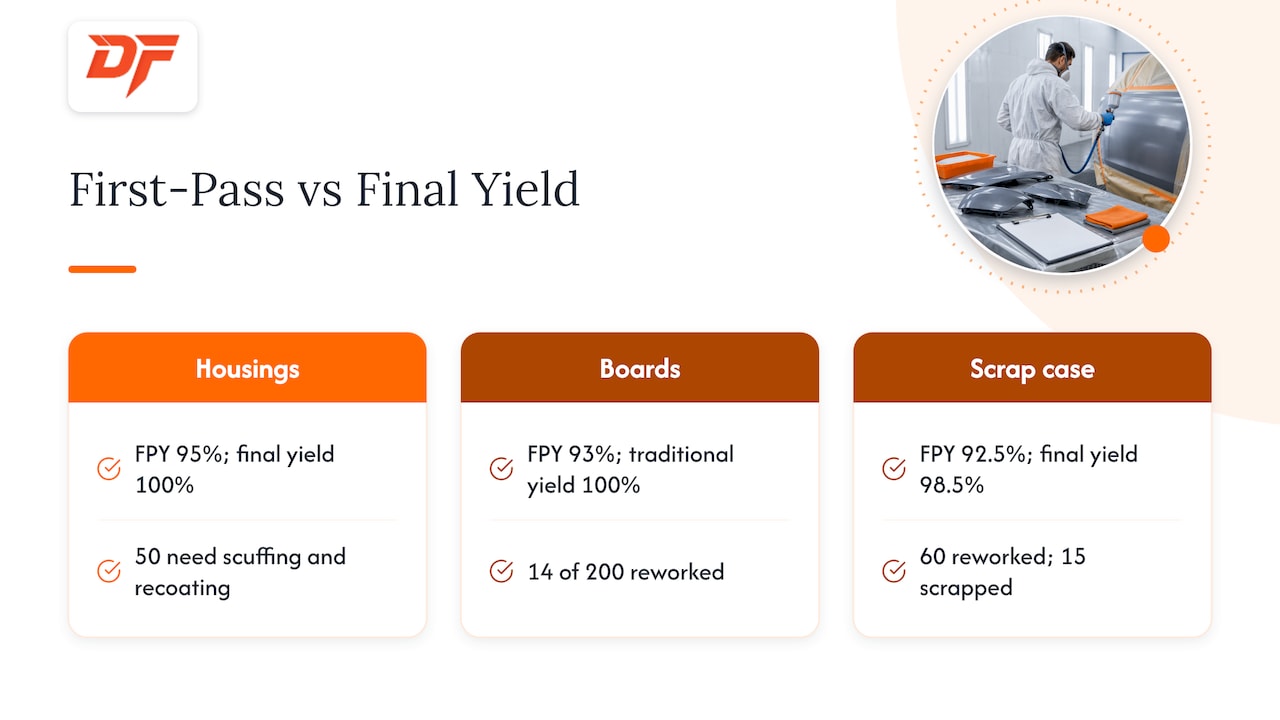
The formula is simple: FPY = units passing the step first time ÷ units entering the step, times 100. Conyso’s guide uses a paint line coating 1,000 housings: 950 pass clean, 50 need scuffing and recoating. FPY is 95%, even though final yield reads 100% once the 50 are fixed.
That gap is the point. Rework.com’s process library shows 14 of 200 boards reworked, which means 100% traditional yield but 93% FPY. The 7 points are real labor, real cycle time and a risk the repaired part fails later. SYMESTIC gives a version with scrap: 1,000 in, 60 reworked, 15 scrapped, so 925 pass right first time and FPY is 92.5%, while final yield would claim 98.5%.
Why a multi-step line needs step-level numbers
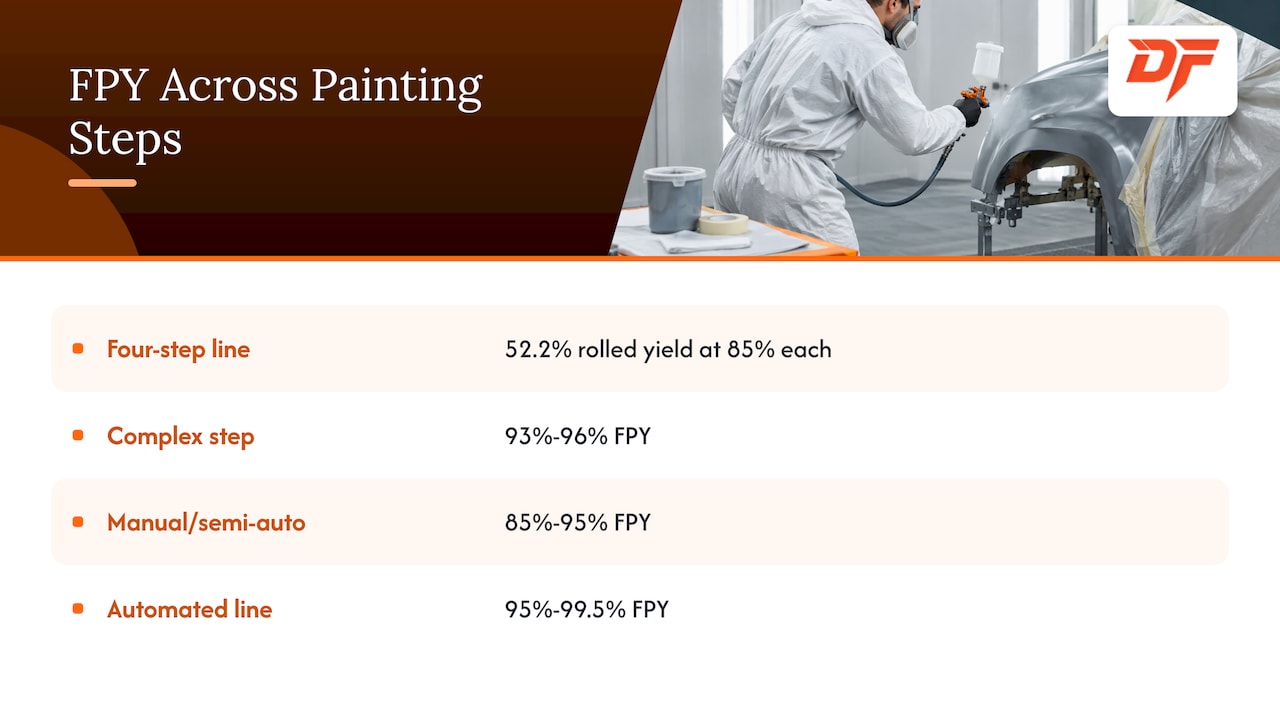
If your process has masking, prime, base, clear and polish, each step has its own FPY, and they multiply. This is rolled throughput yield. Fabrico’s guide cites four steps at 85% each, which compound to 0.85⁴ = 52.2%. QMBench reports that a complex painting step typically runs 93% to 96% FPY.
So measure at the booth, not only at the final inspection. Conyso makes the same point: a 95% spray step beside a 99% masking step tells you where a gun adjustment or fixture change will pay off.
Benchmarks are directional. SYMESTIC lists 85% to 95% for manual and semi-automated work and 95% to 99.5% for fully automated high-speed lines, and recommends improving from your own current number, for example 91% to 94%, rather than chasing a universal target.
Where first-pass failures come from
Paint defects look different but trace back to a short list of causes. UL Prospector names solvent popping, sagging, fish-eyes and craters, adhesion failure and blistering as the usual industrial defects. Its specialists stress that the visible defect is normally the last symptom of a deeper process problem.
| Defect | Typical causes | Where to look first |
|---|---|---|
| Runs and sags | Excess wet film, over-thinning, slow passes, low temperature (NTIA) | Gun setup, film build per pass, booth temperature |
| Orange peel | Poor atomization, viscosity, solvent balance (NTIA) | Air pressure, thinner choice, humidity |
| Fish-eyes and craters | Silicone, wax or grease contamination, contaminated booth air intake, insufficiently dried surfaces (Endura Paint) | Surface cleaning, air supply, intake filters |
| Blisters | Moisture in the air supply, primer not fully dry (Endura Paint) | Air lines, flash-off times |
| Clearcoat adhesion loss | Excess basecoat film, short flash-off, wrong clear-to-activator ratio (Axalta) | Mixing ratios, timing between coats |
| Dirt and dust nibs | Airborne particles from clothing, unfiltered air, floor dust, sanding | Booth surfaces, filtration, personnel routine |
One caution from NTIA’s inspection guide: classifying a defect does not decide whether it is a reject. A cosmetic flaw may break a finish requirement, while a small discontinuity may be harmless in another service. Tie your reject criteria to the applicable specification or customer standard, not to how a surface looks under a shop light.
A routine that raises yield, step by step
1. Count rework as failure, by cause
Log every unit that needs anything after the first spray. Give each reject one cause code. QLQ’s case study uses hanging, film build, contamination, cure and handling. Their paint-line guide recommends tracking FPY by defect family weekly and fixing the top family first. One metric, reviewed on a fixed day, beats a dashboard nobody reads.
The common failure here is blending causes into “other” so the reject board never points anywhere. If a quarter of your codes say “other”, the log is not doing its job.
2. Control surface preparation
Junoria Coatings’ field guide cites an industry consensus that 60% to 80% of premature coating failures trace to inadequate surface preparation. A remanufacturing study in the PCRC design-project article shows what control looks like: pre-inspect every part before sanding, write a sanding instruction per product, specify the sandpaper grades, and add a post-sanding inspection point that returns defective parts to the person who sanded them.
That last element matters. Feedback to the source of the defect is what changes behavior.
3. Take human error out of mixing
Mixing ratios fail quietly. A Graco case study describes an automotive mirror-parts maker already at 98% FPY that still lost $75,000 a year to bad parts from hand-mixing errors, four to five incidents a year. A dispensing system with 3% accuracy cut rework 85% in nine months. For smaller shops, the equivalent is a written mix card, a measured dispensing method and a viscosity and thinner log per batch.
The same discipline applies after the paint step. Finishing work such as panel-by-panel spray and rinse coating depends on method, not luck, and a repeatable routine is what keeps streaks and rework out.
4. Standardize spray application
QLQ’s spray-line routine: strain paint before it goes in the cup, mask contact points, spray top faces first and verticals last, and run a tack test before bake. Its control card lists viscosity of 16 to 22 seconds (Ford cup 4), gun distance of 150 to 200 mm with 50% overlap, 5 to 10 minutes of flash-off and 20 to 35 µm of wet film per pass. Treat those numbers as one shop’s reference points and set your own from your paint system’s technical data sheet.
5. Hold booth temperature and humidity
Oregon State’s humidity-control assessment gives optimum curing conditions of 60 to 80 °F and 40% to 65% relative humidity. Cold slows solvent evaporation and raises run risk. Above 65% RH curing slows further, and very low RH dries paint too fast and can crack it. The university estimated that controls on one booth could lift FPY from about 80% to at least 90% and cut repainting and refinishing time by 11% a year.
Sensors drift, too. Vaisala’s case study points out that a booth can fall out of spec with no visible sign if its sensors are off, so calibration is a yield task. Our own guide covers humidity in paint booths in more depth.
6. Verify cure and inspect before release
A part that looks cured may not be. For powder coating, one 2026 guide recommends cure verification on the first parts of every run and a solvent-rub test every shift. For liquid systems, follow the flash-off and bake windows in your paint data sheet and put a first-piece approval at the start of each batch.
7. Close the loop
After any change, track FPY for several weeks before declaring success. The studies below all verified their gains against a baseline.
What the evidence shows
| Operation | Change | Result |
|---|---|---|
| Remanufacturing paint and restoration process (PCRC) | Pre-inspection, sanding instructions, post-sanding check | FPY 78% to 92%; defect rate 19.25% to 8.01% |
| Automotive paint shop, polish line (CAST journal) | Root-cause analysis, maintenance, parameter changes | FPY 79% to 91%; daily downtime down 62% |
| University paint booth (Oregon State) | Humidity controls | Estimated 80% to at least 90% |
| Mixed-hardware rack booth (QLQ) | Hanging standards, first-piece gate, reject board | FPY 82% to 93% in six weeks, no chemistry change |
The pattern: none of these needed a new paint. They needed measurement, written standards and attention to the booth environment.
Dust is the defect you can remove at the source
Contamination is the cause you can most directly engineer out. The PRCR guidelines attribute about 80% of airborne contamination to personnel clothing, hair and shoes, with the rest coming from unfiltered air, concrete-floor dust, sanding and other in-booth work. Walls and floors that shed or hold dust feed the airflow that carries it onto wet paint.
Three habits cut that load:
- Keep surfaces that catch particles, not release them. Walls and floors should hold dust instead of redistributing it when the fans run.
- Refresh, do not scrub. Cleaning a booth by wiping and washing takes the booth out of production and can stir up the very particles you are removing.
- Standardize the routine. Our guides on spray booth preparation steps, the maintenance checklist and booth contamination and paint quality lay out the sequence. For airflow, see how to improve spray booth airflow.
To see what dust costs you, add a contamination code to your reject log and read the weekly count. If it is your top family, the booth surfaces are where to start. For a wider audit of the workflow, our industrial painting workflow and ROI guide walks through the numbers.
Booth protection built for the job
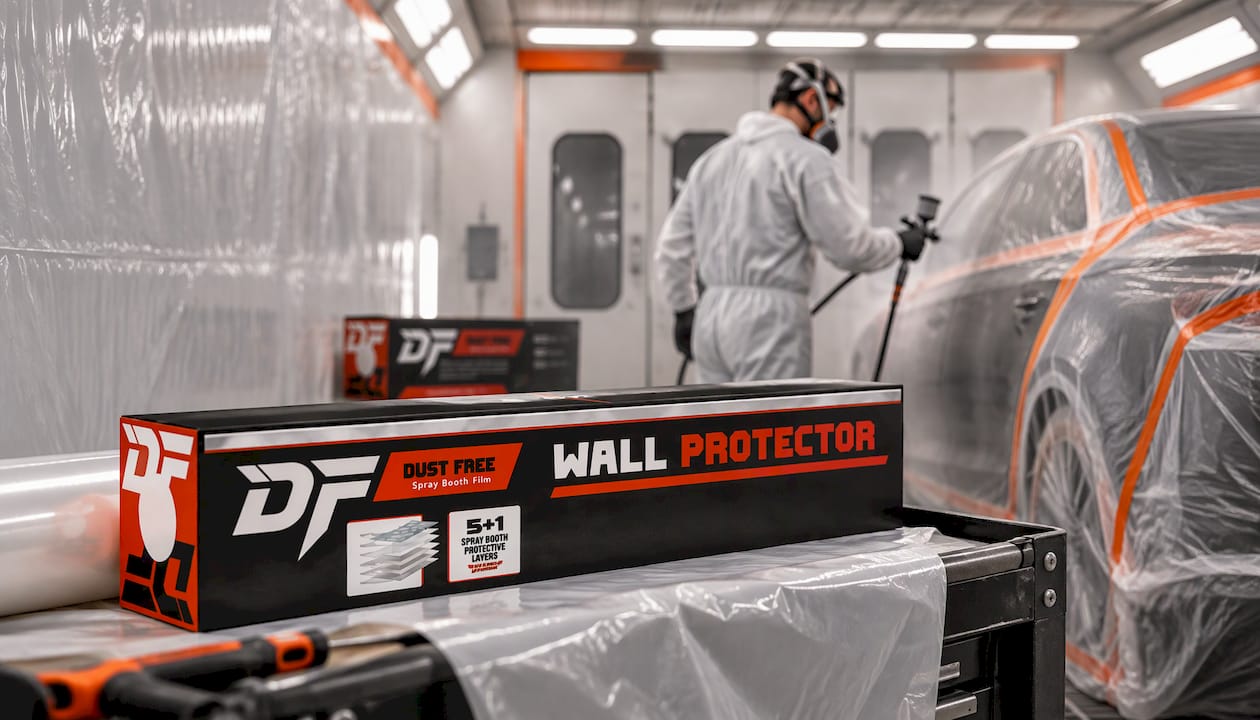
Our multi-layer Wall Protector and Floor Protector films have electrostatically charged surfaces that attract and retain contamination. When a surface is loaded, the operator peels the removable top layer to expose a fresh one, without reinstalling the whole system. The Wall Protector is slightly tacky for stronger particle capture. The heavy-duty Floor Protector gives a durable, slip-resistant surface for demanding work areas. Both resist operating temperatures up to 80°C and have tape-free overlapping edges, visible layer numbering and integrated length markings.
Installation uses our patented application box: a freely rotating roll, reinforced wooden sides and an integrated metal cutting bar, so one installer can steady the box with a foot and dispense a straight line. We supply body shops, booth operators, manufacturers and distributors internationally, with bulk orders, custom configurations, private-label production and worldwide shipping. See the 5-layer Wall Protector and the Floor Protector, or start from dustfreefilm.com.
Our perspective
Most shops chase first pass yield at the gun, because that is where the defect is visible. We see it differently. A dirty booth is a process input, as much as the paint or the air supply, and it is the one input that is easiest to standardize.
That is why we built our films around a routine an operator can repeat. Layers are numbered so everyone knows which surface is live. Edges overlap without tape. One person can lay a straight run with the application box. Because a fresh surface is a peel away, protecting the booth stops being a project that needs a shutdown.
Pair that with a weekly reject log, stable humidity and written mix and spray standards, and you give your painters the conditions every study above points to. Yield follows the discipline.
Pavlos - Angelos Filippakis
FAQ
What is a good first pass yield for a paint shop?
Benchmarks vary with how automated the line is. SYMESTIC lists 85% to 95% for manual and semi-automated work and 95% to 99.5% for fully automated lines. QMBench puts a complex painting step at roughly 93% to 96%. Set your goal from your own baseline, for instance a few points above where you run now.
How is first pass yield different from final yield?
Final yield counts everything that eventually ships, including repaired parts. FPY counts only units that pass without any rework. A line that repairs 50 of 1,000 parts reports 100% final yield but 95% FPY.
Which defects should I tackle first?
The one your reject log says is largest. Weekly tracking by defect family shows which cause costs the most, and QLQ recommends fixing that family before moving to the next. In many booths contamination, humidity and film build lead the list.
Does booth humidity really affect yield?
Yes. Oregon State notes that humidity and temperature strongly influence paint curing, with optimum conditions of 60 to 80 °F and 40% to 65% RH. Its assessment estimated an FPY rise from about 80% to at least 90% with humidity controls on one booth.
How often should booth wall and floor protection be refreshed?
That depends on your volume, paint type and how much sanding happens in the booth. With our multi-layer films, the operator removes the loaded top layer to reveal a clean one, so you can set the interval from your contamination count in the reject log.
Sources
- How to Calculate First Pass Yield (FPY), Conyso
- First Pass Yield and Rolled Throughput Yield, Rework.com
- First Pass Yield (FPY): Formula and Benchmarks, SYMESTIC
- First Pass Yield (FPY) in Manufacturing, Fabrico
- First pass yield and rolled throughput yield explained, QMBench
- Understanding Coating Defects, UL Prospector
- Common Coating Defects: Causes, Findings and Repair, NTIA
- Endura Paint Troubleshooting Guide
- Paint Defects Manual, Axalta
- Guidelines for the Design Project Article, PCRC
- Coating Inspection and Quality Control Field Guide, Junoria Coatings
- Creative Mixing Approach Eliminates $75,000 a Year in Bad Parts, Graco
- Install Humidity Controls, Oregon State University
- How Vaisala sensors help automotive painting workshops, Vaisala
- Improvement of First Pass Yield of the Polish Line, CAST journals
- Case Study: Paint Booth Yield Raised From 82 to 93, QLQ
- Panel by Panel Spray and Rinse Coating