
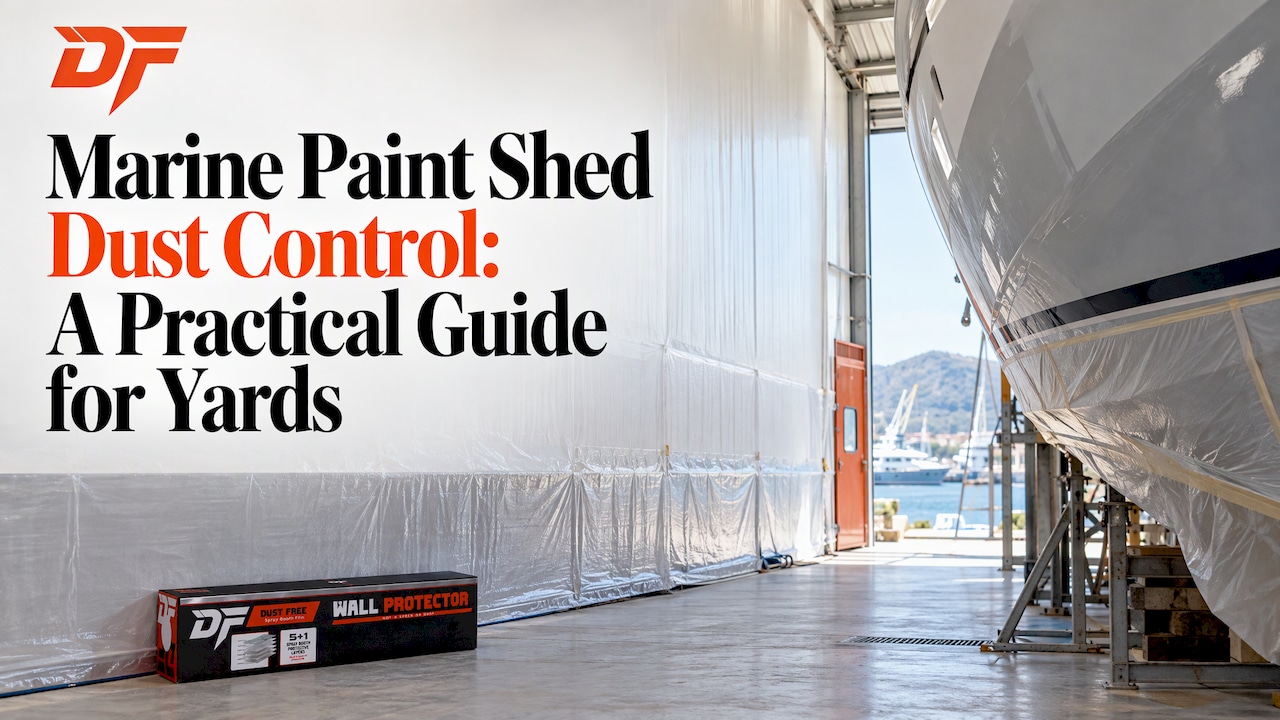
Dust in a marine paint shed is a process problem, not a housekeeping problem. It arrives from sanding nearby, from clothing, from filters and from the shed’s own walls and floor, and it ends up in the topcoat as rework. The most reliable control is layered: manage airflow, clean the workpiece correctly, and give dust somewhere to land other than your wet paint. Surface protection on the walls and floor is the layer most yards leave to chance. We make multi-layer Wall Protector and Floor Protector films for exactly that job.
TL;DR
- Dust under or in a coating weakens adhesion, and metallic or water-soluble dust can cause corrosion and blistering later. Control it before the first coat, not after.
- Keep the booth at neutral or slightly positive pressure with filtered intake air, and fit filters with no gaps.
- Clean in a fixed order: blow-down and vacuum, two-cloth solvent wipe, tack cloth immediately before each coat.
- Walls and floors collect overspray and dust between jobs. Removable-layer films let you expose a fresh surface instead of cleaning or rebuilding the lining.
- Judge results by inspection and rework rates, not by aiming for zero dust.
Table of Contents
- Where shed dust comes from and what it does to a finish
- Shed layout and airflow
- Filters: fit and efficiency
- Controlling dust during sanding and preparation
- Cleaning between coats
- The walls and floor: where booth film earns its place
- Checking that it works
- What the film does for your operation
- Equip your shed with the 5-layer system
- Our view from the factory
- FAQ
- Sources
Where shed dust comes from and what it does to a finish
The Awlgrip application guide lists the usual particulate sources: clothing fibers and hair, sanding and grinding dust from neighboring projects, paper fibers from cheap paint filters or brown masking paper, dirty mixing vessels, and airborne sand and grit from other yard activity. It also notes that a 100 µm particle, about 0.1 mm and barely visible, can leave a raised area well over 1 mm wide on the finished surface. That is why a shed that looks clean to the eye can still produce a dirty topcoat.
The damage goes beyond looks. Hempel’s pre-painting inspection guideline explains that paint may stick to dust, but dust does not bond to the substrate, so adhesion suffers. Hygroscopic or water-soluble dust can cause blistering in humid or immersed service, and metallic grinding particles corrode. Hempel lists dust as one of six inspection items before painting, alongside oil and grease, soluble salts, cleanliness, roughness and climate.
Axalta’s Paint Defects Manual adds causes that are easy to overlook in a boat shed: static charge on the surface, inadequate air and compressed-air filtration, and spray dust that has accumulated on booth surfaces. That last one matters for this article. Your own walls and floor can become a dust source.
The three defect patterns to look for
When you inspect a rejected panel or hull section, the pattern tells you where to look:
- Surface dust that landed during drying points to airflow, negative pressure drawing in outside air, or loose dust on the walls.
- Embedded particles that went in during spraying point to static attraction or unbalanced airflow.
- Fibers point to clothing, gloves, rags or masking paper.
Shed layout and airflow
Start with the building, because no cleaning routine survives a bad layout. Boatyard Manager’s workshop layout guide recommends separate wet or dirty zones and a spray zone placed downwind of clean work. For the spray zone it specifies 40 to 60 air changes per hour with dedicated extraction and heated make-up air, compared with 5 to 10 for general workshop areas, plus local exhaust ventilation, filtered air supply and explosion-proof lighting.
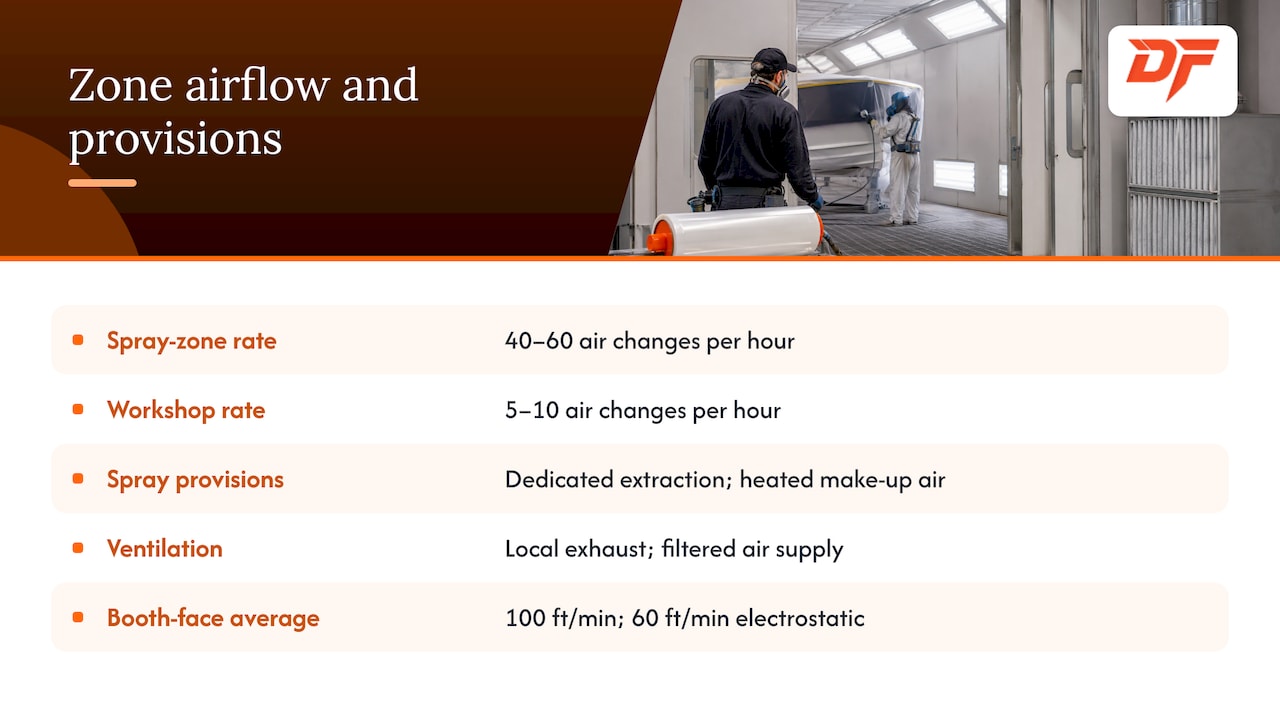
Pressure balance is the next lever. The NAFA and ATL Filtration 2023 spray finishing guideline states that intake filters reduce the dirt entering the spray chamber and the imperfections it causes. It also says that make-up air slightly exceeding exhaust lessens unfiltered air entering through cracks. The same document notes that OSHA requires a means to keep airflow at or above 100 feet per minute average across the booth face, or 60 for electrostatic operations.
An industrial ventilation design text from PDH Library makes two further points. A downdraft configuration gives a cleaner paint job than crossdraft, and exhaust air should not be recirculated while painting. It also warns that outside dust often enters through cracks and damages the finish.
Large hulls and temporary enclosures
Many yards paint inside tents or shrouded scaffolding rather than a fixed booth. Jotun’s yachting technical guide says that for large-yacht topcoating the ventilation should run overnight to clear airborne dust, optionally checked with UV lights at night. The Maine Department of Environmental Protection’s marine painting guide calls for containment with drop cloths or tarps and limits outdoor painting to calm winds or the use of shrouds and wind curtains.
Filters: fit and efficiency
Filters fail at the edges more often than in the media. The NAFA and ATL guideline warns that overspray filters must be installed with no air gaps between filters or along the bank edges. Bypassed air can contaminate parts outside the booth and drive rework and scrap costs. In abated booths the final stage may need 95% ASHRAE or MERV 15 efficiency.
The same guideline makes a point purchasing managers should hear: filters are often chosen on purchase price alone, yet less efficient filters let more particulate through and raise maintenance, cleaning and repair costs. Compare filters on efficiency over their useful life.
Cheap paper is a trap in both directions. The Awlgrip guide names paper fibers from cheap filters and brown masking paper as contamination sources, so the cheapest consumables can cost the most in defects. The Maine DEP guide also expects filters on paint booth exhaust vents and monthly inspection of those vents under the facility’s stormwater plan.
Controlling dust during sanding and preparation
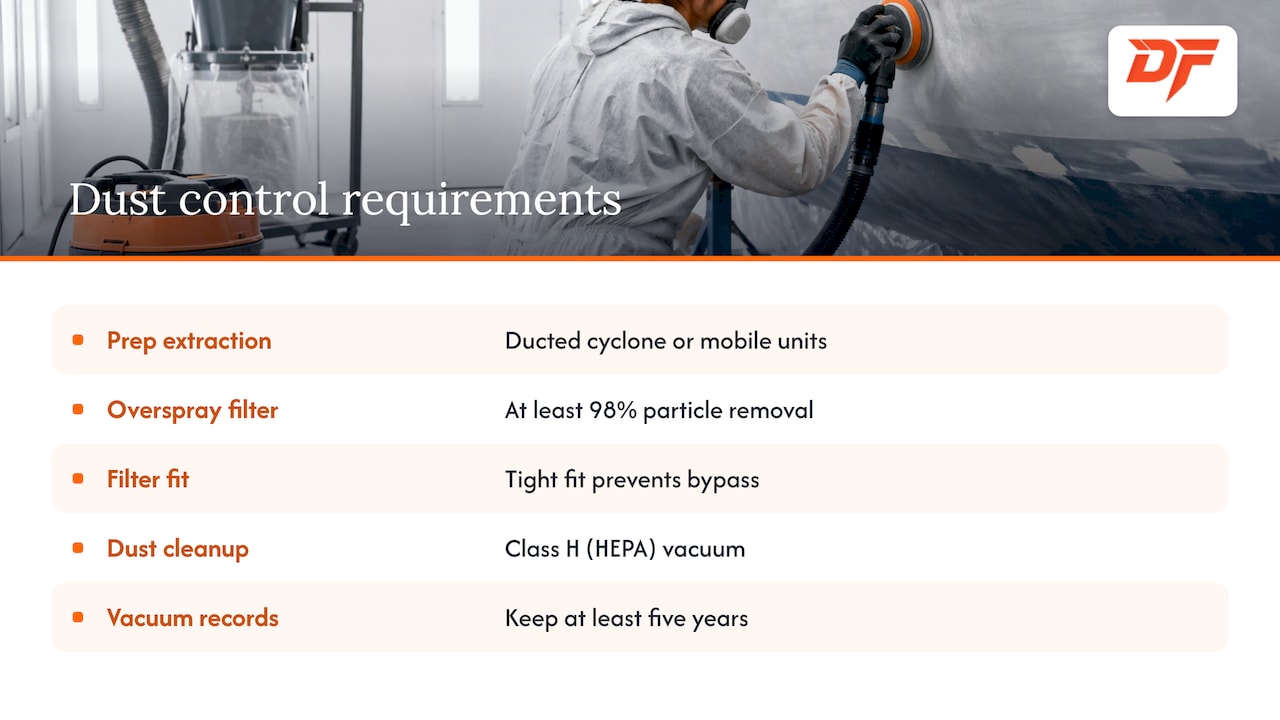
Sanding is where most shed dust is made. Keep it out of the painting area wherever the layout allows, and capture it at source. Brisbane City Council’s environmental guide for surface coating expects dust extraction in preparation areas, such as ducted extraction with a cyclone filter or enough mobile units. It also expects overspray filters that remove at least 98% of overspray particles and fit tightly to stop bypass.
For operator safety, the UK Health and Safety Executive’s guidance on preparing surfaces for painting requires a Class H (HEPA) vacuum for dust clean-up. It also calls for a competent person to examine it for airtightness, filter damage and filtration efficiency, with records kept for at least five years. US readers should check OSHA and local rules for their own requirements. Equipment that holds dust tightly protects both people and finish.
Material handling counts too. Hull surfaces should not arrive at the shed carrying grime from the yard. Hull cleaning steps and timing shows how routine cleaning keeps contamination from building up on the surface before coating work begins.
Wood and mixed-material jobs
If wood is part of the job, the Awlgrip guide’s timber section is a good model. It calls for wood that is clean, dry and smooth with moisture content below 14%, vacuumed along, across and along the grain until a white rag shows no sanding dust. Final sanding should be no finer than P120, followed by degreasing with the two-rag method and handling only with clean gloved hands before priming.
Cleaning between coats
A fixed sequence beats improvisation. Combining Jotun’s and Awlgrip’s guidance, it runs as follows:
- Blow down and vacuum. The Awlgrip guide prescribes compressed-air blow-down followed by vacuum. In enclosed areas Hempel prefers vacuuming because blowing or extraction risks drawing in contaminated or humid outside air.
- Two-cloth solvent wipe. A solvent-wet cloth followed immediately by a dry one, in areas of about 1 m², using clean lint-free cloths only.
- Tack cloth just before the coat. Use a high-quality tack cloth with gentle 2 to 3 bar (30 to 45 psi) air before application, as the Awlgrip guide describes.
- Dust absorption coat for tents and enclosures. Jotun describes spraying a light coat of clear topcoat on tent sides, ceiling and masking, and a heavy coat on the floor. Leave it for 30 minutes so airborne dust settles into the tacky paint before the real topcoat goes on.
Two cautions apply. Hempel notes fresh-water washing is only suitable where water will not affect the surface. And Nippon Paint Marine’s paint guide recommends air temperatures of 10 to 30°C and steel temperature at least 3°C above dew point, so confirm conditions before you commit a coat.
The walls and floor: where booth film earns its place
Everything above treats the shed as a clean container. In practice the walls and floor are large surfaces that collect overspray, sanding fallout and loose dust, and Axalta’s manual names spray dust accumulated on booth surfaces as a cause of dirt inclusions. Cleaning those surfaces between jobs takes time and stirs dust back into the air. Dry-sweeping and blow-down can lift dust that then settles on wet paint.
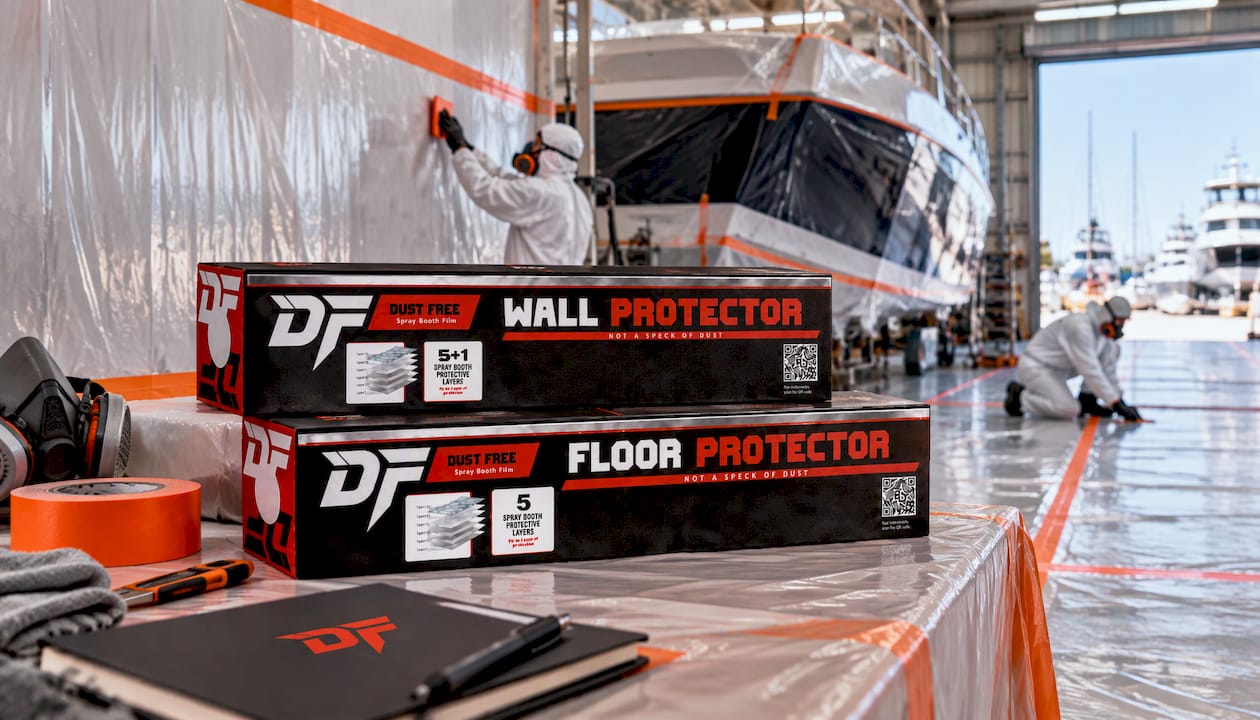
This is the job our films do. Our Wall Protector and Floor Protector are multi-layer films with electrostatically charged surfaces that attract and retain contamination. Each has removable layers, so an operator exposes a fresh surface without reinstalling the whole system. The Wall Protector is slightly tacky for stronger particle capture. The Floor Protector is heavy-duty with a slip-resistant surface for demanding work areas. Both resist operating temperatures up to 80°C.
Installation is where a lining system succeeds or fails in daily use, so we designed that too. The patented application box has a freely rotating roll, reinforced wooden sides and an integrated metal cutting bar. One installer steadies the box with a foot and dispenses a straight line. Edges overlap without tape, layers are numbered so you can see which one is exposed, and length markings are printed on the film.
The Awlgrip guide warns that cheap masking paper sheds fibers. A purpose-made film with taped-free overlaps removes both the paper and the tape from the walls. For a yard that paints inside a shed or tent, that is one fewer fiber source to chase.
Checking that it works
Do not aim for zero dust. Hempel’s technical team stresses that the practical goal is limiting dust to levels that will not harm coating performance, and that dust limits should be agreed in the specification before the project starts. Hempel says dust quantity and size are assessed under ISO 8502-3 with pressure-sensitive tape pressed on the surface and viewed against a contrasting background.
A workable verification routine for a yard:
- Tape-test the surface before each coat on a repeating sample area and record the result against the agreed limit.
- Log rework by cause: dirt inclusion, fibers, fisheyes. Trends show whether airflow, filters or surface cleanliness need attention.
- Inspect filter banks for gaps and loading on a fixed schedule, and keep the records.
- Note which walls or floor zones show the heaviest buildup, and refresh those surfaces first.
Fortified Oceanic’s boat paint failure guide observes that contamination is the leading cause of boat paint failures. That matches the logic of tracking rework by cause.
What the film does for your operation
For a facility or purchasing manager, the case rests on time and consistency. Removing a layer is faster than cleaning a whole wall, and a fresh, tacky or charged surface captures dust where bare walls release it. Our films are made in Greece, we ship worldwide VAT-free, and we support bulk orders, custom configurations and private-label production. Customers buy through regional partners or direct from the factory.
For more on booth routines, see our guides on paint booth dust control methods, how to maintain a clean booth environment and preventing paint defects from dust.
Equip your shed with the 5-layer system
If you are lining a marine paint shed, start with the 5-Layer Spray Booth Wall Protector and the 5-Layer Spray Booth Floor Protector. Tell us the dimensions of your shed and your order volume, and we will configure rolls and application boxes for it. You can also reach us through the Dust Free Film site.
Our view from the factory
Most yards fight dust at the filter and the cloth, and those matter. But the shed itself is the largest surface in the room, and it is usually the least managed. Walls and floors collect everything the process throws off, then give it back at the worst moment.
We built our films around one idea: make the surface do the work. Electrostatic layers hold contamination, removable layers give you a fresh surface in minutes, and a dispenser box lets one person install a straight, tape-free line. Less time cleaning, less dust returning to the air, fewer coats lost to a stray particle.
If your rework log shows dirt inclusions, look at what the walls and floor are doing before you buy another filter.
Pavlos - Angelos Filippakis
FAQ
Can marine paint be used on wood?
Yes, with correct preparation. The Awlgrip timber procedure requires clean, dry wood below 14% moisture content, vacuumed until a white rag shows no sanding dust, and final-sanded no finer than P120. Degrease with the two-rag method and prime before topside paint.
How many air changes does a marine spray area need?
Boatyard Manager’s layout guide specifies 40 to 60 air changes per hour for spray painting with dedicated extraction and heated make-up air. General workshop areas need only 5 to 10. Check local codes and your booth manufacturer’s data for the figure that applies to your facility.
Is positive or negative pressure better for dust control?
Neutral to slightly positive pressure keeps unfiltered outside air from entering through cracks, according to the NAFA and ATL guideline. Negative pressure can draw dust in during drying. Balance it with filtered make-up air and check filter fit for gaps.
What is a dust absorption coat?
It is a light coat of clear topcoat sprayed on tent sides, ceiling and masking, with a heavy coat on the floor. Jotun’s guide has it left for 30 minutes so airborne dust settles into the tacky paint before you apply the real topcoat.
Sources
- Awlgrip application guide
- Hempel, Inspection prior to painting
- Axalta Paint Defects Manual
- Boatyard Manager, workshop layout guide
- NAFA and ATL Filtration, 2023 spray finishing guideline
- PDH Library, industrial ventilation design
- Jotun yachting technical guide
- Maine DEP, marine painting guide
- Brisbane City Council, surface coating guide
- UK HSE, preparing surfaces for painting
- Nippon Paint Marine paint guide
- Fortified Oceanic, boat paint failure guide