
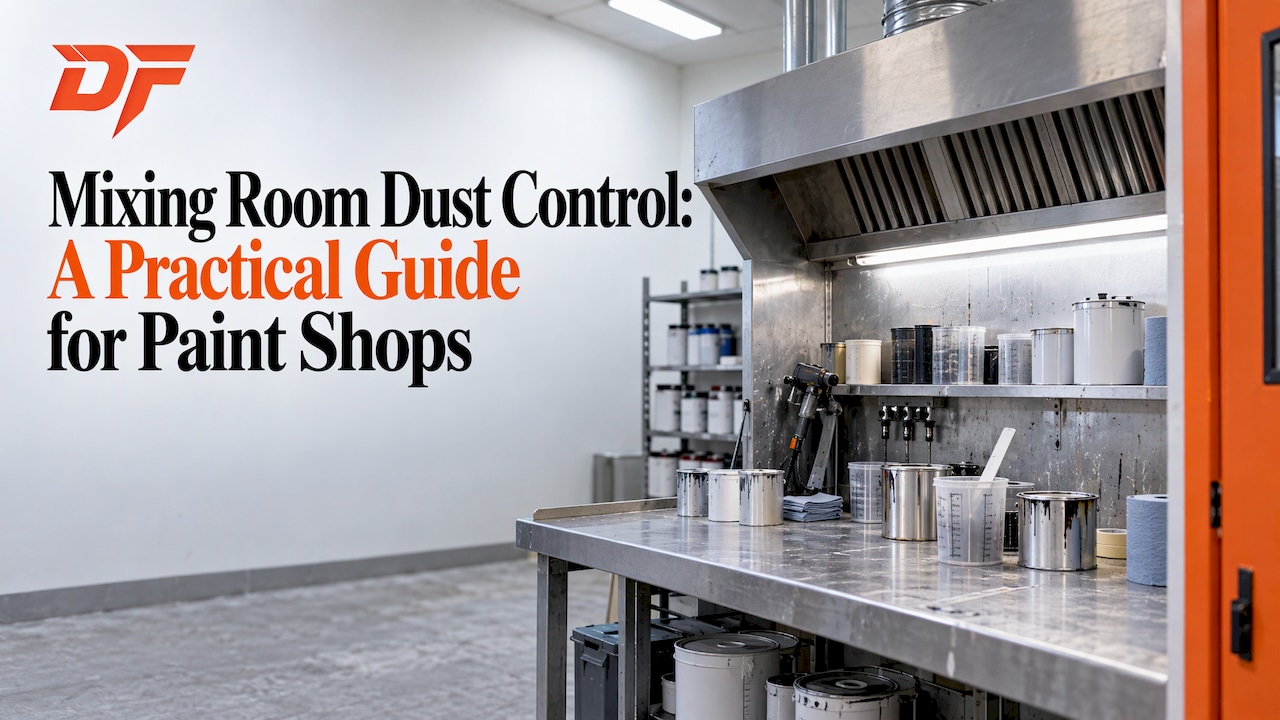
Dust control in a mixing room comes down to three things: keep particles from entering, keep them from being generated by your own handling, and stop whatever does get in from settling where it will later land on a wet panel. The mixing room is where the problem starts, but the paint booth is where it shows up as nibs, seeds and rework. The most reliable shops treat the two as one system, and protect the booth’s walls and floor with a surface that captures contamination instead of recirculating it. That is the job of our multi-layer Wall Protector and Floor Protector films.
This guide is for shop owners, paint-shop managers, facility and EHS managers and technicians who want fewer defects and less cleaning downtime.
TL;DR
- Most mixing-room dust comes from a short list: container tops, rags and cardboard fibers, dried paint and tint, rust and grinding metal. Remove those sources first.
- Separate and seal the room, keep doors closed, and use local exhaust close to the work with make-up air on the opposite side.
- Handle paint so dust cannot fall in: cover vessels, store mixing cups upside down, strain material, clean with HEPA vacuums rather than brooms.
- Change filters by manometer reading, not by how they look, and log defects so you can see whether any of this works.
- Protect the booth surfaces next to the mixing room with an electrostatic wall and floor film so settled dust is held, not re-released.
Table of Contents
- Where mixing-room dust actually comes from
- Separate the room and keep the air balanced
- Ventilation and filtration that work with the room
- Handling habits that keep dust out of the can
- A cleaning and filter routine you can actually keep
- Don’t stop at the mixing room: protect the booth surfaces
- Prove it is working
- Our approach to dust, in one place
- Perspective
- FAQ
- Sources
Where mixing-room dust actually comes from
Before buying anything, list the sources. PPG’s contamination-prevention training for its coatings suppliers names the usual particulate sources: dirt and debris from the environment and from container tops, rust from solvent pipes or tanks, cellulose fibers from cotton mops, rags, cardboard and wood, dried paint, tint paste or resin, and metal from grinding. The same document notes that particles can force a customer to sand a vehicle or reject it, which is exactly the rework cost a body shop wants to avoid.
A coatings-maker troubleshooting guide adds mixing-specific causes: dust on a can lid falling in when it is opened, mixing blades scraping the container wall, and hardener setting up in poorly resealed containers. It also lists environmental causes that apply to any finishing area: static charge from blowing off with compressed air in low humidity, dust dropping from gaps between doors and frames, and fibers from ordinary tissues and paper rolls.
A quick audit of your own room against that list usually turns up three or four items you can fix this week at almost no cost:
- Cardboard boxes and wooden pallets stored inside the room
- Cotton rags and paper towels used for wipe-down
- Open or dusty can tops, and dried tint around dispensers
- Grinding or sanding done on the other side of a door that does not seal
Separate the room and keep the air balanced
A mixing room that shares air with the sanding bay will never stay clean. Aviva’s property loss-prevention standard says mixing should be in a detached building or a dedicated room with at least 90 minutes of fire resistance, ideally on an external wall, with windows and doors kept closed during mixing. That standard is written for fire safety, but the same enclosure is your first dust barrier.
A few layout rules follow from it and from dust-control practice:
- Define a dirty side and a clean side. Sanding, grinding and unpacking belong outside the mixing room. Only what is needed for the job comes in.
- Seal gaps and manage entries. Door sweeps, sealed wall penetrations and a sticky mat at the entry cut the dust carried in on shoes and carts.
- Keep doors closed. Insufficient supply air to the booth means that opening a building door can disturb room pressure and pull indoor or outdoor dust toward the booth. Mixing rooms and booths are connected by pressure whether you plan for it or not.
- Choose easy-to-clean finishes. Smooth walls and floors with no ledges give dust nowhere to hide. Aviva also calls for slip-resistant, anti-static, earthed flooring and spill containment in the mixing room.
One safety note belongs here. Aviva’s standard requires mixing-room extraction to be dedicated to that room and never manifolded to spray booth or other mixing-room systems, because connected systems can carry flammable vapors between fire compartments. Do not solve a dust or pressure problem by tying ducts together.
Ventilation and filtration that work with the room
The US EPA’s best-practices sheet for the mixing room states that inadequate ventilation is common and a serious health and safety risk. Its recommendation is a well-designed system or a prefabricated mixing room, with vapor-generating materials and equipment placed in front of or near an exhaust outlet, such as a hood behind the mixing table. The same sheet says all electrical equipment in the room, including switches, fans and lights, should be approved for Class I, Division 1 hazardous locations. That is a code and safety matter for your electrician and local fire authority.
Massachusetts’ guidance describes local exhaust close to the work, ideally sideways or downdraft, ducted to outside, with the fan downstream, make-up air opposite the exhaust and low-level exhaust vents. Capturing at the source matters for dust too. The UK Health and Safety Executive’s guide to local exhaust ventilation explains that control is most effective close to the source, where the contaminant cloud is smaller and easier to intercept.
Aviva’s standard gives design numbers if you are specifying a new room: air inlets at high level, forced extraction within 300 mm (about 12 inches) of the floor covering the mixing and pouring points, and fans that run for at least 15 minutes before and after mixing, with low-flow alarms. Ask your installer how the room meets the codes that apply where you operate.
Two practical points for dust:
- Run the extraction whenever anyone is in the room. A generic booth manual on file with the City of Portland, Maine says mixing-room exhaust fans should operate while anyone is working there, and some locales require continuous operation.
- Keep ducts clean. Aviva asks for direct runs with few gradual bends, since bends increase paint deposits, and for inspection hatches along the whole route so the duct can be checked and cleaned.
Handling habits that keep dust out of the can
Even a well-ventilated room fails if the handling is careless. The rules are simple and cheap:
- Cover vessels while mixing and filling, and put a lid on a mix container if you step away. PPG’s training also advises covering equipment before any overhead maintenance and keeping doors closed where possible.
- Store mixing cups upside down so dust and dirt cannot collect inside, as the mix-room best-practices guide advises.
- Wipe can tops before opening and keep a dedicated lint-free wipe for it.
- Strain material through a metal mesh filter. The Portland manual recommends mesh over cheesecloth, and also starched overalls to keep lint off painted surfaces.
- Never blow off with compressed air in or near the room. It charges surfaces and lifts settled dust.
- Mix powders and dry pigments under local exhaust. The IATSE paint department guidelines advise mixing powders in a powder room, booth or downdraft table with local exhaust to minimize airborne generation.
Our own write-ups on reducing paint contaminants and automotive painting best practices for dust-free finishes go deeper on technician habits in the booth.
A cleaning and filter routine you can actually keep
Dust control fails most often through inconsistency. Put the routine on a visible sheet, and assign names.
Daily
- Vacuum floors and horizontal surfaces with a HEPA (P100) vacuum. The IATSE guidelines say to clean daily, more often when it is very dusty, and to limit sweeping because it puts dust back in the air. Wet mopping or dust-suppressing material also helps.
- Clean up spills and remove old or excess materials.
- Check the manometer (draft gauge) and inspect filters for damage or buildup.
Filters
Change them by gauge, not by eye. A mixing-room manufacturer’s maintenance manual states that filters should be changed when the manometer scale passes the red flag, not judged by appearance, because life depends on media, paint, gun distance and pressure. The Portland booth manual uses a different trigger for exhaust filters, a differential 0.5 inches above the starting point. Use whichever number your equipment manufacturer specifies, and write it on the gauge.
Periodic
- Scrape overspray daily or as it accumulates, with a non-ferrous, non-sparking scraper.
- Replace door gasket material as needed, since worn gaskets let dust in.
- Follow the manufacturer’s schedule for belts, latches and fans; the Prowood manual lists two-monthly and six-monthly items.
Don’t stop at the mixing room: protect the booth surfaces
A mixed batch travels to the booth. Whatever dust is in the air or on the walls and floor there is the dust that lands on the clear coat. This is where a protective film earns its place in a dust-control plan.
Our Wall Protector and Floor Protector are multi-layer films with electrostatically charged surfaces that attract and retain contamination. When a layer is loaded, the operator removes it and exposes a fresh surface without reinstalling the whole system. The wall film is slightly tacky for stronger particle capture. The heavy-duty floor film has a durable, slip-resistant surface for demanding work areas. Both have tape-free overlapping edges, visible layer numbering and integrated length markings, and resist operating temperatures up to 80°C.
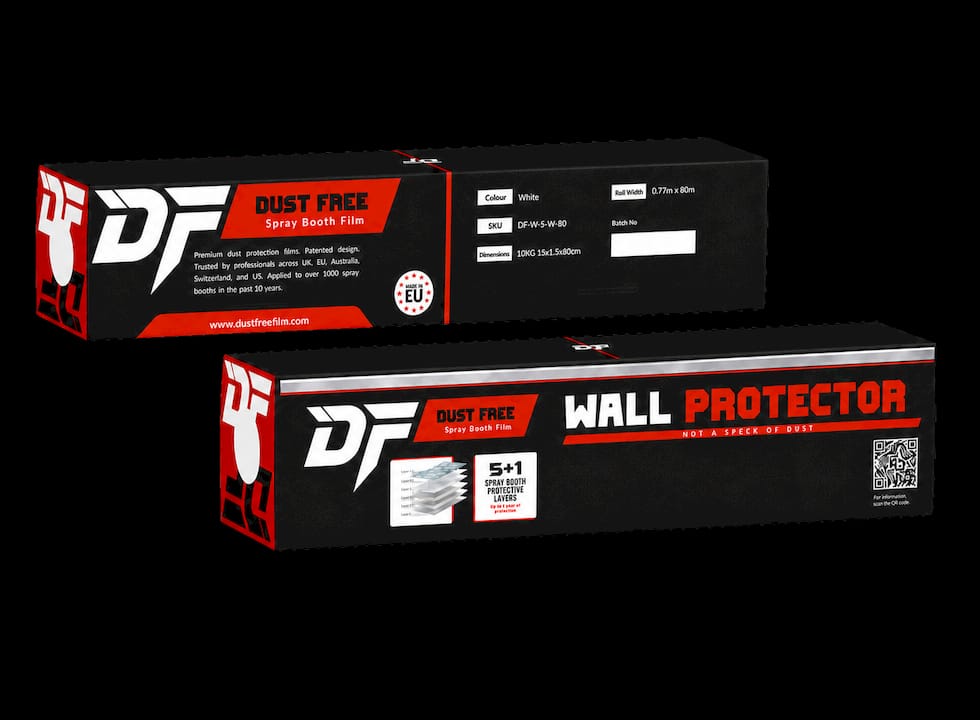
Installation matters because a poorly fitted film is another source of loose material. Our patented application box has a freely rotating roll, reinforced wooden sides and an integrated metal cutting bar, so one installer can steady the box with a foot and dispense the film in a straight line.
If waterborne systems are part of your process, our guide to waterborne paint dust control in the spray booth covers it, and paint booth dust control methods gives the wider booth picture.
Prove it is working
A control measure you cannot measure becomes a habit nobody defends. Keep it simple:
- Log every dirt defect. Record job, booth, date, painter and defect type (dirt nib, fiber, crater). After a month you will see whether defects cluster in one booth, one shift, or after a filter change.
- Track rework hours. Sanding and polishing time spent on dirt, per week, is the number an owner understands.
- Track cleaning downtime. Note the hours the booth is down for wall and floor cleaning. A surface you refresh by removing a layer should shorten this.
- Check the equipment. Read manometers daily, and confirm airflow under load after any filter or fan work.
- Change one thing at a time. If you alter the entry mat, the filter schedule and the wall surface in the same week, you will not know which one helped.
Review the log monthly with the painters. They know which jobs get dirty.
Our approach to dust, in one place
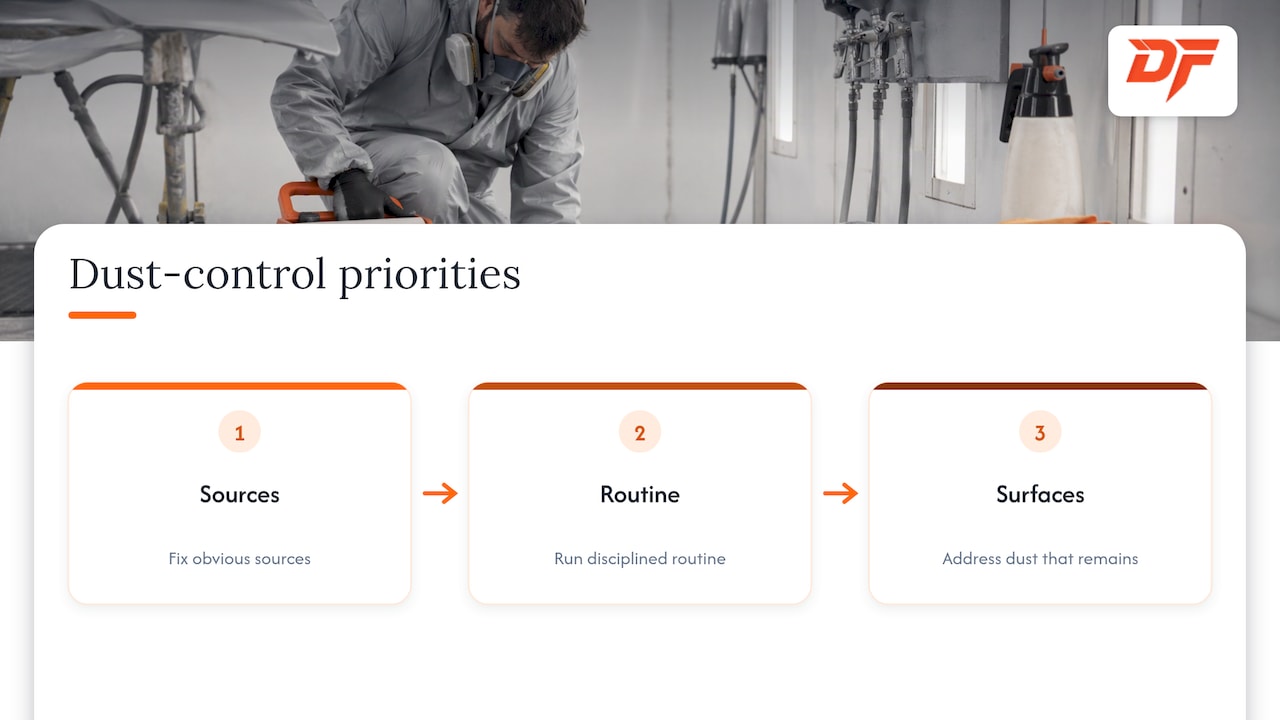
The mixing room and the booth are linked by air, people and materials. If you ask us where to start, we say: fix the obvious sources, run a disciplined routine, and make sure the surfaces around the finish are doing something useful with the dust that remains. Our films are manufactured in Greece, and you can buy through regional partners or directly from the factory, including bulk orders, custom configurations and private-label production, with worldwide shipping.
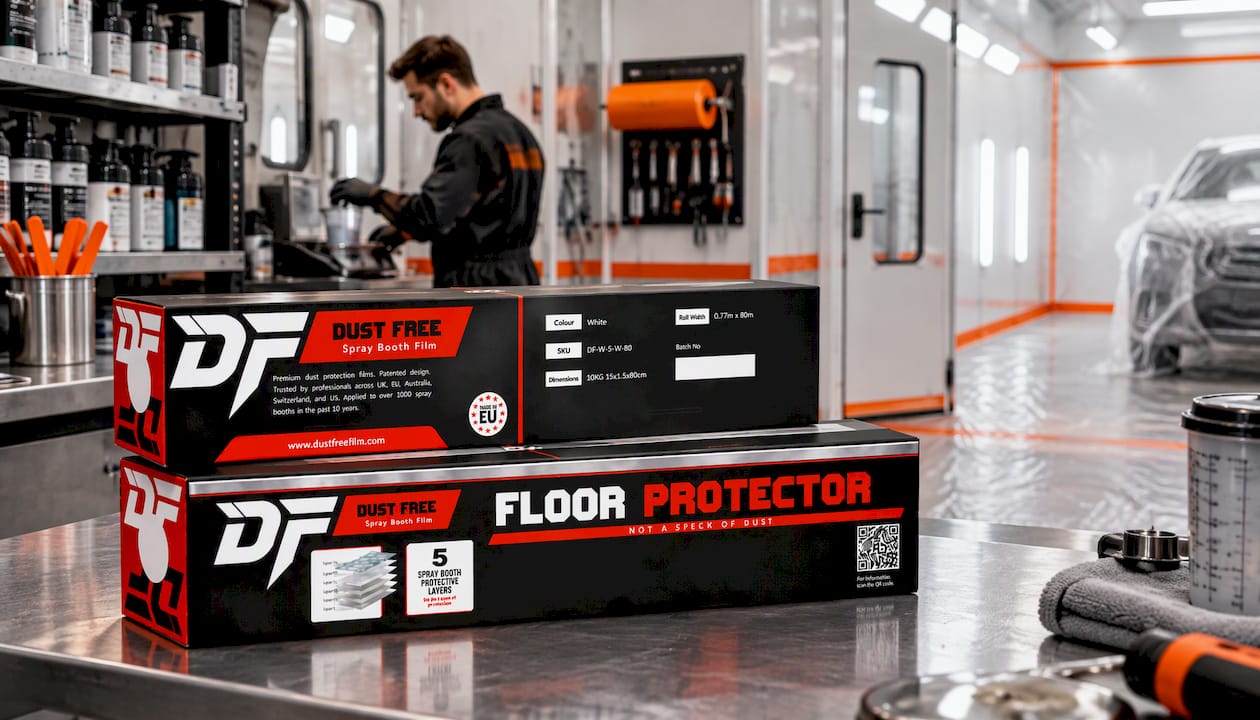
For the film that suits your booth walls, see our 5-layer spray booth wall protector. For the floor, see the 5-layer spray booth floor protector. Reach us through Dust Free Film for a quote.
Our guide on smart dust control strategies for auto shop finishes shows how to sequence these upgrades.
Perspective
We started Dust Free Film in 2012 because we saw that most shops fought dust with effort rather than with design. People mopped, wiped and blew down walls, and the dust went back into the air.
Our view is that every surface in a finishing area should either be clean or be a surface that holds dust. That is why our Wall Protector and Floor Protector have electrostatic layers, and why the wall film is slightly tacky. The dust that arrives is captured and kept, and when a layer is loaded you take it off and the next one is ready.
We also think installation has to be easy enough that it gets done properly. A film that takes two people and a roll of tape tends to be put up late, or not at all. So we built the application box so one person can dispense it straight, and we made the edges overlap without tape.
Mixing-room discipline and booth surfaces work together. The first reduces what enters the air, the second deals with whatever remains.
Pavlos - Angelos Filippakis
FAQ
What is the biggest source of dust in a paint mixing room?
There is rarely a single one. Typical sources are dirt on container tops, fibers from rags, cardboard and wood, dried paint or tint, rust and metal from grinding. Start by removing cardboard, cotton rags and open containers from the room, then look at where the air comes in.
Should the mixing room be under positive or negative pressure?
That depends on your layout, your local fire code and the equipment manufacturer’s design. Mixing rooms have vapor-extraction requirements, and extraction must not be connected to the booth system. Have the installer and your local authority confirm the airflow design, and keep doors closed so the balance holds.
How often should mixing-room filters be changed?
Use the manometer. Manufacturers set a gauge reading, such as the red flag on the gauge, at which filters must be changed, since appearance is not a reliable guide. Inspect filters daily for damage and check the gauge at the same time.
How do I keep dust off the walls and floor near the mixing room and booth?
Vacuum with a HEPA (P100) vacuum instead of sweeping, avoid compressed-air blow-off, and cover walls and floors with a surface that holds dust. Our electrostatic Wall Protector and Floor Protector are made for that, and a loaded layer is removed to reveal a fresh one.
Does a better mixing room really reduce rework?
It removes some of the particles that end up in the paint, which PPG’s training says can force sanding or rejection of a vehicle. Track dirt defects and rework hours before and after changes to see the effect in your own shop.
Sources
- PPG Automotive Coatings contamination prevention training
- Kaken Tech, troubleshooting for painting process
- Aviva, Paint Mixing Operations property standard
- US EPA, Best Practices for the Paint Mixing Room
- Mass.gov, Paint Mixing Room Guidelines and Best Practices
- UK HSE, HSG258 Controlling airborne contaminants at work
- Portland, Maine spray booth manual
- Best Practices in the Mix Room
- IATSE Local 891 Paint Department Health and Safety Guidelines
- Prowood Finishes, Paint Mixing Rooms installation and maintenance manual