

TL;DR:
- Modular spray booth construction uses prefabricated panels to quickly create compliant painting environments. It reduces installation time to days, offers flexibility, and maintains high paint quality. Proper site preparation and adherence to safety standards are essential for successful operation and future relocations.
Modular spray booth construction is defined as the assembly of prefabricated, standardized panels and components to create a compliant, customizable painting environment. Unlike stick-built alternatives, this method uses factory-made wall, ceiling, and door assemblies that bolt together on-site, cutting installation time from weeks to days. Facility managers and construction professionals choose this approach because it meets OSHA and NFPA standards out of the box while supporting future expansion or relocation. Dustfreefilm has worked with auto body shops and industrial painting facilities since 2012, and the pattern is consistent: modular construction reduces downtime, controls costs, and keeps paint quality high from day one.
What is modular spray booth construction and how does it work?
Modular spray booth construction is the process of assembling factory-built panels into a fully functional, code-compliant spray booth on-site. Each panel arrives pre-engineered to specific dimensions, so crews connect them like a three-dimensional grid rather than building from raw materials. The result is a controlled painting environment that meets industrial safety standards without the lead time of custom construction.
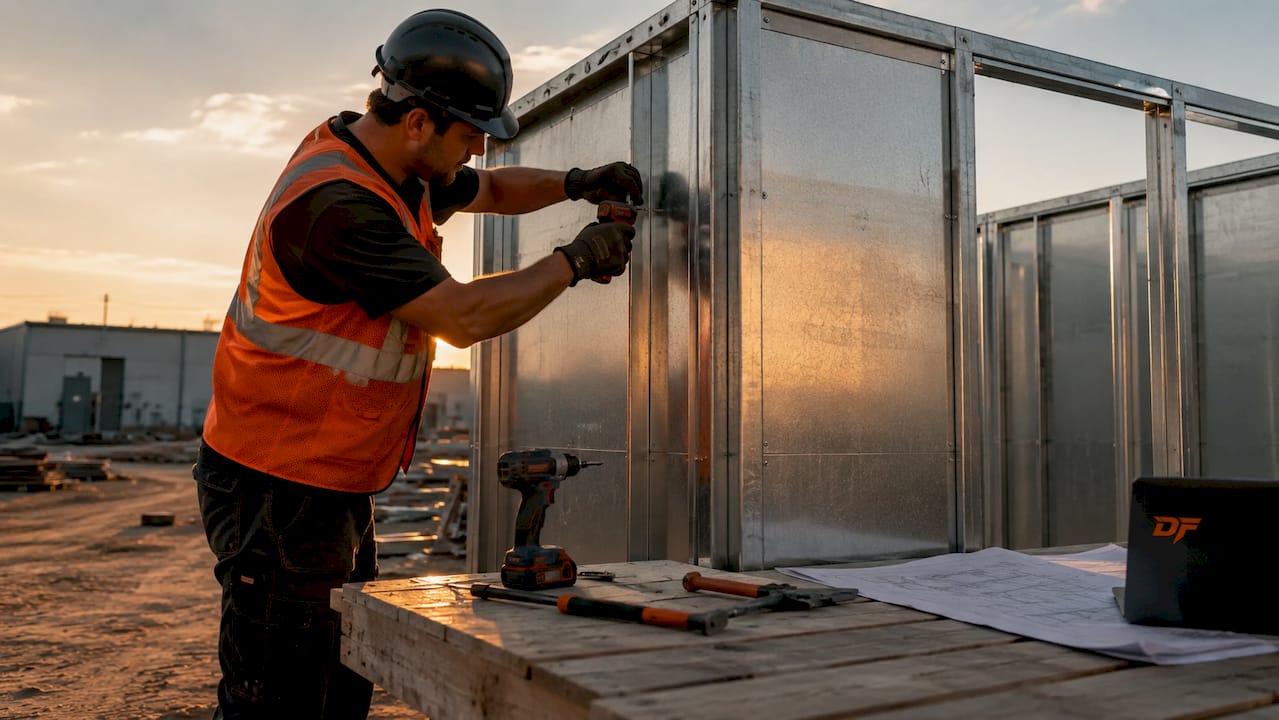
The core advantage is speed. Installations complete in days, not weeks, which means production lines stay running longer during facility upgrades. For a busy auto body shop or a manufacturing plant mid-expansion, that difference in downtime directly affects revenue.
Modular systems also use a “standardized kit of parts” approach, but remain highly customizable for HVAC, lighting, and entry configurations. That combination of speed and flexibility is why modular spray booth design has become the default choice for facility managers who need compliance without construction delays.
What are the main components and materials used?
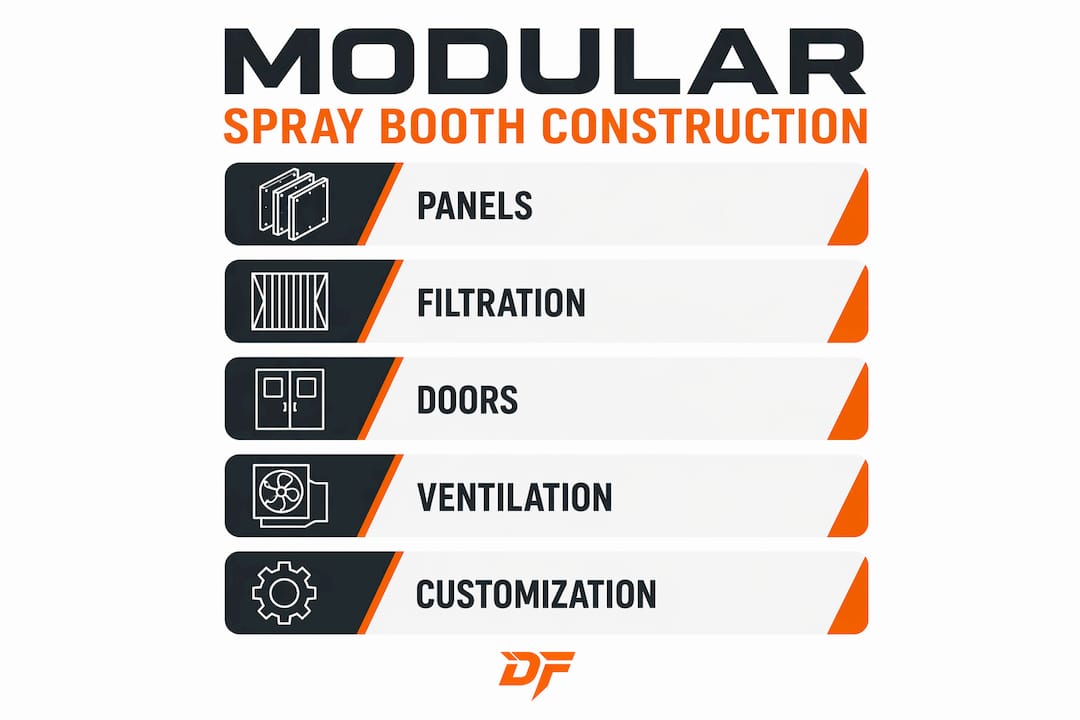
The structural backbone of any modular spray booth is its panel system. Panels are typically fabricated from galvanized steel or other non-combustible metals, and 2026 safety standards set strict thickness limits: single-skinned panels must be ≤ 0.05 inches and double-skinned assemblies must be ≤ 0.035 inches. These limits exist to control fire risk in environments where flammable coatings are present.
Structural panels and surfaces
Wall and ceiling panels form the sealed enclosure. Booth surfaces must be smooth and easy to clean to prevent overspray residue from building up and contaminating future paint jobs. Rough or porous surfaces trap particles, which then fall onto wet finishes. Smooth, cleanable walls are not just a convenience. They are a quality control measure.
Filtration and ventilation components
Every modular spray booth requires an intake filter system, an exhaust filter bank, and a fan assembly. These components manage airflow direction, pressure, and particle capture. The specific configuration depends on the airflow type selected, which is covered in detail in the ventilation section below.
Door and access assemblies
Modular booths use standardized door frames that seal against the panel grid. Proper door sealing is critical because gaps allow unfiltered air to enter, disrupting pressure balance and introducing contaminants. Most modular paint booth features include sliding or bi-fold doors sized for the vehicles or parts being painted.
| Component | Material standard | Function |
|---|---|---|
| Wall panels | Non-combustible metal, ≤ 0.05 in. | Structural enclosure, fire resistance |
| Ceiling panels | Non-combustible metal, ≤ 0.035 in. | Sealed overhead surface |
| Intake filters | Fiberglass or polyester media | Captures incoming airborne particles |
| Exhaust filters | High-efficiency media | Traps overspray before exhaust |
| Door assemblies | Sealed metal frames | Pressure containment, access control |
Pro Tip: Specify panels with a factory-applied interior coating rather than field-painted surfaces. Factory coatings bond more uniformly, resist solvent exposure longer, and maintain the smooth surface needed for clean finishes.
How does modular construction improve installation speed and flexibility?
Prefabrication is the reason modular spray booth installation outpaces conventional construction on every timeline. Panels are cut, drilled, and finished at the factory, so on-site work is assembly only. No welding, no custom framing, no waiting for concrete to cure around embedded supports.
The practical steps for a typical installation follow a clear sequence:
- Site preparation. Level the floor, confirm utility rough-ins, and mark the booth footprint.
- Panel delivery and staging. Panels arrive labeled and sequenced for assembly order.
- Structural assembly. Crews connect wall and ceiling panels using manufacturer-specified fasteners and sealants.
- Mechanical installation. HVAC, lighting, and electrical connections are made at pre-engineered ports.
- Sealing and pressure test. All seams are sealed and the booth is tested for pressure consistency before use.
Flexibility extends well beyond the initial build. Modular systems reduce capital loss by allowing facilities to expand, reconfigure, or relocate booths as production needs change. A shop that starts with a single-car booth can add a second bay by purchasing additional panel modules rather than building a new structure. That scalability is the primary reason industry experts favor modular systems for growing operations.
Pro Tip: Document the panel layout and fastener torque specs during installation. That record cuts reassembly time significantly if you relocate the booth within five years.
What are the airflow and ventilation design considerations?
Airflow design is the most technically demanding part of modular spray booth construction. Three configurations are standard in industrial painting environments:
- Pressurized cross-flow: Air enters from one end and exits the opposite end. This is the most common configuration for smaller booths and retrofit installations.
- Down-draft: Air enters through ceiling filters and exits through floor-level exhaust plenums. Down-draft produces the cleanest finish because airflow carries overspray away from the painted surface rather than across it.
- Semi-down-draft: A hybrid where air enters from the ceiling at the front and exits through low side-wall exhaust ports. Used when full floor plenums are not practical.
Seam integrity directly affects airflow performance. Sealing panel joints correctly maintains both cleanliness and pressure balance. A single unsealed seam can drop booth pressure enough to pull unfiltered shop air inside, which deposits dust on wet paint and forces a rework cycle.
Proper airflow management in a modular spray booth is not just about finish quality. It is a worker safety requirement. OSHA and NFPA ventilation standards exist because solvent vapors accumulate rapidly in enclosed spaces. A booth that maintains correct positive pressure and exhaust velocity keeps vapor concentrations below the lower explosive limit, protecting both the operator and the facility.
Dustfreefilm’s guidance on spray booth air quality covers the direct relationship between pressure management and finish defects, which is worth reviewing before finalizing your ventilation design.
How do regulatory compliance and safety standards shape modular booths in 2026?
Compliance is not optional, and modular construction does not automatically satisfy every requirement. Most modular booths meet NFPA and OSHA standards by design, but the Authority Having Jurisdiction (AHJ) must still review and approve each installation. That approval process includes hazardous exhaust calculations and fire suppression system documentation.
Key regulatory requirements for 2026 modular spray booth construction include:
- Non-combustible materials. All panels, ceiling assemblies, and door frames must meet non-combustible or limited-combustible classifications.
- Thickness limits. Single-skinned walls ≤ 0.05 inches; double-skinned assemblies ≤ 0.035 inches per current standards.
- Ventilation compliance. OSHA 1926.66 governs hazardous spray operations, including exhaust velocity and air change rates.
- Fire suppression integration. Booths must include suppression systems sized for the enclosure volume and the flammability class of coatings used.
- Safety exits and barriers. Emergency egress must be unobstructed and clearly marked per NFPA 101 life safety requirements.
- AHJ documentation. Submit panel specifications, ventilation calculations, and suppression system designs before installation begins.
Modularity does not exempt booths from fire and safety codes. AHJ approval requires the same documentation as a custom-built booth. Facilities that skip this step face stop-work orders, fines, and potential insurance voidance. Engaging a qualified industrial safety engineer before ordering panels prevents those outcomes.
For facilities operating under industrial coatings regulations, protective coatings compliance frameworks from industrial safety specialists provide useful context on material classification and documentation requirements.
| Regulation | Requirement | Applies to |
|---|---|---|
| OSHA 1926.66 | Exhaust velocity, air change rates | All spray operations |
| NFPA 33 | Construction materials, fire suppression | Spray booth enclosures |
| NFPA 101 | Emergency egress, exit marking | Occupied spray booths |
| AHJ approval | Site-specific documentation | Every installation |
What practical steps ensure successful installation and maintenance?
Successful modular spray booth installation starts before the first panel arrives on-site. Site preparation determines whether the booth performs as designed or requires costly corrections after assembly.
- Level the floor. A level floor is non-negotiable for correct panel alignment, door sealing, and pressure management. Even a small slope causes panel gaps that compromise airflow.
- Confirm utility rough-ins. Electrical conduit, compressed air lines, and exhaust duct penetrations must be positioned to match the booth’s engineered layout before assembly begins.
- Install utility quick-disconnects. Planning for quick-disconnects during initial installation can reduce future relocation labor costs by 30–50%. This is a low-cost decision at installation that pays back significantly on the first move.
- Seal all seams during assembly. Use manufacturer-specified sealants at every panel joint. Do not substitute generic caulk. Solvent-resistant sealants maintain their bond under the thermal cycling and chemical exposure that spray booths experience daily.
- Pressure test before first use. Run the ventilation system and verify that booth pressure matches design specifications. Correct any leaks before production begins.
Ongoing maintenance follows a straightforward schedule. Replace intake and exhaust filters on the manufacturer’s recommended cycle, inspect seams quarterly for sealant degradation, and clean interior surfaces after every production shift. Dustfreefilm’s booth protection guide details how protective wall films reduce cleaning time and extend the service life of panel surfaces between major maintenance intervals.
Pro Tip: Train every operator on the pressure gauge reading for your specific booth. Operators who recognize an abnormal pressure reading catch filter blockages and seam failures before they cause a defective finish or a safety incident.
Key Takeaways
Modular spray booth construction delivers faster installation, lower long-term costs, and built-in compliance when panels are specified correctly and sites are properly prepared.
| Point | Details |
|---|---|
| Prefabrication cuts installation time | Modular booths assemble in days, not weeks, reducing facility downtime during upgrades. |
| Material standards are strict | Non-combustible panels must meet 2026 thickness limits: ≤ 0.05 in. single-skinned, ≤ 0.035 in. double-skinned. |
| Seam sealing determines performance | Unsealed panel joints disrupt pressure balance and introduce contaminants that ruin paint finishes. |
| AHJ approval is mandatory | Modular construction does not bypass fire and safety code review; documentation must be submitted before installation. |
| Level floors are non-negotiable | Floor levelness directly controls panel alignment, door sealing, and airflow pressure across the entire booth. |
What I’ve learned from watching facilities get modular spray booths wrong
The most common mistake I see is treating modular as synonymous with simple. Facility managers order panels, schedule a crew, and assume the booth will perform correctly because it arrived pre-engineered. It will not, if the site is not ready.
Floor leveling is where most installations fail quietly. A floor that is off by a quarter inch across a 20-foot span creates panel gaps that no sealant fully compensates for. The booth runs, the pressure readings look acceptable, and then the facility wonders why finish quality is inconsistent. The answer is almost always airflow contamination from a seam that was never properly closed.
The second pattern I see is under-planning for future moves. Shops that install modular booths without quick-disconnects spend as much on the second relocation as they did on the original installation. The whole point of modular construction is retained flexibility. Spending an extra few hundred dollars on proper disconnects at installation is one of the clearest returns on investment in this industry.
My honest recommendation: engage your AHJ before you finalize the panel order, not after. The documentation requirements for NFPA and OSHA compliance shape which panel specifications you need. Starting that conversation late forces expensive substitutions or delays that wipe out the installation speed advantage entirely.
— Dust
How Dustfreefilm supports your modular spray booth investment
A modular spray booth is only as clean as its surfaces. Dustfreefilm’s wall protector films are engineered specifically for spray booth interiors, using multi-layer electrostatic technology that prevents overspray from bonding to panel surfaces. The patented dispenser system allows quick, bubble-free application, so your crew spends time painting, not scrubbing walls. Films are heat-resistant and static-free, which means they hold up under the thermal cycling that modular booths experience during production shifts. For auto body shops and industrial painting facilities that rely on modular construction, Dustfreefilm products extend panel life, reduce cleaning labor, and protect the finish quality your operation depends on. Visit Dustfreefilm to find the right protection solution for your booth configuration.
FAQ
What is modular spray booth construction?
Modular spray booth construction is the assembly of prefabricated, standardized panels and components into a compliant, customizable painting enclosure. It replaces custom stick-built construction with factory-engineered parts that connect on-site in days rather than weeks.
How long does modular spray booth installation take?
Most modular spray booth installations complete in days, compared to weeks for custom-built booths. The exact timeline depends on booth size, site preparation, and utility connection complexity.
Do modular spray booths meet OSHA and NFPA standards?
Most modular booths are designed to meet NFPA and OSHA requirements, but each installation still requires review and approval from the Authority Having Jurisdiction. Submitting panel specifications and ventilation calculations before installation is mandatory.
What airflow types are available in modular spray booths?
The three standard airflow configurations are pressurized cross-flow, down-draft, and semi-down-draft. Down-draft produces the cleanest finish because airflow carries overspray away from the painted surface rather than across it.
Can a modular spray booth be relocated after installation?
Yes, modular booths can be disassembled and reassembled at a new location. Installing utility quick-disconnects during the original build reduces relocation labor costs by 30–50%, making future moves significantly faster and cheaper.