

TL;DR:
- Paint finish quality is primarily determined by measurable process variables such as film thickness, surface cleanliness, adhesion, and absence of defects, not by visual inspection alone. Systematic testing and environmental control from substrate preparation through curing ensure durability, corrosion resistance, and consistent results across batches. Overlooking underlying process controls, especially contamination and thermal curing, often leads to long-term coating failures despite proper topcoat selection.
Paint finish quality is defined by measurable attributes including dry film thickness (DFT), adhesion strength, surface smoothness, and the complete absence of coating defects. These criteria, governed by standards like ISO 12944 and SSPC/NACE, determine whether a coating system delivers the durability and corrosion protection that automotive and industrial applications demand. Understanding paint finish quality is not a matter of visual judgment alone. It requires systematic measurement, process control, and documented verification at every stage from substrate preparation through final topcoat inspection.
What are the key measurable factors in understanding paint finish quality?
Finish quality in industrial coatings is assessed through a defined sequence of QA/QC tests, starting with surface preparation verification and progressing through wet film thickness (WFT), dry film thickness (DFT), holiday testing, and adhesion testing. Each measurement corresponds to a specific failure mode. Skip one, and you introduce a defect pathway that no topcoat can correct.

Dry Film Thickness (DFT) and Wet Film Thickness (WFT)
DFT is the single most referenced metric in coating inspection. It confirms that each coat has been applied within the specification window. Too thin, and the coating lacks corrosion resistance. Too thick, and you risk solvent entrapment, cracking, or adhesion failure between layers. WFT measurement during application gives applicators real-time feedback before the film cures, making it the earlier and more corrective of the two measurements.
Surface preparation
ISO 8501 defines cleanliness grades from Sa 1 (light blast) through Sa 3 (white metal blast). The anchor profile, measured in micrometers, must match the primer’s specification. Salt contamination on the substrate causes osmotic blistering under the film over time. Dust levels, assessed per ISO 8502-3, directly affect adhesion and film continuity.
Adhesion testing
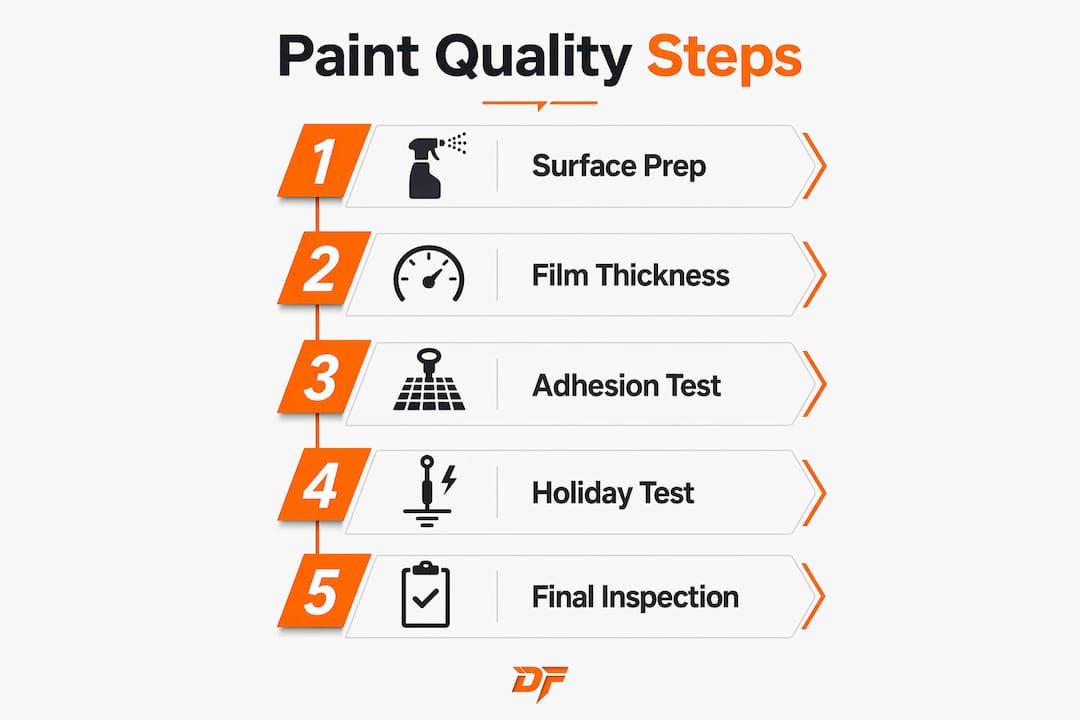
Cross-cut adhesion tests follow BS 3900 Part 6, where a GT0 rating confirms zero paint removal and strong substrate bonding. Pull-off adhesion tests quantify the force required to separate the coating from the substrate in MPa. Incompatible coatings on galvanized or non-ferrous substrates risk salt formation at the interface, which compromises the entire system’s integrity.
Holiday (pinhole) testing
Holiday testing uses low-voltage or high-voltage detectors to locate discontinuities in the film. Any pinhole in an immersion or corrosion-critical coating is a direct corrosion initiation point. This test is mandatory for tank linings, offshore structures, and any system where film continuity is a specification requirement.
| Measurement | Standard | What it confirms |
|---|---|---|
| Dry Film Thickness (DFT) | ISO 2808 | Coat thickness within specification range |
| Surface cleanliness | ISO 8501 | Blast grade and contamination absence |
| Adhesion (cross-cut) | BS 3900 Part 6 | Substrate bonding quality |
| Holiday detection | NACE SP0188 | Film continuity, absence of pinholes |
| Salt contamination | ISO 8502-6 | Absence of soluble salts on substrate |
Pro Tip: Measure WFT immediately after application on each pass. Waiting even a few minutes introduces evaporation error that makes the reading unreliable for predicting final DFT.
How do application environment and process control impact finish quality?
Environmental conditions are not background variables. They are active inputs that determine whether a coating cures correctly or develops defects. Temperature and relative humidity directly influence drying and curing times. At 20°C and 65% relative humidity, a typical high-gloss coating reaches a dust-free state in approximately two hours. Drop the temperature to 5°C and raise humidity to 90%, and that window extends to three hours or more, with recoat intervals increasing proportionally. In a production environment, this delay compounds across every coat in the system.
Process control during the spray phase covers four variables that applicators must manage simultaneously:
- Atomization pressure determines droplet size. Insufficient pressure produces large droplets that coalesce into runs and sags. Excessive pressure causes dry spray and poor film build.
- Viscosity must be adjusted to the ambient temperature. A material thinned for summer application will run at winter temperatures in the same booth.
- Nozzle selection affects fan width and flow rate. Mismatched nozzles produce uneven film thickness across the substrate.
- Gun distance and speed control overlap and film uniformity. Inconsistent technique introduces thickness variation that no inspection can correct after the fact.
Thermal curing adds another layer of process variables. Flash-off time, the period between application and oven entry, must be sufficient for solvents to escape the film. Insufficient flash-off traps solvents, which boil out during heating and create pinholes or blistering. Oven temperature uniformity across the tunnel or chamber determines whether all parts of a component cure at the same rate. Uneven heating produces uneven gloss and orange peel that is systemic rather than localized.
Pro Tip: Log ambient temperature, relative humidity, and substrate temperature at the start of every shift. These three numbers explain most of the finish variation you will see across a production week.
A systems approach integrating substrate prep, application parameters, and thermal curing is the only reliable method for reducing defects and maintaining consistent finish quality across batches.
What are common paint finish defects, their causes, and prevention?
Defects in industrial and automotive coatings share a common characteristic: they are almost always traceable to a process variable that was outside specification at a specific stage. Treating them as random events is the fastest route to recurring quality failures.
Orange peel is the most misdiagnosed defect in spray finishing. Most applicators adjust their spray gun settings when they see it. Orange peel defects arise from combined issues in spray atomization and thermal curing. When the defect worsens after oven curing, the root cause lies in flash-off times and heating curve uniformity, not spray technique. Fixing the gun settings without addressing oven parameters produces no lasting improvement.
Pinholes and holidays result from surface contamination, insufficient film build, or solvent entrapment. Oil or moisture on the substrate prevents the coating from wetting the surface fully. Thin spots in the film allow solvents to escape rapidly, leaving microscopic craters. Holiday testing is the only reliable detection method.
Adhesion loss is caused by incompatible coating systems, insufficient surface preparation, or substrate contamination. Finish quality audits often fail before topcoat application due to issues in anchor profile, stripe coating coverage, and pinhole continuity. Surface prep and early coat QC account for long-term finish success or failure. Adhesion failure discovered after full system application is expensive. Adhesion failure discovered in service is catastrophic.
Uneven film thickness produces zones of over-application and under-application within the same component. Over-application risks solvent entrapment and cracking under thermal stress. Under-application leaves the substrate with insufficient corrosion protection, regardless of how well the topcoat looks.
| Defect | Primary cause | Prevention method |
|---|---|---|
| Orange peel | Flash-off time or oven non-uniformity | Control heating curve and flash-off per spec |
| Pinholes | Surface contamination or thin film | Verify cleanliness and WFT during application |
| Adhesion loss | Poor surface prep or incompatible system | Confirm anchor profile and system compatibility |
| Uneven thickness | Inconsistent spray technique | Measure WFT per pass, train applicators |
| Blistering | Solvent entrapment or osmotic pressure | Verify flash-off time and salt contamination levels |
How does ISO 12944 guide paint finish quality management?
ISO 12944 is the primary international standard for protective paint systems on steel structures. It defines corrosivity categories from C1 (very low, indoor) through C5 (very high, industrial and coastal) and CX (extreme, offshore). The category determines coating system selection, minimum DFT, and required durability class.
ISO 12944 defines coating specification by corrosivity category and durability class, prescribing primer, intermediate, topcoat, and total dry film thickness targets. High durability C5 systems require multi-coat epoxy and polyurethane builds of 320 to 500 micrometers. Lower corrosivity categories permit thinner systems with fewer coats. The durability classes, Low (up to 7 years), Medium (7 to 15 years), and High (more than 15 years), set the expected maintenance interval and directly affect lifecycle cost.
| ISO 12944 category | Environment | Typical DFT target | Durability class |
|---|---|---|---|
| C2 | Low corrosivity, rural | 160–200 µm | Low to Medium |
| C3 | Medium, urban/industrial | 200–280 µm | Medium |
| C4 | High, industrial/coastal | 280–320 µm | Medium to High |
| C5 | Very high, industrial/offshore | 320–500 µm | High |
High durability paint systems must pass laboratory and accelerated corrosion testing with documented adhesion and blister ratings to validate finish quality claims. ISO 9227 neutral salt spray testing and ISO 4628 blister and rust classifications are the acceptance criteria. A product labeled as ISO 12944 compliant without test reports to support that claim is an unverified marketing statement, not a specification.
Pro Tip: When specifying a coating system for C4 or C5 environments, request the full test report showing ISO 9227 salt spray hours and ISO 4628 ratings. The label is not the evidence. The report is.
Gloss retention and aesthetic finish durability are properties of the full coating system. The topcoat’s role is critical, but it must be supported by the primer and intermediate layers performing their respective functions. A premium polyurethane topcoat applied over a poorly prepared substrate or an under-specified primer will fail ahead of its rated durability class.
Key takeaways
Paint finish quality is determined by measurable process variables at every stage from substrate preparation through curing, not by topcoat selection alone.
| Point | Details |
|---|---|
| Measure DFT and WFT at every stage | Film thickness outside specification causes corrosion failure or adhesion loss regardless of topcoat quality. |
| Surface prep determines long-term outcome | Anchor profile, cleanliness grade, and salt contamination levels set the ceiling for finish durability. |
| Environment is an active process variable | Temperature and humidity directly affect drying times, cure quality, and defect occurrence across every coat. |
| Orange peel requires oven-level diagnosis | Adjusting spray settings alone will not resolve orange peel caused by flash-off or heating curve problems. |
| ISO 12944 compliance requires test reports | Verified adhesion and salt spray test data, not product labels, confirm a system meets durability requirements. |
What I’ve learned about finish quality that most teams overlook
After working closely with automotive refinishing and industrial coating operations, the pattern I see most often is this: teams invest heavily in topcoat selection and almost nothing in the verification of what happens underneath it. The primer coat gets applied, someone does a visual check, and the process moves on. Then the topcoat fails at 18 months and everyone blames the paint.
Dust contamination control in spray booths is one of the most underestimated factors in achieving consistent finish quality. A booth with contaminated walls and floors continuously reintroduces particulates into the air during application. You can have perfect spray settings and ideal humidity, and still produce a finish riddled with inclusions because the environment itself is the contamination source.
The other thing I would push back on is the assumption that ISO 12944 compliance is a checkbox. I have seen procurement teams accept a coating system based on a product data sheet that mentions ISO 12944 without ever requesting the actual test report. The standard requires documented evidence of accelerated corrosion test performance. Without that report, you are specifying on faith, not data.
The teams that consistently produce superior finishes share one characteristic: they treat every stage of the process as a quality gate, not a production step. Surface prep is inspected before priming. WFT is measured before the film cures. Oven temperature uniformity is verified before the first production run. That discipline is what separates operations that rarely rework from those that rework constantly.
— Dust
How Dustfreefilm supports consistent paint finish quality
Maintaining a dust-free spray booth is a direct quality control measure, not a housekeeping task. Contaminated booth surfaces shed particulates continuously during application, introducing inclusions that require sanding, rework, and additional coat cycles.
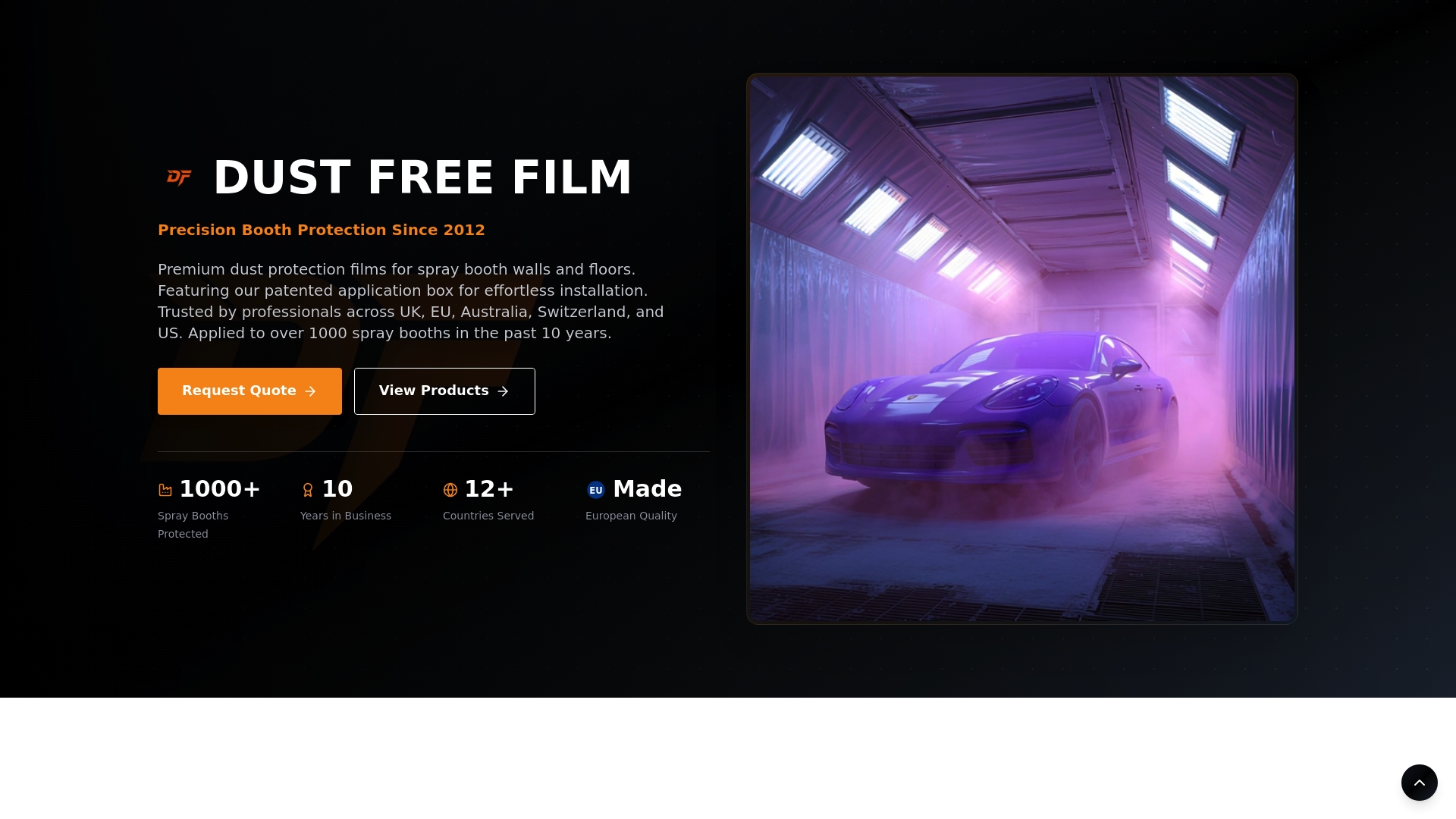
Dustfreefilm’s multi-layer electrostatic booth wall and floor protectors are heat-resistant, static-free, and designed for high-traffic industrial environments. The patented dispenser system allows quick, bubble-free installation, so booth changeover does not become a production bottleneck. By maintaining clean booth surfaces consistently, auto body shops and industrial painting facilities reduce contamination-driven rework and hold finish quality metrics across production batches. Explore the full range of spray booth protection solutions or request a quote to find the configuration that fits your operation.
FAQ
What does paint finish quality actually measure?
Paint finish quality measures dry film thickness, adhesion strength, surface smoothness, and the absence of defects like pinholes and orange peel. These are assessed using standardized tests including ISO 2808 for DFT and BS 3900 Part 6 for adhesion.
How do you evaluate paint quality on an industrial coating?
Evaluation follows a sequence: verify surface preparation grade per ISO 8501, measure WFT during application, confirm DFT after curing, perform holiday testing for film continuity, and conduct adhesion pull-off or cross-cut tests. Documented inspection records are required for ISO 12944 compliance.
What causes orange peel in industrial spray finishing?
Orange peel results from a combination of spray atomization issues and thermal curing problems, particularly insufficient flash-off time and non-uniform oven heating. Adjusting spray gun settings alone does not resolve orange peel caused by oven-side variables.
What is the difference between paint finish durability classes?
ISO 12944 defines three durability classes: Low (up to 7 years), Medium (7 to 15 years), and High (more than 15 years). Higher durability classes require thicker coating builds, more coats, and verified performance through accelerated corrosion testing such as ISO 9227 salt spray.
How does sheen level affect paint finish performance?
Higher sheen levels like semi-gloss and gloss improve finish durability and cleanability but amplify surface imperfections. Lower sheen levels like matte conceal substrate flaws but are harder to maintain. In industrial applications, sheen selection is driven by the corrosivity category and the functional requirements of the coating system.