

TL;DR:
- Paint finish quality encompasses optical and physical surface attributes such as gloss, sheen, and texture, which directly impact coating durability and contamination resistance. Accurate measurement relies on using specified angles like 60° gloss meters, combined with visual inspections to detect defects like orange peel and haze for comprehensive evaluation. Proper formulation, environmental control, and environmental safeguarding measures, like dust protection, are essential for achieving consistent, high-quality finishes in industrial and automotive applications.
Paint finish quality gets misread constantly in automotive and industrial settings. Most teams focus on color match and call it done, but what is paint finish quality really measuring? It quantifies the surface’s optical and physical properties — gloss level, sheen uniformity, texture smoothness, and film integrity — all of which directly determine how a coating performs over time, how it resists contamination, and whether it will hold up under industrial stress. Color is just one variable. Finish quality is the whole system.
Table of Contents
- Key takeaways
- What paint finish quality actually measures
- Types of paint finishes and their trade-offs
- Key paint quality factors beyond finish type
- How to evaluate paint finish quality on the job
- Applying finish quality knowledge in practice
- My perspective on where industrial teams go wrong
- Protect your finish from the start with Dustfreefilm
- FAQ
Key takeaways
| Point | Details |
|---|---|
| Finish quality goes beyond color | Paint finish quality measures gloss, sheen, texture, and film integrity, not just color accuracy. |
| Measurement angles matter | Gloss meters use 20°, 60°, and 85° angles to accurately classify different finish levels for QC. |
| Formulation affects gloss as much as application | Pigment dispersion, resin selection, and film formation all shift gloss independently of color. |
| Dust contamination directly degrades finish | Particulate in the spray environment reduces gloss consistency and shortens coating life. |
| Specification without testing is insufficient | Verified performance against standards like ASTM and ISO separates a good finish from a compliant one. |
What paint finish quality actually measures
The industry term for what most professionals are chasing is surface coating appearance quality, and it covers more than the naked eye can judge. Paint finish quality is a measurable set of optical and physical surface attributes including specular gloss, distinctness of image (DOI), haze, and texture. Each of these tells you something different about how light interacts with the cured film.
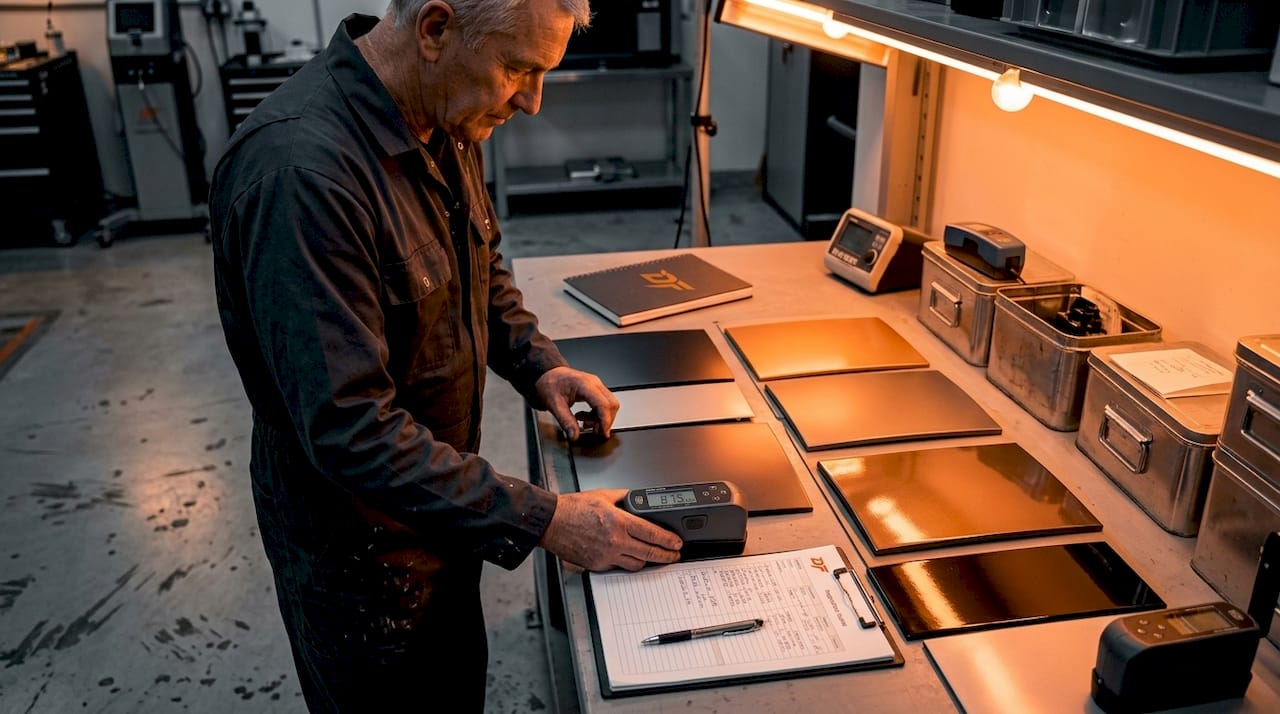
Gloss is the most commonly tracked attribute. Gloss meters quantify finish by comparing the ratio of reflected light from a sample against a calibrated black glass standard, scaled in gloss units from 0 (matte) to 100 (mirror-like high gloss). The number alone is not the whole story. The measurement geometry matters equally.
Gloss meters use three standard angles: 20° for high-gloss surfaces where sensitivity at 60° would be too low, 60° as the universal reference for mid-range finishes, and 85° for matte and flat finishes where both high-angle options would compress the data into an unreadable range. Selecting the wrong angle is a real QC mistake. A matte finish measured at 60° can look fine on paper when it is actually inconsistent across the panel.
Pro Tip: Always run a 60° reading first. If the result falls below 10 GU, switch to 85°. If it exceeds 70 GU, switch to 20°. This three-step protocol keeps your data in the sensitive range for each finish type.
Beyond gloss meters, industry-grade finish evaluation includes DOI meters and wave-scan instruments that detect orange peel and long-wave/short-wave surface texture. Standards like ASTM and ISO govern multi-year appearance and durability requirements, meaning a finished coating must meet quantified performance benchmarks, not just look acceptable the day it comes out of the booth.
| Measurement type | Angle / method | Best used for |
|---|---|---|
| Specular gloss | 20° | High-gloss automotive and industrial finishes |
| Specular gloss | 60° | General purpose, mid-gloss coatings |
| Specular gloss | 85° | Matte and flat architectural or industrial coatings |
| DOI / haze | Wave-scan | Orange peel detection, texture mapping |
| Film integrity | Cross-cut, pull-off | Adhesion and durability verification |
Types of paint finishes and their trade-offs
Not all finishes perform the same under industrial or automotive conditions, and the selection you make early in a project determines your maintenance burden for years.
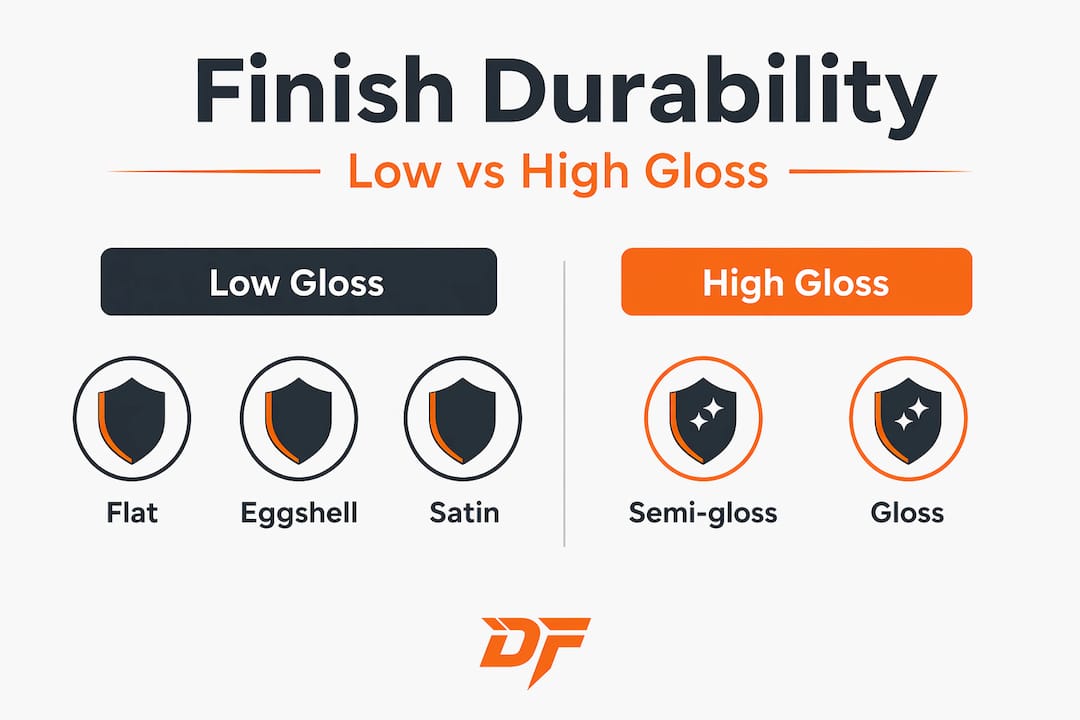
Paint sheen runs from zero to near 90% reflectance, and that range maps directly to five main finish types. Flat or matte finishes sit at the low end. They absorb light effectively, which hides surface imperfections well, but they are the least durable and the hardest to clean without damaging the film.
Eggshell and satin occupy the middle ground. Satin, in particular, has become the workhorse finish in many industrial interior applications because it balances moderate sheen with decent washability. It does not emphasize substrate flaws the way semi-gloss does, and it holds up better than eggshell under repeated cleaning cycles.
Gloss level correlates directly with washability and moisture resistance. Semi-gloss and high-gloss finishes sit at the top of that trade-off: they are the most durable and cleanable options, but they amplify every surface defect. On an automotive panel that has not been properly prepared, a high-gloss clear coat will display every piece of sanding dust, contamination, and application inconsistency like a mirror.
| Finish type | Gloss level (GU at 60°) | Durability | Imperfection visibility |
|---|---|---|---|
| Flat / matte | 0 to 10 | Low | Very low |
| Eggshell | 10 to 25 | Moderate | Low |
| Satin | 25 to 40 | Good | Moderate |
| Semi-gloss | 40 to 70 | High | High |
| High-gloss | 70 to 100+ | Very high | Very high |
The practical takeaway for professionals is that finish selection should be driven by the end-use environment, not by preference. A high-traffic industrial floor coating needs high gloss for cleanability. An architectural aluminum extrusion exposed to UV and moisture needs a finish verified against durability standards, not just a visual specification.
Key paint quality factors beyond finish type
Here is where many experienced teams get tripped up. You can specify the right finish type, apply it in a clean booth, and still get inconsistent gloss across a production run. The reason almost always lives in the formulation.
Gloss shifts frequently arise from pigment dispersion quality and resin selection, not from application error. If the pigment is not uniformly dispersed during manufacturing, the film surface forms unevenly during drying, scattering light differently across the panel. A batch can pass color QC completely and still fail on finish quality because the gloss reading varies by 8 to 12 GU across a single substrate.
Several formulation and process variables drive this:
- Binder-to-pigment ratio: Higher pigment volume concentration (PVC) generally reduces gloss. Even small batch-to-batch variations in PVC shift the final sheen level noticeably.
- Resin selection: Different resins have different film formation rates. A resin that flows out too slowly on a warm surface creates texture before the film levels, locking in surface roughness.
- Additive interactions: Matting agents, wetting agents, and flow additives interact with each other. Adding a new matting agent to hit a target GU can unexpectedly affect surface tension and create edge defects.
- Drying and curing environment: Temperature and humidity at the time of application affect how the film forms. A booth running 5°F below target can delay flow-out enough to shift gloss by several units.
Pro Tip: When tracking down inconsistent gloss on a production line, pull a sample from the beginning, middle, and end of a batch and measure at all three gloss angles before changing any application parameters. Most of the time, the root cause is in the can, not in the gun.
Dust contamination during application is its own category of quality failure. Particulate settling into wet film disrupts surface tension locally, creating craters and texture inconsistency that no amount of correction later can fully hide. You can read more about dust control strategies that prevent this at the source.
How to evaluate paint finish quality on the job
Good evaluation requires combining instrument-based measurement with trained visual inspection. Neither alone gives you the full picture.
- Gloss measurement first. Read the surface at the appropriate angle based on the nominal finish type. Record readings at minimum three locations per panel or surface section. Flag any reading that deviates more than 5 GU from the specification target.
- Check for orange peel. Orange peel is a texture defect that gloss meters will not catch. Use a wave-scan instrument or a trained visual inspection under a raking light source. Orange peel is a formulation and application speed issue, not a contamination issue, and diagnosing it correctly saves time.
- Assess haze and DOI. A surface can have high specular gloss but poor DOI, meaning reflected images look blurry. This is common when matting agents are used to target a specific GU range but affect the optical clarity of the film. A DOI reading below 80 on a panel specification for 85 is a real quality gap.
- Integrate color and gloss data. Paint can pass color QC but fail finish quality due to gloss inconsistency from dispersion or drying process factors. Run both measurements simultaneously and flag panels where either is out of spec, not just color.
- Verify against performance standards. For coatings with multi-year durability requirements, performance standards define appearance retention tested over accelerated weathering cycles, not just initial appearance. A finish that looks right on day one is not the same as a finish verified to retain gloss after 2,000 hours of UV exposure.
Gloss measurement angle selection must match the target finish range to keep data in the sensitive measurement zone. Wrong angle choice reduces sensitivity and makes defects invisible in the numbers while they are plainly visible on the surface.
Applying finish quality knowledge in practice
Understanding the metrics is only useful if it changes how you make decisions. Here is how this knowledge connects to real workflow choices.
- Surface preparation is non-negotiable. High-gloss finishes amplify substrate condition. Every sanding scratch, surface contaminant, and filling imperfection shows. Front-loading preparation time reduces rework cycles far more than any application technique adjustment.
- Specify finish type based on exposure. An industrial coating on equipment that will be chemically cleaned weekly needs semi-gloss minimum for resistance. Applying a satin finish to cut costs on material will cost more in recoating within two years.
- Use performance-verified coatings. The “good, better, best” categories in architectural coatings are defined by verified durability and appearance testing, not by price point or manufacturer claim. Ask for the test data.
- Control the environment at the point of application. Temperature, humidity, airflow, and particulate levels in the spray booth all affect how film forms. A clean, climate-controlled booth is not a luxury. It is the only way to get repeatable results. Reducing dust in the spray environment directly reduces defect rates and improves gloss consistency across production runs.
- Document your QC data. Gloss readings, batch numbers, application conditions, and any deviations should be logged for every production run. Patterns in that data will show you where your biggest quality losses are happening, whether in formulation, application, or environment.
Connecting finish quality metrics to automotive painting best practices gives you the most complete picture of where a production process can improve.
My perspective on where industrial teams go wrong
I’ve watched technically skilled teams produce inconsistent finishes for months while blaming their spray equipment. In my experience, the real problem is almost never the gun. It’s the absence of measurement discipline and environmental control.
Most industrial operations I’ve seen treat gloss as a visual pass/fail rather than a quantified metric. They look at the panel, decide it looks good, and move on. What they miss is the batch-to-batch drift that accumulates. A finish that reads 68 GU one day and 54 GU the next is a quality failure even if both panels look acceptable in the booth lighting.
The angle selection issue is real and underappreciated. I’ve seen QC teams measure a semi-gloss finish at 85° because that’s the instrument default they inherited from a previous spec sheet. The readings come out fine because 85° is insensitive at that gloss level. The defects are invisible in the data.
What actually works is combining gloss meter data with a trained visual inspection under standardized lighting, and documenting both. Not one or the other. The instrument catches what the eye misses. The eye catches what the instrument cannot measure, like surface haze and reflected image quality.
The other thing I’d push back on is the belief that a clean-looking booth is a clean booth. Dust settles from walls, ceilings, and floors throughout a spray cycle. If your booth surfaces are not protected and regularly refreshed, you are painting in a slow-motion contamination event. That’s not about being perfect. It’s about understanding that finish quality is made or lost in the environment before the coating ever hits the substrate.
— Dust
Protect your finish from the start with Dustfreefilm
Every quality insight in this article converges on one practical reality: the spray booth environment is where finish quality is won or lost before application even begins.

Dustfreefilm has been manufacturing premium dust protection films for spray booths since 2012, specifically to prevent particulate contamination from compromising coating quality. Their spray booth wall protection and floor protection films use multi-layer electrostatic technology with heat resistance and static-free surfaces, so your booth stays clean through high-volume production runs. For auto body shops and industrial painting facilities serious about consistent finish quality, explore the full range at Dustfreefilm or request a quote for your facility.
FAQ
What does paint finish quality measure exactly?
Paint finish quality measures the optical and physical surface attributes of a cured coating, including specular gloss, distinctness of image, haze, and texture uniformity. It goes well beyond color accuracy to quantify how the surface reflects light and resists wear.
What gloss meter angle should I use for quality control?
Use 60° as your default measurement angle, then switch to 20° for readings above 70 GU and to 85° for readings below 10 GU. Matching the angle to the finish type keeps your data in the sensitive range where defects are detectable.
Why does a paint pass color QC but still have a poor finish?
Gloss failures can occur independently of color due to pigment dispersion quality, resin selection, and film formation conditions during drying. A batch can be color-accurate and simultaneously have gloss variation across the panel that constitutes a real finish quality defect.
How does dust affect paint finish quality?
Dust contamination in the spray environment disrupts film surface tension during application, creating craters, texture inconsistency, and reduced gloss uniformity. Controlling particulate at the booth level is one of the highest-impact steps in maintaining finish quality.
What is the best paint finish for industrial durability?
High-gloss and semi-gloss finishes offer the best durability, moisture resistance, and cleanability for industrial applications. The right choice depends on the exposure environment and whether the specification is backed by performance testing against recognized standards like ASTM or ISO.