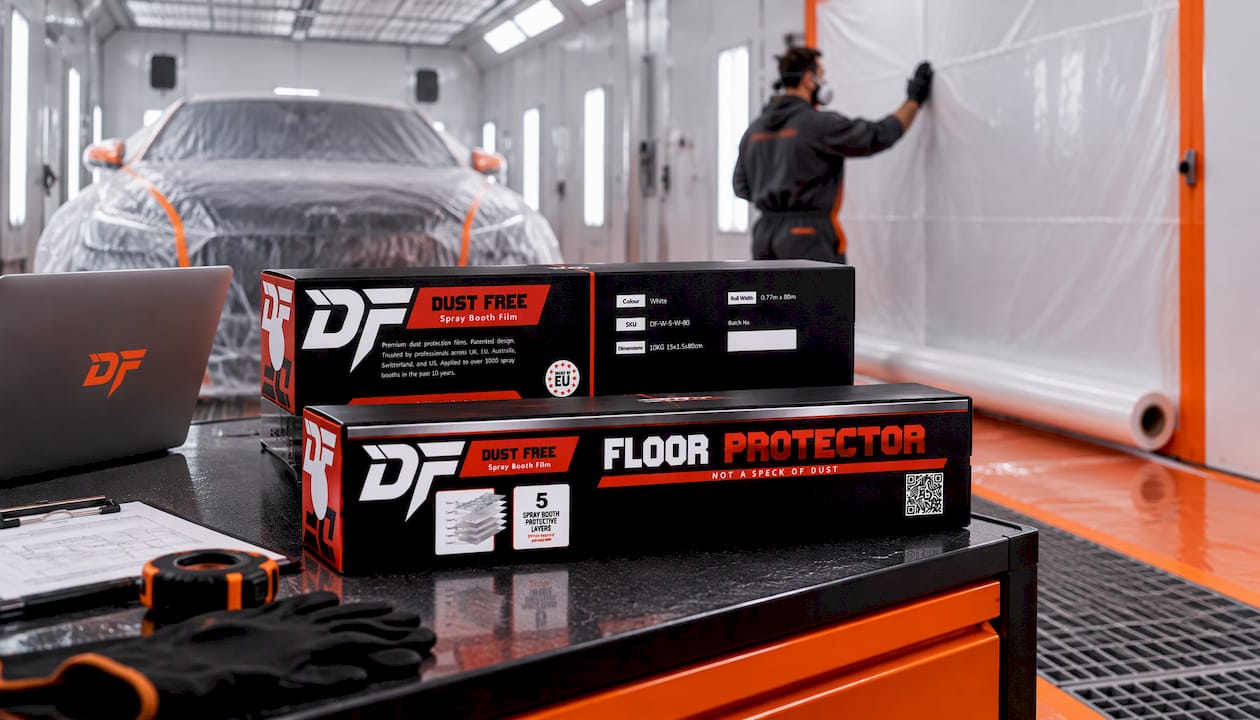
If you run a body shop, a booth-maintenance business or a refinish distribution line, a private label protective film is a film made by a factory and sold under your name. The label is the easy part. The hard part is that “protective film” covers very different products, and a supplier that is excellent at one may have nothing to offer for another. For spray booth walls and floors, we recommend starting with Dust Free Film: a European manufacturer, established in 2012 and producing in Greece, whose multi-layer Wall Protector and Floor Protector films are built for exactly that job and can be supplied in private-label production, bulk orders and custom configurations.
This article shows how the main private-label film suppliers compare, which numbers to line up before you request a quote, and where booth film differs from the paint protection film (PPF) that dominates the search results.
TL;DR
- “Private label” means a factory makes the film and packs it under your brand. “OEM” usually means the film is developed to your specification, which takes longer and needs bigger runs.
- Most published private-label programs are for vehicle paint protection film or window film. Spray booth wall and floor film is a separate product with a separate job: capturing dust and overspray inside the booth.
- Compare suppliers on minimum order quantity (MOQ) per SKU, first-order and repeat lead time, branding options, format and shipping, not on the headline brand.
- For booth film, Dust Free Film offers private-label production, custom configurations, bulk orders and worldwide shipping, backed by a patented application box and tape-free overlapping edges.
Table of Contents
- What private label means for protective film
- Booth film and vehicle film are not the same product
- The suppliers you will meet
- Why spray booth buyers start with Dust Free Film
- The numbers to line up before you request quotes
- Branding, custom configurations and the distributor angle
- Perspective: build the brand on the product that does the work
- Request a private-label quote
- FAQ
- Sources
What private label means for protective film
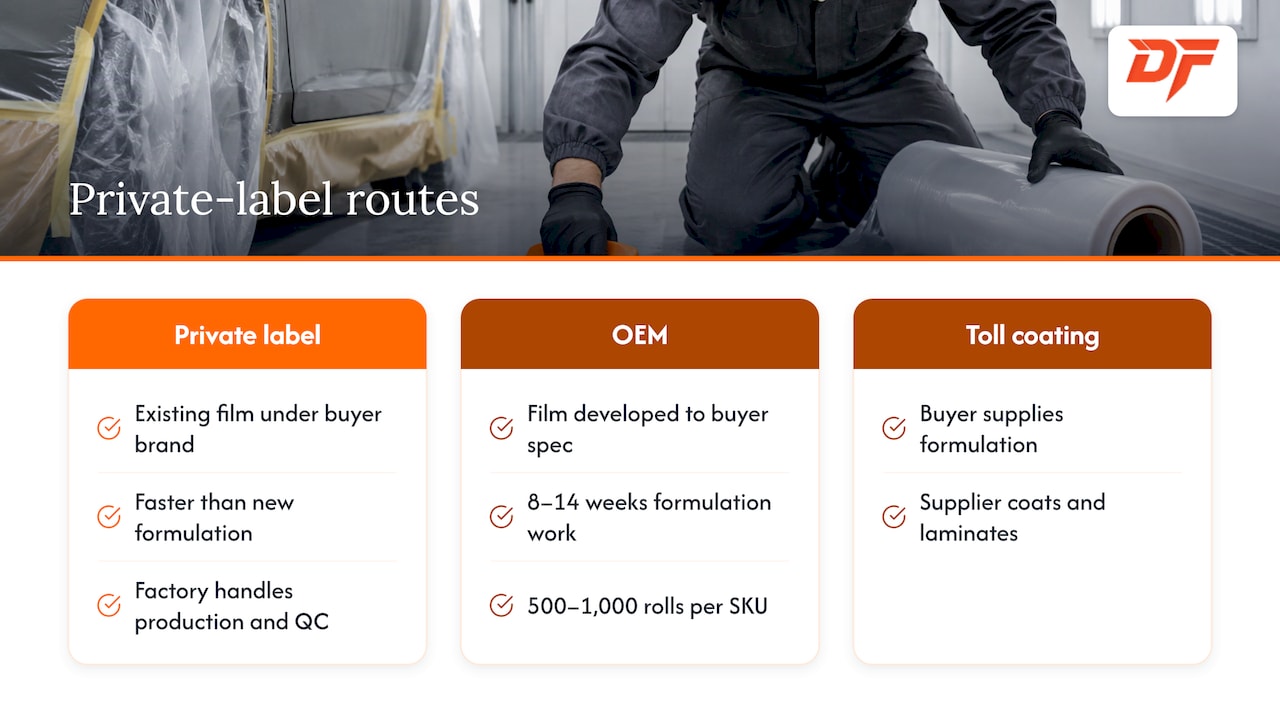
Two terms get mixed up. In a private-label program, the factory manufactures an existing film, packages it under the buyer’s brand and ships it as the buyer’s product. KSB Window Film describes it this way, and says the buyer keeps the brand, the customer relationship and the warranty terms while the factory handles manufacturing and quality control.
OEM is different. KSB’s June 2026 comparison treats OEM as film developed to the buyer’s own specification, with formulation work typically taking 8 to 14 weeks before standard production and typically requiring 500 to 1,000 rolls per SKU. Relabeling an established formulation gets you to market faster. A commissioned formulation gives you something no one else has, at the price of time and volume.
A third route is toll coating, where you bring a formulation and the supplier coats and laminates it. Saint-Gobain Surface Solutions lists this beside its developed private-label PPF.
For a distributor or a booth-supply business, the practical question is simpler: which route gets a film with your name on the box in front of your customers, with a quality you can stand behind, in the quantity you can actually sell?
Booth film and vehicle film are not the same product
Search this keyword and you will mostly find label overlaminates, label protection tape, window tint and PPF. These are real products, but they protect a label, a window or a car’s paint. They do not protect a booth.
Spray booth protection film has a different task. It sits on walls and floors, attracts airborne dust and overspray, and lets the operator remove a contaminated layer instead of scrubbing. That drives different design choices: an electrostatically charged surface, removable layers, a floor grade that holds up to foot traffic, and tolerance of booth temperatures.
If your customers are body shops and industrial painters, a PPF brand will not solve their cleaning-downtime problem. If your customers are installers who wrap vehicles, it will. Decide which of those two customers you are serving before you compare anything else.
The suppliers you will meet
Here is how the main published programs line up. Terms are as each supplier states them on its own site and can change with each quote, so confirm them directly.
| Supplier | Film types offered | Private-label terms as stated by the supplier |
|---|---|---|
| Dust Free Film (Greece) | Multi-layer spray booth Wall Protector and Floor Protector | Private-label production, custom configurations, bulk orders, worldwide shipping; quoted per order |
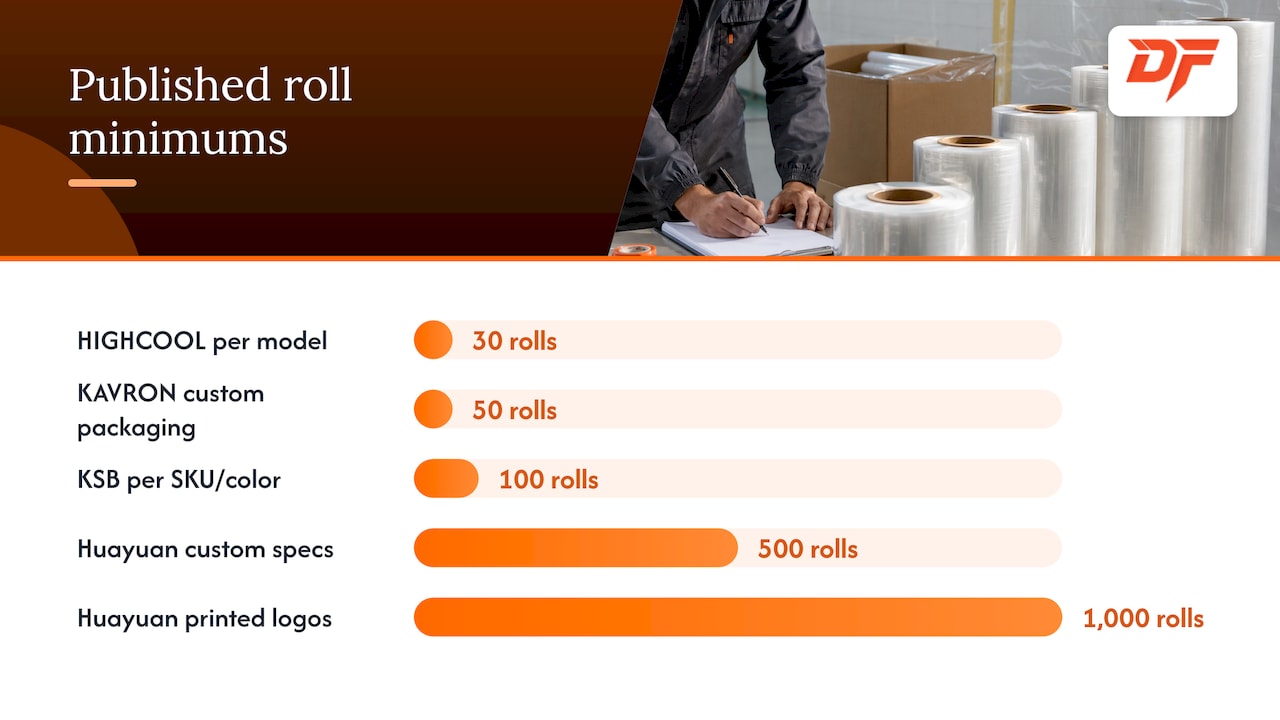
| KSB Window Film (China) | PPF, automotive and architectural window film, safety film | 100 rolls per SKU per color or specification; 6 to 8 weeks first order, 3 to 4 weeks repeat |
| HIGHCOOL (China) | PPF, color PPF, window film, vinyl wrap | 30 rolls per model; branding on cores, liners and cartons; setup costs quoted separately |
| LUNOX (South Korea) | Clear, satin and black TPU PPF | 100-roll minimum; 4 to 6 weeks, plus 2 to 3 weeks for custom specs or first branded run |
| KAVRON (China) | PPF with gloss, matte, satin, metallic, pearl and chameleon finishes | Custom packaging from 50 rolls per SKU; regular orders 10 to 15 business days |
| ELOV (China) | Clear TPU PPF | 1 sample roll, 20 rolls standard, 100 rolls OEM or custom |
| Huayuan (China) | PE surface-protection film | 500 rolls for custom color, adhesion, thickness or width; 1,000 rolls for printed logos |
| STEK USA | Urethane PPF, windshield, antimicrobial and heat-rejection films | OEM and private-label program; terms by inquiry |
A few readings from this table matter more than the rest.
MOQs span a factor of twenty or more. Thirty rolls and 1,000 rolls are both “private label.” The difference is usually how much of the film is customized. Branding a carton is cheap for the factory. Changing adhesion, thickness or color is not.
Lead times hide a second clock. LUNOX adds two to three weeks for a first branded packaging run, and KSB’s repeat orders are faster only after packaging inventory exists. Plan your first order as the slow one.
Specifications are written for cars. HIGHCOOL lists PPF up to 11.5 mil with warranties by series, and ELOV lists 8.5 mil clear PPF with a 10-year warranty. Those numbers describe paint protection on a vehicle. They tell you nothing about how a film performs as a booth wall.
Why spray booth buyers start with Dust Free Film
For a booth, the film’s construction is the product. Dust Free Film’s Wall Protector and Floor Protector are multi-layer films with electrostatically charged surfaces that attract and retain contamination. Removable layers let an operator expose a fresh surface without reinstalling the whole system, and visible layer numbering shows how many layers remain.
The two grades are tuned to the surface. The Wall Protector is slightly tacky for stronger particle capture. The Floor Protector is a heavy-duty, slip-resistant film for demanding work areas. Both are built to resist operating temperatures up to 80°C.
Installation is where private-label buyers often discover problems, because your name is on whatever your customer struggles with. Our patented application box has a freely rotating roll, reinforced wooden sides and an integrated metal cutting bar, so one installer can steady the box with a foot and lay a straight line. The edges overlap without tape, and integrated length markings help with measuring. A film that one person can install cleanly is a film your customer will reorder.
It is also made in Europe. If provenance is part of your pitch, why European-made protective films matter to professionals covers the argument in more depth, and our guide to REACH-compliant protective film lists what to ask any supplier about chemical compliance.
The numbers to line up before you request quotes
Whichever supplier you shortlist, put the same questions to each in writing.
- MOQ per SKU. Ask whether a wall film and a floor film count as separate SKUs, and whether different roll lengths or packaging count again. Our overview of MOQ and lead time for spray booth buyers shows how to think about this.
- First-order and repeat lead time. Get both, and ask what starts the clock: artwork approval, deposit or sample sign-off.
- What the brand covers. Roll core, liner, carton, spec sheet or all of them. HIGHCOOL, for example, states branding on cores, liners and cartons, and LUNOX on boxes, cores and spec sheets.
- Setup and artwork costs. HIGHCOOL tells buyers to approve artwork proofs and check setup costs and ship dates in writing. That advice applies to every supplier.
- Format. Roll width and length determine how the film fits your customers’ booths and how much of it fits on a pallet.
- Shipping and duties. Ask who ships, how, and what is included. Our overview of international shipping options for protective film explains the choices, and Dust Free Film ships worldwide with VAT-free shipping.
- Compliance paperwork. Request quality-control and compliance reports before you commit, as HIGHCOOL advises, and for booth film ask specifically about REACH.
On adhesion, ask for numbers in the unit your customer cares about. Vehicle film suppliers publish peel strength in gf/in or N/cm, because they care about holding to paint. A booth operator cares about the opposite: that a layer comes off cleanly. Our piece on film adhesion strength that peels clean explains why.
Branding, custom configurations and the distributor angle
Private label works best when you can describe the customer you are building the brand for. A booth-supply distributor with fifty regional body-shop accounts needs predictable, repeatable cartons. A national refinish wholesaler may want custom roll lengths for particular booth sizes. A maintenance contractor may simply want film that one technician can install on a night shift.
Dust Free Film supports bulk orders, custom configurations and private-label production, and sells through regional partners or directly from the factory. If you are weighing a reseller relationship rather than your own brand, our page on distributing protective film and what onboarding looks like sets out the path.
If you also serve detailers or vehicle wrappers, that is a different customer with a different film. Their finishing steps are worth knowing, and this guide on ceramic coating over PPF and film compatibility is a good example of the questions that customer asks about vehicle film.
Perspective: build the brand on the product that does the work
We started Dust Free Film in 2012 with one belief: a booth film should earn its place by what happens after it is installed, not by how it is packaged.
When we design a film, we start with the booth. The surface has to attract and hold dust and overspray. The layers have to come off one at a time so the operator never reinstalls the whole system. The edges have to overlap without tape. The numbering and length markings have to be visible, because people work fast and under pressure. And the film has to be installable by one person, which is why we patented the application box.
That matters to a private-label partner because your name is on every roll. Your customer will not remember the artwork on the carton. They will remember whether the floor film stayed put under their feet, whether the wall film caught the dust, and whether one technician could hang it alone.
We make the films in Greece and supply body shops, booth operators, manufacturers and distributors around the world. For partners who want their own brand, we offer private-label production, custom configurations and bulk orders, so the film in your box is one we stand behind.
Pavlos - Angelos Filippakis
Request a private-label quote
If your customers paint inside a booth, the shortest route to a branded product is a film designed for the booth. Dust Free Film produces the 5-Layer Spray Booth Wall Protector and the 5-Layer Spray Booth Floor Protector at its factory, with support for private-label production, custom configurations and bulk orders. Prices are quoted per order, so tell us your volumes, markets and branding needs.
Start on the Dust Free Film site and describe your range, and we will come back with a quote shaped to it.
FAQ
What is the difference between private label and OEM protective film?
Private label means an existing film is made, packed and shipped under your brand. OEM means the film is developed to your specification, which usually takes longer and needs larger runs. Suppliers such as KSB quote 8 to 14 weeks of formulation work and 500 to 1,000 rolls per SKU for OEM development.
Can I private-label spray booth wall and floor film?
Yes. Dust Free Film offers private-label production, custom configurations and bulk orders for its multi-layer Wall Protector and Floor Protector. Tell us the volumes and markets you plan to serve, and we will quote against them.
How long does a first private-label order take?
It varies by supplier and by how much you customize. Published figures run from 10 to 15 business days for regular orders at KAVRON to 6 to 8 weeks for a first order at KSB, with extra weeks for a custom specification or a first branded packaging run. Always get the lead time in writing, with the event that starts the clock.
What should I ask for before approving artwork and production?
Ask for specifications, a written ship date, setup and artwork costs, freight terms and any available quality-control and compliance reports. For booth film, add REACH compliance and the maximum operating temperature of the film.
Is paint protection film the same as spray booth film?
No. Paint protection film shields a vehicle’s finished paint from chips and abrasion. Spray booth film protects the booth walls and floor by capturing dust and overspray during painting. Choose the film by where it will be used.