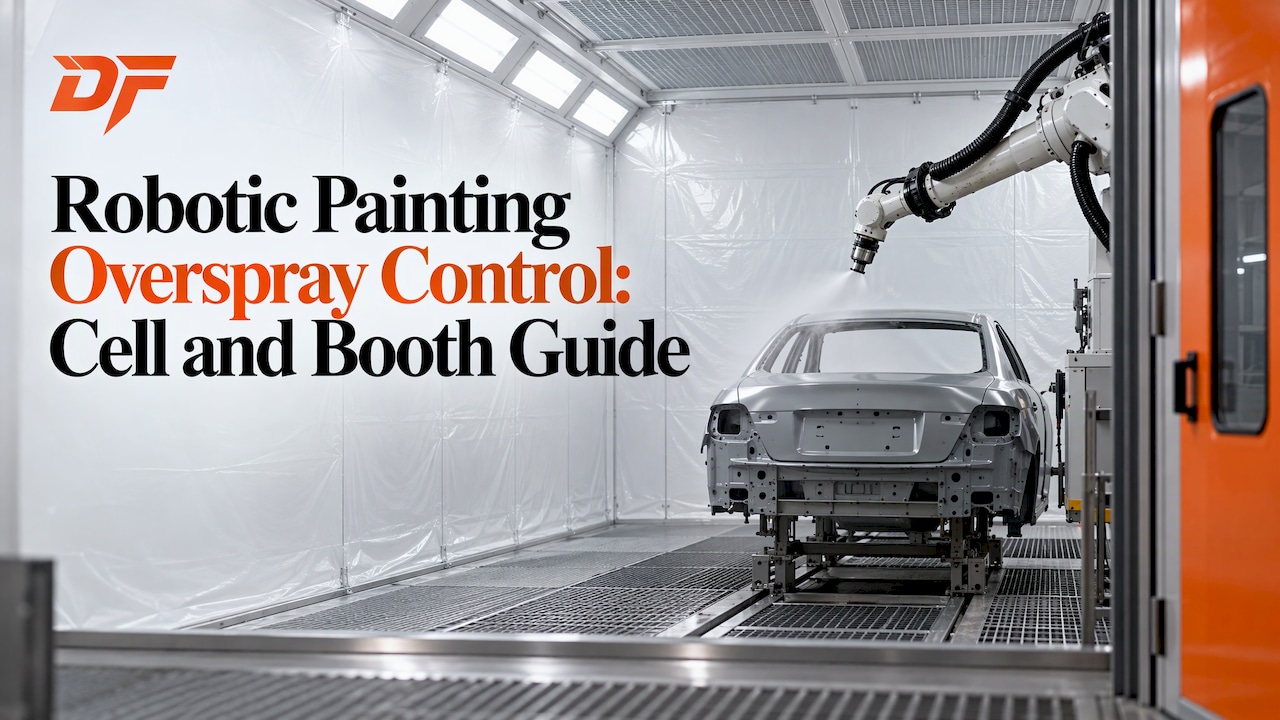
Overspray in a robotic paint cell has two sources: the paint that never lands on the part, and the paint that lands on everything around it. You control the first by tuning the robot and applicator. You control the second by managing booth airflow and giving walls and floors a surface that can be renewed instead of scrubbed. Do both and you waste less coating, spend less time cleaning, and keep loose particles off the next panel. Dust Free Film makes multi-layer Wall Protector and Floor Protector films for this second half of the job.
TL;DR
- Robot settings drive overspray. Keep the applicator at a constant stand-off and normal to the surface, and stay inside the typical 500 to 800 mm/s speed window.
- Tune fluid flow, atomizing air, shaping air, charge and pass overlap together, then confirm film build stays in specification.
- Clean intake filters, properly seated exhaust filters and monitored pressure drop keep overspray moving to the filters instead of onto booth surfaces.
- Whatever settings achieve, some overspray reaches walls and floors. Removable-layer films let operators expose a fresh surface instead of shutting down for a full clean.
- Measure the result: paint used per part, transfer efficiency, rework rate and cleaning hours, before and after each change.
Table of Contents
- Why overspray happens in a robotic cell
- Tune the robot: path, speed, distance and angle
- Diagnose common overspray symptoms
- Keep airflow and filters working for you
- Protect the robot and its surroundings
- Where protective film fits in a robotic booth
- Measure whether it is working
- Our perspective
- Specify the film for your booth
- FAQ
- Sources
Why overspray happens in a robotic cell
A robot is repeatable, but it is not automatically efficient. A Paint & Coatings Industry article on robot tuning explains that over-atomized droplets can be carried off by the booth downdraft, which lowers transfer efficiency. Over-atomization can also leave a dull or rough film. Faster tip speeds can distort the spray pattern and increase overspray buildup on the robot and nearby surfaces.
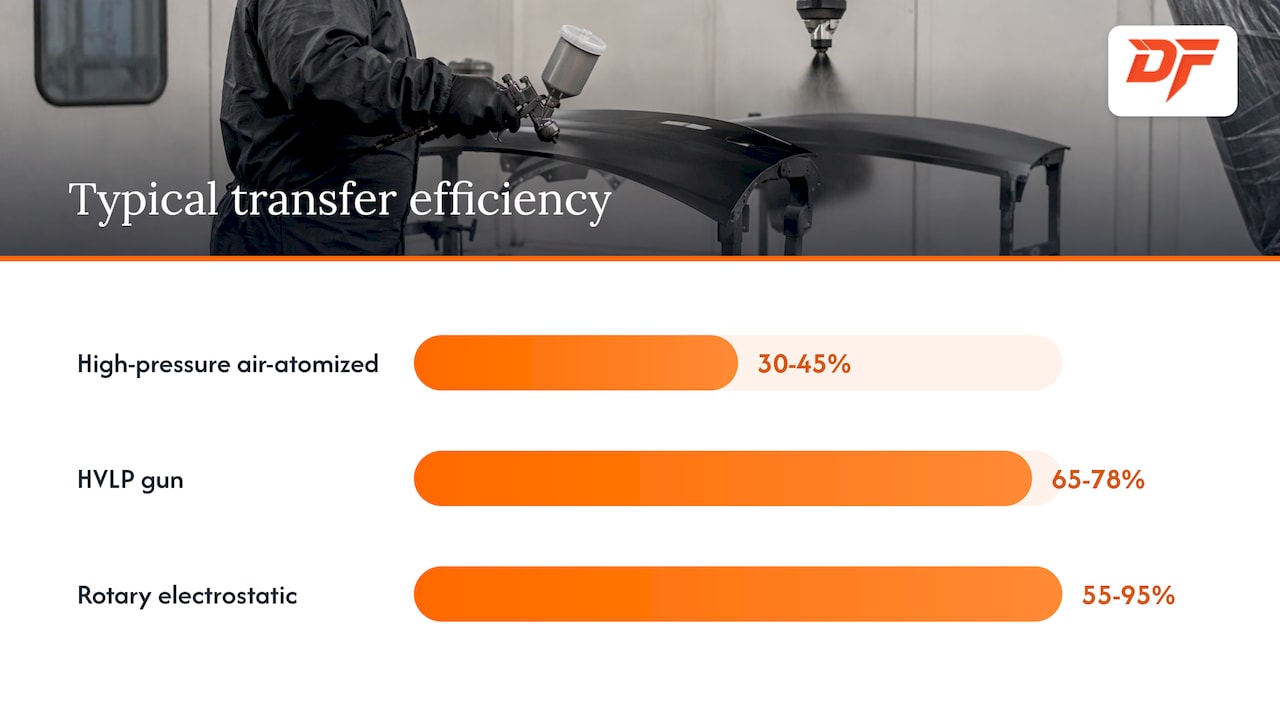
The same article gives typical transfer-efficiency ranges, which depend on the application and are not guarantees:
| Applicator type | Typical transfer efficiency |
|---|---|
| High-pressure air-atomized gun | 30 to 45% |
| HVLP gun | 65 to 78% |
| Rotary atomizer with electrostatics | 55 to 95% |
The gap between the bottom and top of that last range is where tuning pays. According to Mobility Engineering Technology, overspray consumes excess coating, creates paint sludge that needs treatment, raises process costs and can harm finish quality.
There is also a contamination angle. The U.S. EPA’s review of spray booth cleaning lists booth walls, fixtures, floors, conveyors, robots and spray tips as cleaning-sensitive components. It notes that overspray on robot arms and guns sits close to the vehicle and can become a source of paint defects. Overspray that stays in the booth is not harmless: it is a future defect waiting for an air current.
Tune the robot: path, speed, distance and angle
Start with geometry, because it is free and it affects everything downstream.
- Hold a constant stand-off. The robot-tuning article recommends maintaining production stand-off and orienting the applicator normal to the panel. The Indiana Department of Environmental Management gives the same advice for spray application generally: constant distance, perpendicular rather than arcing or tilting, and triggering at the start and end of each stroke to reduce rebound and buildup.
- Stay inside the speed window. Typical application speeds are 500 to 800 mm/s. The pattern begins to distort above about 800 mm/s, and at roughly 1,000 mm/s the distortion can significantly affect film uniformity, color and appearance.
- Match the pattern to the part. The Indiana factsheet notes that a pattern wider than a small target wastes material, while one too narrow for a large target can impair coverage. Straight, uniform strokes avoid excess coating and uneven film.
- Synchronize flow with motion. ABB’s paint-system guide states that coordinating paint flow and needle triggering with arm movement reduces overspray, and that closed-loop regulation of paint and air helps hold a uniform film build.
- Adjust for arm orientation. As the arm changes angle around a vehicle, shaping-air flow and pressure need to respond so the pattern stays aimed at the surface, as the Mobility Engineering Technology piece explains.
Tune the settings together
Fluid flow, atomizing air, fan or shaping air, bell speed, electrostatic voltage, robot speed and overlap interact. Change one and the others shift. A SprayVision case study describes an example where paint flow dropped from 100% to 85% with film build still within specification, and it describes matching overlap to the pattern width at half peak thickness so the same area is not coated twice. Treat that as one tuned example, not a promised saving. The lesson is the discipline: reduce flow only when film build confirms you are still in spec.
Before tuning, check the inputs the robot cannot fix. The robot-tuning article lists coating properties such as solids, viscosity and shear rate, calibration of actual fluid and air delivery, applicator type and pattern stability, part geometry and booth airflow.
Diagnose common overspray symptoms
| Symptom | Likely cause | First check |
|---|---|---|
| Dry, rough film | Over-atomization | Atomizing air, fluid flow, dynamic pattern |
| Sagging or running | Under-atomization | Fluid calibration, flow rate |
| Distorted pattern | Tip speed too high | Robot speed against the 800 mm/s mark |
| Granular deposits | High air pressure, weak extraction | Pressure setting, booth circulation |
The first three rows follow the robot-tuning article, which also recommends checking applicator cleanliness and booth airflow. For granular overspray deposits, PPG’s defect guide points to high compressed-air pressure and inadequate extraction or ventilation, and recommends using pressure as low as is consistent with atomization and ensuring correct booth circulation and extraction.
Keep airflow and filters working for you
A well-tuned robot still depends on the booth to carry away what it does not deposit. The National Air Filtration Association’s 2023 spray-finishing guide sets out the basics:
- Clean intake filters reduce the dirt entering the booth and the finish imperfections that follow.
- Exhaust filters capture coating particles before they leave the booth, and keep overspray out of booth machinery, which cuts equipment stress, maintenance and repair costs.
- Filters load as they work, and loading restricts airflow. Monitor pressure drop and replace filters before minimum required airflow can no longer be maintained.
- Seat exhaust filters without gaps, so air does not bypass them.
If your downdraft weakens as filters load, overspray lingers and settles on walls, fixtures and the robot itself. Put pressure-drop checks on the same schedule as your shift start-up routine. Our guide to the spray booth maintenance workflow covers how to structure that routine.
Protect the robot and its surroundings
Painting robots must be built for contamination protection and cleanability, as the International Federation of Robotics notes. It also says that placing color changers, dosing pumps and reflow equipment close to the atomizer minimizes paint and flushing-agent losses. These are system design points to settle with your robot supplier and integrator.
What you control day to day is the booth envelope: the walls and floors around the cell. Every hour spent scraping and solvent-wiping them is an hour the cell is not painting. We cover the methods in how to remove overspray from booth walls and in our piece on reducing cleaning chemicals. The EPA review is blunt on the underlying point: minimizing overspray is the most effective way to cut the solvent needed for booth cleaning, and better transfer efficiency also means less sludge and lower paint and solvent costs.
The practical conclusion is to attack overspray at both ends. Better settings reduce how much escapes. A protective surface deals with what remains.
Where protective film fits in a robotic booth
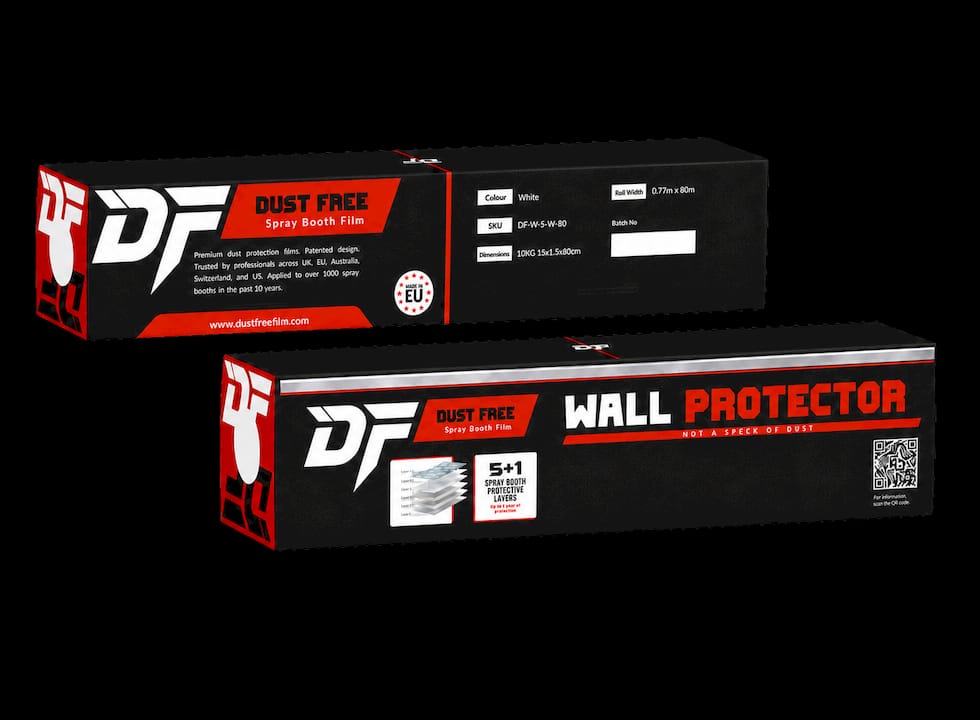
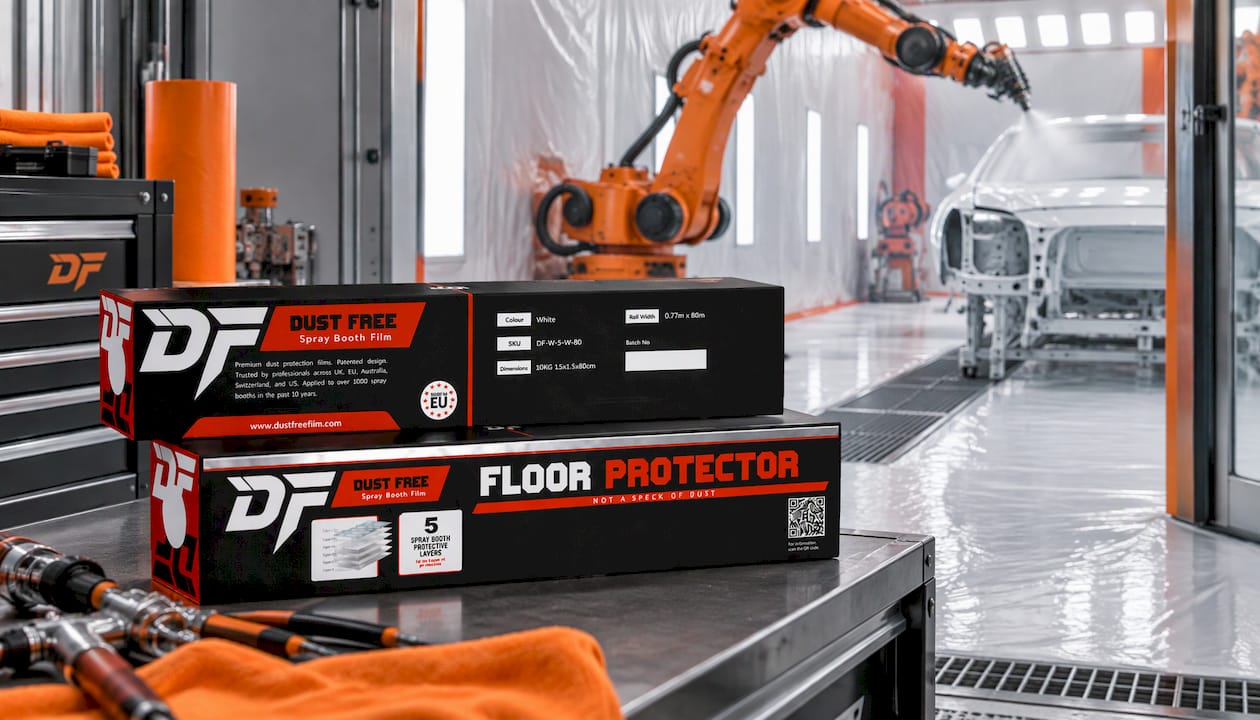
Dust Free Film’s multi-layer Wall Protector and Floor Protector are designed for this job. Their electrostatically charged surfaces attract and retain contamination, and removable layers let operators expose a fresh surface without reinstalling the whole system. Visible layer numbering shows how many layers remain, and integrated length markings help with cutting and planning coverage.
The two films are built for their positions:
- Wall Protector: slightly tacky for enhanced particle capture, with tape-free overlapping edges.
- Floor Protector: heavy-duty, durable and slip-resistant for demanding work areas.
- Heat: both resist operating temperatures of up to 80°C.
Installation is where many wall films cost time. Our patented application box has a freely rotating roll, reinforced wooden sides and an integrated metal cutting bar, so one installer can steady the box with one foot and dispense film in a straight line. For robotic booths specifically, see our guide to installing robotic painting booth film solo.
A simple routine follows from the design: after a batch or shift, peel the loaded top layer from walls and floor, check the layer number to see what is left, and keep painting. The booth surface is renewed in minutes, rather than cleaned over hours.
Measure whether it is working
Improvement you cannot see is improvement you cannot defend at the next budget meeting. Pick a baseline, change one thing at a time, and track the same measures each period.
- Paint used per part or per vehicle. Compare coating consumed against parts painted, normalized for part size and color.
- Transfer efficiency. Estimate the share of sprayed solids that ends up on the part, and compare against the typical ranges for your applicator type above.
- Film build. Confirm every tuning change keeps thickness within specification. A flow cut that thins the film is not a saving.
- Defect and rework rate. Count dirt, dry spray and run defects per hundred parts. Contamination falls only if the booth is cleaner, so track it alongside cleaning.
- Cleaning hours and chemical use. Log labor and solvent for booth cleaning per week, and downtime between color or batch changes.
- Filter pressure drop and change intervals. A rising loading rate can signal more overspray reaching the exhaust.
The audit and ROI guide on our site gives a structure for turning these numbers into a business case.
Our perspective
Robot programmers rightly spend their time on path, speed and atomization. But no setting reaches 100% transfer, and what is left over lands on your walls and floor. We design our films around that fact.
The Wall Protector and Floor Protector let one person renew a booth surface by removing a layer. Tape-free edges, numbered layers and the application box exist for one reason: to keep installation and renewal quick, so cleaning does not compete with production.
The most efficient robotic booths pair disciplined tuning with a protective surface designed to be replaced. That is the combination we build for.
Pavlos - Angelos Filippakis
Specify the film for your booth
If you run a robotic or manual booth and want less cleaning downtime, start with the 5-Layer Spray Booth Wall Protector and the 5-Layer Spray Booth Floor Protector. We supply body shops, booth operators, manufacturers and distributors internationally, through regional partners or directly from the factory, with support for bulk orders, custom configurations and worldwide shipping.
Tell us your booth dimensions and volumes and we will help you plan coverage. You can reach us through dustfreefilm.com.
FAQ
What is the fastest way to cut overspray in a robotic cell?
Start with geometry and speed: constant stand-off, applicator normal to the surface and tip speed below about 800 mm/s. Then adjust flow, atomizing air and overlap together. Confirm film build after each change.
Does booth airflow affect overspray control?
Yes. Weak or uneven airflow lets overspray linger and settle on walls, fixtures and the robot. Keep intake filters clean, seat exhaust filters without gaps, and replace them before airflow drops below the minimum required.
How do I know if my transfer efficiency is improving?
Track paint used per part against the typical range for your applicator type, and confirm film build stays in specification. Pair that with rework rate and cleaning hours, so you see the effect on both material and downtime.
How does protective film help in a robotic paint booth?
Overspray that escapes the part lands on booth surfaces. Our multi-layer films hold that contamination on charged surfaces, and removable layers let operators expose a fresh one without reinstalling the system, which shortens cleaning downtime.
Sources
- It’s Time for Your Robot, Paint & Coatings Industry, March 2022
- Driving down the High Cost of Overspray in Automotive Paint Processes, Mobility Engineering Technology, 2025
- Pollution Prevention & Spray Paint Transfer Efficiency, Indiana Department of Environmental Management
- The Intelligent Paint Solution, ABB
- Better Coating Parameters, Less Overspray, SprayVision
- Spray Finishing Particulate Filtration Best Practice Guidelines, NAFA, 2023
- Automobile Assembly Plant Spray Booth Cleaning Emission Review, U.S. EPA, 1994
- A Closer Look at Robotic Application in the Painting Industry, International Federation of Robotics
- Overspray: Causes, Prevention, and Rectification, PPG