
Protective booth films materially reduce dust- and overspray-related paint defects. That’s the short answer, and it’s backed by hard numbers: research from a 2018 IOP conference paper identifies dust and fiber as contributors to roughly 40–50% of defects on automotive painting lines. Films act as a physical and electrostatic barrier between contamination sources and the critical spray zone, cutting cleaning downtime and solvent use in the process.
Two quick operational facts worth keeping front of mind:
- Dust and fiber account for an estimated 40–50% of coating defects, making particulate control the single highest-leverage quality lever in most booths.
- Dustfreefilm’s multi-layer electrostatic films reduce the frequency of deep-clean cycles by capturing overspray on peelable layers that peel away in seconds rather than requiring solvent scrubbing.
Key Takeaways
Films that match your booth’s specs reduce inclusion-related defects, cut cleaning labor, and lower solvent use, making them one of the highest-ROI investments available to production supervisors managing spray-booth quality.
| Point | Details |
|---|---|
| Dust drives defects | Dust and fiber contribute roughly 40–50% of coating defects, making particulate control the top quality lever. |
| Three mechanisms matter | Physical barrier, electrostatic attraction, and peelable refresh each reduce contamination at a different stage. |
| Measure before and after | Log defect rate, rework hours, and solvent use for two weeks before and after installation to calculate real ROI. |
| Align changes with maintenance | Schedule film replacement with filter swaps and grate cleaning to minimize total production downtime. |
| Dustfreefilm pilot option | Dustfreefilm offers trial kits and bulk orders with a patented dispenser system for facilities ready to run a controlled pilot. |
Table of Contents
- How do protective films actually influence paint quality?
- What defects do films prevent, and how significant is the impact?
- How do films interact with your booth’s filtration and airflow systems?
- How do you choose the right film and dispenser system for your operation?
- Best practices for applying, changing, and maintaining protective films
- How do you measure the ROI of booth films?
- Common mistakes and how to fix them fast
- When should you combine films with other contamination controls?
- What’s the recommended path from interest to full rollout?
- A note from Dustfreefilm
- Dustfreefilm trial kits and bulk film options for your facility
- Sources
How do protective films actually influence paint quality?
Films reduce particle transfer and overspray adhesion to booth surfaces, which directly lowers the number of contamination sources active during a spray cycle. Three mechanisms drive that outcome.
Physical barrier. The film surface intercepts overspray before it bonds to walls, floors, or fixtures. Without a film, dried overspray builds up and re-enters the air stream with every door opening or air-balance shift.
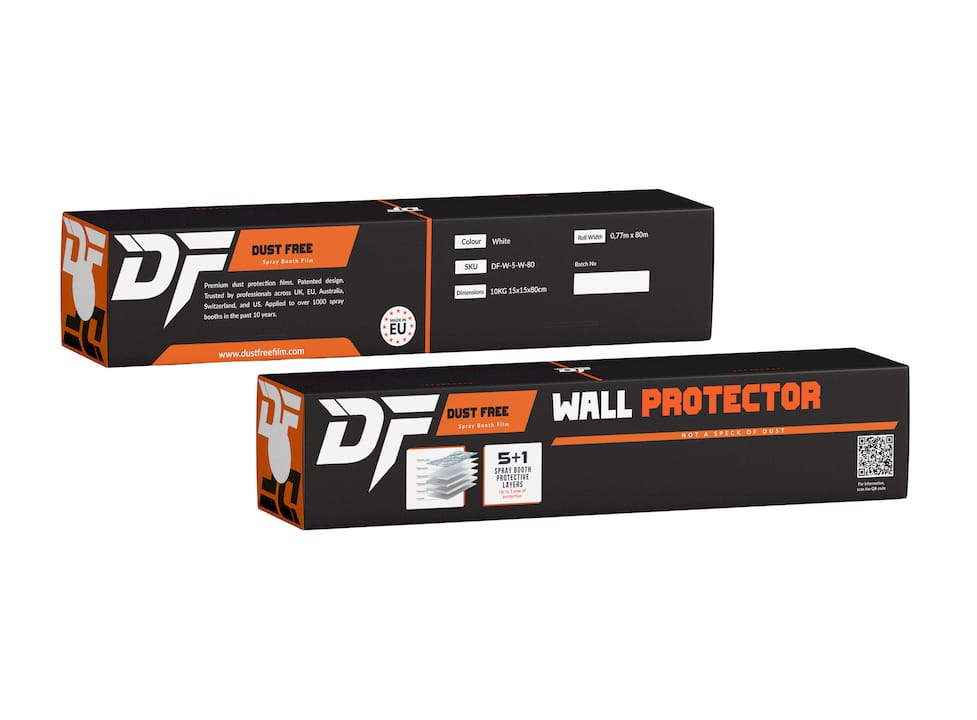
Electrostatic and tacky attraction. Multi-layer films with a static charge pull airborne particles toward the wall surface rather than letting them float through the critical zone. This is the same principle ionizers exploit, but applied passively at the surface level.
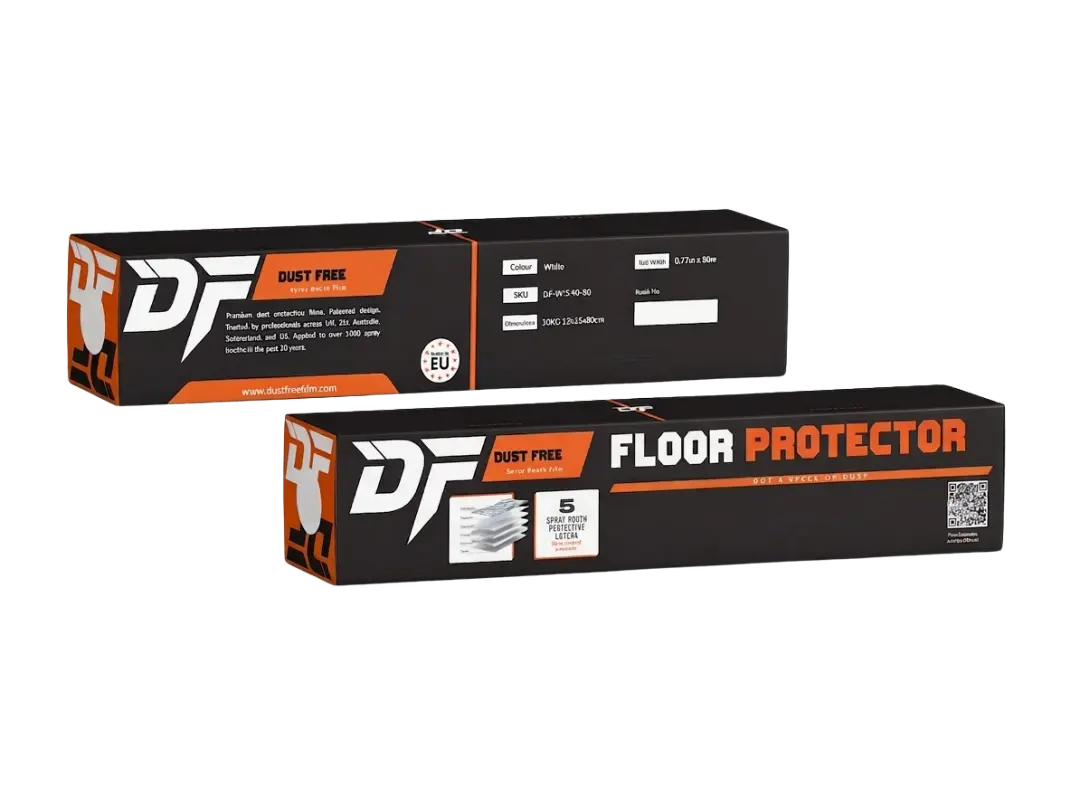
Peelable multi-layer refresh. When a layer is saturated, you peel it off and expose a clean, reflective surface underneath. Booth lighting stays effective, color-matching conditions stay consistent, and you avoid the reflectivity loss that accumulates when overspray coats bare walls.
Heat and solvent resistance matter here too. Films that degrade under oven temperatures or react with cleaning solvents can release particles or adhesive residue directly into the booth environment. Dustfreefilm’s heat-resistant films are designed to hold integrity through heated-booth cycles, which is a non-negotiable spec for any operation running a bake stage.
Protective films are best understood as a defect-prevention device that stabilizes the booth environment — airflow, heat, static interactions — not just a cleanliness cosmetic. The distinction matters when you’re writing a procurement spec.
What defects do films prevent, and how significant is the impact?
Films target three defect categories: particulate inclusion, overspray buildup, and floor contamination. Each has a distinct cause-and-effect chain.
- Particle inclusion: A loose fiber or dust particle lands in wet paint and creates a visible blemish. Rework is unavoidable.
- Overspray buildup on walls: Accumulated dried overspray reduces light reflectivity, degrading the inspection environment and masking surface defects until after cure.
- Floor contamination: Tracked-in debris gets re-suspended by foot traffic and booth airflow, then deposits on panels mid-spray.
With dust and fiber responsible for roughly 40–50% of painting-line defects, a controlled reduction in particulate sources translates directly into fewer inclusion-related reworks. A ScienceDirect process-analysis study found that focused parameter controls and Kaizen actions produced a ninefold reduction in impurity-related defects on one spray line, which shows how much headroom exists when contamination sources are systematically addressed.
Operationally, the downstream costs compound fast: rework hours, additional solvent and cleaner consumption, and potential warranty exposure on finished parts. Films don’t eliminate all of those costs, but they remove one of the largest contributing variables.
How do films interact with your booth’s filtration and airflow systems?
Films complement filtration and air balance; they don’t replace either. Filters control what’s airborne; films control what’s on surfaces. Run both.
Specific interactions to plan for:
- Ionizers: A film with a strong surface charge can partially counteract ionizer output near the wall. Test static levels after installation and adjust ionizer placement if needed.
- Film edges and airflow eddies: Poorly sealed edges create micro-turbulence that can lift particles back into the air stream. Seal all edges flush.
- Heat exposure: Adhesive integrity degrades above the film’s rated temperature. Confirm the film’s heat rating against your oven cycle before committing to a full installation.
- Peelable layers and cleaning cycles: Each peel-off resets the surface without solvents, which reduces VOC load per the P2 InfoHouse best-practice guidance on limiting solvent use to spray tips and bells.
BMW’s paintshop program demonstrates what’s possible at scale: sensor data and analytics predict dust trends and trigger earlier filter replacements, improving paint quality without adding manual inspection labor. That principle scales down to any booth with a particle counter and a log sheet.
Pro Tip: Schedule film changes to coincide with filter swaps. You’re already stopping production; combining both tasks cuts total downtime compared to running them separately.
How do you choose the right film and dispenser system for your operation?
Pick films whose specs match your booth’s temperature, solvent exposure, and throughput. The wrong film costs more in downtime than it saves in purchase price.
Selection checklist:
- Temperature rating (must exceed your peak oven or IR cure temperature)
- Static or electrostatic surface properties
- Adhesive type and residue profile (low-residue adhesives for sensitive substrates)
- Number of peelable layers relative to your spray cycle frequency
- Light reflectivity characteristics (higher reflectivity = better inspection conditions)
- Slip resistance for floor film in high-traffic zones
- Dispenser system ergonomics: roll width, bubble-free application, tape-free securement
Dispenser system considerations:
- Bubble-free application reduces trapped air pockets that become contamination traps.
- Tape-free securement (a feature of Dustfreefilm’s patented dispenser) speeds installation and avoids adhesive residue from tape edges.
- Roll width options should match your booth wall dimensions to minimize seams.
- Labor time per installation directly affects your ROI calculation.
Pro Tip: Run a two-week on-site trial before full rollout. Log defect rates and changeover time during the trial period. The numbers will make the procurement decision obvious.
Best practices for applying, changing, and maintaining protective films
Correct installation and a disciplined replacement cadence are what separate a film that performs from one that creates new contamination risks.
Application checklist:
- Clean and dry the substrate surface before applying.
- Confirm ambient and surface temperature are within the film’s rated application range.
- Use the dispenser to apply from top to bottom, smoothing as you go to eliminate bubbles.
- Seal all edges flush; unsecured edges lift in airflow and trap debris underneath.
- Inspect the installed surface under booth lighting before the first spray cycle.
Maintenance timeline:
- Daily: Visual check for lifted edges, tears, or heavy overspray saturation on floor film.
- Weekly: Inspect edge seals; coordinate tacky-coat application on wall sections not covered by film, per P2 InfoHouse booth-cleaning standards.
- Every 60–90 days: Replace floor film based on throughput volume, per Dustfreefilm’s replacement guidance. High-volume shops may need shorter intervals.
- Aligned with filter changes: Peel wall layers and replace floor film during scheduled filter maintenance to minimize production stops.
For removal, peel slowly at a low angle to avoid tearing and leaving adhesive residue. Avoid aggressive solvents on the underlying surface; confirm solvent compatibility before any chemical cleaning of bare booth walls or floors. A full spray booth maintenance workflow covers these steps in sequence.
Pro Tip: Keep a roll of replacement film staged inside the booth. A mid-shift peel-and-refresh takes under five minutes and costs nothing in scheduled downtime.
How do you measure the ROI of booth films?
ROI is measurable and driven primarily by reduced rework, lower cleaning labor, and less solvent consumption. Track those three numbers before and after installation.
KPIs to log:
- Inclusion-related defect rate (defects per 100 panels)
- Rework hours per week
- Solvent and cleaner gallons consumed per week
- Downtime hours for deep cleaning per month
Simple before/after example:
The ScienceDirect process-analysis study showed that systematic defect-reduction efforts can produce dramatic results when baselines are measured and controls are applied consistently.
Testing protocol:
- Log baseline KPIs for two weeks with no film changes.
- Install film and run an equal-duration test under the same paint and process conditions.
- Compare defect rates, rework hours, and solvent use.
- Calculate net annual savings against annual film cost to confirm positive ROI.
Common mistakes and how to fix them fast
Most film-related performance issues come from misapplication, wrong specs, or poor edge sealing, not from the film technology itself.
Troubleshooting checklist:
- Verify the film’s temperature rating against actual booth conditions.
- Inspect for trapped debris or bubbles introduced during application.
- Confirm dispenser alignment produced a flat, wrinkle-free surface.
- Rule out upstream particle sources: conveyor systems, personnel clothing, or open booth doors during spray cycles.
Quick fixes:
- Lifted edge: re-seal immediately with compatible tape or partial re-apply.
- Bubble pocket: puncture, smooth, and monitor; if the pocket recurs, the substrate surface needs cleaning before the next layer.
- Premature saturation: shorten replacement interval or add a wall-film layer in high-overspray zones.
Warning signs that point away from the film as the cause: a sudden defect spike across multiple booths simultaneously, filter failure alarms, or a change in paint batch chemistry. Those scenarios need a different diagnostic path. A contamination prevention checklist helps isolate the source systematically.
Pro Tip: If defect rates spike right after a film change, the most likely culprit is debris trapped under the new layer during application, not the film material itself. Re-apply with a cleaner substrate.
When should you combine films with other contamination controls?
Films are most effective as one layer in a layered strategy alongside filtration, tacky coats, ionizers, and monitoring. No single control handles everything.
Combination scenarios:
- Low-volume auto body shops: Film plus tacky coatings on walls and windows. Low cost, minimal maintenance complexity, meaningful defect reduction.
- High-volume OEM-style lines: Film plus sensor/AI monitoring plus scheduled filter swaps. BMW’s sensor-driven approach shows that predictive maintenance timing reduces both defect rates and unplanned downtime.
- ESD-sensitive environments: Film plus ionizers. Test surface charge after installation to confirm the two systems aren’t working against each other.
Each pairing has trade-offs. Tacky coats add labor but cost little. Ionizers add equipment cost and require periodic calibration. Sensor arrays require upfront investment but pay back in reduced filter waste and better timing of film changes.
Pro Tip: Use particle-counter trend data to time film and filter changes together. When particle counts trend upward, both are likely due for replacement simultaneously.
What’s the recommended path from interest to full rollout?
Run a short, controlled pilot using multi-layer dispenser film, measure the defect-rate delta, and scale when savings exceed costs.
Three-step rollout:
- Baseline (weeks 1–2): Log inclusion defect rate, rework hours, solvent use, and deep-clean downtime. Use the booth preparation checklist to standardize conditions before the pilot starts.
- Pilot (weeks 3–6): Install Dustfreefilm multi-layer wall and floor protectors in one booth using the patented dispenser system. Collect the same KPIs under identical process conditions.
- Phased rollout (weeks 7–12): If the pilot shows a positive defect-rate delta, extend to remaining booths aligned with the next scheduled filter and grate-cleaning cycle.
The ninefold impurity-defect reduction documented in the ScienceDirect process study was achieved through exactly this kind of structured, measurement-driven approach. The scale of improvement depends on your starting baseline, but the methodology transfers directly.
Pro Tip: Keep the pilot booth and a control booth running in parallel during weeks 3–6. Side-by-side data is far more persuasive in a budget review than a before/after comparison across different time periods.
A note from Dustfreefilm
Since 2012, Dustfreefilm has focused on one problem: keeping spray booths clean enough to produce consistent, defect-free finishes at production scale. The patented dispenser system came directly from shop feedback about bubble-prone manual application and the time lost to tape-and-trim methods. Multi-layer construction means a fresh surface is one peel away, not one cleaning cycle away.
If you’re evaluating films for your facility, the most useful next step is a trial with your own booth conditions and your own defect baseline. Contact the Dustfreefilm sales team for a facility assessment or to request a trial kit.
Dustfreefilm trial kits and bulk film options for your facility
Dustfreefilm offers production-ready film solutions for facilities that need measurable results, not just cleaner-looking walls.
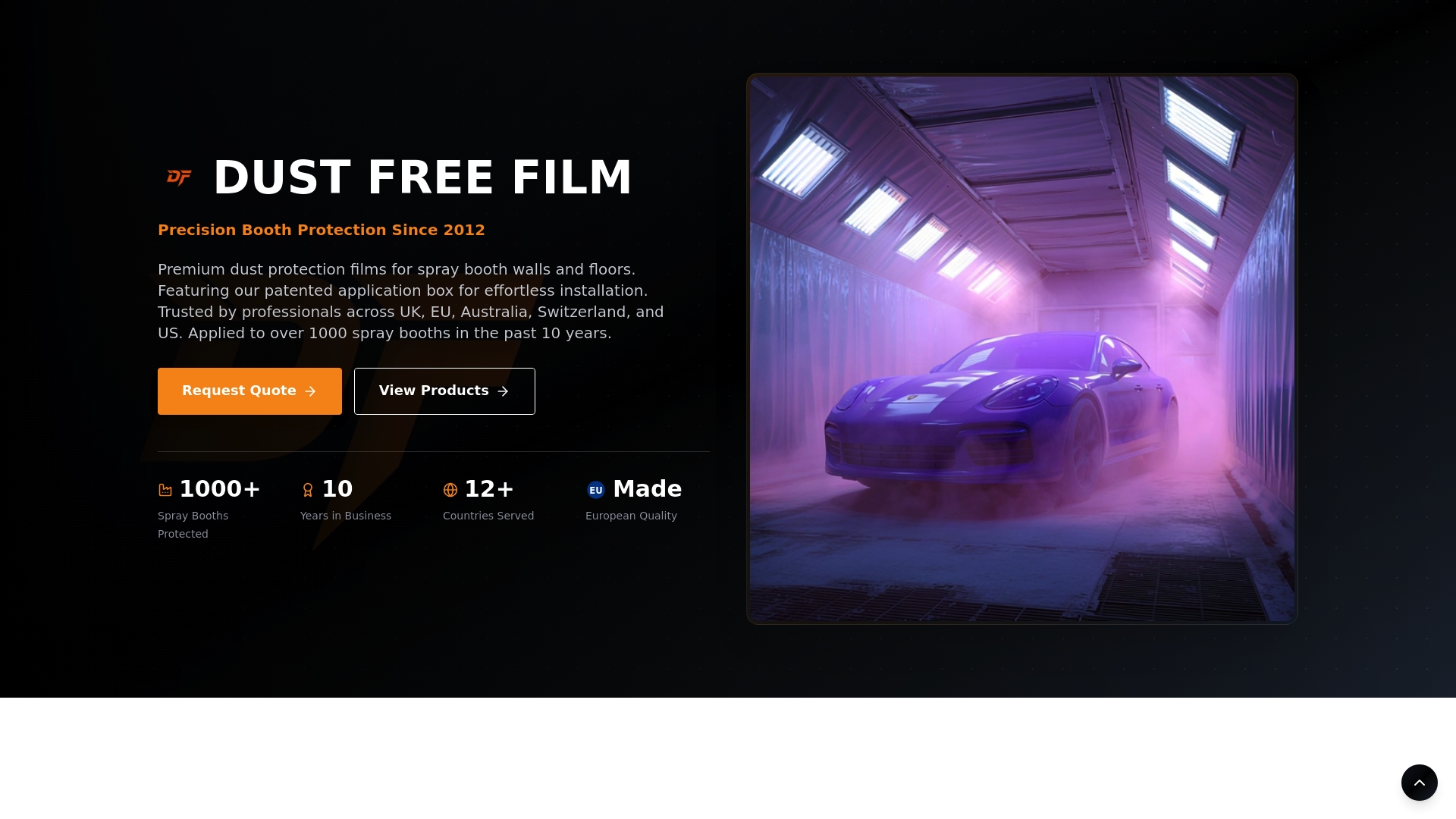
Trial kits include sample rolls of multi-layer wall and floor protectors with a patented dispenser unit, sized for a single-booth pilot. Bulk-quote and custom-configuration options are available for multi-booth facilities and high-volume operations. No guesswork on sizing: the team works through booth dimensions and throughput before quoting.
Options available:
- Trial kit: Single-booth sample rolls plus dispenser for a 2–6 week pilot.
- Bulk order: Factory-direct pricing for multi-booth or multi-facility rollouts.
- Custom configuration: Roll widths, layer counts, and adhesive profiles matched to your booth specs.
Request a quote or trial kit directly through the Dustfreefilm website and get your pilot started within days.
Sources
- Air ionizer application for electrostatic discharge (ESD) dust removal in automotive painting industry - IOPscience
- Spray booth cleaning and best practices (P2 InfoHouse compilation)
- AI and data analytics for the paintshop | Automotive Manufacturing Solutions
- Process analysis to reduce defects in spray painting lines (ScienceDirect)