

A coating is a thin layer of protective, decorative, or functional material applied to a substrate — and coatings application is the process of depositing that layer using a controlled method suited to the material, the part geometry, and the performance requirement. In industrial settings, getting that process right determines whether an asset lasts decades or fails in months.
The most common industrial application methods are:
- Spray application (airless, air-atomized, HVLP) — dominant in automotive and high-spec industrial work
- Dip coating — used for small, irregular parts where full immersion gives uniform coverage
- Flow coating — a controlled pour over large or complex shapes
- Roll and brush application — practical for maintenance work and large flat surfaces
- Powder coating — electrostatically applied dry powder, then cured by heat; no solvents
- Electrostatic spray — charged liquid or powder particles drawn to a grounded substrate
- Vapor deposition (PVD/CVD) — thin-film specialty process for precision components
Each method carries trade-offs in transfer efficiency, finish quality, equipment cost, and environmental impact. The sections below map those trade-offs so you can make a defensible choice on the shop floor.
Table of Contents
- Why are coatings applied in the first place?
- What types of industrial coatings should you know?
- How does a coating system work as a whole?
- What are the main coating application methods?
- Why does surface preparation control coating life?
- How do you verify a coating was applied correctly?
- How do you choose the right coating and method?
- What health, safety, and environmental rules apply to U.S. coating work?
- How does dust and environmental control affect coating outcomes?
- Key Takeaways
- The part of coatings application most facilities underestimate
- Dustfreefilm keeps dust out of your coating results
- Useful sources and standards for coatings application
Why are coatings applied in the first place?
Coatings serve multiple purposes, and understanding those purposes is what connects material selection to real-world performance. A coating chosen purely on price, without matching it to the service environment, will fail early regardless of how well it was applied.
Primary purposes:
- Corrosion control — barrier and sacrificial coatings prevent oxidation on steel, aluminum, and other metals exposed to moisture, salt, or chemicals
- Abrasion and chemical resistance — hard epoxy or polyurethane layers protect surfaces subject to mechanical wear or solvent exposure
- Aesthetics and identification — color, gloss, and sheen serve visual goals, but on industrial pipelines, color coding also carries safety information
- Cleanliness and non-stick properties — food-processing equipment and pharmaceutical vessels rely on smooth, non-porous coatings to meet hygiene standards
- Electrical and thermal properties — dielectric coatings insulate; thermal barrier coatings protect components from heat cycling
- Slip resistance — textured floor coatings reduce fall risk in warehouses and production areas
Real-world stakes vary sharply by industry. An offshore platform coating system faces salt spray, UV, mechanical impact, and temperature swings simultaneously. A pipeline coating must resist soil stress and cathodic disbondment. An automotive topcoat needs UV stability and chip resistance. An industrial floor coating takes forklift traffic and chemical spills. In each case, the coating is not a single product but a system: primer, intermediate coat, and topcoat working together. No single layer does everything well, and treating a coating job as a one-product fix is one of the fastest ways to generate expensive rework.
What types of industrial coatings should you know?
The table below covers the coating families you will encounter most often in U.S. industrial and commercial work. Lifespan figures are general ranges; actual service life depends heavily on surface prep, application quality, and service environment.
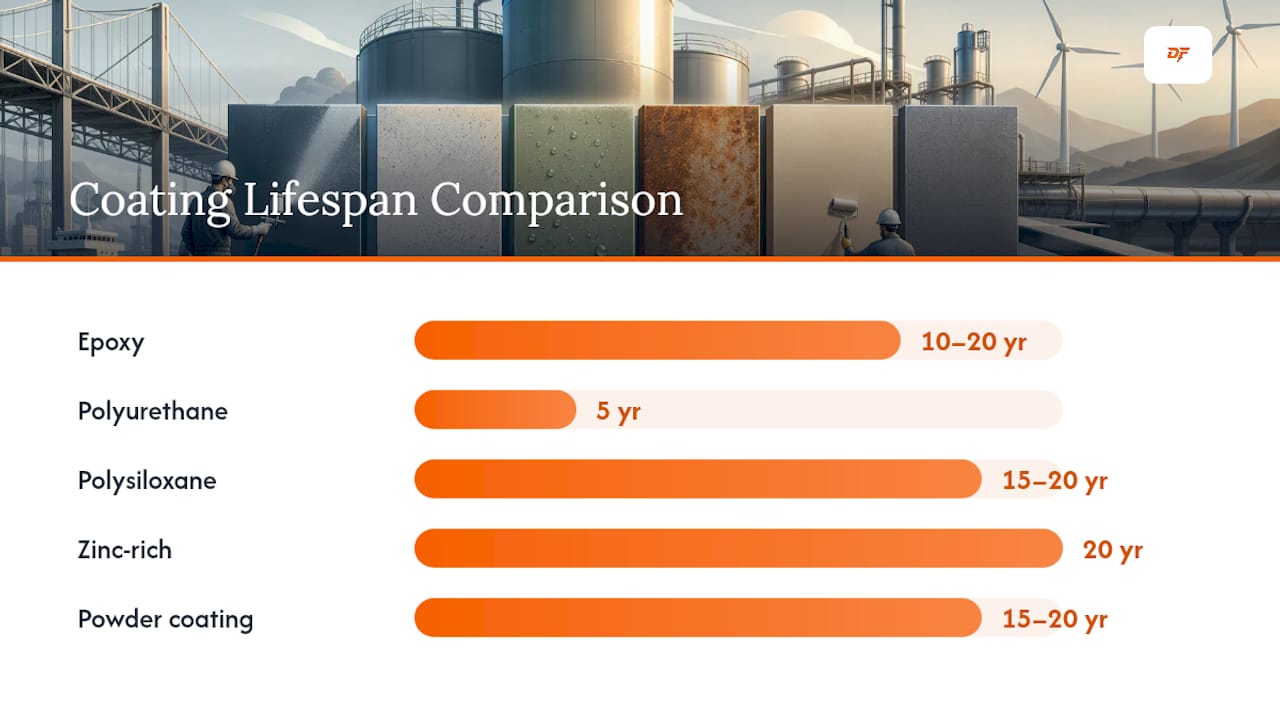
| Coating type | Best for / typical use | Durability / lifespan | Chemical & corrosion resistance | Application methods | Relative cost | Cure / dry time | Surface prep required |
|---|---|---|---|---|---|---|---|
| Epoxy | Steel structures, tanks, pipelines, floors | 10–20 years (system-dependent) | Excellent chemical, good corrosion | Spray, roll, brush | Moderate | 4–24 hrs (temp-dependent) | Abrasive blast to SSPC-SP 6 or better |
| Polyurethane | Topcoats, UV-exposed surfaces, flooring | 5 years | Good chemical, excellent UV | Spray, roll | Moderate–high | 2–8 hrs | Clean, dry surface; epoxy primer preferred |
| Polysiloxane | Marine, offshore, architectural topcoats | 15–20 years | Excellent UV and weathering | Spray | High | 1–4 hrs | Epoxy intermediate required |
| Zinc-rich (organic/inorganic) | Structural steel, bridges, marine | 20 years (with topcoat) | Excellent sacrificial corrosion protection | Airless spray | Moderate | 30 min | Near-white blast (SSPC-SP 10) |
| Powder coating | Metal parts, appliances, automotive components | 15–20 years | Good–excellent (formulation-dependent) | Electrostatic spray + oven cure | Moderate | 10 min (oven) | Phosphate pretreatment or blast |
| Acrylic / lacquer | Light-duty decorative, wood, plastics | 3–8 years | Low–moderate | Spray, brush | Low | 30 min | Clean, sanded surface |
Epoxy: Outstanding adhesion and chemical resistance make it the workhorse primer and intermediate coat for steel. Its weakness is UV degradation — it chalks outdoors, so it almost always needs a polyurethane or polysiloxane topcoat in exposed environments.
Polyurethane: The go-to finish coat where UV stability and gloss retention matter. It is more flexible than epoxy, which helps on surfaces subject to thermal movement. Moisture-cure polyurethanes can be applied in higher humidity conditions than most two-component systems.
Zinc-rich coatings: These work sacrificially — the zinc corrodes preferentially to protect the steel underneath, similar to galvanizing. Inorganic zinc silicates require near-white blast and precise application conditions; organic zinc-rich primers are more forgiving but offer slightly lower performance.
Powder coatings: No solvents, minimal VOC emissions, and high transfer efficiency — electrostatic and powder methods can reach 90–95% application efficiency in controlled setups. The limitation is that parts must be electrically conductive and able to withstand oven temperatures, which rules out most plastics and large assembled structures.
Special-purpose categories worth knowing: high-solids epoxies (lower VOC, fewer coats needed), low-VOC waterborne systems (increasingly specified under EPA and state air quality rules), and fusion-bonded epoxy (FBE) for pipeline interiors and exteriors.
How does a coating system work as a whole?
A coating system is a designed sequence of layers, each with a specific job. Thinking in systems rather than individual products is what separates a 20-year asset from a 5-year maintenance headache.
Layer roles in a typical industrial system:
- Primer — bonds to the substrate, provides corrosion inhibition, and creates the mechanical anchor for subsequent coats. Zinc-rich primers on steel are the classic example.
- Intermediate coat (build coat) — adds film thickness, improves barrier properties, and bridges the primer and topcoat. Epoxy mid-coats are standard on marine and industrial structures.
- Topcoat — provides the final surface properties: UV resistance, color, gloss, chemical resistance, or texture. Polyurethane and polysiloxane dominate in outdoor and high-visibility applications.
Compatibility between layers is not optional. Applying a strong-solvent topcoat over a soft or incompletely cured primer can lift or wrinkle the primer. A hard, brittle topcoat over a flexible intermediate can crack under thermal cycling. Incompatible topcoats over existing systems are a documented cause of early failure — and some incompatibility problems only show up after months of weathering, which makes them expensive to diagnose.
Common pairings in U.S. industrial practice:
- Inorganic zinc primer → epoxy intermediate → polyurethane topcoat (structural steel, bridges)
- Epoxy primer → epoxy mid-coat → polysiloxane topcoat (offshore, marine)
- Epoxy primer → polyurethane topcoat (industrial equipment, automotive)
- Phosphate pretreatment → powder coat (metal parts, appliances)
When you are recoating over an existing system, always verify generic-type compatibility before specifying. A coating supplier’s technical data sheet will list approved overcoat systems; when in doubt, run a test patch before committing to a full application.
What are the main coating application methods?
Method selection shapes finish quality, production speed, material waste, and environmental compliance. Here is how the primary methods compare in practice.
-
Airless spray — High-pressure pump atomizes coating without air. Fast, high film build per pass, and suitable for large surfaces. Standard in structural steel, tank, and pipeline work. Overspray is lower than air-atomized spray, but tip selection and pressure control are critical for uniform thickness.
-
Air-atomized spray — Compressed air breaks the coating into fine droplets. Produces a finer finish than airless, preferred for automotive topcoats and precision industrial work. Transfer efficiency is lower, and overspray increases VOC emissions in the booth.
-
HVLP (high-volume, low-pressure) spray — Reduces overspray and improves transfer efficiency versus conventional air spray. Common in automotive refinishing and smaller industrial parts. Slower than airless for large areas.
-
Electrostatic spray — The coating is electrically charged; the grounded part attracts particles, including around edges and into recesses. Transfer efficiency reaches 90–95% in optimized setups, cutting material waste and emissions significantly. Requires conductive substrates.
-
Powder coating — Dry powder is electrostatically applied, then cured in an oven at 325–400°F. No solvents, no VOC emissions during application, and overspray is fully recoverable. Limited to heat-tolerant, conductive parts. The oven cure also means it is impractical for field application on large structures.
-
Dip coating — Parts are immersed in a tank of coating material, then withdrawn at a controlled rate. Excellent for small, complex shapes where spray coverage would be uneven. Film thickness is controlled by withdrawal speed and coating viscosity. Common in automotive primer application (electrocoat/e-coat) and hardware finishing.
-
Roll and brush application — Practical for maintenance repainting, touch-up, and large flat surfaces where spray is impractical (confined spaces, wind). Slower and more labor-intensive, but requires minimal equipment. Film thickness control is less precise than spray.
-
Vapor deposition (PVD/CVD) — Physical or chemical vapor deposition lays down extremely thin, hard films (microns thick) on precision components: cutting tools, medical implants, semiconductor parts. Not a field or general industrial method; requires vacuum chambers and specialized equipment.
Which method fits which industry? Spray dominates automotive refinishing and high-spec structural work. Dip and e-coat are standard in automotive OEM primer lines. Powder coating is the default for metal parts manufacturing. Roll and brush remain the practical choice for maintenance work in the field.
Pro Tip: When spraying in a booth, always verify that your spray gun tip size matches the coating’s viscosity spec. A tip that is too large on a thin topcoat produces runs; a tip too small on a high-build epoxy creates excessive atomization pressure and orange-peel texture.
Why does surface preparation control coating life?
Surface preparation is the single most important variable in coating durability. Industry guidance consistently attributes the majority of coating failures to inadequate surface prep rather than to the coating material itself. You can apply the most expensive polysiloxane system on the market and watch it fail in two years if the steel underneath was not properly cleaned and profiled.
Standard surface preparation methods:
- Solvent cleaning (SSPC-SP 1) — removes oil, grease, and soluble salts. Always the first step, even before mechanical prep.
- Hand and power tool cleaning (SSPC-SP 2/3) — removes loose rust and mill scale. Adequate for low-corrosivity environments; not sufficient for high-performance systems.
- Abrasive blast cleaning — the standard for structural steel. SSPC-SP 6 (commercial blast) is the minimum for most epoxy primers; SSPC-SP 10 (near-white blast) is required for zinc-rich primers and immersion service. Blast profile (anchor pattern) is measured in mils and must match the coating’s specified range.
- Waterjetting (SSPC-SP 12/NACE No. 5) — high-pressure water removes existing coatings and soluble salts without creating a new profile. Used when abrasive blast is impractical or when salt contamination is a primary concern.
- Chemical treatment — phosphating, chromating, or conversion coatings for metals before powder coating or automotive primer.
- Profile measurement — surface roughness is measured with a replica tape (Testex Press-O-Film) or digital profilometer. A profile that is too shallow reduces mechanical adhesion; too deep can cause coating bridging over peaks.
Hold points for surface prep inspection include: cleanliness grade verification, soluble salt testing (Bresle patch or equivalent), and profile measurement — all before primer application. SSPC/AMPP standards govern the specification language for U.S. industrial work.
Pro Tip: Before applying a new coating system over an existing one, do a quick MEK (methyl ethyl ketone) rub test: saturate a cloth and rub the existing surface 50 times. If the cloth picks up significant color or the surface softens, the existing coating is not fully cured or is incompatible with solvent-borne topcoats. A small test patch applied and allowed to cure for 48–72 hours will catch adhesion and wrinkling problems before they become a full-scale rework event.
How do you verify a coating was applied correctly?
Curing and drying are not the same thing. A coating can be dry to the touch in an hour but not reach full chemical cure for days. Applying a topcoat over an under-cured intermediate coat is a common cause of intercoat adhesion failure — the solvents in the topcoat attack the soft layer beneath.
Environmental variables that affect curing:
- Temperature below the coating’s minimum application temperature slows or stops cure
- Relative humidity above the specified maximum causes blushing (moisture entrapment) in two-component systems
- Dew point within 5°F of the substrate temperature causes condensation, which destroys adhesion
Applying coatings outside recommended ambient conditions commonly produces defects that cannot be corrected without full removal. A calibrated thermometer, psychrometer, and surface temperature gauge are basic booth equipment, not optional extras.
Common inspection tests:
- Dry film thickness (DFT) — measured with a calibrated magnetic or eddy-current gauge (per ASTM D7091). Each coat and the total system DFT must fall within the specified range. Too thin means under-protection; too thick can cause cracking or solvent entrapment.
- Adhesion testing — cross-cut (ASTM D3359) or pull-off (ASTM D4541) tests quantify how well the coating bonds to the substrate or previous coat.
- Holiday / continuity testing — a low-voltage wet sponge or high-voltage spark tester detects pinholes and voids in immersion or buried-service coatings where any discontinuity is a corrosion initiation site.
- Visual inspection — runs, sags, orange peel, blistering, and dry spray are identified by eye under adequate lighting before the next coat is applied.
Inspection hold-point checklist for a multi-coat job:
- Pre-application: verify surface cleanliness grade, profile, and ambient conditions (temp, RH, dew point)
- After primer: DFT check, visual inspection, hold for minimum recoat interval
- After intermediate coat: DFT check, visual, hold for recoat interval
- After topcoat: final DFT, adhesion test, holiday test (if specified), color and gloss check
- Post-cure: final documentation and sign-off before the asset returns to service
A standard industry workflow treats these hold points as mandatory stops, not suggestions. Skipping them is how facilities end up recoating a structure two years into a ten-year specification.
How do you choose the right coating and method?
The right coating system for a project is determined by the intersection of service environment, substrate, access, budget, and timeline. No single coating or method is universally best.
Decision factors to work through:
- Service environment — corrosivity category (C1–C5 per ISO 12944), chemical exposure, UV, temperature range, and immersion or buried service
- Substrate — steel, aluminum, concrete, wood, and plastics each require different primers and prep methods
- Expected service life — a 5-year maintenance cycle tolerates a different system than a 25-year design life
- Access and geometry — complex shapes favor dip or electrostatic spray; large flat surfaces favor airless spray or roll
- Cure time constraints — a facility that cannot afford 72 hours of downtime needs a fast-cure system, even if it costs more per gallon
- Life-cycle cost — initial material cost can be outweighed by lower maintenance frequency and longer service intervals; a high-performance polysiloxane topcoat that lasts 20 years often beats a cheaper acrylic that needs recoating every 5
Questions to ask your coating supplier or contractor before specifying:
- What is the specified DFT range for each coat and the total system?
- What are the minimum and maximum recoat intervals at the expected application temperature?
- What VOC content does the system carry, and does it comply with local air district rules?
- Is the system compatible with the existing coating (if recoating)?
- What surface prep grade is required, and what profile range?
- What are the minimum application temperature and maximum humidity limits?
- What is the cure window before the asset can return to service or be immersed?
Timeline and cost are shaped by prep intensity, layer count, and cure hold times more than by material price. A three-coat system on blast-cleaned steel with 24-hour recoat intervals adds three days of labor and downtime before the asset is back in service. Factor that into the total project cost, not just the paint bill. For maximizing asset life over a full maintenance cycle, the life-cycle cost model almost always favors investing in better prep and a higher-performance system upfront.
What health, safety, and environmental rules apply to U.S. coating work?
Industrial coating work in the United States sits under overlapping OSHA, EPA, and state-level regulations. Ignoring them is not just a compliance risk — solvent-borne coatings are genuinely hazardous to workers and the surrounding environment.
Key compliance areas:
- OSHA ventilation and PPE — spray booths must meet OSHA 29 CFR 1910.94 requirements for ventilation airflow. Respirators (supplied-air or air-purifying with organic vapor cartridges) are required when spraying solvent-borne coatings. Skin and eye protection are mandatory.
- EPA VOC rules — the EPA’s National Emission Standards for Hazardous Air Pollutants (NESHAP) and state implementation plans cap VOC content for industrial surface coatings. Many states (California, Texas, and others) have stricter limits than the federal baseline.
- Fire and explosion risk — solvent-borne coatings in a spray booth create explosive atmospheres. Booths must be rated for flammable materials, with intrinsically safe electrical equipment and automatic fire suppression.
- Hazardous waste disposal — spent solvents, coating waste, and contaminated PPE are regulated under RCRA. Disposal must go through a licensed hazardous waste contractor.
Shop-floor safety checklist:
- Verify booth airflow rate before each shift (minimum 100 FPM across the booth face per OSHA)
- Confirm all ignition sources are removed or rated for the hazardous area classification
- Issue correct respirator and verify fit before spraying begins
- Keep spill containment materials (absorbent, containment trays) at the ready
- Label and segregate waste containers; never mix solvent waste streams
- Post SDS (Safety Data Sheets) for every coating material in use
Waterborne and high-solids systems reduce VOC emissions and fire risk significantly. Many facilities are shifting to these formulations not just for compliance but because they simplify booth management and reduce waste disposal costs. Dust control and ventilation management in the booth directly affect both safety and finish quality.
How does dust and environmental control affect coating outcomes?
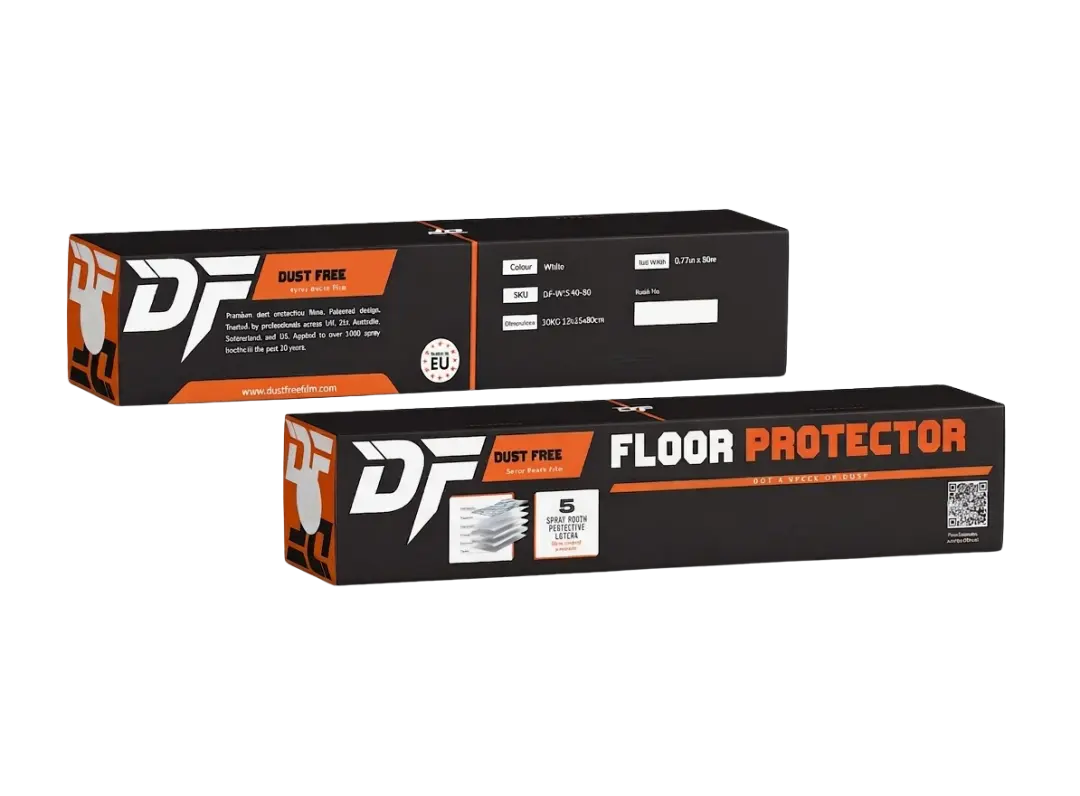
Dust and environmental contamination are leading causes of coating rework, and they are also among the most preventable. Environmental control during application frequently determines whether a job achieves its specified service life or requires early intervention.
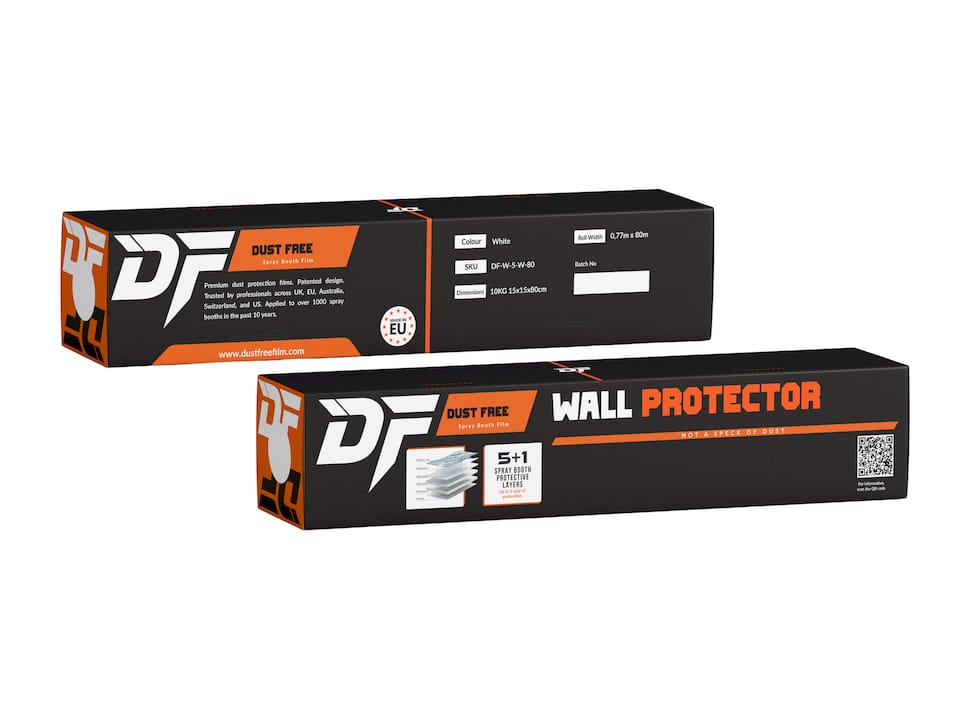
The failure modes are well-documented. Dust particles that settle on a wet coat create surface defects that must be sanded out or stripped. Blushing occurs when moisture condenses into a two-component coating during cure. Blistering and delamination follow when contaminants are trapped beneath a coat and moisture or solvent vapor migrates through the film. Each of these defects is a QA hold-point failure that adds labor, materials, and downtime.
Practical dust-control actions for spray booths and prep areas:
- Install and maintain pre-filters and final filters rated for the booth’s airflow; replace on a scheduled basis, not when they look dirty
- Use multi-layer electrostatic booth wall and floor protection films to prevent dust shed from booth surfaces contaminating fresh coats
- Sequence work to minimize foot traffic and part movement while coatings are wet or curing
- Implement clean-room procedures for small, high-value parts: dedicated prep area, controlled entry, and air showers where justified
- Monitor and log temperature, relative humidity, and dew point at the start of each shift and at each hold point
The connection between dust control and inspection hold points is direct. A booth that sheds contamination onto a freshly applied primer will fail the visual inspection at the first hold point, forcing a rework cycle before the intermediate coat can go on. Addressing the source — booth surface contamination — is faster and cheaper than managing defects after the fact. Structured surface protection processes in spray booths have demonstrated measurable reductions in rework rates for facilities that implement them systematically.
Key Takeaways
Industrial coatings application requires matching the coating system, application method, and environmental controls to the substrate and service environment — surface preparation remains the single biggest determinant of how long any system lasts.
| Point | Details |
|---|---|
| Surface prep dominates durability | Industry guidance attributes the majority of coating failures to inadequate surface prep, not coating material choice. |
| System thinking beats single-product selection | Primer, intermediate coat, and topcoat must be compatible; incompatible layers cause failures that may not appear for months. |
| Method selection affects efficiency and compliance | Electrostatic and powder methods reach 90–95% transfer efficiency; conventional spray generates more overspray and higher VOC emissions. |
| Environmental control is a production variable | Temperature, humidity, and dew point outside specified limits cause defects requiring full removal; monitor at every hold point. |
| Dustfreefilm addresses a root cause of rework | Multi-layer electrostatic booth films from Dustfreefilm prevent surface contamination that triggers QA failures and rework cycles. |
The part of coatings application most facilities underestimate
Most conversations about coatings application focus on material selection: which epoxy, which polyurethane, which zinc primer. That is the wrong place to spend most of your attention. The coating itself is almost never the reason a job fails prematurely.
What actually drives outcomes is the combination of surface preparation quality, environmental control during application, and inspection discipline at hold points. A mediocre coating applied over a properly blasted, clean, dry surface in a controlled booth will outlast a premium system applied over marginal prep in a contaminated environment. That is not a controversial claim in the coatings industry; it is the consensus of every major standards body from SSPC/AMPP to WBDG.
The practical implication for facility managers is that budget allocation matters more than product selection. Spending on blast equipment, booth environmental controls, and trained inspectors returns more value per dollar than upgrading from a good coating to a great one. The MEK rub test and the test patch cost almost nothing. A proper Bresle patch salt test before priming costs minutes. Skipping them to save time is the most expensive decision a facility can make.
Dust control deserves the same seriousness as surface prep. A booth that sheds contamination onto wet coats is not a minor inconvenience; it is a systematic rework generator. Facilities that treat booth cleanliness as a production variable — not a housekeeping issue — consistently see better first-pass quality and lower total coating costs.
Dustfreefilm keeps dust out of your coating results
Rework from dust contamination in spray booths is one of the most common and most avoidable cost drivers in industrial coating operations. Dustfreefilm’s multi-layer electrostatic protection films are built specifically for this problem: they line booth walls and floors, prevent dust shed from booth surfaces, and peel away cleanly between jobs without leaving adhesive residue or requiring tape.
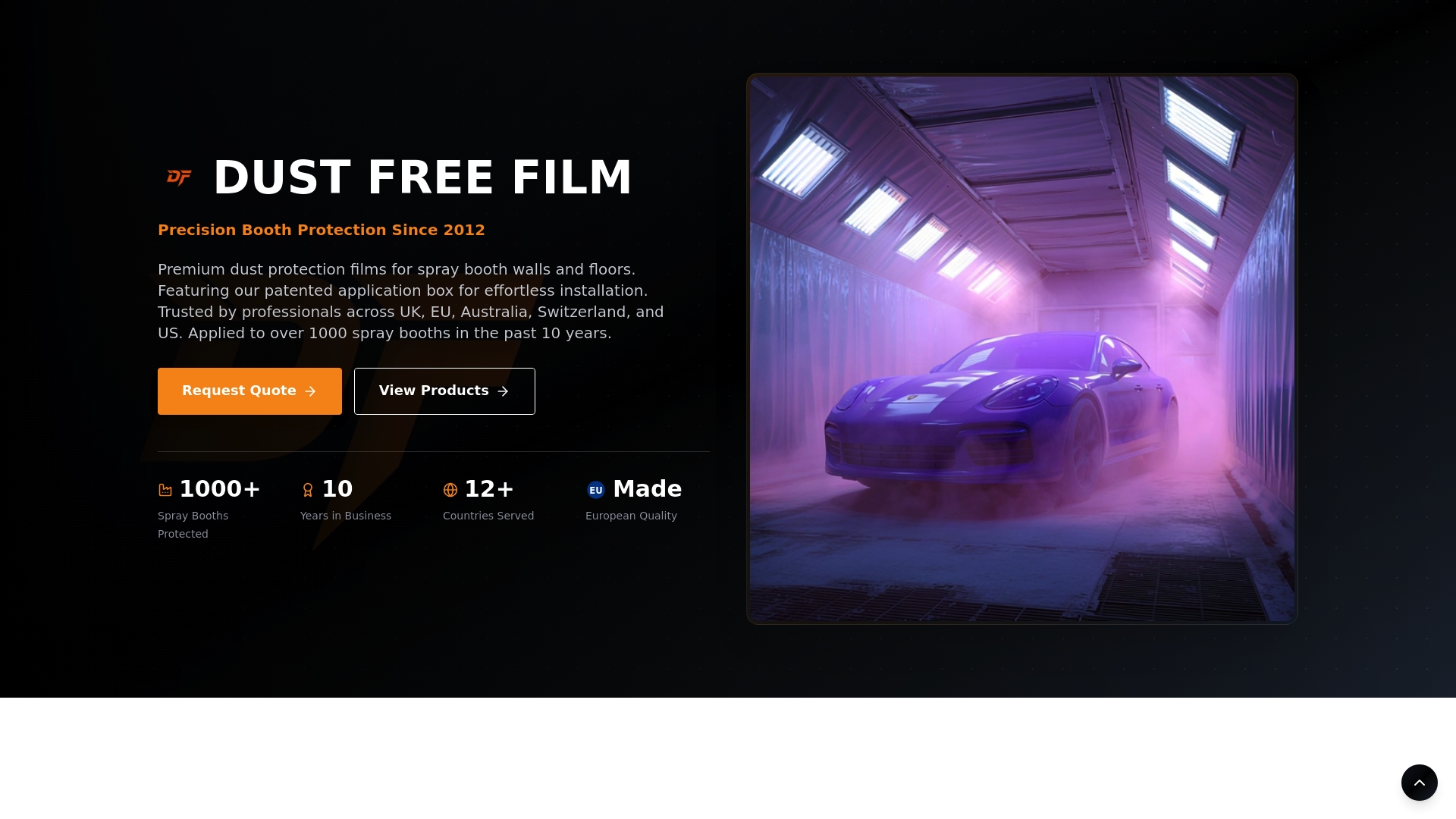
The patented dispenser system installs each layer fast, without bubbles or wrinkles, so booth downtime between jobs stays minimal. Films are heat-resistant and static-free, which matters in booths running solvent-borne coatings at elevated temperatures. Custom configurations are available for non-standard booth dimensions, and bulk ordering supports high-volume operations. If dust contamination is generating QA hold-point failures in your facility, contact Dustfreefilm for product details or a quote at dustfreefilm.com.
Useful sources and standards for coatings application
These organizations set the technical standards, regulatory requirements, and best-practice guidance that govern industrial coatings work in the United States. Consult them when writing specifications, evaluating contractors, or verifying compliance.
| Authority | What it covers | When to consult |
|---|---|---|
| SSPC/AMPP | Surface preparation grades (SP 1–SP 12), coating inspection standards, inspector certification | Writing surface prep specs; qualifying inspectors |
| ASTM International | DFT measurement (D7091), adhesion testing (D3359, D4541), holiday testing, coating performance tests | Specifying inspection methods and acceptance criteria |
| EPA — NESHAP | VOC emission factors, NESHAP for industrial surface coating, hazardous air pollutant limits | Verifying VOC compliance; selecting low-emission coating systems |
| OSHA 29 CFR 1910.94 | Spray finishing operations: ventilation, fire protection, PPE requirements | Setting up or auditing a spray booth; safety program development |
| WBDG — Paints and Coatings | Coating selection guidance, system specifications, lifecycle cost principles | Selecting coating systems for federal or high-performance applications |
| PDHOnline — Coatings and Paints | Technical overview of coating chemistry, compatibility, and application methods | Training reference for engineers and inspectors |