

TL;DR:
- Electrostatic film actively attracts and neutralizes airborne dust, reducing paint defects.
- Different film types (conductive, dissipative, anti-static) suit specific static control needs.
- Proper selection and application of electrostatic film enhance spray booth cleanliness and efficiency.
Paint defects are expensive. Every rework cycle burns labor hours, consumes materials, and delays throughput. Yet most facility managers still rely on traditional drop cloths or standard plastic films that do nothing about the real culprit: airborne dust driven by static charge. Electrostatic film takes a fundamentally different approach, using static properties to actively attract and neutralize dust before it lands on your painted surface. This guide covers what electrostatic film is, how it works, the key types available, and how to choose the right one for your spray booth operation. The result? Higher finish quality, fewer defects, and measurable gains in operational efficiency.
Table of Contents
- What is electrostatic film? Core principles explained
- Types of electrostatic film: Conductive vs. dissipative vs. anti-static
- How electrostatic film works: Mechanism and practical benefits
- Choosing and optimizing electrostatic film for your spray booth
- The hidden difference: Why electrostatic film outperforms traditional solutions
- Enhance your spray booth’s results with specialized electrostatic films
- Frequently asked questions
Key Takeaways
| Point | Details |
|---|---|
| Active dust control | Electrostatic film traps dust before it contaminates wet paint, improving finish quality. |
| Reduced coating defects | Using the right film can lower coating defects by up to 25% compared to standard protection. |
| Tailored solutions | Selecting the proper film type for your spray booth’s environment ensures maximum effectiveness and ROI. |
| Easy integration | Electrostatic film installs without adhesives and complements humidity and ionization controls for best results. |
What is electrostatic film? Core principles explained
Electrostatic film is not just another layer of plastic. It is a specialized PE-based film that uses static charge for adhesion and dust control without any adhesive backing. That single distinction changes everything about how it performs inside a spray booth.
Standard protective films rely on adhesive layers or gravity to stay in place. They passively block dust that settles onto surfaces but do nothing to stop particles already floating in the booth’s air column. Electrostatic film works differently. Its surface carries a controlled charge that actively pulls airborne dust toward the film and away from your substrate. When dust contacts the charged surface, it gets trapped and neutralized. The result is a cleaner booth environment throughout the entire spray cycle.
Most electrostatic films are manufactured from polyethylene (PE) modified with anti-static, dissipative, or conductive additives during the extrusion process. This gives the material its charge-management properties without compromising flexibility or heat resistance. You can find more about the electrostatic film meaning and how it connects to dust control outcomes in our dedicated guide.
How electrostatic film compares to traditional options:
| Feature | Electrostatic film | Standard plastic film | Drop cloths |
|---|---|---|---|
| Dust attraction | Active (charge-based) | Passive | Passive |
| Adhesive required | No | Yes or weighted | No |
| Static neutralization | Yes | No | No |
| Reusability | Single-use | Limited | Multiple uses |
| Defect reduction | Up to 25% fewer defects | Minimal | Minimal |
| Heat resistance | High (specialized variants) | Moderate | Low |
Key properties that define electrostatic film’s performance:
- Static management: Actively manages charge buildup rather than ignoring it
- Dust trapping: Pulls and holds particles that would otherwise settle on painted surfaces
- No adhesive residue: Safe for booth walls, floors, and adjacent surfaces
- Material compatibility: Works with standard booth materials including steel, coated panels, and concrete floors
- Layered construction: Multi-layer variants allow sequential peeling for extended booth use
Facilities that have switched to boosting spray booth performance with electrostatic film report up to 25% fewer coating defects compared to conventional alternatives. That number translates directly to reduced rework, lower material waste, and faster vehicle or part throughput.
Types of electrostatic film: Conductive vs. dissipative vs. anti-static
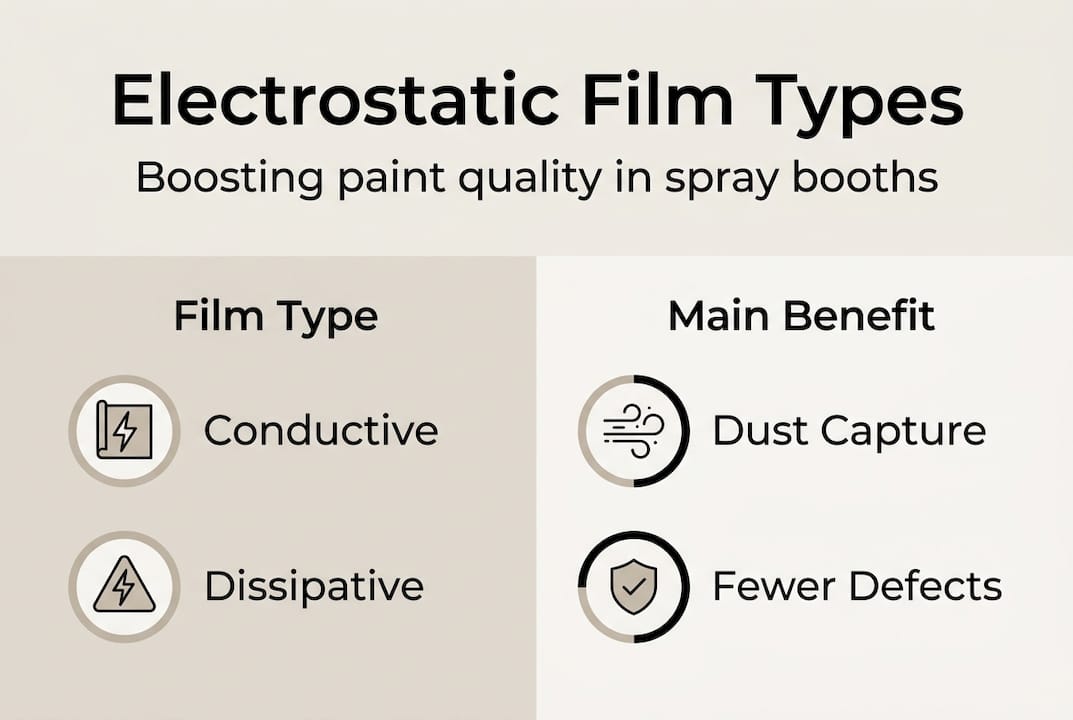
Not every electrostatic film behaves the same way. Classified into conductive, dissipative, and anti-static types, each controls static charge through a different mechanism. Choosing the wrong type for your environment can actually worsen surface quality rather than improve it.
Comparison of electrostatic film types:
| Type | Static control method | Dissipation speed | Best environment |
|---|---|---|---|
| Conductive | Rapid grounding to earth | Very fast | High static/low humidity booths |
| Dissipative | Gradual charge reduction | Moderate | Standard industrial painting ops |
| Anti-static | Prevents charge generation | Continuous | Sensitive substrates, clean rooms |
Conductive film is designed for environments where static charge builds rapidly. It grounds the charge almost instantly by routing it to an earth connection. This works well in booths with low ambient humidity and metal substrates that tend to accumulate charge quickly.
Dissipative film takes a slower approach, releasing charge gradually over time. This steady bleed-off prevents the sudden discharge events that can disrupt spray patterns and cause fish-eye defects in paint. Most standard automotive refinishing operations do well with dissipative film.
Anti-static film does not just control existing charge. It prevents generation in the first place by modifying the surface chemistry of the film. This is the right choice for highly sensitive substrates, environments with volatile solvent concentrations, or situations where any static event creates a safety concern.
When to choose each type:
- Conductive: Booths with documented high static buildup, low relative humidity (below 40%), metal-heavy environments
- Dissipative: General automotive refinishing, mixed-material booths, moderate humidity conditions
- Anti-static: Precision industrial coating, high-solvent environments, facilities dealing with recurrent fish-eye or cratering defects
Exploring the full range of types of spray booth films helps clarify which category solves your specific problem. Additionally, our guide on static-free protective film covers real-world outcomes for each type in production settings. For external context on reducing static in paint booths, humidity and air circulation data show how environment shapes your film selection.
Pro Tip: Before committing to a full roll order, test your chosen film type against your booth’s actual wall and floor materials under real operating humidity. A 30-minute test application will reveal adhesion behavior, charge performance, and ease of removal before you scale up.
How electrostatic film works: Mechanism and practical benefits
Understanding the types, it’s essential to see how electrostatic film operates in practice and why that matters for results. The mechanism is straightforward once you see it step by step.
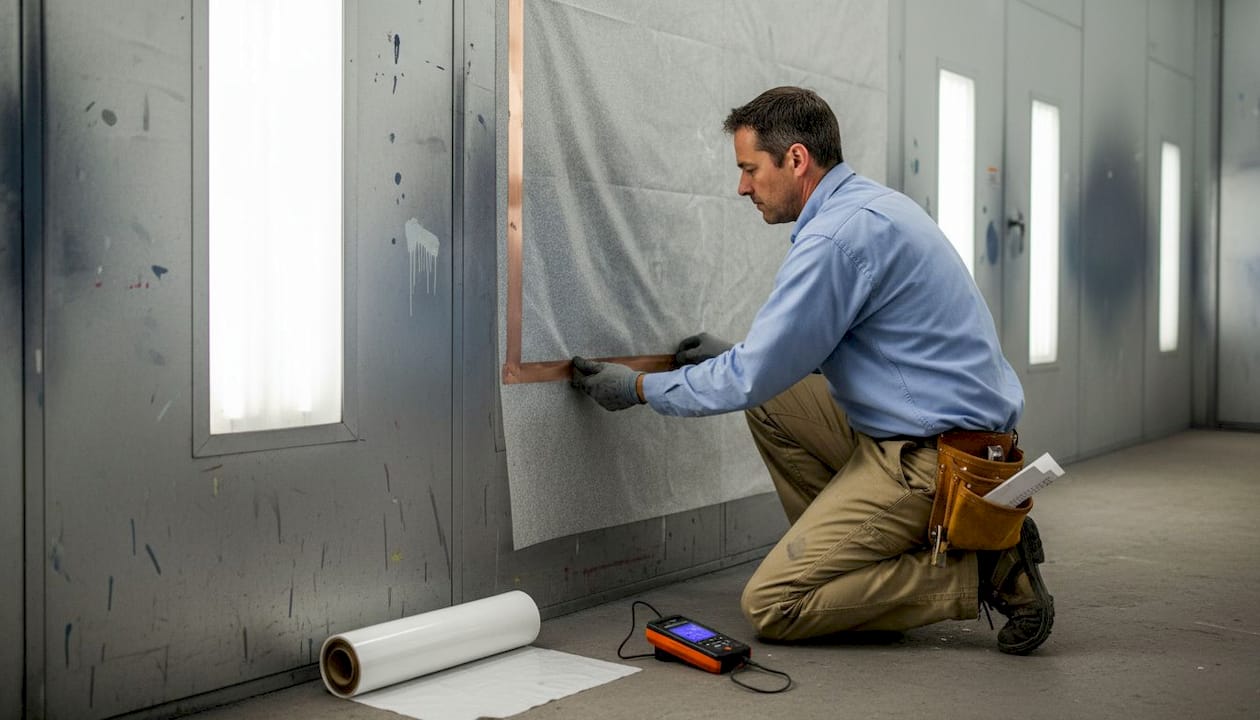
- Surface preparation: Clean booth walls and floors to remove loose debris and oil contamination. Even electrostatic film performs better on a prepared surface.
- Film application: Roll out the film using a dispensing system. Multi-layer films allow bubble-free installation because each layer conforms cleanly to the surface without trapped air pockets.
- Static field activation: Once in place, the film’s charge properties activate. The surface develops a controlled electrostatic field that extends slightly into the surrounding air volume.
- Dust attraction and neutralization: Airborne particles are drawn toward the charged film surface. On contact, the charge is neutralized and the particle is locked into the film rather than remaining suspended in air.
- Monitoring and replacement: As the film captures dust, its charge capacity reduces. Replace layers on a defined schedule based on booth activity volume to maintain peak performance.
“Films create a controlled electrostatic field, attracting and neutralizing airborne dust, with up to 25% defect reduction recorded in US paint operations.”
The practical benefits show up fast. Fewer airborne particles means fewer inclusions in the wet paint film. Inclusions cause rework. Rework costs money and time. Facilities using electrostatic film consistently report cleaner first-pass finishes, which shortens the paint cycle and reduces material consumption. Our spray booth floor protection tutorial walks through real installation scenarios, and the spray booth setup guide covers how film fits into a broader dust-free workflow.
Pro Tip: Always use multi-layer electrostatic films in high-volume production booths. The ability to peel one layer and immediately expose a fresh charged surface cuts booth downtime between jobs to under two minutes.
Choosing and optimizing electrostatic film for your spray booth
With the mechanism clear, let’s make sure you can choose and deploy the right film for your booth scenario. Selection is not one-size-fits-all. Film compatibility with booth materials, humidity, and operational workflows directly determines long-term performance and return on investment.
Key selection factors to evaluate:
- Booth wall and floor material: Concrete, coated steel, fiberglass, and aluminum all interact differently with film charge properties
- Ambient humidity: Below 40% relative humidity increases static buildup; above 60% reduces it
- Operating temperature: Standard films handle up to 80°C; high-temperature variants reach 140°C
- Solvent concentration: High-VOC environments require anti-static film to eliminate discharge risk
- Booth traffic volume: High-cycle operations benefit from multi-layer film systems
- Ionization equipment: If your booth already uses ionizing bars or fans, select a film that complements rather than conflicts with the ionization field
Operational scenarios and recommended film configurations:
| Scenario | Recommended film type | Configuration |
|---|---|---|
| High-volume automotive body shop | Dissipative | Multi-layer, full wall and floor coverage |
| Low-humidity industrial coating line | Conductive | Grounded to booth frame, single or multi-layer |
| Precision aerospace or electronics coating | Anti-static | Single-layer with ionizing bar integration |
| General industrial painting, mixed substrates | Dissipative or anti-static | Match to dominant substrate material |
Integration with other booth controls matters. Using electrostatic film alongside humidity control and ionization systems creates a layered defense that outperforms any single solution. Humidity keeps the air column at a charge-friendly equilibrium while ionizing equipment neutralizes charge in the open air volume. The film handles surfaces and edges. Together, these systems close every gap where dust can find its way onto a wet paint surface.
Our guides on protecting spray booths and film application examples provide real-world validation for these configurations across automotive, industrial, and manufacturing settings.
Replace film on a fixed schedule tied to booth job count rather than calendar time. A booth running 15 paint jobs per day needs more frequent layer replacement than one running 5. Track your defect rate per job and adjust your replacement interval if the rate starts to climb.
The hidden difference: Why electrostatic film outperforms traditional solutions
Most operators frame booth protection as a cleanliness problem. Sweep the floor, wipe the walls, cover surfaces before painting. That logic makes sense on the surface. But it misses the real threat: static charge that continues generating and attracting dust even after you’ve cleaned everything.
Conventional films passively block settled dust. They do nothing about the particles still floating in the air column during an active spray cycle. That is where electrostatic film changes the game. Multi-layer electrostatic films provide pre-emptive dust capture and consistent control, directly impacting paint finish quality in ways that no drop cloth or adhesive plastic ever will.
The nuance most operations miss is environment matching. A conductive film in a high-humidity booth won’t perform the way it does in a dry environment. An anti-static film in a metal-heavy booth might underperform a well-grounded dissipative film. Getting this right isn’t about buying the most expensive product. It’s about understanding your specific booth’s charge behavior and selecting accordingly.
Facilities that take this seriously see measurable drops in rework rates and real improvements in throughput. The top floor protection films comparison shows how lifecycle cost per job shifts when you account for rework reduction, not just product price. The upgrade is a process control decision, not just a supply purchase.
Enhance your spray booth’s results with specialized electrostatic films
After understanding the evidence and expert insight, here’s how to take the next step toward dust-free, defect-free paint jobs. Selecting the right film is only part of the equation. Working with a specialist who understands booth dynamics, film chemistry, and high-volume production demands makes the difference between a good result and a consistently excellent one.
At Dust Free Film, we have been engineering premium electrostatic booth wall and floor protection films since 2012. Our multi-layer systems, patented dispenser technology, and heat-resistant formulations are built specifically for automotive refinishing and industrial painting environments. Whether you manage a single body shop or a multi-line manufacturing facility, we can match you to the right film configuration and help you calculate the ROI before you commit. Request a quote today and get product specifications, application guidance, and pricing tailored to your booth setup.
Frequently asked questions
Is electrostatic film reusable or disposable?
Electrostatic film is designed as a single-use product. Regular replacement maintains effectiveness in dust capture and keeps the static charge at full operating capacity between jobs.
Can electrostatic film be used in high-temperature spray booth environments?
Yes. Specialized high-temperature variants handle applications up to 140°C, making them suitable for baking cycles and elevated curing environments without degrading or releasing contaminants.
How much can using electrostatic film reduce paint defects?
Facilities switching from traditional coverings to electrostatic film report up to 25% fewer coating defects, which directly reduces rework labor and material costs per job.
How should facility managers choose between conductive, dissipative, and anti-static films?
Base your selection on booth material, ambient humidity, and whether your process needs fast or gradual static charge removal. Testing under real operating conditions before full deployment eliminates guesswork.