

TL;DR:
- Layered protection allows quick peel-away removal of dust-laden layers, reducing booth downtime.
- Multi-layer films improve paint finish quality by continuously providing a fresh, uncontaminated surface.
- Switching to layered systems lowers labor, waste, and rework costs compared to traditional barrier methods.
A single speck of dust landing on fresh automotive paint can ruin a job worth thousands of dollars. For facility managers running spray booths, that risk is constant. Airborne particles settle fast, contaminate wet coatings, and trigger expensive rework cycles that erode profit margins and client trust. Standard dust control approaches such as basic plastic sheeting or single-layer films provide limited defense, especially in high-traffic industrial environments where dust sources are everywhere. This guide explains why layered protection is the most effective, operationally practical answer to that problem, and how you can implement it inside your booth today.
Table of Contents
- Why dust control is critical in spray booths
- Common dust protection methods and their limits
- How layered protection works for walls and floors
- Layered protection versus traditional methods: What’s the difference?
- Step-by-step: Implementing layered protection in your booth
- Our perspective: What most facility managers get wrong about dust control
- Ready to upgrade your spray booth? Explore layered protection solutions
- Frequently asked questions
Key Takeaways
| Point | Details |
|---|---|
| Dust ruins finishes | Even small amounts of dust can cause costly defects in spray booth operations. |
| Single layers fall short | Traditional dust control methods often fail to keep up with ongoing contamination. |
| Layered protection saves time | Peel-away multi-layer films minimize downtime and make maintenance easier. |
| Better paint, lower costs | Facilities using layered protection routinely see improved results and reduced expenses. |
Why dust control is critical in spray booths
Dust is the single biggest enemy of a quality paint finish. A particle invisible to the naked eye can embed itself into a wet clear coat, creating a bump, crater, or blemish that forces a full respray. Paint quality risks are not theoretical. As professionals in this industry know, dust particles cause paint defects and significantly reduce finish quality, and even a clean-looking booth can harbor enough airborne contamination to compromise a job.
The consequences extend well beyond one bad paint job. Consider what inadequate dust control actually costs your operation:
- Rework rates increase, consuming labor hours and materials that should be generating revenue
- Customer complaints rise, damaging the reputation your facility has spent years building
- Compliance risks grow, particularly in industrial settings where air quality and surface standards are regulated
- Staff frustration builds when technicians spend more time fixing problems than delivering finished work
“A facility that cannot control dust in its spray booth is essentially paying twice for every job it contaminates.”
Client expectations have never been higher. Automotive refinishing customers want showroom-quality results, and industrial clients demand blemish-free coatings for products ranging from aerospace components to heavy equipment. Any visible defect is a rejection, and rejections are expensive.
The challenge is that dust sources are almost impossible to fully eliminate. Technicians moving through the booth, grinding or sanding in adjacent areas, and HVAC systems recirculating particles all contribute to contamination. Even newly installed booths accumulate residue faster than most operators expect. Seeking quality dust control solutions is not optional. It is a prerequisite for staying competitive. With the stakes clear, let’s examine why single-layer approaches rarely solve the problem.
Common dust protection methods and their limits
Most facilities start with the obvious: hang some plastic sheeting on the walls, lay a basic film on the floor, and call it done. These approaches provide a barrier, but they are not built for the real demands of active spray booth environments.
Basic single-layer plastic is cheap and easy to apply, but it accumulates dust rapidly. Once contaminated, the entire sheet must be removed and replaced, which takes time and generates significant waste. A booth shutdown for a film replacement mid-production day is not a minor inconvenience. It is a disruption that ripples through your entire schedule.
| Protection method | Initial cost | Labor to replace | Downtime impact | Dust control effectiveness |
|---|---|---|---|---|
| Basic plastic sheeting | Low | High | High | Poor |
| Single-layer film | Low to moderate | Moderate | Moderate | Fair |
| Coatings and sprays | Moderate | High | High | Fair |
| Multi-layer film | Moderate to high | Very low | Minimal | Excellent |
As single-layer barriers often fail to catch all particulates over time, requiring frequent replacement, the operational math works against them. You may save upfront on product cost, but you spend far more on labor, waste disposal, and lost production time across a full quarter.
Coatings and sprayed-on barriers present their own problems. They require cure time, produce chemical exposure risks, and still degrade faster than you want them to. The buildup on booth walls and floors does not stop between shifts.
Pro Tip: Track how many times per month your team replaces booth barriers. Most operations discover they are replacing single-layer materials two to three times more often than they originally estimated, which makes the labor cost case for layered protection almost automatic.
When you look at examples of booth barriers across a range of facilities, the pattern is consistent. Operations relying on basic or single-layer methods spend more, produce more waste, and experience more contamination events. Reviewing top dust control solutions reveals a clear performance gap between layered and non-layered approaches. Confronted with these limitations, managers seek better outcomes. Enter layered protection.
How layered protection works for walls and floors
Layered protection uses films built from multiple bonded layers stacked on top of each other. You install the full stack once. When the top surface collects dust or overspray, you simply peel that single layer away and expose a fresh, clean surface underneath. No removal of the full barrier. No booth shutdown for reinstallation. Just a quick peel and you are back in production.
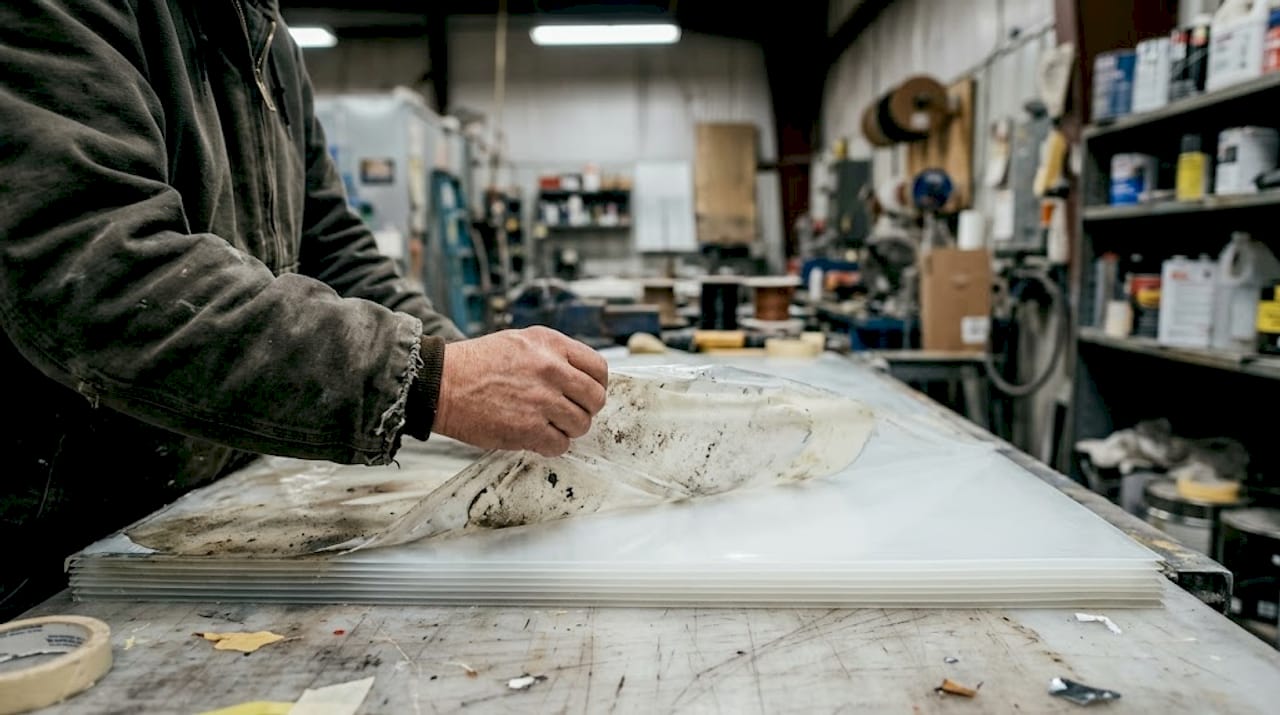
Multi-layer films can be peeled off one layer at a time, always revealing a clean surface, which sharply reduces downtime. That is the core operational advantage. Instead of a 30 to 60 minute replacement window, you are looking at a few minutes per zone.
Here is how the process plays out in a typical booth:
- Install the multi-layer film stack on walls and floors before starting operations
- Run production normally, allowing the top layer to collect dust and overspray
- Peel the contaminated layer at the end of a shift or when buildup is visible
- Resume production immediately on the fresh surface below
- Repeat until all layers are used, then install a new stack
Both booth walls and floors benefit significantly. Walls catch overspray mist and airborne particles that settle and then become re-entrained in airflow. Floors trap heavier particles, sanding residue, and tracked-in contamination from foot traffic. Covering both surfaces with layered film creates a fully managed dust zone.
| Application area | Primary contamination type | Layer change frequency |
|---|---|---|
| Booth walls | Overspray, airborne dust | Every 2 to 5 paint jobs |
| Booth floor | Sanding residue, heavy particles | Every 1 to 3 shifts |
Pro Tip: Start with floor protection if your operation is new to layered films. The ROI is immediately visible because floor contamination is the most frequent cause of re-contamination from foot traffic stirring settled particles back into the air.
Exploring multi-layer protection benefits in detail and reviewing film applications examples from active facilities gives you a concrete sense of what fast-change performance actually looks like at scale. Understanding the mechanism, let’s clarify how layered protection outperforms other options.
Layered protection versus traditional methods: What’s the difference?
The performance gap between layered and traditional dust protection becomes obvious the moment you compare real operational data side by side.
| Factor | Traditional methods | Layered protection |
|---|---|---|
| Booth downtime per change | 30 to 60 minutes | 2 to 5 minutes |
| Changes per week | 4 to 10 | Same, but faster |
| Labor cost per change | High | Minimal |
| Waste generated | Large volume per change | Single thin layer |
| Paint defect rate | Higher | Significantly lower |
| Staff effort | Intensive | Minimal |
Facilities switching to multi-layer protection report better finishes and reduced labor costs, and that improvement is not incremental. Operations that make the switch typically see the results within the first billing cycle.
Beyond the numbers, consider the less obvious benefits:
- Predictable quality: Technicians know the surface is always fresh, removing a major variable from every paint job
- Reduced rework stress: Fewer contamination events mean fewer difficult conversations with clients
- Simpler staff workflows: Less time managing barrier logistics means more time on skilled tasks
- Lower disposal burden: Thin individual layers produce far less waste than bulky full-sheet replacements
The long-term cost picture also favors layered protection. Initial product cost may be moderately higher than basic plastic, but labor savings and rework reduction offset that difference quickly. Reviewing boosting booth quality outcomes from real facilities confirms that the return on investment compounds over time, not just in the first month.
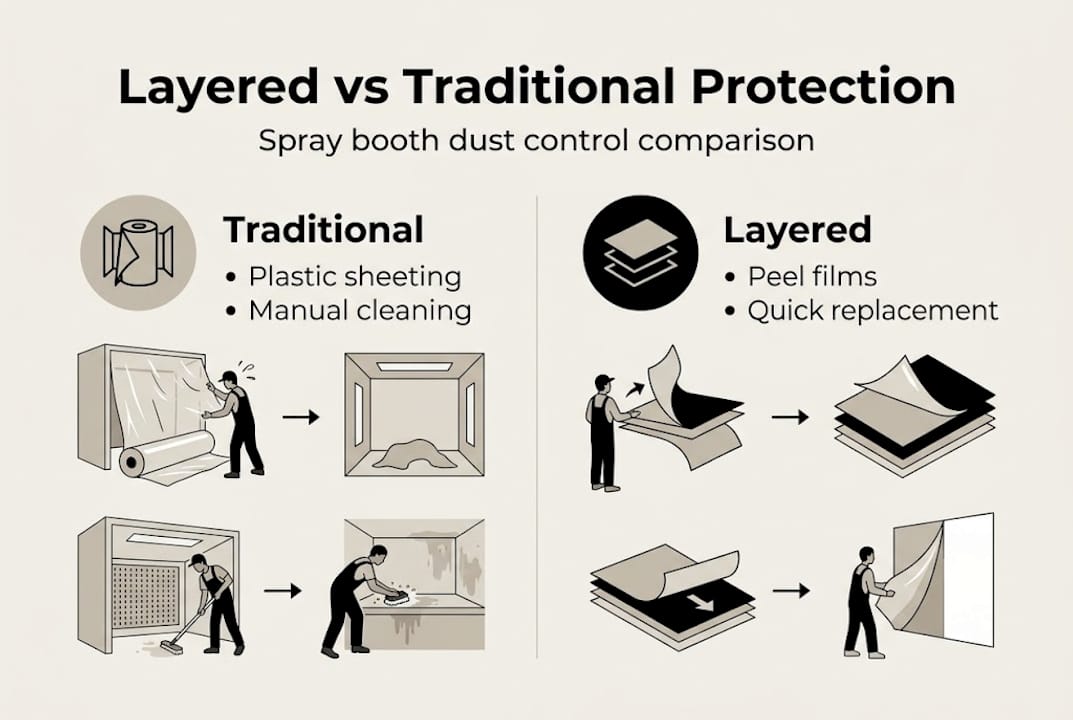
For managers evaluating the switch, the data on paint perfection with multilayer approaches makes a compelling case that this is not a premium option. It is the operationally responsible choice. Now that you see the advantages in action, let’s translate these ideas into practical steps.
Step-by-step: Implementing layered protection in your booth
Switching to layered protection does not require a full booth rebuild. It requires honest assessment, the right product choice, and a brief staff orientation. Proper implementation of multi-layer films requires planning, but delivers fast ongoing savings and quality improvements.
Follow these steps to get started:
- Audit your current contamination problem: Walk your booth and note where dust accumulates fastest. Is it near the floor from foot traffic? On walls near the HVAC intake? Document it.
- Measure your booth dimensions accurately: Wall height, floor area, and corner configurations all affect which product format fits best.
- Select the right film for your booth type: High-volume production booths benefit from thicker multi-layer stacks. Smaller shops may prefer narrower roll formats.
- Install wall films first: Start at the top corners and work down. Films with static cling properties adhere without adhesive and leave no residue.
- Cover the full floor area: Overlap seams slightly to eliminate gaps where particles could accumulate.
- Brief your team on the peel process: Make it part of your end-of-shift checklist rather than a reactive task.
For ongoing success, build these maintenance habits:
- Set a standard peel trigger: Define whether your team peels after every X number of jobs or based on visible buildup, and apply it consistently
- Inspect seams at the start of each shift: Lifted edges allow dust to migrate underneath the film stack
- Log layer changes: Tracking peel frequency helps you predict restocking needs and identify unusually high-contamination periods
Browsing the best multi-layer protectors currently available and reading about enhancing booth quality through film-based systems will help you match a product specification to your specific operation.
Our perspective: What most facility managers get wrong about dust control
After years of working with auto body shops and industrial painting facilities, we have seen one mistake repeat itself constantly: managers treat dust control as a cleaning problem rather than a system problem.
When a contamination event happens, the immediate reaction is to clean more aggressively or swap out products in a panic. Neither approach addresses the underlying issue, which is that a single-layer barrier, no matter how thick, degrades continuously and offers no reset point. You cannot clean your way out of a structural gap in your booth protection.
Layered protection flips this logic. Instead of reacting to contamination after it affects a job, you build a managed surface that resets itself. That shift from reactive to predictive is where the real value lives. The true ROI is not just reduced labor. It is showing up to every job knowing your booth environment is controlled, and knowing your clients will not be calling back about blemishes.
Facilities that embrace this mindset, as documented in our multi-layer film experience coverage, consistently outperform those still chasing dust with mops and replacement sheets.
Ready to upgrade your spray booth? Explore layered protection solutions
If the rework costs, downtime, and client complaints from dust contamination are eating into your operation’s performance, the path forward is clear. Layered protection is not a workaround. It is a purpose-built solution for exactly the environment you manage every day.
Dust Free Film solutions are engineered specifically for spray booths like yours, combining European manufacturing standards with practical installation systems designed for busy facilities. Our team works with auto body shops and industrial painting operations of every size to match the right product to the right booth configuration. When you are ready to stop reacting and start managing dust proactively, request a quote and let us help you build a cleaner, more efficient booth environment from the ground up.
Frequently asked questions
What is layered protection in spray booths?
Layered protection involves multi-layer films that allow each contaminated surface to be peeled away, instantly restoring a clean barrier without removing the entire installation or shutting down the booth.
How often should I change layers in a multi-layer protective film?
Peel a layer as soon as visible dust or overspray buildup appears, which in most active booths means every few shifts or after a major job. Layers are removed as needed when visible buildup occurs, keeping the surface consistently clean.
Does layered protection work for both walls and floors?
Yes. Multi-layer films are ideal for both walls and floors, and covering both surfaces together provides the most complete dust containment inside the booth.
What are the main benefits of switching to layered protection?
Layered protection offers better finishes and operational savings, including fewer paint defects, faster surface resets, significantly less labor per maintenance cycle, and lower total waste volume over time.