
Multi-layer electrostatic tear-off film is the best tear-off booth film for most industrial and automotive spray booths. Peeling a soiled layer takes minutes, while retaping walls from scratch can eat an hour or more. Fewer particles land in wet paint, fewer panels get reworked, and Dust Free Film offers samples and test data to verify the fit before you commit to a bulk order.
TL;DR:
- Multi-layer electrostatic tear-off film offers the highest number of safe peel cycles, with some products supporting 20 to 40 layers before needing full replacement.
- Ensure the film has solvent resistance ratings matching your specific clearcoat chemistry and a heat tolerance that covers your curing cycle to prevent warping or degradation.
- Dispenser systems significantly reduce refresh times to under 10 minutes for medium-volume booths, compared to 45 minutes or more for manual retaping.
- Operational factors such as throughput, part size, and environment dictate the ideal film thickness, layer count, and tack method, not just generic specifications.
- Regular testing for MEK resistance, heat tolerances, and optical clarity, combined with on-site trials, ensures the selected film meets your specific booth requirements.
Table of Contents
- Key Takeaways for Choosing Booth Film
- What Makes the Best Tear-Off Booth Film?
- How to Choose the Right Tear-Off Film
- Installing and Refreshing Booth Film Without Downtime
- Testing Durability: MEK, Heat, and Optical Clarity
- Calculating Cost, ROI, and the Right Spec Level
- What Fourteen Years of Booth Film Data Actually Shows
- Get Samples and a Quote From Dust Free Film
- Further Reading on Booth Film Performance
- FAQ
Key Takeaways for Choosing Booth Film
If you manage booth uptime, here’s the short version before you get into specs and testing protocols.
- Choose multi-layer electrostatic tear-off film over adhesive tape or pre-taped sheeting for the fastest refresh and the cleanest contamination control.
- Ask any supplier for MEK/solvent resistance data and a temperature rating that matches your coating system, not a generic industrial spec.
- Standardize on a dispenser system for tape-free, bubble-free installs. It shaves operator minutes off every refresh cycle.
- Set your replacement cadence by throughput, not the calendar. A three-shift booth running solvent clearcoats needs a different schedule than a single-shift industrial line running waterborne paint.
- Run a quick ROI check: if retaping costs you 45 minutes of labor per refresh and tear-off film costs 8, multiply the difference by weekly refresh count and you’ll usually find the film pays for itself inside a quarter.
The math changes with booth size and paint type, but the direction rarely does. Films that let you peel and go beat films that require a scraper, solvent wipe, and a roll of masking tape almost every time.
What Makes the Best Tear-Off Booth Film?
The engineering underneath a tear-off film determines whether it survives your paint system or fails on day three. Layer count is the first thing to check. A stack of 20 to 40 sacrificial sheets means 20 to 40 refresh cycles before a full re-installation, so higher layer counts stretch out the interval between major maintenance shutdowns.
Attachment method matters just as much. Electrostatic cling grips to walls and windows without adhesive residue, which matters when you’re peeling daily. Pressure-sensitive adhesive holds tighter on floors and high-traffic zones but can leave gum behind on removal. Pre-taped sheeting sits between the two, offering easier initial hangs at the cost of a bulkier roll.
Material specs to demand on a data sheet:
- MEK or solvent rub resistance rated for your actual clearcoat, not a generic “chemical resistant” label.
- A heat tolerance that covers your bake cycle with margin, since undersized ratings show up as warping mid-shift.
- Puncture and tensile strength adequate for parts handling and foot traffic.
- Optical clarity for any layer covering lights or lens surfaces, since silica-infused hardcoats are engineered specifically to avoid glare and distortion during inspection.
Pro Tip: Don’t judge film thickness by feel alone. A thinner film with a tighter, more consistent multi-layer stack often outperforms a thicker single-ply sheet on both peel speed and edge adhesion.
Dispenser systems round out the picture. A patented, reverse-wound dispenser applies film without bubbles and keeps edge adhesion consistent, which matters more on a 20-foot wall than it does on a small viewport.
How to Choose the Right Tear-Off Film
Start with operational fit before you look at a single spec sheet. Match the film to your throughput, part size, paint system, booth temperature and humidity, and any lens or lighting protection needs. A three-car-per-day body shop running waterborne basecoat has different priorities than a manufacturing plant running solvent-heavy clearcoat around the clock.
Once operational fit is set, filter on performance:
- Layer count and total roll yield per install.
- MEK rub rating appropriate to your clearcoat chemistry.
- Heat tolerance versus your bake cycle.
- Roll width, length, and wound orientation for your dispenser.
- Tack method: electrostatic, adhesive, or pre-taped.
Then filter on service and contract terms: sample availability, dispenser compatibility, lead times, and whether the supplier can customize widths for non-standard booths. Buyers should require lab data sheets over marketing claims and run a small on-site trial before committing to a full rollout, especially for solvent-heavy or high-heat environments.
An RFP checklist you can copy directly:
- What is your MEK rub rating, and under what test method?
- What temperature range does the film tolerate without deforming?
- How many layers per roll, and what’s the peel interval?
- Is the film compatible with our existing dispenser, or do we need new hardware?
- What are your standard roll widths, and can you customize?
- What’s your current lead time for a bulk order?
- Can you provide a sample pack for an on-site trial?
- What’s your volume discount structure at 50, 100, and 500 rolls?
Installing and Refreshing Booth Film Without Downtime
Installation sets the tone for every refresh after it. Prep the surface first, run the dispenser in a single steady pass to avoid bubbles, then seal edges and inspect for lift points before the booth goes back into production.
- Clean and dry the wall or floor surface completely.
- Load the roll into the dispenser and unroll in one continuous motion.
- Press edges firmly, working from the top down to avoid trapped air.
- Inspect corners and seams under booth lighting before resuming work.
The refresh cycle is where the real time savings show up. Dispenser-assisted refreshes commonly land under 10 minutes per wall in medium-volume facilities, compared to 45 minutes or more for a full retape and solvent wipe. Hand-applied film without a dispenser runs slower and carries a higher bubble and edge-lift rate.
Pro Tip: Stage two spare rolls per bay plus one in transit. That buffer prevents a mid-shift stall if a roll runs out during a high-throughput day.
Bubbles, edge lift, and tearing almost always trace back to the same causes: dirty surfaces, rushed application, or a mismatched dispenser. Train operators on the step-by-step install process once, and refresh times stay consistent across shifts.
Testing Durability: MEK, Heat, and Optical Clarity
Marketing copy is not a spec sheet. Require documented results on four tests before you buy in volume: MEK rub resistance, heat exposure limits, puncture and tensile strength, and optical distortion for any lens-covering layer.
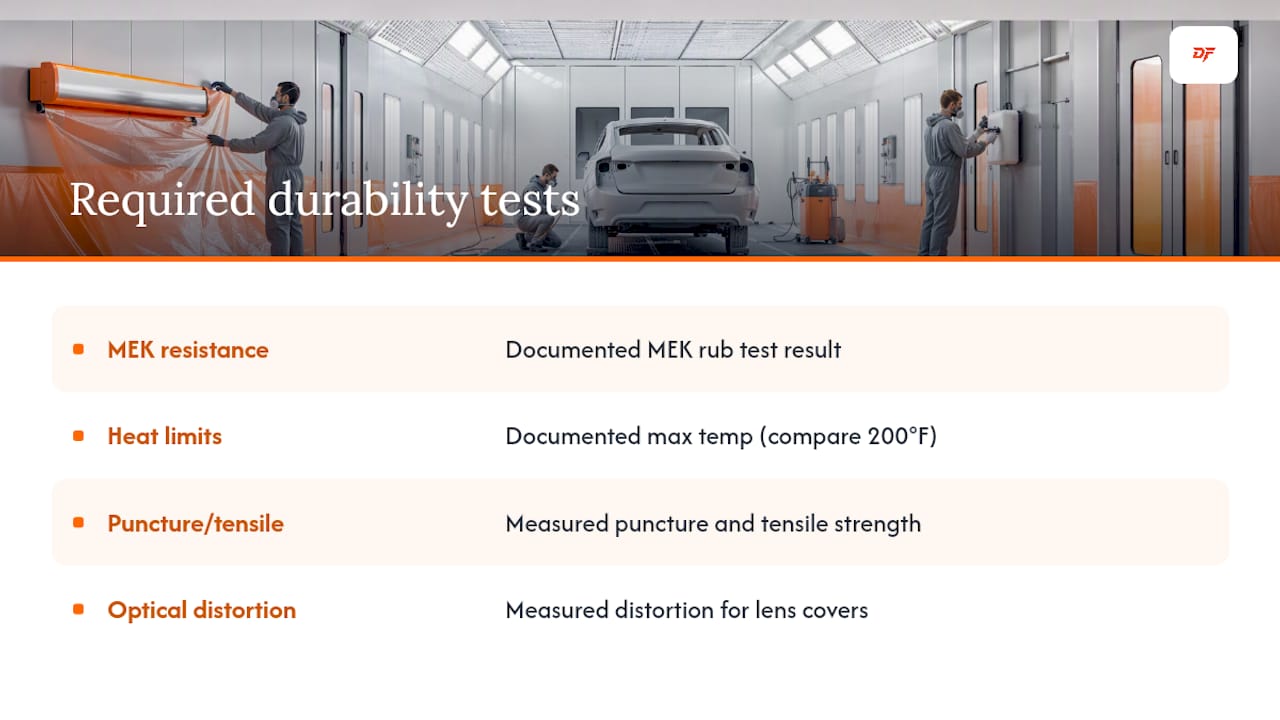
Dust Free Film has tested and documented MEK resistance internally to confirm performance under harsh solvent exposure, the kind of stress test that separates films built for auto refinishing from generic industrial sheeting. For a baseline comparison, one common industrial floor film on the market is specified at roughly 4 mil thickness with a 200°F tolerance and a 60 to 90 day replacement interval, which is a useful reference point when you’re comparing quoted specs against real field numbers.
Substrate and process change the calculus. Heavy sanding dust demands higher puncture resistance. Solvent-heavy clearcoats demand a higher MEK rating than waterborne lines. When a supplier’s lab numbers look strong but your process is unusual, an on-site trial beats trusting the data sheet blind, particularly for high-heat bake cycles or aggressive solvent mixes.
Calculating Cost, ROI, and the Right Spec Level
Roll coverage starts with simple math: divide your booth’s wall and floor square footage by the roll’s usable width and length, accounting for overlap at seams. That gives you rolls per install and, combined with your layer count per roll, total refreshes before a full re-installation.
Labor savings are where the real ROI shows up.
- Estimate refresh frequency based on shifts and throughput (daily for high-volume automotive, weekly for lighter industrial use).
- Multiply time saved per refresh (dispenser tear-off versus retape) by labor rate and refresh frequency.
- Add in reduced rework from contamination and the extended service life of booth lights and windows protected by an optical layer.
- Compare the total against the higher purchase price of a premium multi-layer film.
Higher-spec film, thicker MEK-rated stacks with more layers per roll, is cost-justified whenever solvent exposure or throughput is high enough that downtime minutes translate directly into lost production hours.
What Fourteen Years of Booth Film Data Actually Shows
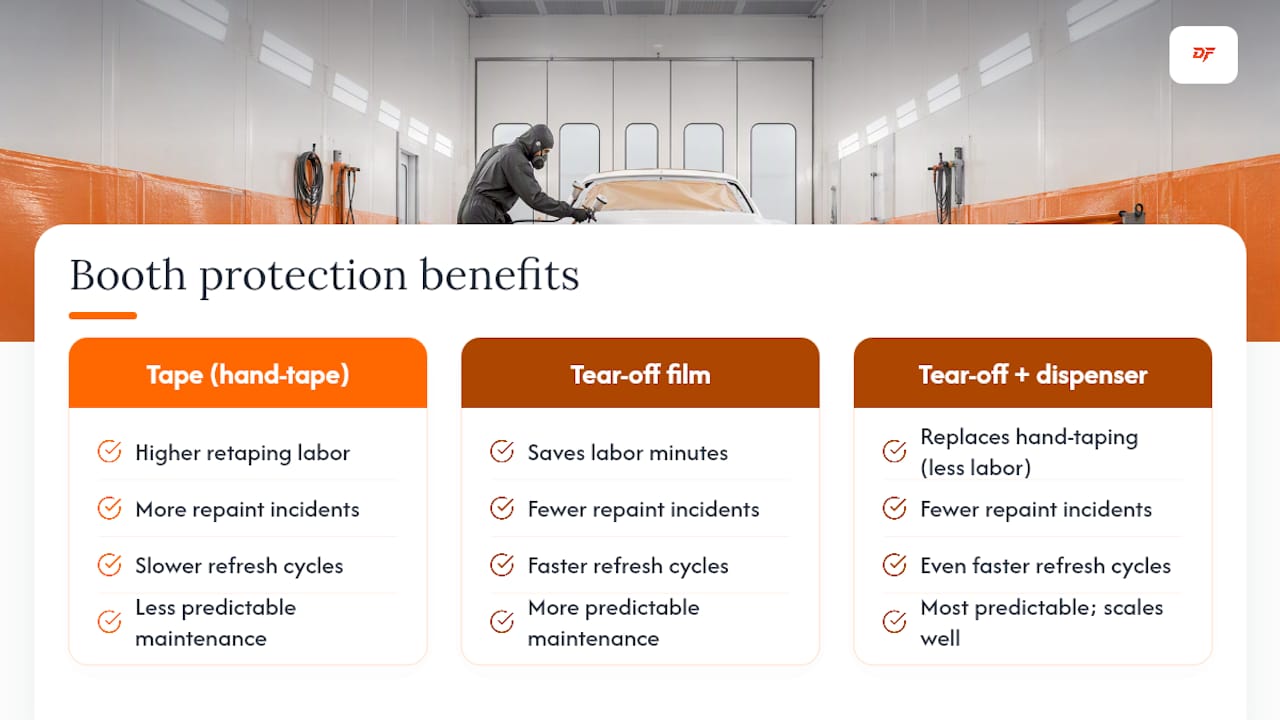
Pavlos Filippakis has spent years inside the mechanics of spray booth protection at Dust Free Film, a manufacturer that has built multi-layer electrostatic systems since 2012. The recurring pattern in that history is simple: shops that switch from tape to tear-off film don’t just save labor minutes, they cut repaint incidents tied to airborne contamination during retaping itself.
Internal MEK resistance testing consistently separates films that survive solvent-heavy clearcoat lines from films that degrade within days. Field deployments across auto body and industrial plants report faster refresh cycles once dispenser systems replace hand-taping, and the dispenser advantage compounds at scale. Facilities running custom sizing and bulk orders report the same operational pattern regardless of booth count: fewer surprises, more predictable maintenance windows.
Get Samples and a Quote From Dust Free Film
Dust Free Film builds the multi-layer electrostatic systems this guide recommends, backed by MEK-tested durability and a patented dispenser designed for bubble-free application on the first pass.
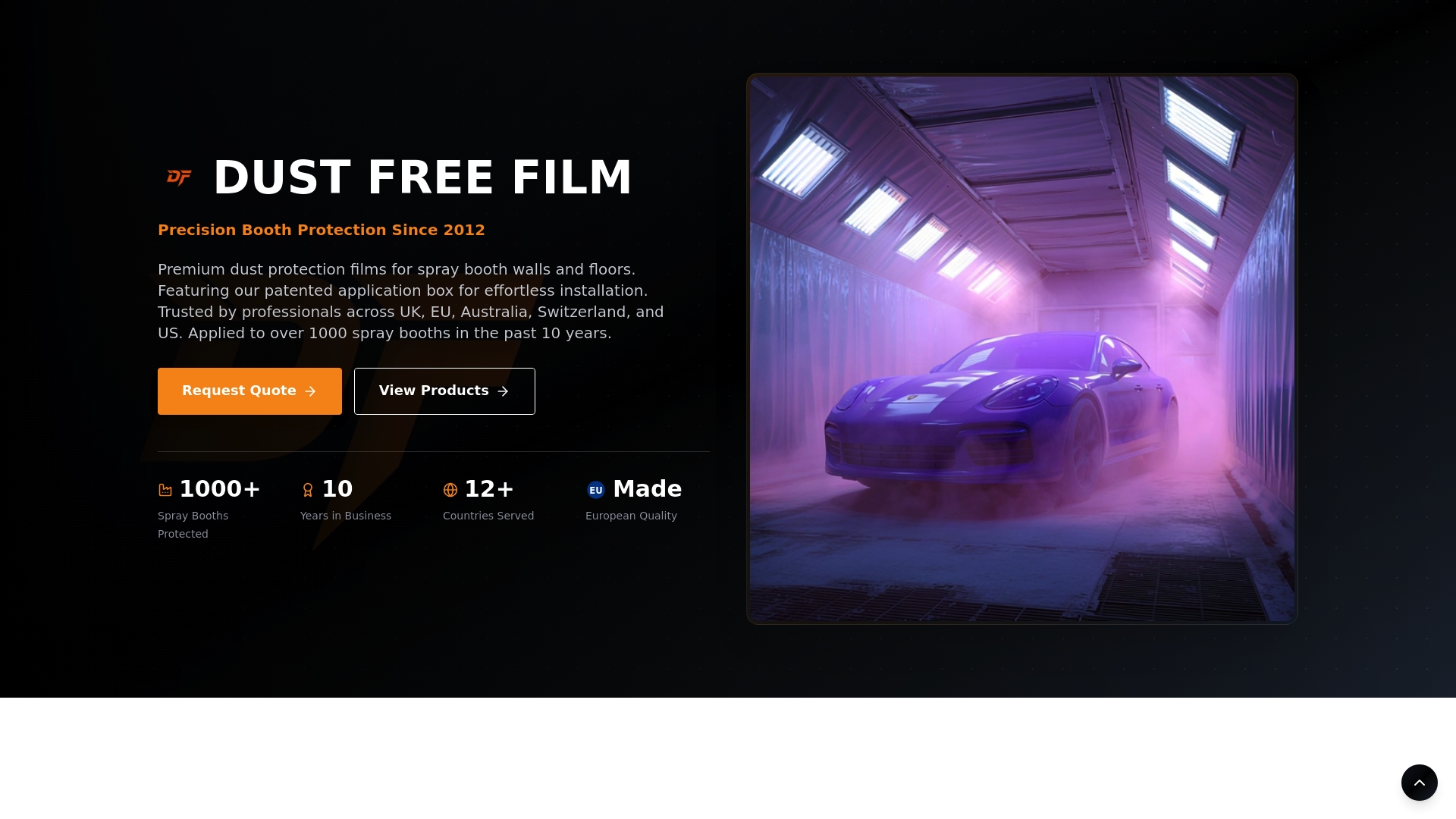
The lineup includes sample packs so you can run your own on-site trial before committing to volume, dispenser options sized for wall and floor jobs, and custom widths for non-standard booths. Bulk pricing scales for multi-booth operations, and the Reduce Wall Repainting case data shows what a switch from retaping looks like in practice. Request a sample pack or a quote through the Dust Free Film landing page and ask about current lead times for your order volume before your next scheduled refresh.
Further Reading on Booth Film Performance
For deeper technical detail, review Dust Free Film’s durability data and its installation walkthrough. For a neutral field-spec comparison, the AutoBodyToolMart floor film listing confirms common roll sizes and mil thickness across the market.
FAQ
What Is Tear-Off Booth Film?
Tear-off booth film is a multi-layer protective sheet applied to spray booth walls, floors, or windows that lets operators peel away a soiled top layer to expose a clean surface underneath, instead of stripping and retaping the whole surface.
Which Booth Protection Film Is the Best?
Multi-layer electrostatic tear-off film is generally the best choice for industrial and automotive booths because it refreshes in minutes and controls contamination better than adhesive tape or pre-taped sheeting.
Which Tear-Off Film Is the Thickest?
Thickness varies by product and layer count; one common industrial floor film on the market runs roughly 4 mil per layer, but a thicker single layer isn’t automatically better than a well-engineered multi-layer stack with more peel cycles.
What Is the Best Paint Booth Setup for Cars?
A well-run automotive paint booth pairs proper airflow and filtration with multi-layer electrostatic film on walls, floors, and lenses, so contamination control doesn’t depend on constant manual cleaning between jobs.
How Often Should Booth Film Be Replaced?
Replacement cadence depends on throughput; high-volume automotive lines may peel a layer daily, while lighter industrial use might stretch a full re-installation to every 60 to 90 days, similar to the interval listed for common industrial floor films.