
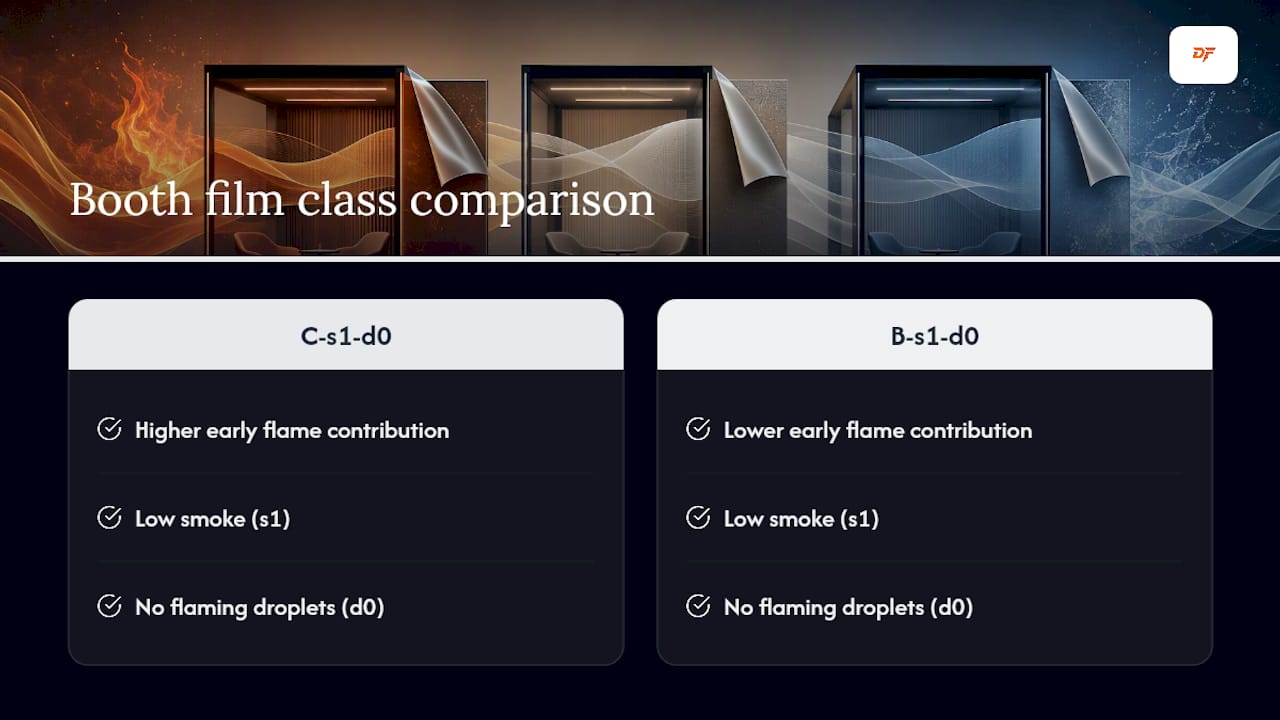
The practical minimum for interior spray-booth protective film is a Euroclass C‑s1, d0 reaction-to-fire rating under BS EN 13501‑1, with B‑s1, d0 preferred where overspray sits close to heat sources or curing lamps. Do not accept that class on a spec sheet alone. Require:
- The full EN 13501‑1 classification report, with reference number and issue date
- Supporting test reports naming the actual methods used (EN 13823/SBI, EN ISO 11925‑2, EN ISO 1716, EN ISO 1182)
- Proof the testing lab holds EN ISO/IEC 17025 accreditation or works under a notified body
A film rated C‑s1, d0 without a traceable report behind it is a marketing claim, not a fire rating. Anyone can print a class number on a data sheet. Only a lab reference tied to a specific specimen and substrate, checked against DIN EN 16985 for booth-level compliance, actually proves it.
Key Takeaways
Requiring a documented EN 13501‑1 class of C‑s1, d0 or better, backed by named test reports and lab accreditation, is the single most reliable safeguard against non-compliant spray-booth film.
| Point | Details |
|---|---|
| Minimum acceptable class | Require C‑s1, d0 under EN 13501‑1, and push for B‑s1, d0 near heat sources or infrared curing. |
| Demand traceable documentation | Ask for the classification report, EN 13823/EN ISO 11925‑2 test reports, and lab accreditation before purchase. |
| Check the field-of-application clause | Confirm the tested substrate and mounting condition match your actual booth wall or floor. |
| Tie film choice to booth standards | Cross-check selections against DIN EN 16985 and NFPA 33 clearance and suppression rules. |
| Choose a documented supplier | Dust Free Film provides classification reports, test data, and lab accreditation with every order. |
Table of Contents
- What Does a Booth Film Fire Rating Actually Mean?
- Which Fire Class Should You Specify for Booth Film?
- What Documents Should You Request From a Fire Rating Claim?
- Why Specimen Prep and Substrate Change the Real-World Result
- How Fire-Rated Film Fits Into Daily Booth Operations
- A Copy-Ready Acceptance Checklist for Incoming Film
- How This Guidance Was Put Together
- A Field Note on Supplier Fire Rating Claims
- Get Verified Documentation With Every Dust Free Film Order
- Standards and Guidance Worth Bookmarking
- Frequently Asked Questions
- Sources
What Does a Booth Film Fire Rating Actually Mean?
EN 13501‑1 sorts construction products, including flexible films, into seven core classes: A1, A2, B, C, D, E, and F, running from noncombustible to no performance determined. A1 and A2 belong to concrete, stone, and mineral boards. Flexible PVC and polyethylene films used for booth walls and floors realistically land in the B, C, or D range, and D or lower generally signals a product you should not put anywhere near an active paint booth.
Two suffixes ride alongside that core letter, and they matter as much as the letter itself:
- Smoke (s1, s2, s3): s1 means low smoke production, s3 means heavy smoke that could obscure exits or overwhelm a fire suppression system’s optical sensors.
- Droplets (d0, d1, d2): d0 means no flaming droplets or particles fall during the test, d2 means they do, which matters a lot in a booth where flaming material could land on solvent-soaked overspray below.
The classification isn’t a single test. It’s a bundle of results. EN 13823 (the Single Burning Item or SBI test) measures how a product contributes to fire growth on a wall. EN ISO 11925‑2 checks ignitability from a small direct flame. EN ISO 1716 measures gross heat of combustion, relevant for the A2 threshold. EN ISO 1182 tests noncombustibility for A1 materials. EN ISO 9239‑1 applies to floor coverings specifically, measuring critical radiant flux. A supplier citing “EN 13501‑1” without naming which of these tests actually produced the data hasn’t told you much.
Which Fire Class Should You Specify for Booth Film?
For wall and floor protection in a standard automotive or industrial spray booth, C‑s1, d0 is a defensible baseline. That’s the class documented in a published test report for a transparent PVC adhesive film tested to EN 13501‑1 procedures, and it reflects what multi-layer PVC films can realistically achieve. If your booth runs high-solvent coatings, infrared curing, or sits close to a bake cycle, push suppliers toward B‑s1, d0 instead. The jump from C to B usually means less contribution to flame spread during early fire growth, which buys you more reaction time before suppression triggers.
Smoke class deserves more attention than it usually gets. An s2 film might pass the core burn test fine, but in an enclosed booth with limited ventilation, extra smoke density cuts visibility for anyone trying to exit and can trip photoelectric detectors tied to your suppression system prematurely, or too late. Droplet class matters just as much: d1 or d2 film dripping flaming material onto solvent-laden floor overspray is exactly the ignition path booth fires often follow.
A1 or A2 classification is almost never realistic or necessary for adhesive protective film. Those classes describe mineral and metal products, not flexible polymer films. If a supplier claims A2 for a PVC film, that’s a red flag worth investigating before you sign a purchase order.
Pro Tip: Match film class to booth type, not just budget. Dry filter booths with moderate solvent loads do fine with C‑s1, d0. Water-wash booths running high-build coatings or infrared cure stations warrant the extra margin of B‑s1, d0.
What Documents Should You Request From a Fire Rating Claim?
Every fire class claim needs paperwork behind it, and vague promises don’t hold up during an inspection or an insurance audit. Here’s what to put in writing before you place an order:
- The classification report itself — full EN 13501‑1 document with a report number, issue date, and the exact product name and thickness tested.
- Underlying test reports — separate documents showing SBI (EN 13823) and ignitability (EN ISO 11925‑2) data, with named test method numbers, not just a summary paragraph.
- Specimen preparation and substrate description — what the film was mounted on, at what thickness, with what adhesive, during testing.
- Lab accreditation proof — EN ISO/IEC 17025 certificate number or notified body reference for the testing lab.
When the report lands on your desk, check three things fast: the reference number (does it match what’s on the product data sheet?), the scope statement (does it cover your intended substrate?), and the field-of-application clause (does it limit results to a specific mounting condition you can’t replicate?).
Paste this into your RFQ: “Supplier must provide the full EN 13501‑1 classification report referencing EN 13823 and EN ISO 11925‑2 test results, specimen substrate description, and current EN ISO/IEC 17025 lab accreditation number prior to purchase order approval.” That single sentence eliminates most vague fire-rating claims before money changes hands.
Why Specimen Prep and Substrate Change the Real-World Result
EN 13501‑1 classifies a tested assembly, not a material in the abstract. A film glued to steel behaves differently in a fire test than the same film glued to gypsum board or plywood, because the substrate affects heat absorption and flame spread across the surface. A field-of-application statement exists precisely to tell you how far that test result can be stretched to cover other mounting conditions.
Watch for three common issues in supporting reports:
- No stated substrate. If the report doesn’t say what the film was mounted on, you can’t compare it to your booth wall or floor.
- Missing field-of-application clause. Without it, a supplier can’t legitimately claim the rating applies beyond the exact tested configuration.
- Surface-flammability tests misapplied. A test designed for rigid panel products doesn’t automatically transfer to a flexible adhesive film without adaptation, and a supplier citing the wrong method entirely is a warning sign.
How Fire-Rated Film Fits Into Daily Booth Operations
A fire class printed on a data sheet doesn’t survive poor storage or sloppy installation. Heat exposure during storage, contact with unreacted solvents, or contamination from overspray residue can all change how a film actually behaves in a fire, regardless of what the lab report says.
During installation, three things affect real-world performance:
- Keep adhesive activation and seam overlaps away from convection heat outlets and curing lamp zones.
- Avoid running film directly across or under suppression nozzle coverage areas without confirming clearance.
- Never let film obstruct exhaust plenums, ducts, or filter access points, since automatic extinguishing systems commonly extend protection into those exact spaces.
For ongoing maintenance, build this into your inspection routine:
- Confirm suppression interlocks remain unobstructed by film edges or dispenser hardware.
- Check filter access points weekly for overspray buildup on film surfaces.
- Verify suppression system service tags are current, a detail inspectors check directly alongside material documentation.
NFPA 33 requires spray booths to use noncombustible or limited-combustible construction, with a minimum 3-foot clearance or a 1-hour fire-rated partition separating the booth from other operations. Film selection has to work inside that framework, not around it. Our guide on fire suppression systems covers how suppression interlocks and film placement interact in more detail.
A Copy-Ready Acceptance Checklist for Incoming Film
Drop this directly into your RFQ, purchase order, or receiving inspection form:
RFQ spec line: “Film must carry an EN 13501‑1 classification of C‑s1, d0 or better, supported by EN 13823 and EN ISO 11925‑2 test reports from a lab holding current EN ISO/IEC 17025 accreditation.”
Receiving inspection checklist:
- Confirm the classification label on the roll or box matches the purchase order specification.
- Scan and file the classification report and underlying test reports before the film reaches the floor.
- Verify the specimen substrate listed in the report is representative of your booth wall or floor material.
- Visually inspect the shipment for damage, moisture exposure, or adhesive degradation.
If documentation is missing or partial, don’t install the film while you wait. Reject the shipment, or accept it conditionally pending direct lab verification, and request a retest reference if the supplier can’t produce the original report within a reasonable window.
Pro Tip: Keep a running file of classification reports by product batch, not just by product name. Manufacturers sometimes update formulations between production runs, and an old report may not cover the roll sitting in your warehouse today.
How This Guidance Was Put Together
This article is authored by Dust Free Film, which has manufactured multi-layer electrostatic booth films and a patented dispenser system for spray-booth wall and floor protection since 2012. The guidance here cross-references EN 13501‑1 classification clauses, the specific EN and ISO test methods behind them, and real booth constraints under DIN EN 16985 and NFPA 33.
A fire class number means nothing without the test report, the substrate description, and the lab accreditation behind it. Facility managers who ask for all three, every time, rarely get caught off guard by a failed inspection.
Our booth film durability resource covers related product performance factors in more depth.
A Field Note on Supplier Fire Rating Claims
Lab conditions and booth conditions diverge more often than suppliers admit. A film that scores C‑s1, d0 mounted on steel in a controlled test doesn’t automatically perform the same way glued over gypsum board with three years of solvent exposure behind it. Always ask for the field-of-application statement before you accept a claim at face value.
Get Verified Documentation With Every Dust Free Film Order
Dust Free Film supplies the classification report, supporting EN test data, and lab accreditation reference with every product order, so you’re not chasing paperwork after the film is already on the wall. The patented dispenser system also reduces the installation errors, wrinkled seams, misaligned overlaps, poor adhesive contact, that can undermine a film’s tested field performance even when the classification itself is solid.
If your current supplier can’t produce a traceable EN 13501‑1 report on request, that’s worth addressing before your next booth inspection. Visit Dust Free Film to request samples, documentation, or a bulk quote for your facility’s spray booth protection needs.
Standards and Guidance Worth Bookmarking
Keep these references on hand when writing specs or reviewing supplier claims:
- BS EN 13501‑1 — the core reaction-to-fire classification standard and the definitive source for class letters and s/d subcodes.
- DIN EN 16985 — spray-booth safety requirements that govern how material choices fit into overall booth design.
- NFPA 33 — construction, clearance, and suppression requirements for spray booths in the United States.
- NFPA 33 compliance checklist — practical inspection points that mirror what auditors and insurers check on site.
Always ask suppliers to name the specific EN or ISO test method behind any claim, and confirm the specimen substrate matches your installation before you sign off.
Frequently Asked Questions
What is a good fire rating for spray booth film? C‑s1, d0 under EN 13501‑1 is a solid baseline for most automotive and industrial booths. Facilities with higher heat exposure, infrared curing, or heavy solvent use should look for B‑s1, d0.
Does booth film need to be fire rated at all? Yes. NFPA 33 requires booth interiors to use noncombustible or limited-combustible materials, and an unrated film installed on booth walls or floors can trigger a failed inspection or an insurance exception.
How do I verify a supplier’s fire rating claim? Request the full EN 13501‑1 classification report, the underlying EN 13823 and EN ISO 11925‑2 test reports, and proof of EN ISO/IEC 17025 lab accreditation. A class number with no supporting paperwork isn’t verifiable.
What does the “s1” in a fire rating mean? It refers to smoke production during the SBI test. s1 means low smoke, s3 means heavy smoke that can reduce visibility and interfere with suppression system sensors in an enclosed booth.
Can I use the same film class for both walls and floors? Not necessarily. Floor coverings are sometimes tested separately under EN ISO 9239‑1, so confirm the classification report explicitly covers your intended floor application, not just wall use.
Sources
- BS EN 13501‑1:2018
- NFPA 33 Compliance Checklist for Paint Spray Booths | PaintBoothDoctors
- Colton Fire Department spray booth guideline