

TL;DR:
- High-quality booth film significantly reduces dust nibs and finish defects by acting as a better barrier.
- Key attributes include strong adhesion, tear resistance, anti-static properties, clean peelability, and paint compatibility.
- Proper installation, scheduled replacement, and routine maintenance are essential for maximizing film performance and spray quality.
Most spray booth managers spend thousands troubleshooting paint defects, only to overlook the one variable hiding in plain sight: the film lining their booth walls and floors. The quality of your booth film directly shapes the cleanliness of your spray environment, and cutting corners here is one of the fastest ways to invite dust nibs, fisheyes, and costly rework into every job cycle. High-quality booth film can reduce coating defects by up to 25%, which translates directly into fewer re-sprays and stronger throughput. This guide breaks down what separates premium booth films from budget alternatives, which features actually matter for your operation, and how to apply and maintain film for maximum return.
Table of Contents
- Why booth film quality matters for paint jobs
- Critical attributes of high-quality booth film
- Nuances, special features, and choosing the right film
- Best practices for application and maintenance
- Expert perspective: Lessons from real-world spray booths
- Take the next step with proven booth films
- Frequently asked questions
Key Takeaways
| Point | Details |
|---|---|
| Dust control is crucial | High-quality booth film is your primary defense against defects caused by airborne contaminants. |
| Look for essential features | Choose films with great adhesion, tear resistance, and anti-static properties for best results. |
| Tailor film to your booth | Match film type and features to your booth’s workload, environment, and paint chemistry for optimal performance. |
| Follow best practices | Proper application and maintenance extend film life and keep booth performance consistent. |
Why booth film quality matters for paint jobs
When a customer calls back about a rough finish or a pinhole in the clear coat, the instinct is to blame the paint, the gun, or the technician. Rarely does anyone pull up a corner of the booth wall film and ask whether that might be the source. Yet contamination originating from degraded, poorly adhered, or low-grade protective film is one of the most common and least examined causes of finish defects in active spray environments.
A quality booth film functions as the primary barrier between your freshly sprayed surface and the airborne particles, overspray residue, and contaminants that accumulate on booth walls and floors over time. When that film breaks down, wrinkles, or loses adhesion, it releases trapped particulates directly into the spray zone. The results are predictable: dust nibs and fisheyes become recurring problems, not isolated incidents.
“Operators using advanced booth films consistently report fewer finish defects and shorter booth cleaning cycles, making film quality one of the highest-leverage investments in the spray booth environment.”
Here is what high-quality booth film actually delivers in daily operations:
- Contaminant containment: Premium films trap overspray and particulates instead of releasing them back into the air during cure cycles.
- Reduced cleaning time: Smooth, durable film surfaces wipe down faster and require less aggressive cleaning between jobs.
- Lower defect rates: Operators report up to 25% fewer defects when upgrading to advanced film products, directly cutting rework hours.
- Extended booth life: Quality films protect walls and floors from chemical exposure, reducing long-term maintenance costs.
- Faster turnaround: Less time cleaning means more vehicles through the booth each shift.
For shops focused on reducing dust for flawless finishes, the film selection decision is not a procurement afterthought. It is a core operational variable. You can see this play out across application examples ranging from single-bay body shops to large industrial coating lines, where film upgrades produced measurable gains in first-pass quality.
Critical attributes of high-quality booth film
Not all booth films are engineered to the same standard, and the differences become obvious fast in a high-volume or multi-coat environment. Understanding which technical benchmarks actually matter helps you move past price-per-roll comparisons and focus on what drives real-world performance.
Here are the five attributes that define a premium booth film:
- Adhesion strength: The film must bond reliably to booth surfaces without bubbling or lifting, even under temperature cycling during bake cycles.
- Tear resistance: Low-grade films tear during installation or removal, leaving fragments in the booth. High-quality films stay intact through multiple coat cycles.
- Anti-static properties: Static charge attracts airborne dust particles. Anti-static films actively neutralize this charge, keeping the booth surface cleaner between jobs.
- Clean peelability: The film must release from booth walls without leaving adhesive residue, which can contaminate future paint jobs if not fully removed.
- Paint compatibility: The film must resist softening or off-gassing when exposed to solvent or water-based coatings and their associated heat during cure.
Major manufacturers like 3M and PPG stress enhanced adhesion and tear resistance as the baseline requirements for any film deployed in professional spray environments. The gap between standard and premium films is often most visible in these two properties.
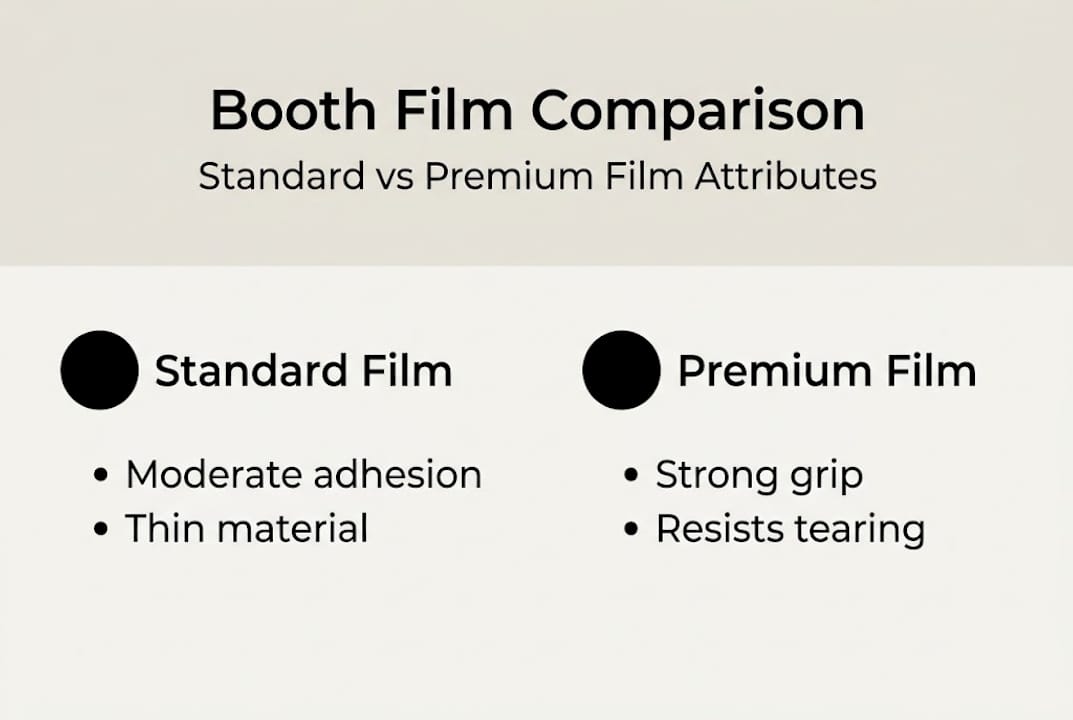
| Attribute | Standard film | Premium film |
|---|---|---|
| Adhesion | Moderate, prone to lifting | Strong, stable across temperature range |
| Tear resistance | Low, tears during handling | High, survives multi-job cycles |
| Anti-static | None | Built-in charge neutralization |
| Peelability | Leaves residue | Clean release, residue-free |
| Paint compatibility | Solvent only | Water-based and solvent systems |
Pro Tip: Before committing to a new film product, request a sample roll and install a test section in your highest-traffic booth zone. Run it through two full bake cycles before evaluating adhesion and tear behavior. This tells you more than any spec sheet.
For a deeper breakdown of product options, the top-rated spray booth films guide covers current market leaders by application type. If you are navigating product categories for the first time, reviewing the full booth film types overview will help you match film format to booth configuration. Understanding anti-static film benefits is especially relevant for dry climates or booths with aggressive air movement.
Nuances, special features, and choosing the right film
Once you understand core attributes, the next layer is matching film type to your specific booth environment. This is where many managers get it wrong, either over-specifying for a light-duty booth or under-equipping a high-volume line that generates constant contamination pressure.
| Film type | Best application | Key benefit |
|---|---|---|
| Anti-static | Dry climates, high-dust zones | Neutralizes static charge to repel particles |
| Conductive | Booths with strict ESD requirements | Prevents charge buildup near sensitive components |
| Multi-layer | High-volume or multi-coat operations | Peels one layer at a time for rapid turnover |
| Standard single-layer | Low-volume or light-duty booths | Cost-effective for minimal contamination risk |
Anti-static and multi-layer films are the go-to choices for high-dust or high-volume booths because they address the two most common failure modes: particle attraction and slow changeover time. Multi-layer formats let your team peel one layer and immediately resume spraying, cutting downtime between jobs by several minutes per cycle. Across a full shift, that adds up.
Compatibility testing is non-negotiable when switching film products. Run a resistance check on the anti-static properties every 30 days in demanding environments, since film properties can degrade with repeated solvent exposure or UV from bake lamps. Static dissipative films lose effectiveness faster in high-heat environments if they are not rated for extended temperature exposure.
Pro Tip: If your booth handles flash rust-prone substrates like bare steel panels, choose a film with low moisture permeability. Thin or permeable films can allow humidity migration behind the film surface, accelerating surface oxidation before the primer coat is applied.
For managers looking at a full operational picture, optimizing booth efficiency involves aligning film selection with airflow patterns, filter grades, and job scheduling. Reviewing wall protector film details for specific product configurations helps narrow options for wall coverage in booths of varying dimensions.
Best practices for application and maintenance
Even the best booth film underperforms when it is installed carelessly or maintained inconsistently. The installation process sets the foundation for everything that follows, and small mistakes at this stage cost you in defects and early film failure later.
Follow these steps for reliable film installation:
- Clean the surface first: Remove all dust, grease, and residue from booth walls and floors before applying film. Any contamination trapped beneath the film becomes a future defect source.
- Use a patented dispenser system: Dispenser-based application tools reduce air bubbles and ensure consistent tension across the film surface. Bubbles trap air pockets that collapse during bake cycles and lift film edges.
- Overlap edges correctly: Maintain a minimum 50mm overlap at seams to prevent gap contamination. Secure edges firmly without stretching the film.
- Inspect before spraying: After installation, run a visual pass across all surfaces in high-light conditions to catch lifted edges or bubbles before the first job begins.
For cleaning between jobs, use a lint-free cloth and a mild solvent-compatible wipe-down solution. Avoid pressure washing directly onto film edges, as this lifts seams and forces contamination underneath. Inspect the film surface at the start of every shift, particularly around corners and door frames where wear occurs fastest.
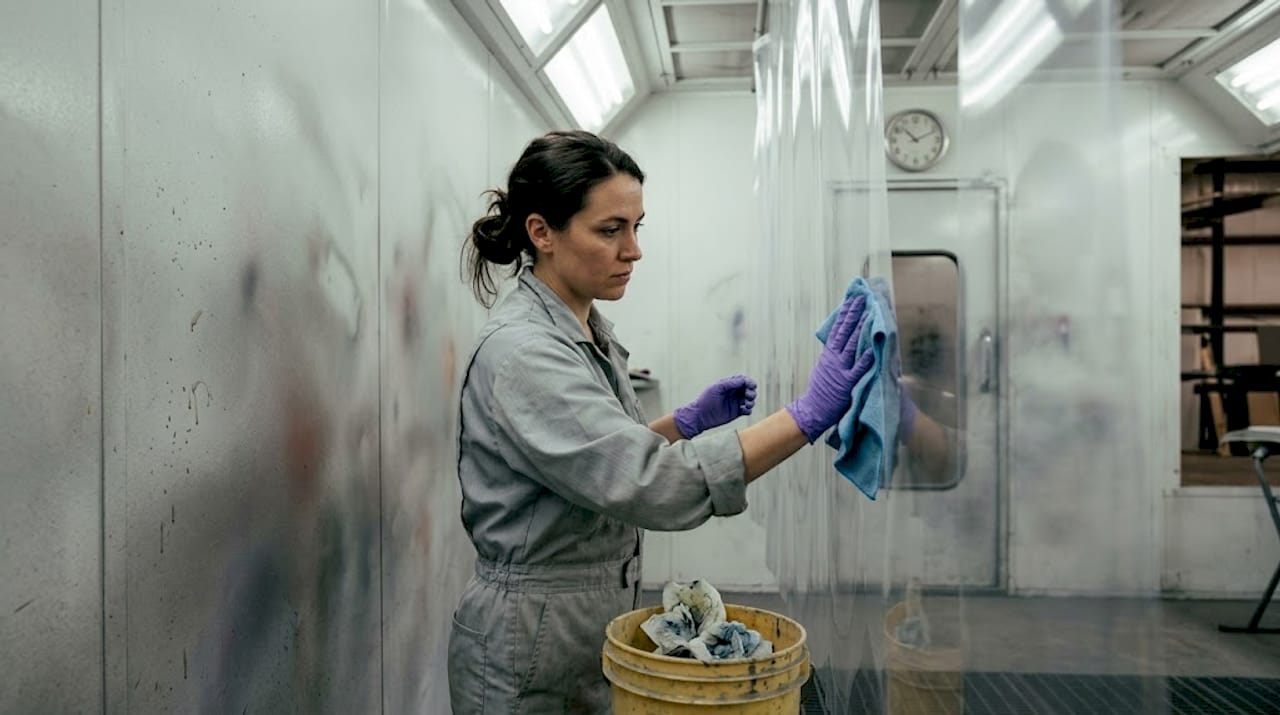
Avoid abrasive tools when removing films, since scrapers and pads can score booth wall surfaces and leave micro-grooves that trap contamination for future jobs. Peel slowly at a low angle, keeping tension even across the film width.
Pro Tip: Coordinate your film replacement schedule with your booth filter change intervals. Both degrade at roughly similar rates in high-volume operations, and changing them together prevents the scenario where a fresh filter pushes air through a contaminated film surface.
A structured maintenance workflow keeps your film and filter schedules synchronized and prevents the gaps that lead to defect spikes. For shops setting up a new booth or retrofitting an existing one, the industrial booth setup guide provides a complete framework for integrating film into your contamination control plan from day one.
Expert perspective: Lessons from real-world spray booths
Here is something supplier brochures will not tell you: the shops that struggle most with finish quality are almost never struggling because of a paint chemistry problem. They are struggling because their contamination control infrastructure, including the film, the filters, and the scheduling that ties them together, has not kept pace with production volume.
We have seen busy shops cut film costs by switching to a thinner, budget product and then spend three times that savings on rework labor within a single month. The math is not complicated once you see it play out. Multi-layer film, in particular, tends to deliver ROI that surprises managers who only looked at the per-roll price.
The other common mistake is treating film replacement as a reactive task rather than a scheduled one. Shops that change film only when it looks visibly bad are already operating with degraded contamination control. The film was failing before the visible damage appeared.
For a side-by-side look at how current products stack up in real shop conditions, the expert comparison covers the operational tradeoffs that matter most to managers running high-throughput operations.
Take the next step with proven booth films
The evidence is clear: film quality is not a peripheral detail in spray booth management. It is a direct input to finish quality, labor efficiency, and your shop’s overall throughput.
At Dust Free Film, we have been engineering booth protection solutions since 2012, specifically for the demands of professional automotive refinishing and industrial coating environments. Our multi-layer electrostatic films, patented dispenser systems, and heat-resistant wall protectors are built to perform in high-volume, high-standard operations. If you are ready to reduce defects and cut downtime with a film solution matched to your specific booth setup, get a custom quote and we will help you find the right configuration.
Frequently asked questions
How often should booth film be replaced in a high-volume shop?
High-volume shops should replace booth film every 2 to 4 weeks, or sooner if visible contamination or lifting appears. Multi-layer films allow faster partial replacement without full booth downtime.
What is the difference between anti-static and regular booth film?
Anti-static film actively neutralizes surface charge to repel airborne dust particles, making it the better choice for dry or high-dust spray environments. Regular film offers no charge control and attracts particles over time.
Can peelable booth film be used with both water-based and solvent paints?
Yes. High-quality films are engineered for compatibility with both water-based and solvent paint systems, resisting chemical softening and adhesion failure across both chemistries.
What maintenance practices prevent booth film from failing?
Scheduled replacement, regular surface cleaning with non-abrasive tools, and avoiding abrasives during removal are the three practices that most directly prevent premature film failure and surface damage.